• Our new ticketing site is now live! Using either this or the original site (both powered by TrainSplit) helps support the running of the forum with every ticket purchase! Find out more and ask any questions/give us feedback in this thread!

What I think is wrong with current OHLE electrification practice

Nottingham59

Established Member
Joined
10 Dec 2019
Messages
3,354
Location
Nottingham
Okay, I think this is pretty fair overall - but I do have a couple of further questions?

1. would you de-electrify routes?
Unlikely, even in a future world where all EMUs had at least minimal traction battery back up. The capital has already been spent, and any "redundant" OHLE could still be useful for shifting battery recharge loads to times and to locations with spare grid capacity. I wouldn't expect the extra ongoing maintenance and unreliability costs of OHLE to be significant enough to warrant removing any existing electrification.

2. would you electrify short sections like Didcot - Oxford which would enable better use of existing stock?
Not in general (though Didcot Oxford is a special case in that much of the capital needed has already been spent). Certainly not for short routes like Windermere or Tweedbank. They are perfect for BEMU operation.

At Oxford, I would start with wiring the platforms (plus any reversing sidings used by terminating services), with relatively cheap contact bar or tram-wire OHLE and fed from an SFC with BESS battery boost. This is what I understand TPE is proposing for Saltburn and Scarborough. That would make Oxford a useful recharge point for BEMU services to Paddington, Marylebone and Bedford, without needing a massive connection to the National Grid.

Same for Tweedbank and Skegness and Grimsby/Cleethorpes etc. But that approach needs a proper National Batterification strategy that has been updated to take account of the major developments in battery technology that have occurred over the past ten years.

3. why not try and find a way of cutting OHLE costs - as you say the GWML kit in particular is completely over specced but other European countries manage it!
That would be great wouldn't it? The railway industry set itself a cost-reduction challenge some years ago and as far as I can see has completely failed to deliver.
 
Last edited:
Sponsor Post - registered members do not see these adverts; click here to register, or click here to log in
R

RailUK Forums

Class15

Established Member
Joined
30 Dec 2021
Messages
4,192
Location
North London or Mildmay line
Im inclined, unfortunately, to agree with most of what you’ve said. In particular, using a single trolley wire - I cannot understand why this wasn’t done at places like Wembley and Basford Hall yards!
 

zwk500

Veteran Member
Joined
20 Jan 2020
Messages
18,664
Location
Northampton
Im inclined, unfortunately, to agree with most of what you’ve said. In particular, using a single trolley wire - I cannot understand why this wasn’t done at places like Wembley and Basford Hall yards!
Wembley Yard certainly uses very simple OLE for the actual sidings. And IIRC The OLE from Wolves to Oxley Depot is not mainline spec, as the trains don't get up to the speeds to require it.

Never seen Basford Hall Yard properly so can't comment on it.
 

Nottingham59

Established Member
Joined
10 Dec 2019
Messages
3,354
Location
Nottingham
Never seen Basford Hall Yard properly so can't comment on it.
This image suggests that through lines (two tracks, left centre) are wired with catenary, and the electrified sidings (five tracks right centre, with empty flats) have tram-wire overheads.


Peter Wilde

Member
Joined
14 Oct 2019
Messages
149
Location
Surrey
I suggest a lot of the argument on this thread has not paid enough attention to freight. Very different requirements to occasional, light passenger trains on branch lines.

Can we really believe that the rest of Europe has got this issue entirely wrong?

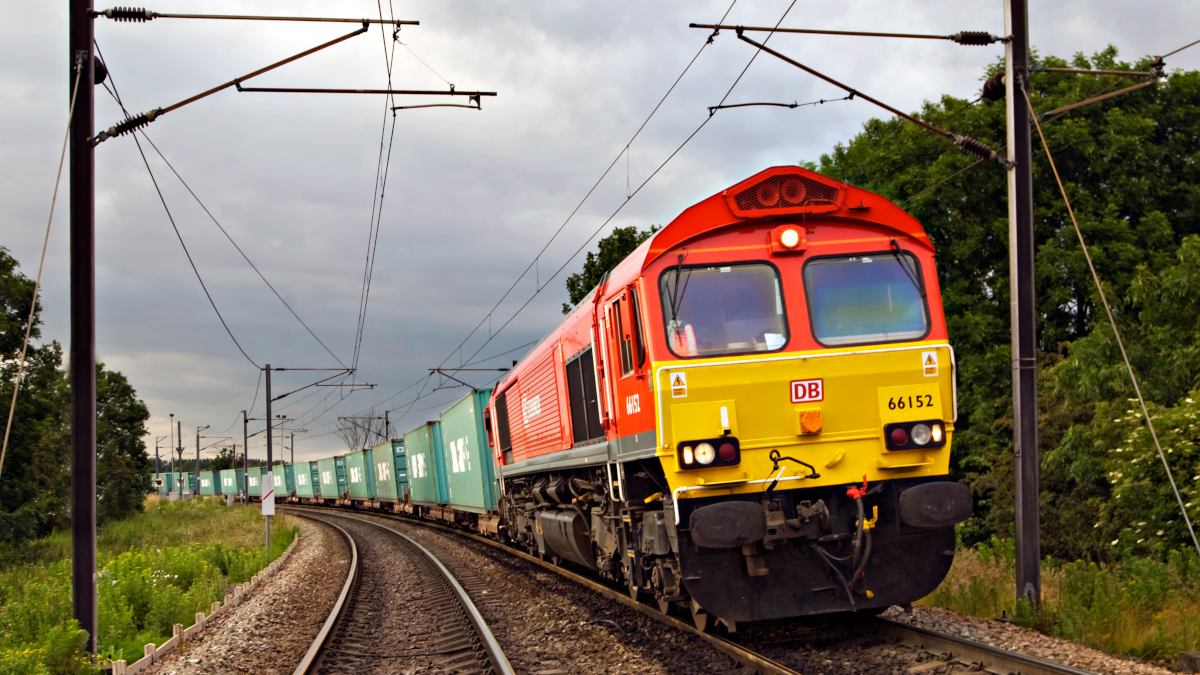
Spent some time in Germany recently and more than 50% of the trains passing (on a busy line that also carries many ICEs and local EMUs) seemed to be freight, often long container trains, travelling fast, at maybe 10 minute intervals. Surely the present state of battery tech is some long way away from being able to power that sort of traffic?

There is also the point that with road traffic (HGVs) still diesel the railway ought to be taking the opportunity to grab more freight traffic and grow its market.

Of course it's insane (in green terms) for electrification to cost so much - and even worse, for Government to allow freight traffic to be put off from using electric traction when under the wires by high prices for electricity. Correct sums about costs and benefits - including environmental ones) have not been done. Oh yes, of course, this is the UK ....!!
 

Class 317

Member
Joined
7 Jul 2020
Messages
578
Location
Cotswolds
I suggest a lot of the argument on this thread has not paid enough attention to freight. Very different requirements to occasional, light passenger trains on branch lines.

Can we really believe that the rest of Europe has got this issue entirely wrong?

Spent some time in Germany recently and more than 50% of the trains passing (on a busy line that also carries many ICEs and local EMUs) seemed to be freight, often long container trains, travelling fast, at maybe 10 minute intervals. Surely the present state of battery tech is some long way away from being able to power that sort of traffic?

There is also the point that with road traffic (HGVs) still diesel the railway ought to be taking the opportunity to grab more freight traffic and grow its market.

Of course it's insane (in green terms) for electrification to cost so much - and even worse, for Government to allow freight traffic to be put off from using electric traction when under the wires by high prices for electricity. Correct sums about costs and benefits - including environmental ones) have not been done. Oh yes, of course, this is the UK ....!!
Use of BEMU'S for passenger service doesn't rule out electrification for freight. Indeed if the programme is well thought out a lot of the necessary lines for freight could form the basis of a core network for both electric and battery services.

You can't really compare the situation in Germany as most lines would have been electrified before battery technology was even remotely similar to now.

Looking ahead battery technology will play an increasing part in converting services to electric operations but quite a bit of route mileage will still be electrified.

A core network of main lines electrified might see Bristol to Birmingham, Birmingham to Doncaster, Basingstoke to Reading, Didcot to WCML etc which would facilitate a lot of freight moving to electric operations particularly with last mile battery capability whilst also facilitating conversion of many additional services to BEMU operation.

Use of BEMU'S will increase the BCR of future schemes massively by extending the area covered at low additional costs.
 

Nottingham59

Established Member
Joined
10 Dec 2019
Messages
3,354
Location
Nottingham
on a busy line that also carries many ICEs and local EMUs) seemed to be freight, often long container trains, travelling fast, at maybe 10 minute intervals.
Sounds a bit like the WCML. Any line carrying 6tph freight throughout the day would pass the test for continuous electrification. But there are precious few of those in GB that meet that level of use.

Even the Felixstowe branch only carries around 1tph freight, with an operational constraint of 2tph each way.
 

HSTEd

Veteran Member
Joined
14 Jul 2011
Messages
20,378
Can we really believe that the rest of Europe has got this issue entirely wrong?
A lot of European countries have more electrification than Britain, but that is not the same as saying that the optimum level of electrification starting now would be that high.

Spent some time in Germany recently and more than 50% of the trains passing (on a busy line that also carries many ICEs and local EMUs) seemed to be freight, often long container trains, travelling fast, at maybe 10 minute intervals. Surely the present state of battery tech is some long way away from being able to power that sort of traffic?
It probably could do so if the locomotive was designed and built from scratch.

And even at ten million pounds each, developing and building such locomotives would probably be cheaper than any meaningful electrification.
There is also the point that with road traffic (HGVs) still diesel the railway ought to be taking the opportunity to grab more freight traffic and grow its market.
Electric HGVs probably aren't that far away. The charger connection bottlenecks will be overcome eventually.

Most HGV hauls are very short after all.
 

Harpo

Established Member
Joined
21 Aug 2024
Messages
3,972
Location
Newport
An interesting statistic from Rail Engineer (link below)
Despite a large proportion of the core freight network being electrified, in Britain a mere 2.8% of rail freight traction energy consumption is from electricity.
And from the Chartered Institute of Transport & Logistics (second link) -
The research reveals that only 800 miles of additional electrification is needed in the UK to enable 95% of rail freight to be electrically hauled.


Rail electrification possible for 95% of UK freight trains, CILT(UK) research reveals - CILT
 

Nottingham59

Established Member
Joined
10 Dec 2019
Messages
3,354
Location
Nottingham
Electric HGVs probably aren't that far away.

Maybe they're already here. The IEA says Electric truck sales doubled in 2025 to reach 9% of truck sales worldwide.

"One in four trucks sold in China in 2025 was electric, as momentum continued to build thanks to operational cost advantages as well as declining battery costs. As highlighted in the Global EV Outlook 2025, battery electric HFTs in China have already reached total cost of ownership (TCO) parity with diesel trucks in certain cases after 5 years of ownership."


Top