• Our new ticketing site is now live! Using either this or the original site (both powered by TrainSplit) helps support the running of the forum with every ticket purchase! Find out more and ask any questions/give us feedback in this thread!

Train derailment near Córdoba, Spain

Status
Not open for further replies.

ac6000cw

Established Member
Joined
10 May 2014
Messages
3,916
Location
Cambridge, UK
I agree with @John Palmer on the location of the iryo bogie.

I was looking at the Google satellite images of the area and the 'greenery' is masking the stream bed. There's a better view in OpenStreetMap's edit mode: the screenshot of the area, below, with a square marking the eastern end of the culvert, makes it more clear. Note that this is nearly in line with the southern corner of the dam on the stream, as an added point of reference. This is near enough 90 metres from the rails, and 380 metres from the final location of the iryo's rear carriage as per the photos. That can be located from the pedestrian underpass (between the 'platforms') visible in the photos.
View attachment 196370
I agree that's the likeliest place - it also agrees with where the abc.es news article suggests (scroll down the page) - https://www.abc.es/espana/andalucia...ado-adamuz-300-metros-20260121130539-nts.html
 
Sponsor Post - registered members do not see these adverts; click here to register, or click here to log in
R

RailUK Forums

chrisjo

Member
Joined
18 May 2024
Messages
604
Location
Llanishen
We don't need to speculate on this occasion, as the location of the bogie was pin-pointed in an annotated map in El Pais yesterday, and is pretty much as deduced above. I can give you another map to look at though...

1769072745829.png

The text is not very legible at this scale but says 'Arroyo Tamujoso' in blue, and 'Colada del Camino de Cordoba al Molino Tamujoso' in black. For future reference, I recommend this mapping site: https://www.ign.es/iberpix/visor/ which covers all of Spain down to the level of individual houses.
 
Last edited:

Paul AC

Member
Joined
3 Aug 2025
Messages
243
Location
Timperley
For future reference, I recommend this mapping site: https://www.ign.es/iberpix/visor/ which covers all of Spain down to the level of individual houses.
Many thanks for the site link, which I was not aware of. I have been doing some exploring of disused railways in Spain, particularly around where my sister lives west of Huelva, when I visit her; and a query I had has already been solved.
 

Spouse

New Member
Joined
20 Oct 2024
Messages
4
Location
Madrid
What does it mean by "a weight being pulled by carriage 6"?
This is a limitation of non Spanish speakers using Google Translate. The weight in question is the derailed coches 7 y 8.

The driver mentioning the snag again is incorrect translation.
 

Cloud Strife

Established Member
Joined
25 Feb 2014
Messages
2,965
The preliminary report says that track failure caused the disaster.


The preliminary report of the Railway Accident Investigation Commission (CIAF) proposes as its main hypothesis that the break in the track caused the derailment in Adamuz (Cordoba).

"These nicks in the wheels and the deformation observed in the rail are consistent with the rail being fractured," states the CIAF document, which COPE has obtained. This is a preliminary report that must be corroborated by detailed calculations and analysis.

In addition to the notches found on the derailed Iryo train, the CIAF has detected other notches with a compatible geometric pattern on the treads of some right-hand wheels of three different train sets that had traveled through the area prior to the accident.

"It can be hypothesized that the rail fracture occurred prior to the passage of the Iryo train involved in the accident and therefore prior to the derailment."

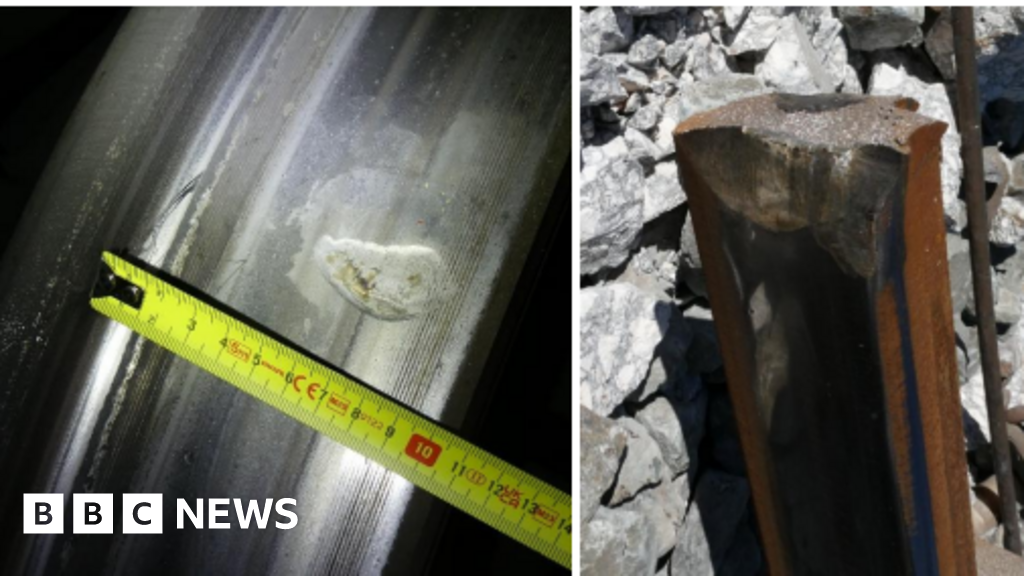
According to the report, "during the inspection of the Iryo train, notches were detected in the tread of the right-side wheels of cars 2, 3, 4, and 5. The notches are present on all wheels corresponding to the odd-numbered axles of these cars. The notches have a uniform pattern on cars 2, 3, and 4 and are consistent with an impact on the railhead. Visual comparison between the wheel notches and the section of broken rail at the derailment's zero zone yielded presumably matching results."
 

LNW-GW Joint

Veteran Member
Joined
22 Feb 2011
Messages
21,943
Location
Mold, Clwyd
Which, if confirmed in later CIAF reports, would absolve the Iryo train of being the primary cause of the derailment.
The focus will now be on Adif as infrastructure owner, to explain how the recently-upgraded line (last May by all accounts) was in such a poor state 8 months later.
 
Last edited:

John Palmer

Member
Joined
23 Oct 2015
Messages
399
Here is DeepL's translation to English of CIAF's note relating to the derailment at Adamuz, as referenced in the site forming the subject of @Cloud Strife's post #187. I have added two italicized suggestions of better translations than those provided by DeepL, but not changed the wording of the translation otherwise. Hope this will be of interest.
 

Attachments

  • CIAF note on (Adamuz) Investigation.pdf
    331.5 KB · Views: 96

hwl

Established Member
Joined
5 Feb 2012
Messages
8,292
Here is DeepL's translation to English of CIAF's note relating to the derailment at Adamuz, as referenced in the site forming the subject of @Cloud Strife's post #187. I have added two italicized suggestions of better translations than those provided by DeepL, but not changed the wording of the translation otherwise. Hope this will be of interest.
Thank you! Your two italisations are much better translations.
In the first instance the translation software tried to be too clever - coupon would be the right technical translation for a small piece that was later cut out for mechanical (e.g. tensile or fracture toughness) testing from that segment but it is very obvious that the 2m segment of rail (1m either side of the weld) is what is being discussed rather than a later sample from that segment in the lab.

As expected the bodies of the two missing people (1 staff, 1 passenger) have been found when the remains of Renfe train were being removed, this brings the total fatalities to 45.

== Doublepost prevention - post automatically merged: ==

Which, if confirmed in later CIAF reports, would absolve the Iryo train of being the primary cause of the derailment.
The focus will now be on Adif as infrastructure owner, to explain how the recently-upgraded line (last May be all accounts) was in such a poor state 8 months later.
The transport minister is still trying to find new reasons that don't eventually attribute to Adif! e.g. suggesting it was defect in the rail but at the same time stating that Arcelor Mittal make greater rail that exceeds standards! and repeatedly stating that the Iryo trains are very heavy (high axle load) compared to Spanish built trains but still comply with all the standards...

Other details that emerged today in the more reliable end of the Spanish news:
  • The rail before the weld was older (and not recently renewed), the rail after the weld was new in last May/June and went in as part of the renewal of the points very slightly further along the line.
  • The replacement work was carried out by a JV established for that renewal contract (now ended). Only 30% of the work carried out was later inspected / audited by Adif.
  • The weld was carried out by a subcontractor for the JV, this subcontractor has Adif as the largest shareholder.
  • The PM (not the transport minister) has stated that the line will be fully independently inspected
 
Last edited:

Angmering1974

On Moderation
Joined
26 Jun 2023
Messages
162
Location
UK

Spanish track was fractured before high-speed train disaster, report finds

A gap of almost 40cm (15in) in the track has become the focus of the investigation into the crash.
The CIAF called its report a "working hypothesis", adding that it "must be corroborated by later detailed calculations and analysis".
 
Last edited:

john77

Member
Joined
9 Sep 2016
Messages
34
Just a note to say that I have travelled this line three times in the last three years, most recently on Friday and today going to Madrid and back from Malaga, with the RRB in the middle.

The journey has alway seemed pretty smooth and this time was no exception, we have never experienced any noticeable vibration on this or any other journeys we have made in Spain in recent years, although the video evidence from other travellers certainly seems to indicate problems.

In contrast, coming back from Lille to St Pancras last October, it felt like the train hit a few potholes on one stretch in France.
 

John Palmer

Member
Joined
23 Oct 2015
Messages
399
In relation to the 2013 rail crash at Santiago, on Friday last, 23rd January, the Provincial Court of A Coruna dismissed the appeal of Driver Garzon but upheld the appeal against criminal conviction of Andres Cortabitarte, ADIF's Head of Traffic Safety at the time of the accident. Cortabitarte's appeal was supported by the public prosecutor and upheld by a two to one majority, one judge issuing a dissenting opinion on his culpability. Further details here.

So far as I have been able to ascertain, Cortabitarte was one of the three persons responsible for the investigation by CIAF of the Santiago accident. That investigation was condemned by the European Union Agency for Railways for its failure to look for root causes going beyond the driver's loss of spatial awareness as his train approached the curve at Angrois, e.g. the absence of appropriate assessments of the risks posed by such human factor failures and the measures that might have mitigated them.

Spain repudiated the ERA's criticisms. In January 2019 the European Commission issued a formal notice of Spain's non-compliance with European rail safety legislation, but in February 2024 CIAF announced that it would not be carrying out the further investigation of the Santiago accident the Commission had requested. On 13 March 2024 the EC recorded closure of the infringement proceedings initiated in 2019. By way of explanation of that closure, on 27 June 2024 the Commission issued a written response to an MEP's parliamentary question indicating that it had no power to trigger a fresh investigation and that the decision to do so rested exclusively with CIAF.

The 23rd January decision of the Provincial Court therefore seems to set the final seal on the Spanish state's view that criminal responsibility for the Santiago accident rests solely with the driver, and that there is no need of further investigation that might reveal shortcomings on the part of the state rail agencies involved. No doubt investigation of the derailment at Adamuz is being viewed against the background of these developments.
 

68000

Member
Joined
27 Jan 2008
Messages
835
In relation to the 2013 rail crash at Santiago, on Friday last, 23rd January, the Provincial Court of A Coruna dismissed the appeal of Driver Garzon but upheld the appeal against criminal conviction of Andres Cortabitarte, ADIF's Head of Traffic Safety at the time of the accident. Cortabitarte's appeal was supported by the public prosecutor and upheld by a two to one majority, one judge issuing a dissenting opinion on his culpability. Further details here.

So far as I have been able to ascertain, Cortabitarte was one of the three persons responsible for the investigation by CIAF of the Santiago accident. That investigation was condemned by the European Union Agency for Railways for its failure to look for root causes going beyond the driver's loss of spatial awareness as his train approached the curve at Angrois, e.g. the absence of appropriate assessments of the risks posed by such human factor failures and the measures that might have mitigated them.

Spain repudiated the ERA's criticisms. In January 2019 the European Commission issued a formal notice of Spain's non-compliance with European rail safety legislation, but in February 2024 CIAF announced that it would not be carrying out the further investigation of the Santiago accident the Commission had requested. On 13 March 2024 the EC recorded closure of the infringement proceedings initiated in 2019. By way of explanation of that closure, on 27 June 2024 the Commission issued a written response to an MEP's parliamentary question indicating that it had no power to trigger a fresh investigation and that the decision to do so rested exclusively with CIAF.

The 23rd January decision of the Provincial Court therefore seems to set the final seal on the Spanish state's view that criminal responsibility for the Santiago accident rests solely with the driver, and that there is no need of further investigation that might reveal shortcomings on the part of the state rail agencies involved. No doubt investigation of the derailment at Adamuz is being viewed against the background of these developments.
Thanks for the summary, it is scandalous how Spain made the driver the scapegoat for that crash
 

stuu

Established Member
Joined
2 Sep 2011
Messages
3,774
You imply that the route through the crash site at Adamuz has had the track repaired and re-opened. Is this in fact the case?
No. It is closed, and the OP's message said about buses anyway
 

Giugiaro

Established Member
Joined
4 Nov 2011
Messages
1,314
Location
Valongo - Portugal
The rail broke at the weld, but there are no details about whether the weld itself broke, or if the rail itself broke close to the weld.

We are still months away from a clear answer.
 

hwl

Established Member
Joined
5 Feb 2012
Messages
8,292
The rail broke at the weld, but there are no details about whether the weld itself broke, or if the rail itself broke close to the weld.

We are still months away from a clear answer.
Photo taken from the right hand side (outside) of the right rail looking left (westwards)
Screenshot 2026-01-27 175843.png
 

edwin_m

Veteran Member
Joined
21 Apr 2013
Messages
28,749
Location
Nottingham
Looks like the Heat Affected Zone - not the weld itself but the area whose microstructure is affected by the heat from welding nearby.
 

hwl

Established Member
Joined
5 Feb 2012
Messages
8,292
Looks like the Heat Affected Zone - not the weld itself but the area whose microstructure is affected by the heat from welding nearby.
On the web it is certainly heat affected zone slightly away from the end of the rail, but on both the head and bottom (where the crack is likely to have started compared to the web) it is starting to look like the boundary between rail and weld - which might hint at preparation issues.
 

Annetts key

Established Member
Joined
13 Feb 2021
Messages
3,831
Location
West is best
Yeah, I would agree with hwl, that looks like something went wrong during the preparation of, or during the welding of the rails.

When I was last present on the ground on Network Rail infrastructure during rail welding, the welders had to stamp the rail with a identification number or code. I believe this was being done to keep track of welds. Previously there had been too many "failed" welds that became rail defects. These had to be cut-out and new rail (requiring two new welds) inserted.

One of the problems that was identified by Network Rail, was too much time pressure on a welding team.
 

John Palmer

Member
Joined
23 Oct 2015
Messages
399
The impression I get from the image in post #200 is that there is a complete absence of weld fusion in the head of the rail now lying on its side, and possibly in the foot as well. Alternatively, if any fusion has been achieved then the extent of its penetration into the rail head looks negligible.

Of particular interest to me is the picture appearing in post #106. This appears to me to show, adjacent to the '3' marker, a segment of rail that has dropped way from a fracture point beneath the rail head, the end of which seems to have remained intact to the extent that it bears indentations produced by wheel strikes, according to the narrative proposed in CIAF's initial report.

I understand it to be CIAF's hypothesis that at least one wheel on an Iryo bogie ran along the web of the fractured rail, which by that stage was lying on its side, and that such wheel was then deflected towards the opposite track by the diverging closure rail of the turnout. By what appears to be extraordinary misfortune, the fractured rail seems to have taken up an alignment that would lead a wheel running in the web into exactly the right position for the switch tongue and closure rail to bring such a deflection about.

It has been reported that the rail pictured lying on its side adjacent to the fracture was laid in in May last year as part of the work of installing the new crossover, but that the track in rear of the fracture point was not the subject of renewal in 2025. Is there some technical reason for renewal of this short section of plain track on the approach to the new turnout? Apparently the fractured rail has broken away from the the turnout's straight road stock rail, which remains upright, albeit affected by some sideways displacement that presumably resulted from the initial derailment.
 

Annetts key

Established Member
Joined
13 Feb 2021
Messages
3,831
Location
West is best
The impression I get from the image in post #200 is that there is a complete absence of weld fusion in the head of the rail now lying on its side, and possibly in the foot as well. Alternatively, if any fusion has been achieved then the extent of its penetration into the rail head looks negligible.

Of particular interest to me is the picture appearing in post #106. This appears to me to show, adjacent to the '3' marker, a segment of rail that has dropped way from a fracture point beneath the rail head, the end of which seems to have remained intact to the extent that it bears indentations produced by wheel strikes, according to the narrative proposed in CIAF's initial report.

I understand it to be CIAF's hypothesis that at least one wheel on an Iryo bogie ran along the web of the fractured rail, which by that stage was lying on its side, and that such wheel was then deflected towards the opposite track by the diverging closure rail of the turnout. By what appears to be extraordinary misfortune, the fractured rail seems to have taken up an alignment that would lead a wheel running in the web into exactly the right position for the switch tongue and closure rail to bring such a deflection about.

It has been reported that the rail pictured lying on its side adjacent to the fracture was laid in in May last year as part of the work of installing the new crossover, but that the track in rear of the fracture point was not the subject of renewal in 2025. Is there some technical reason for renewal of this short section of plain track on the approach to the new turnout? Apparently the fractured rail has broken away from the the turnout's straight road stock rail, which remains upright, albeit affected by some sideways displacement that presumably resulted from the initial derailment.
The trouble is, with the available information, it's difficult to say when and how the broke rail came to turn over on to its side. Did it do this just under the pressure of the wheels running on the head (maybe because of another defect), or did this happen when a wheel got momentarily trapped in the break in the rail, which in turn caused the sleeper/bearer fixings to fail, causing the rail to overturn? This may have also caused a second "break" near the points. Certainly the "six foot" rail in the photo in post #106 does not look as straight as I would expect, indicating a lot of force has caused it to bend. But at the same time, you have to be careful when reviewing the photos, as small lenses can cause distortion of the image. Things that are straight in real life may look slightly curved in a photo.

With most rail breaks, as long as the gap is small enough, the sleeper/bearer fixings keep the rails upright and stable enough such that train wheels can pass over the break (gap) without derailing. And this appears to have occurred for the earlier trains and for the leading coaches / cars of the derailed train.

I have seen rail breaks that would shock most members of this forum, but up until the defect was found by a real person walking the track, and then they got the line closed to traffic, trains had been running over the break. Sometimes still at line speed (in most cases, the problem initially being only reported as a track circuit {signalling equipment} failure, so if this was the case the driver was only cautioned about the track circuit failure and as caution is whatever a driver is happy to drive at, it could be nearly line speed if the driver had a clear view ahead). In all the cases I saw, there were no derailments because the sleeper/bearer fixings kept the rails upright.

Modern points ("S&C") often have longer "stock" rails than normal so that they can be joined to plain line rail by welding (at one or both ends). Same with the switch rail and the crossing (frog). This reduces the number of mechanical fish-plated joints. This is more reliable than using traditional joints with fish plates.

Rail is typically only renewed when either the number of defects becomes too many, the rail has worn too much or it's become too old (rail can last for thirty or more years). Hence its not unusual for a line to be made up of sections of rail of various ages as various sections get renewed at different times. And yes, its acceptable to weld older existing rail to brand new rail.

Incidently, the weld in question looks to me like its a thermit weld.
 
Last edited:

hwl

Established Member
Joined
5 Feb 2012
Messages
8,292
And the largest missing bit below.
23 = 2023 (delivered to Renfe in 2024 according to the paperwork on the serial number)
60E1 is the rail spec.

The foot on the in-situ rail shows signs of sudden catastrophic failure, hence the foot was probably fine. The two thumb nail sized dark patches in the head are most likely to be where this all started...
"The big chunk" - where did it come from:
a) The difference in rust colour on the far left is indicative of HAZ suggesting this was immediately adjacent to the fracture
b) the mount clip marks align with a), it has only moved about 2" in the direction of moving train and there is no other possible sleeper it could have been attached to
c) but the curvature on the right hand edge matches the curvature on the rail on its side

So there is a potential conflict between a/b and c but from other photos the rail on it side (from the left side in the direction of travel so the underside is visible), it has moved about 0.6 of a sleeper spacing (pitch) in the direction of train travel (based on rubber pad marks). Hence there isn't a large volume of missing material and the end of the rolled over rail (with the small area of missing top) was probably adjacent to the weld

The packing of the ballast under the sleeper in the middle of the image probably needs looking at as well.

2026-01-28_084951.png
 

edwin_m

Veteran Member
Joined
21 Apr 2013
Messages
28,749
Location
Nottingham
And the largest missing bit below.
23 = 2023 (delivered to Renfe in 2024 according to the paperwork on the serial number)
60E1 is the rail spec.

The foot on the in-situ rail shows signs of sudden catastrophic failure, hence the foot was probably fine. The two thumb nail sized dark patches in the head are most likely to be where this all started...
"The big chunk" - where did it come from:
a) The difference in rust colour on the far left is indicative of HAZ suggesting this was immediately adjacent to the fracture
b) the mount clip marks align with a), it has only moved about 2" in the direction of moving train and there is no other possible sleeper it could have been attached to
c) but the curvature on the right hand edge matches the curvature on the rail on its side

So there is a potential conflict between a/b and c but from other photos the rail on it side (from the left side in the direction of travel so the underside is visible), it has moved about 0.6 of a sleeper spacing (pitch) in the direction of train travel (based on rubber pad marks). Hence there isn't a large volume of missing material and the end of the rolled over rail (with the small area of missing top) was probably adjacent to the weld

The packing of the ballast under the sleeper in the middle of the image probably needs looking at as well.
Looks to me like the big chunk (turned end for end and tipped over) would fit into the end of the rolled over rail on the right, but it would need a picture from a higher camera angle to be more certain. It doesn't match the shape of the break at the weld so I don't think the discolouration is HAZ, though I can't offer any better explanation. The pounding of the running on end (the rolled over rail) probably also explains the disintegration of the sleeper supporting it.
 

Annetts key

Established Member
Joined
13 Feb 2021
Messages
3,831
Location
West is best
And the largest missing bit below.
23 = 2023 (delivered to Renfe in 2024 according to the paperwork on the serial number)
60E1 is the rail spec.

The foot on the in-situ rail shows signs of sudden catastrophic failure, hence the foot was probably fine. The two thumb nail sized dark patches in the head are most likely to be where this all started...
"The big chunk" - where did it come from:
a) The difference in rust colour on the far left is indicative of HAZ suggesting this was immediately adjacent to the fracture
b) the mount clip marks align with a), it has only moved about 2" in the direction of moving train and there is no other possible sleeper it could have been attached to
c) but the curvature on the right hand edge matches the curvature on the rail on its side

So there is a potential conflict between a/b and c but from other photos the rail on it side (from the left side in the direction of travel so the underside is visible), it has moved about 0.6 of a sleeper spacing (pitch) in the direction of train travel (based on rubber pad marks). Hence there isn't a large volume of missing material and the end of the rolled over rail (with the small area of missing top) was probably adjacent to the weld

The packing of the ballast under the sleeper in the middle of the image probably needs looking at as well.

View attachment 196828
Yes, that photo tells much more of the story. The (for want of a better term) second break is what caused the derailment. The second break having occurred as a consequence of the first break.

Unfortunately train drivers find it difficult to see "simple" vertical or near vertical breaks in the rail if the gap is small. If the break is not noticed by drivers, it doesn't get reported. This is why frequent inspection, testing and high quality workmanship is required.
 

LNW-GW Joint

Veteran Member
Joined
22 Feb 2011
Messages
21,943
Location
Mold, Clwyd
Excellent report in Railway Gazette on the investigation into this dual derailment in Spain.
Including a timeline of the event, which says the Iryo driver had no idea his train had derailed or that another train had run into the debris.
He thought he had encountered an OHLE fault and had lost power.
The article is too long to quote fully, but here is part of it:
Meanwhile, a bogie from the Iryo-operated Hitachi S109 trainset was discovered partially submerged in the Tamujosillo stream, around 300 m from the site of the derailment and approximately halfway between where the two trains came to rest. Puente later confirmed that it came from the rear coach 8. The bogie is believed to have become detached following the derailment, and its trajectory is expected to provide investigators with information about the dynamics of the Iryo trainset during the accident.

Spanish train drivers have called a three-day strike on February 9-11 in sympathy for the deaths of three of their colleagues, which is being attributed to poorly maintained infrastructure. As well as the Alvia driver, a second RENFE driver who had been travelling on the S120 as a passenger with his family was killed. A third died in an unrelated accident on the evening of January 20, when a Barcelona suburban EMU ran into a section of retaining wall which had collapsed during heavy rain.
...

Accident timeline clarified​

Information collected by CIAF, including data from the event recorder of the Iryo trainset, has brought further clarity to the timeline of the accident, confirming that there was barely 9 sec between the initial derailment and the collision between the two trains.

Iryo train 6189, the 18.40 from Málaga to Madrid, was formed of an eight-car S109 trainset carrying 289 passengers, plus the driver and four on-train crew. Train 2384, the 18.10 Alvia service from Madrid-Atocha to Huelva, was formed of a four-car Series 120 carrying 187 passengers. Of these, 40 had reservations in the leading vehicle and 13 in the second coach.


The rear three cars of the S109 were derailed at 19.43.40, and the collision with the other train occurred at 19.43.49. Bodyshell impacts show that the leading vehicle of the S120 struck the coupled ends of cars 6 and 7, which were fouling the southbound track. The eighth coach of the Iryo trainset was overturned by the glancing blow, which diverted the Alvia set to its right.

Systems at the Atocha control centre recorded that the traction current was lost at 19.43.45.

The leading vehicles of the S120 trainset were thrown into a 4 m deep drainage ditch beside the line.
At 19.45.02 the Iryo driver called the control centre to report that the train had come to a halt due to loss of power, suggesting that it had become entangled with the overhead wire. The vehicles had been ‘plunged into darkness’, implying that the onboard auxiliary batteries were not working. At this stage the driver did not realise that the rear vehicles had become derailed, or that a collision had occurred.

At 19.46.07, the control centre received a call from the driver of northbound train 2181, which was following the Iryo service, reporting that it had also lost power and had therefore stopped.

On two occasions, at 19.48.39 and 19.48.51, the control centre attempted to contact the driver of the southbound Alvia service, without success. Control finally established contact with the S120’s train manager at 19.49.53. Although reporting that she was suffering from head injuries, the train manager said she would try to contact the driver, but she was unable to do so.

At 19.49.35: the Iryo driver asked the control centre to halt all traffic, having established that the train had been derailed, although still unaware of the collision, or the fact that the S120 had come to rest some 800 m further along the line. The control centre activated the emergency services at 19.50.

At 19.50 the Alvia train manager informed the control centre that passengers had been injured, and that the last two cars of the train were being evacuated. Calls from the train reached the Andalucía emergency services around 19.55.

According to the ministry, the Guardia Civil managed to locate the derailed S120 at around 20.15. The first medical team reached the Alvia at 20.30, and evacuation of the injured passengers started around 21.00, being completed at 23.00.
 
Status
Not open for further replies.

Top