Platform 2
Member
- Joined
- 23 Nov 2018
- Messages
- 16
Much appreciated.Just 466016, which is the one you saw. Been there about four years now, stored as part of the initial downsizing of the fleet from 43 to 38 (the other 4 were at Worksop).

Much appreciated.Just 466016, which is the one you saw. Been there about four years now, stored as part of the initial downsizing of the fleet from 43 to 38 (the other 4 were at Worksop).

6 or 7?I'm guessing around 4-5 weeks left of white 376s now since there's 6 or 7 left
According to my searches on this website, the first blue 376 was spotted on the 15th of April this year.6 or 7?
Interesting.
How long has the typical turnover been from one unit to the next?

 www.realtimetrains.co.uk
www.realtimetrains.co.uk
www.realtimetrains.co.uk
I have just watched an interview with the managing director of South Eastern Rail, Steve White, and credit goes to the YouTube channel Green Signals and Richard Bowker for interviewing Steve White. Here is the interview itself.
The concept of a Final Business Case just seems plain wrong. Normally just have a Business Case, which either stacks up or doesn't work.The talk about rolling stock is from around minute 28. He mentioned that they are preparing "the final business case", to be submitted "next year" to the treasury and the DfT
They are really taking their time. Anyway good luck with getting anything from the treasury....
The concept of a Final Business Case just seems plain wrong. Normally just have a Business Case, which either stacks up or doesn't work.

No chance. Northern is ahead of Southeastern in the queue for new passenger rolling stock, and even with the tender exercise ongoing, the first Northern vehicles will only be entering service in 2030.At this rate new stock in service by 2030 IF the Treasury agrees? And that is far from a given

But the North get nuffink! It's always the south first in the queue!!No chance. Northern is ahead of Southeastern in the queue for new passenger rolling stock, and even with the tender exercise ongoing, the first Northern vehicles will only be entering service in 2030.
At this rate new stock in service by 2030 IF the Treasury agrees? And that is far from a given
The government will develop a long-term industrial strategy for rolling stock, which will support manufacturing and ensure a stable pipeline of work. Once established, GBR will take a whole-system and long-term approach to using rolling stock across the network, providing certainty to manufacturers and rolling stock companies across the country and globally. Taking this approach to rolling stock will enable greater certainty and lower risk for the supply chain and will be a better way to secure value for money.
If you want a timeline, this appears as part of overnight GBR announcements. The long term strategy starts once GBR established
Reported on RailCam to be 465920 and 465934.Drag to Booths scheduled for Wednesday:
Realtime Trains | 5Q19 0820 Ely Mlf Papworth Sidings to Masboro Booths P S | 05/11/2025
Real-time train running information for 5Q19 0820 departure from Ely Mlf Papworth Sidings to Masboro Booths P S on 05/11/2025. From Realtime Trains, an independent source of train running info for Great Britain.
Reported to be trailing only 140 tonnes, so probably the equivalent of 4-cars only.
I thought that (most of) the idea of the RoSCo model was that such capital expenditure is kept off the public books?At the moment the government seems to be in a money saving mode, so they will probably postpone things as much as possible, without necessarily openly announcing it.
It's not unheard of to take that long. The invitation to tender wasn't in November 2022, that was the first procurement notice. For the HS2 rolling stock, the equivalent notice was in April 2017 and the contract award only in December 2021 four and a half years later. Steve White has posted on Twitter/X "early next year" for the metro fleet to be finalised which would be three and a half years.Regardless it's been a very slow process from the invitation to tender being first issued in 2022. Two years later came a shortlist. Is it normal for a tender to take four years to reach final business case status?
At this rate new stock in service by 2030 IF the Treasury agrees? And that is far from a given
They'd need to pay for both fleets during the transition period, any depot modifications and the testing/training costs too. All of those costs would need to feature in the business case and generally will be upfront resource or capital expenditure.I thought that (most of) the idea of the RoSCo model was that such capital expenditure is kept off the public books?
So the govmernment in theory would only be paying for subsidising potentially higher leasing costs of new stock, not putting up hundreds of millions up-front.
Primarily the inner suburban. Some outer suburban may also feature, such as to Tunbridge Wells. Having part of the fleet ordered with an enhanced interior for outer-suburban operation, like the 465/9s did, would be useful, as routes that are relatively long, but with frequent calling points, need higher acceleration stock, including the Maidstone East line and some Chatham mainline services. SE would have to order at the top end of their tender size to make this possible though.Do we know what routes exactly these proposed new trains are likely going to serve, will it be inner or outer suburban through Kent?
Not so much anymore, most of their longer distance work have been taken over by mainline 375/377 fleets. Tunbridge Wells and Gillingham are the remaining frequent long distance work for them. 376s and 707s don't go beyond Gravesend or Sevenoaks in service.Aren't the Networkers mostly on the longer distance routes. They have toilets and more seating than the 707 and 37X fleets.
Yes.Are 465241, 242 and 247 still on lease and stored at Worksop?
Southeastern have recently expanded their infrastructure monitoring cameras onto the mainline fleet after the successful trial on the metro trains. That might be the camera you saw and if so only a proportion of the fleet will get them. Southeastern has a press release here if interested in more information.Although this might warrant opening a new thread I saw 375627 at Waterloo East the other day with a camera fitted to the front valance. So maybe the 375s are now getting a mod like the 377s have.
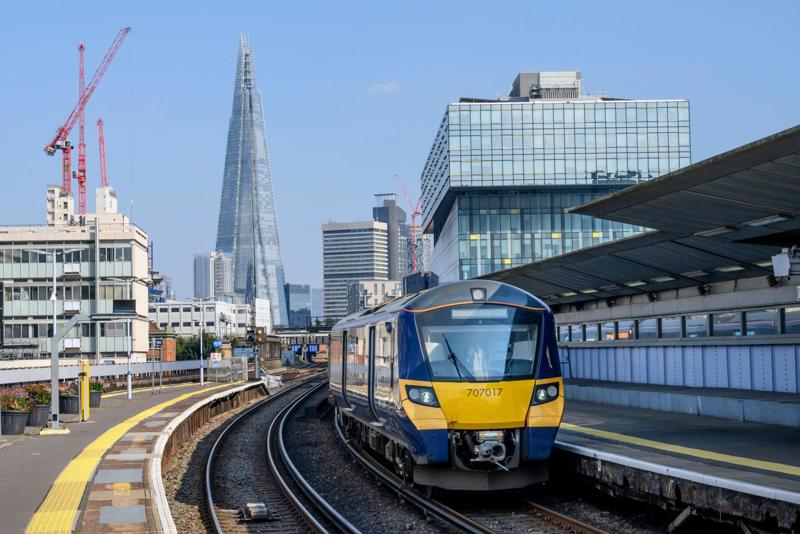
Earlier this year, a pilot programme installed thermal imaging cameras on the front of a small number of Class 707 ‘City Beam’ trains. They successfully spotted 41 overheating incidents and prevented over 9,000 minutes of delays for customers.
The technology is provided by AIVR tech company One Big Circle and is now being expanded to include 20 Class 375 ‘Electrostar’ Main Line trains alongside the 12 Class 707 ‘City Beam’ trains already fitted. Other UK train operators have used similar technology but South Eastern Railway is the first to permanently install on-board cameras on this scale.
Yes it is. High numbered units in each subfleet getting this, which might give the impression it's more of a full fitment, but it's not.Southeastern have recently expanded their infrastructure monitoring cameras onto the mainline fleet after the successful trial on the metro trains. That might be the camera you saw and if so only a proportion of the fleet will get them. Southeastern has a press release here if interested in more information.
 www.railmagazine.com
“We want to do a Greater Anglia. We want to buy a new fleet of trains and use that as the catalyst for transforming the railway, and we're going to buy the right train for our railway, not the right train for the operator,” he said.
“Network Rail have been fully involved in the design and specification of this train. It will carry an onboard battery that will allow us to operate in the event of a trespasser and the event of a failure of the third rail power supply.
Pursuing this makes me wonder if Southeastern will then proceed to either fit batteries to the rest of the fleet, and/or withdraw trains without them? 707s could probably have them retrofitted, and maybe 376s, though the latter being older might make them more likely to be replaced. They don't want a situation where the power supply fails, only to find the train(s) affected are the existing stock that doesn't have them. I doubt 375s, 377s and 395s have the underfloor space.Mention of fleet replacement in Steve White speach:
Hopes new South Eastern Railway fleet will be "catalyst for transformation"
Managing Director Steve White has explained what's been happening since train operator and infrastructure management was brought together.
They probably don't want to let perfect get in the way of the good. We may have already seen the last third rail (or perhaps any EMU) fleet order without backup battery capable of providing traction power for small distances. While other fleets not having that capability will create limitations, it's much easier to fit batteries on fleets designed for it from the start. The business case will be less good for other units, from new the capability will pay for itself quickly.Pursuing this makes me wonder if Southeastern will then proceed to either fit batteries to the rest of the fleet, and/or withdraw trains without them? 707s could probably have them retrofitted, and maybe 376s, though the latter being older might make them more likely to be replaced. They don't want a situation where the power supply fails, only to find the train(s) affected are the existing stock that doesn't have them. I doubt 375s, 377s and 395s have the underfloor space.

I'm sure every train operator would love to do a "Greater Anglia" but someone has to take the displaced midlife (or newer) trains. I can't see both the 376s and 707s being needed elsewhere.Mention of fleet replacement in Steve White speach:
Hopes new South Eastern Railway fleet will be "catalyst for transformation"
Managing Director Steve White has explained what's been happening since train operator and infrastructure management was brought together.




