• Our new ticketing site is now live! Using either this or the original site (both powered by TrainSplit) helps support the running of the forum with every ticket purchase! Find out more and ask any questions/give us feedback in this thread!

Signal Box Opening Times

Status
Not open for further replies.

edwin_m

Veteran Member
Joined
21 Apr 2013
Messages
28,660
Location
Nottingham
Perhaps this is off topic, but I'd like to get clear in my head what block instruments would a box have:

1. You are working box B
2. Either side of you are boxes A & C.
3. This a a double line (Up & Down).

Questions:
Would you have two block instruments, one for the Up line and one for the Down line?
Presumably you would have a block instrument showing the state of the line from box A & C? and again would these be one or two instruments?
Would the bell for the bell codes be incorporated in these instruments?
For a double line section there is one block indicator at each box for each track, controlled by the box the train goes towards and indicating the same to both. The two indicators and the "pegger" to control it are often incorporated into the same physical instrument. The same bell is used for communication between the two boxes relating to trains in both directions (four-track lines may have different bells for each track pair). So for your example there would be four indicators, two peggers and two bells but probably two instruments. One instrument would be used for the tracks to and from A and the other to and and from C.
 
Sponsor Post - registered members do not see these adverts; click here to register, or click here to log in
R

RailUK Forums

Gloster

Veteran Member
Joined
4 Sep 2020
Messages
12,987
Location
Up the creek
Perhaps this is off topic, but I'd like to get clear in my head what block instruments would a box have:

1. You are working box B
2. Either side of you are boxes A & C.
3. This a a double line (Up & Down).

Questions:
Would you have two block instruments, one for the Up line and one for the Down line?
Presumably you would have a block instrument showing the state of the line from box A & C? and again would these be one or two instruments?
Would the bell for the bell codes be incorporated in these instruments?

The most common arrangement is that you have one A to B block instrument and one B to C. Each block instrument would have two windows on the front, possibly the full width of the instrument. One window in the A-B instrument would show, using a needle pointing to sectors on the backing, the state of the line from A to B (say, the Up) and the other, normally the upper window, would show the state of the Down line from B to A. The states are Normal or Line Blocked: nothing about, Line Clear: permission has been given by B for a train to come from A, and Train on Line: there is a train in section. Below the windows (normally, but it can be elsewhere) is a handle that controls the indication for the towards the box: at B this controls the Up from A, but the one at A controls the one from B to A. All is combined in one instrument, usually.

If you mean the bell plungers or tappers, the answer is that it varies. Some types had the tappers built into the instrument at the bottom and had the bell in their as well. Many had the bell unit separate from the block instrument, but with the tapper built into that; I worked WR boxes like this. Some had the bell or plunger all on its own somewhere convenient on the block shelf, or even more than one plunger serving the same block instrument: my first box had five tappers and plungers on a very short block shelf.
 

Rescars

Established Member
Joined
25 May 2021
Messages
2,546
Location
Surrey
Perhaps this is off topic, but I'd like to get clear in my head what block instruments would a box have:

1. You are working box B
2. Either side of you are boxes A & C.
3. This a a double line (Up & Down).

Questions:
Would you have two block instruments, one for the Up line and one for the Down line?
Presumably you would have a block instrument showing the state of the line from box A & C? and again would these be one or two instruments?
Would the bell for the bell codes be incorporated in these instruments?
Just to clarify, is box B always open when the line is open, or are there arrangements so that Box B can be switched out?
 

Springs Branch

Established Member
Joined
7 Nov 2013
Messages
1,681
Location
Where my keyboard has no £ key
Perhaps this is off topic, but I'd like to get clear in my head what block instruments would a box have:

1. You are working box B
2. Either side of you are boxes A & C.
3. This a a double line (Up & Down).

Questions:
Would you have two block instruments, one for the Up line and one for the Down line?
Presumably you would have a block instrument showing the state of the line from box A & C? and again would these be one or two instruments?
Would the bell for the bell codes be incorporated in these instruments?
@Andy873 if you're interested in the 'how to' and wanted to have a dabble at working some easy "A - B - C" double line absolute block signalling - you could have a look at this one for Atherton Goods Yard for free (i.e. without subscribing or paying for some of the more elaborate signal simulation software)
In this case, 'box A = Walkden, B = Atherton Goods Yard, C = Crow Nest Junction.

You'd need to familarise yourself with the basics of Absolute Block semaphore signalling before trying, as this simulation doesn't provide a tutorial for that, and the graphics for block instrument etc. are not too sophisticated (you get what you pay for), but things are in line with what @Gloster described above. The only trains you get to see on this line are 3-1 and 4's.

Be prepared for a few foul-ups the first few times ("Why isn't anything moving?!?"), but it doesn't take long to get the knack and you'll soon be belling on trains with no delay. You could then graduate to Crow Nest Junction on the same website, and have a go at a regulating a double-line junction which fringes Warrington Power Box.

Warning: the tinging of computer-generated block bells from the laptop is guaranteed to annoy the wife - and lead to accusations of blatant time-wasting.
 

Andy873

Established Member
Joined
23 Mar 2017
Messages
1,412
@edwin_m and @Gloster Thanks for clarifying the instruments!

@Springs Branch Thanks also for that link, I will definitely give it a go!

@John Webb And another thanks! I clean forget about that video, it's very well explained, and of course you could have another train coming the other way.

John, I didn't fully understand the black & white levers for emergencies, if a train runs over detonators what purpose were did those levers serve?

Just to clarify, is box B always open when the line is open, or are there arrangements so that Box B can be switched out?
No, it gets switched out.

Question - Switching out a box implies a switch, if a box was closing (say for the night) what switches were thrown? If box B closed overnight, doesn't that make the block section longer i.e. A - C only?
 

Gloster

Veteran Member
Joined
4 Sep 2020
Messages
12,987
Location
Up the creek
John, I didn't fully understand the black & white levers for emergencies, if a train runs over detonators what purpose were did those levers serve?


No, it gets switched out.

Question - Switching out a box implies a switch, if a box was closing (say for the night) what switches were thrown? If box B closed overnight, doesn't that make the block section longer i.e. A - C only?

I have not seen the video, but I presume that the levers were for detonator placers. The levers are connected by the usual rodding to a small metal plate on which are attached two detonators (*) and which is fitted in a small housing on the outside of a running rail. If the signalman needs to stop a train in an emergency he can, in addition to putting back the signals or waving a red, pull the appropriate lever, which slides the small plate on to the top of the rail so that if a train passes over the dets they will explode to warn the driver. Normally the black and white chevrons on the lever point down for the lever applicable to the Down Line and up for the Up. It is just another safety option, very much belt and braces, and much quicker than the signalman having to grab some dets and dash outside to attach them to the rail, particularly as he may have other things to do if it s an emergency.

* - Two dets so as to be sure that at least one goes off: they are outside for weeks on end between changeovers.


Yes, if B switches out, then the block section becomes A to C and all the bells, instruments, telephones, etc. are now linked directly between those two. It is as if B no longer exists. Switching out is done by B getting permission to close from A and C, setting the road for the through route, pulling the appropriate signals and then using the switch (*); after A and C have tested that all is now working correctly between them they tell B and he goes home.

* - The switch was not a simple switch, but a complicated mechanism in B that when operated connected the various A-B wires to the appropriate B-C wires and cut out the equipment in B. Example: there would be a wire running from A’s bell tapper to B’s bell (from A) and another from B’s tapper to the bell at C: operating the switch connected these two so that the current ran directly from A’s tapper to C’s bell. I know of two types of switch: the GW type where a rod with contacts attached was rotated ninety degrees and a Southern type with a slide that was moved back and forth.
 

edwin_m

Veteran Member
Joined
21 Apr 2013
Messages
28,660
Location
Nottingham
There were local instructions about whether you could switch in and out when with a train in one of the sections, which varied from box to box. Obvious risk of a train being "lost" if this was done wrong.
 

Gloster

Veteran Member
Joined
4 Sep 2020
Messages
12,987
Location
Up the creek
There were local instructions about whether you could switch in and out when with a train in one of the sections, which varied from box to box. Obvious risk of a train being "lost" if this was done wrong.

Switching out with a train in the section was almost unknown as there was the risk of a false Line Clear, although I have heard of it occurring somewhere with Permissive Block. I believe that it was allowed at Lugton on the single line between Barrhead and Kilmarnock: it could be done with two trains if they were both heading away from Lugton.

Switching in could be done if there was a train in section or there was no train signalled, but not when then the block for the long section was at Line Clear. The signalman would have ‘phoned to one of the adjacent boxes first.
 

Taunton

Veteran Member
Joined
1 Aug 2013
Messages
12,278
I have not seen the video, but I presume that the levers were for detonator placers. The levers are connected by the usual rodding to a small metal plate on which are attached two detonators (*) and which is fitted in a small housing on the outside of a running rail. If the signalman needs to stop a train in an emergency he can, in addition to putting back the signals or waving a red, pull the appropriate lever, which slides the small plate on to the top of the rail so that if a train passes over the dets they will explode to warn the driver. Normally the black and white chevrons on the lever point down for the lever applicable to the Down Line and up for the Up. It is just another safety option, very much belt and braces,
These were installed on both Down lines at Silk Mill box west of Taunton in the aftermath of the 1941 Norton Fitzwarren accident, where the train continued at speed reading in the blackout the wrong signals, those for the adjacent line. If Norton couldn't give a clear run for a train on the Relief it had to be checked at Silk Mill, and if it appeared not to be doing so the detonators were not retracted. All part of the Five Belts and Two Braces procedures put in place after that accident, which I have written about elsewhere here.
 

Rescars

Established Member
Joined
25 May 2021
Messages
2,546
Location
Surrey
Switching out with a train in the section was almost unknown as there was the risk of a false Line Clear, although I have heard of it occurring somewhere with Permissive Block. I believe that it was allowed at Lugton on the single line between Barrhead and Kilmarnock: it could be done with two trains if they were both heading away from Lugton.

Switching in could be done if there was a train in section or there was no train signalled, but not when then the block for the long section was at Line Clear. The signalman would have ‘phoned to one of the adjacent boxes first.

On a single line, I assume any switching between short section and long section working could only be carried out when no trains were about as it was necessary to withdraw the tablet from the short section instrument and insert it into a lock to free the long section instrument. A similar procedure was needed to revert to short section working. Presumably this process was carried out for each short section part of the long section to ensure that no short section tablets were unaccounted for whilst long section working was in operation.
 

Gloster

Veteran Member
Joined
4 Sep 2020
Messages
12,987
Location
Up the creek
On a single line, I assume any switching between short section and long section working could only be carried out when no trains were about as it was necessary to withdraw the tablet from the short section instrument and insert it into a lock to free the long section instrument. A similar procedure was needed to revert to short section working. Presumably this process was carried out for each short section part of the long section to ensure that no short section tablets were unaccounted for whilst long section working was in operation.

As far as I aware that was how it worked, but it was sufficiently rare that the 1972 regulations said that special instructions would be provided where it was in force. I am not sure if it was B that took a token out of each instrument (A-B and B-C) and placed then in the switch, or whether it was done at A and C. More likely it was B, as it would also be necessary to have the lever interlocking arranged so that one route could be set and the signals cleared in both directions.

The exception was Tokenless Block, which did allow switching out with a train in one of the two sections. Lurton appears to have been an oddity in allowing it with two trains going away from the box.
 
Last edited:

Railsigns

Established Member
Joined
15 Feb 2010
Messages
2,754
The exception was Token;ess Block, which did allow switching out with a train in one of the two sections. Lurton appears to have been an oddity in allowing it with two trains going away from the box.
The ability to switch out with a train in both sections was a standard feature of Scottish Region Tokenless Block. Not every box using this system was able to switch out; of those that could, Lugton was the last example.

Here is a photo I took in Lugton signal box in 1990 just after it had been switched out, leaving two trains in section. Notice the king lever no. 20 (brown and white stripes) in the reverse position.

Lugton switched out 1990.jpg
 

Rescars

Established Member
Joined
25 May 2021
Messages
2,546
Location
Surrey
As far as I aware that was how it worked, but it was sufficiently rare that the 1972 regulations said that special instructions would be provided where it was in force. I am not sure if it was B that took a token out of each instrument (A-B and B-C) and placed then in the switch, or whether it was done at A and C. More likely it was B, as it would also be necessary to have the lever interlocking arranged so that one route could be set and the signals cleared in both directions.

The exception was Tokenless Block, which did allow switching out with a train in one of the two sections. Lurton appears to have been an oddity in allowing it with two trains going away from the box.
Seems most likely it was B, so that the points and signals could be set and cleared as you suggest. There must have been ingenious arrangements in locations where B and C were both switched out with long section working between A and D.
 

John Webb

Established Member
Joined
5 Jun 2010
Messages
3,768
Location
St Albans
...@John Webb And another thanks! I clean forget about that video, it's very well explained, and of course you could have another train coming the other way.

John, I didn't fully understand the black & white levers for emergencies, if a train runs over detonators what purpose were did those levers serve?....

I have not seen the video, but I presume that the levers were for detonator placers. The levers are connected by the usual rodding to a small metal plate on which are attached two detonators (*) and which is fitted in a small housing on the outside of a running rail. If the signalman needs to stop a train in an emergency he can, in addition to putting back the signals or waving a red, pull the appropriate lever, which slides the small plate on to the top of the rail so that if a train passes over the dets they will explode to warn the driver. Normally the black and white chevrons on the lever point down for the lever applicable to the Down Line and up for the Up. It is just another safety option, very much belt and braces, and much quicker than the signalman having to grab some dets and dash outside to attach them to the rail, particularly as he may have other things to do if it s an emergency.

* - Two dets so as to be sure that at least one goes off: they are outside for weeks on end between changeovers.....
Thanks to Gloster for replying - Yes we have four Detonator levers for placers, one for each of the four lines. They held two detonators. One of our members, who operated the box, could only recall one occasion he'd heard of a detonator placer being used. A colleague used one of the levers when a train just departing the station was spotted with an open door on the non-platform side. The train was stopped and the door secured.
 

Andy873

Established Member
Joined
23 Mar 2017
Messages
1,412
@Gloster and John, thanks for explaining about the detonators and those black and white levers. I couldn't work out just how the detonators would stay in place, a detail that I was not aware of!

Regarding the video from St. Albums South box - what I spotted in the video is that as the train is coming towards the box from the left, that all the levers pulled were also on the left hand side. Presumably the right hand levers would be for trains coming from the right?

In a simplistic way, was this the general arrangement in boxes? The photo from @Railsigns (Great photo!) mentions the box is switched out with two trains in section hence levers on the left and right have been pulled.

Regarding boxes closing, the LYT 1880's WTT does show that from 9.30pm Sunday - 6am Monday Great Harwood Junction box (Blackburn) "A" would only have communicated with Padiham Station East box "F", with boxes "B" to "E" closed.
 
Last edited:

John Webb

Established Member
Joined
5 Jun 2010
Messages
3,768
Location
St Albans
@Gloster and John, thanks for explaining about the detonators and those black and white levers. I couldn't work out just how the detonators would stay in place, a detail that I was not aware of!

Regarding the video from St. Albums South box - what I spotted in the video is that as the train is coming towards the box from the left, that all the levers pulled were also on the left hand side. Presumably the right hand levers would be for trains coming from the right?

In a simplistic way, was this the general arrangement in boxes? .......
18-03-25 BW 12. Upstairs - Keith MOD.jpg
Yes, the levers for the Down trains (running right to left) are the ones nearest the camera. The levers featured in the video were at the far end of the frame. But this means that with the block instruments in the centre, the signaller has to do a lot of hurrying up and down the box! Our four detonator placer levers can be seen.
So in later LMS and BR days, new frames were often made with the main running line signals in the centre where they would be close to the Block Instruments.
(The above photo was taken during a demonstration on one of our Open Days - note the enthusiastic young assistants!)
 

Gloster

Veteran Member
Joined
4 Sep 2020
Messages
12,987
Location
Up the creek
There is no absolute pattern for the way levers are set out, but a major consideration was to ensure that the various horizontal bars and rods in the locking underneath the levers were no longer than necessary. Generally, the levers for the signals on each running line were at the end from which the train came, with only levers related to any level-crossing beyond them: in (say) a 40-lever frame with the Up line coming from the right, Down signals might be 1-5, with 1 the Down Distant, and Up 40-44, with 44 the Up Distant. If there was a crossing at the Up end, then the Up signals might be 37-41 and the various barrier levers 42-44. This principle continued to apply when the general preference for lever frame siting changed from the old one where the signalman looked over the levers to the line, to ‘back to traffic’ when he had his back to the line when standing at the frame. Numbering in almost all cases was done left to right when standing at the frame, however it was orientated. it was also quite common to concentrate those points that were most often used together somewhere in the centre and for ground signals to be adjacent to the points they were related to. However, there are plenty of exceptions to just about all these rules.

Back in the distant past, it was normal for goods traffic to continue running on a Saturday, which was part of the normal week. Therefore you might get traincrew signing on late on Saturday and not finishing until after dawn on Sunday: it costs the railway no extra because they were still on the normal weekday rate as they had signed on on Saturday. For those trains you needed signalboxes and the signalmen there would have also signed on on Saturday on basic rate, so they could work through to the end of the shift: often 06.00, but sometimes they had to stay on for an hour or two to clear the last stragglers (the overtime is at weekday rate). Sunday was slightly better paid, so the railway tried to avoid running goods trains and often didn’t run much of a passenger service: so fewer boxes are required. When the service restarted on Monday, the would have as few traincrew as possible signing on on Sunday night, so fewer trains running early on (that is why many early goods are MX in the working timetable) and not so many boxes required: some boxes might open before the standard opening time, but an hour’s overtime by the early turn is cheaper than a whole shift at Sunday rate.

 

John Webb

Established Member
Joined
5 Jun 2010
Messages
3,768
Location
St Albans
There is no absolute pattern for the way levers are set out, but a major consideration was to ensure that the various horizontal bars and rods in the locking underneath the levers were no longer than necessary......
Just for information, the Midland Railway lever frame shown in my picture above uses the MR 'Tumbler' locking system that works on the lever catch handles, not the levers themselves as the majority of locking systems did. As a result it is much more compact, and resides under the black covers behind the levers, not in the separate 'locking room' below the levers.
 

Taunton

Veteran Member
Joined
1 Aug 2013
Messages
12,278
I was a bit surprised at the opening comment about BR working timetables not showing box opening times, as in my little collection they all have it. here's the Bristol to Taunton line in 1960. Was it just the Western Region, following GWR practice?
 

Attachments

  • Sig box.JPG
    Sig box.JPG
    181.5 KB · Views: 18

Andy873

Established Member
Joined
23 Mar 2017
Messages
1,412
I was a bit surprised at the opening comment about BR working timetables not showing box opening times, as in my little collection they all have it. here's the Bristol to Taunton line in 1960. Was it just the Western Region, following GWR practice?
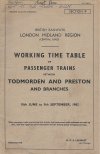
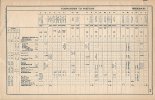
That's a good question! If you look at one page from my 1962 summer WTT you will see that the box opening times simply aren't there. None of my BR WTT's show any box times. That's why the surprise was the other way around for me with the L&Y one.
 

Attachments

  • A1 Front Cover.jpg
    A1 Front Cover.jpg
    480.2 KB · Views: 6
  • F5.jpg
    F5.jpg
    867.8 KB · Views: 6

30907

Veteran Member
Joined
30 Sep 2012
Messages
21,950
Location
Airedale
I was a bit surprised at the opening comment about BR working timetables not showing box opening times, as in my little collection they all have it. here's the Bristol to Taunton line in 1960. Was it just the Western Region, following GWR practice?
Haven't come across it elsewhere.
 

Andy873

Established Member
Joined
23 Mar 2017
Messages
1,412
Haven't come across it elsewhere.
And the box times are not even listed in the BR 1960 sectional appendix either.

If BR did list box opening times, what document would it be in?

@Gloster and John (another great photo), once more, thank you both for explaining about the general layout of the levers. It's logical but I've learnt that logic doesn't always prevail in the railway world!

Sunday was slightly better paid, so the railway tried to avoid running goods trains and often didn’t run much of a passenger service: so fewer boxes are required.
That's exactly what I see in the WTT's covering my old line, very few trains on Sundays, and once we get to BR days, none at all. I guess the whole line in BR days (except for the holiday period) was simply closed on Sundays which would have included the boxes of course.
 

Andy873

Established Member
Joined
23 Mar 2017
Messages
1,412
A separate booklet entitled "Hours of Opening of Signal Boxes", covering a specific area.
Thanks for clarifying that.

How would a relief signaller go on at a box they didn't normally work? especially if they were on their own?

The basic principles would be the same, but the track layout would be different, which would include the lever numbers - is this the reason why each box had a box (track) diagram with the signals / points labelled. And would you be given any training?
 

The Puddock

Member
Joined
10 Jan 2023
Messages
482
Location
Frog
Thanks for clarifying that.

How would a relief signaller go on at a box they didn't normally work? especially if they were on their own?

The basic principles would be the same, but the track layout would be different, which would include the lever numbers - is this the reason why each box had a box (track) diagram with the signals / points labelled. And would you be given any training?
Then, like now, relief signalmen would have specific boxes they were permitted to work after undertaking location specific training.
 

Gloster

Veteran Member
Joined
4 Sep 2020
Messages
12,987
Location
Up the creek
You would never work a box until you had learnt it and were happy to work the box. At one time I think that you physically signed a piece of paper to say that you knew the box; I still knew it as ‘signing for a box’ in the early 1980s, although it was no more than telling the roster clerk that you knew X. New signalmen would usually be checked out at their first box by the local inspector, but once he had assessed you as reliable, they tended to let you get on with it without supervision. They might check a bit more when passing out for large or difficult boxes and I suspect that it may have been a bit more formalised in the past. When you started you might be expected to take a couple of weeks to learn your first box, but after that you should take much less time: during my brief period as a Reliefman I learnt a couple of boxes in only a few hours each.

By the 1980s signalmen were considered to be trustworthy and reliable men (and a few women) who could judge their own competence to do the job safely. Once you had been initially judged to be reliable, you were trusted to do it all without supervision.
 

John Webb

Established Member
Joined
5 Jun 2010
Messages
3,768
Location
St Albans
Several of our Preservation Trust members who worked the St Albans South box have explained how on being allocated to a box, you usually spent a week on each of the three shifts learning both the box and the service it controlled. On promotion to a relief signalman you already knew the service on the line and therefore the learning of each new box could be much quicker. This seems to parallel much of Adrian Vaughan's experiences that he wrote about.
I had a very lucky find some years ago: on a railway society stall at a model railway show I found a loose-leaf binder amongst the books for sale which was a signaller's notes from their training course. It has a mix of duplicated official notes and the signaller's own very neat written notes and carefully drawn diagrams; alas, there is no indication of date or name in it, but we think early 1970s. We have it to hand upstairs on the operating floor (on a shelf under the Train Register Book's desk) because usually two or three times each open day we get asked "But how did they learn about this?" and we have to explain how they would attend the signalling school. The folder cost me the princely sum of 50p!
 
Status
Not open for further replies.

Top