• Our new ticketing site is now live! Using either this or the original site (both powered by TrainSplit) helps support the running of the forum with every ticket purchase! Find out more and ask any questions/give us feedback in this thread!

HSUK vs HS2

Which would have been better: HS2 or HSUK?


  • Total voters
    129
Status
Not open for further replies.

Shrop

Established Member
Joined
6 Aug 2019
Messages
1,350
2 minute dwells only. You can pass through International at 100mph, Cov at 80 on the up and 75 on the down.

== Doublepost prevention - post automatically merged: ==


For a 390 Stechford to International is 2½ pass to pass, 3½ pass to stop. International to Berkswell is 3½ pass to pass, 4 start to pass. 2 minute dwell, 3½ total loss.
Berkswell to Coventry is 4 pass to pass, 4½ pass to stop, Coventry to Rugby TV is 6½ pass to pass and 7 start to pass. 2 minute dwell, 3 total loss.
All nice in theory, but I'd be pretty sure it's quite different in practice. These theoretical figures might just account for some of the delays, because they don't take a lot of practicalities into account. How do you get pass times for BHI or COV when all trains stop at these stations? Just theory?
 
Sponsor Post - registered members do not see these adverts; click here to register, or click here to log in
R

RailUK Forums

The Planner

Veteran Member
Joined
15 Apr 2008
Messages
19,641
All nice in theory, but I'd be pretty sure it's quite different in practice. These theoretical figures might just account for some of the delays, because they don't take a lot of practicalities into account. How do you get pass times for BHI or COV when all trains stop at these stations? Just theory?
No, none of that is theory. Those numbers are what are used to build a schedule.
 

Bald Rick

Veteran Member
Joined
28 Sep 2010
Messages
35,636
Yes, no disagreement about how you arrived at the 6.5 minutes, that's just about what I would have expected for calculating the time losses for deceleration and acceleration. However, whereabouts within that 6.5 minutes is your station dwell times of 2 minutes per station?

75 sec deceleration
120 sec dwell
105 sec acceleration

Total 5 minutes per stop from the braking point at 100mph to the point where the train re-achieves 100mph.

That distance is 2.5 miles.

If the train didn‘t stop, it would take 90 seconds to travel that distance at 100mph.

Therefore a 2 minute dwelled stop on a 100mph line with rolling stock accelarating and braking similar to a Pendolino costs (5 minutes - 90 seconds), ie 3.5 mins.


All nice in theory, but I'd be pretty sure it's quite different in practice. These theoretical figures might just account for some of the delays, because they don't take a lot of practicalities into account. How do you get pass times for BHI or COV when all trains stop at these stations? Just theory?

My train last night, in practice, proved the ‘theory’ correct.
 

Shrop

Established Member
Joined
6 Aug 2019
Messages
1,350
75 sec deceleration
120 sec dwell
105 sec acceleration

Total 5 minutes per stop from the braking point at 100mph to the point where the train re-achieves 100mph.

That distance is 2.5 miles.

If the train didn‘t stop, it would take 90 seconds to travel that distance at 100mph.

Therefore a 2 minute dwelled stop on a 100mph line with rolling stock accelarating and braking similar to a Pendolino costs (5 minutes - 90 seconds), ie 3.5 mins.
Thanks, I appreciate your time explaining this. I have yet to be fully convinced by practical experience, and unfortunately I don't do so much rail travel in retirement, but I do understand what you say. If only I had access to the rail travel bargains that many on this forum doubtless do! As and when I can offer further comment I will, suffice to say for now that the station dwell times I've experienced in recent years have very often been well over two minutes, even when the train has been running a few minutes late. Also, the decelerations and accelerations have often been less enthusiastic than your figures would suggest, but hey-ho, I guess there may well be reasons, perhaps I must have a jinx that often puts late running slow trains in front of the fast ones that I happen to be on!
 

Nottingham59

Established Member
Joined
10 Dec 2019
Messages
3,328
Location
Nottingham
Therefore a 2 minute dwelled stop on a 100mph line with rolling stock accelarating and braking similar to a Pendolino costs (5 minutes - 90 seconds), ie 3.5 mins.
Given the topic of this thread, it's important to note that the stopping penalty for a very high speed train would be much greater than this. According to the HS2 train specification, at normal service braking, stopping from 360km/h will take 220s, during which time it will have travelled 12km. Allowing 2 minutes dwell and if the rate of acceleration were the same, the train would get back to line speed after 220+220+120s = 560secs, after a further 12km.

Travelling 24km non-stop will take 240s, so the stopping penalty for HS2 or HS(UK) will be at least 560-240= 320s = five minutes 20s.

In practice, the time penalty will be greater than this. An HS2 train takes 535s to achieve 360km/h, in which time it covers 40km. It's a waste of all that investment in speed for trains running at HS2 speeds to have stops any closer than around 100km apart.
 

The Planner

Veteran Member
Joined
15 Apr 2008
Messages
19,641
Thanks, I appreciate your time explaining this. I have yet to be fully convinced by practical experience, and unfortunately I don't do so much rail travel in retirement, but I do understand what you say. If only I had access to the rail travel bargains that many on this forum doubtless do! As and when I can offer further comment I will, suffice to say for now that the station dwell times I've experienced in recent years have very often been well over two minutes, even when the train has been running a few minutes late. Also, the decelerations and accelerations have often been less enthusiastic than your figures would suggest, but hey-ho, I guess there may well be reasons, perhaps I must have a jinx that often puts late running slow trains in front of the fast ones that I happen to be on!
If dwell times and running times are not sufficient, then it soon gets flagged via performance processes and delay attribution. Are you suggssting the running times and dwells are unachievable? Just because you are running late doesnt mean a dwell can be quicker.
 

Shrop

Established Member
Joined
6 Aug 2019
Messages
1,350
If dwell times and running times are not sufficient, then it soon gets flagged via performance processes and delay attribution. Are you suggssting the running times and dwells are unachievable? Just because you are running late doesnt mean a dwell can be quicker.
Unachievable? Not at all, but are they always achieved? I mean, a great many trains in the UK run late, and for a huge variety of reasons, some of which include longer than expected dwell times in stations. Once again there are many reasons for longer dwell times, but if the train hadn't stopped there, then that extra dwell time wouldn't have been able to happen.
 

The Ham

Veteran Member
Joined
6 Jul 2012
Messages
12,030
Unachievable? Not at all, but are they always achieved? I mean, a great many trains in the UK run late, and for a huge variety of reasons, some of which include longer than expected dwell times in stations. Once again there are many reasons for longer dwell times, but if the train hadn't stopped there, then that extra dwell time wouldn't have been able to happen.

To always achieve an on time departure from every station you'd need to allow a significant amount of dwell time at every station.

However, that would make rail travel pretty uncompetitive, and so there's a level of risk (as with everything) which is generally acceptable.

If that means that (say) about 90% of trains leave within 5 minutes of their scheduled departure, then that's probably accurate enough that it's not going to cause too much of a knock on effect of delays elsewhere.

Even then there's probably a significant amount of the rest of the departures which are later than that which are because of already significant issues (for example signalling issues) and so if it ends up getting later and later (due to there being fewer trains or just carrying more people as it's been some time since the previous service) the overall impact isn't that bad.

Especially given the change in rules with regards to refunds for late running trains, with more and more people eligible for a refund with a delay of less than an hour, especially when compared to air travel where you can be delayed by 4 hours before you even get given anything and road travel where you just have to lump it regardless of the delay.

The bottom line is that whilst removing two stops from the existing services could improve the journey time, it's still going to be quicker on HS2. Not only will it be quicker, but quicker on 3tph rather than 1tph sometimes 2tph. With the increase in frequency arguably being more beneficial than the faster journey time to a lot of passengers.

If you could get from London to Birmingham in 49 minutes (on every service) being able to leave London at xx:10, xx:30 and xx:50 that's more useful than being able to get there in 68 minutes but only at xx:20 (arrival xy:28) but with other services taking 109 minutes at xx:25 and xx:35 (arrivals times of xz:14 and xz:24), as very free would bother with the xx35 as it would only arrive 4 minutes before the following fast service.

Whilst those shower services would likely still be needed (as they serve other stations), the removal of the fast service from New Street would provide extra platform capacity for other services and/or longer services. Which would likely benefit local services.

Basically, whilst there's potential to improve reliability or speed or capacity (maybe with some potential to do more than one of those) on the existing network, chances are with HS2 you'd be able to deliver all three much more easily and to the benefit to far more people.
 

Shrop

Established Member
Joined
6 Aug 2019
Messages
1,350
I have a question which is relevant to this thread, but I have to admit to not being able to find the information I'm interested in. I wonder where I might be able to find how many journeys are made by rail between any town and city pairs, eg. London to Sheffield, or Birmingham to Manchester. I know this information must be available, but how could I find it?

If I could look at this, it might help me to reduce the numbers of questions I ask, which others with much more of a rail background than myself, quite possibly (and rightly!) despair of from time to time! ;) :D
 

Nottingham59

Established Member
Joined
10 Dec 2019
Messages
3,328
Location
Nottingham
I have a question which is relevant to this thread, but I have to admit to not being able to find the information I'm interested in. I wonder where I might be able to find how many journeys are made by rail between any town and city pairs, eg. London to Sheffield, or Birmingham to Manchester. I know this information must be available, but how could I find it?

If I could look at this, it might help me to reduce the numbers of questions I ask, which others with much more of a rail background than myself, quite possibly (and rightly!) despair of from time to time! ;) :D
Try here
 

Senex

Established Member
Joined
1 Apr 2014
Messages
2,956
Location
York
If dwell times and running times are not sufficient, then it soon gets flagged via performance processes and delay attribution. Are you suggssting the running times and dwells are unachievable? Just because you are running late doesnt mean a dwell can be quicker.
Some stations seem very much better than others at dwell times. Acceleration times from stops not on loops do seem to be highly predictable. But stopping times seem to shew very much more variation—occasionally very Teutonic swiftly in and to a stand, but rather more frequently a crawl along the platform as the seconds tick by. And are there different start allowances for stations like Crewe, for example, where the distance at 20 for an up train out of 1 is much longer than the distance at 20 out of 5?
 

The Planner

Veteran Member
Joined
15 Apr 2008
Messages
19,641
Some stations seem very much better than others at dwell times. Acceleration times from stops not on loops do seem to be highly predictable. But stopping times seem to shew very much more variation—occasionally very Teutonic swiftly in and to a stand, but rather more frequently a crawl along the platform as the seconds tick by. And are there different start allowances for stations like Crewe, for example, where the distance at 20 for an up train out of 1 is much longer than the distance at 20 out of 5?
Not at Crewe no, unless the detriment is more than 30 seconds it won't have requirement for an adjustment. If there is a requirement, it sits in the TPRs.
 

HSTEd

Veteran Member
Joined
14 Jul 2011
Messages
20,269
In practice, the time penalty will be greater than this. An HS2 train takes 535s to achieve 360km/h, in which time it covers 40km. It's a waste of all that investment in speed for trains running at HS2 speeds to have stops any closer than around 100km apart.
Worth noting that 360kph operation is not proving to be particularly popular abroad.

It appears to have pushed passed the optimum for rail operation, a lot of people have given up on it.
Trains can reach 300kph an awful lot faster than they reach 360kph.
 

Shrop

Established Member
Joined
6 Aug 2019
Messages
1,350
Worth noting that 360kph operation is not proving to be particularly popular abroad.

It appears to have pushed passed the optimum for rail operation, a lot of people have given up on it.
Trains can reach 300kph an awful lot faster than they reach 360kph.
Interesting to note this response to the comment by @Nottingham59 who said that HS2 takes 535s to reach 360kph. I remember visiting the Shanghai Maglev in 2006 and noted that it reached 430kph in just 180s. This technology was (and still is) rubbished by many (most members of this forum I suspect, please correct me if I'm wrong :D) who said that heavy rail was the only way to go, but it's still interesting to note Maglev's capabilities. Maglev for the UK (instead of HS2) was of course dismissed a long time ago as too expensive, "untried", impractical etc, and of course the Transrapid accident was the final nail in its coffin even though Shanghai's own Maglev has a superb safety record.

Purely out of interest then, Maglev's tremendous acceleration to 430kph in just 180s was accomplished so smoothly that people could stand throughout, without any hint of discomfort or safety risk. The only thing that caused people to stumble a little was a deliberate thing to show off the technology which was when the train reached 430kph. At this point there was a sudden lurch forwards, which made passengers think the brakes had been applied - we all looked at the speed reading which was displayed at the ends of every carriage, and yet it was constant at 430kph. The truth was just that the acceleration had been cut, the brakes hadn't been applied at all, it was quite something to realise how much power was still left at this speed!

Okay, I know that people could bombard me with all sorts of reasons for not having Maglev, but given the modern habit of stopping trains more frequently than they used to, it does highlight just how useful this superb acceleration would have been. I used to wonder about using renewable technology to generate the necessary power, but never mind, it's all about our decimated HS2 now. Oh what a cynic I must be! :lol:
 

The Ham

Veteran Member
Joined
6 Jul 2012
Messages
12,030
Interesting to note this response to the comment by @Nottingham59 who said that HS2 takes 535s to reach 360kph. I remember visiting the Shanghai Maglev in 2006 and noted that it reached 430kph in just 180s. This technology was (and still is) rubbished by many (most members of this forum I suspect, please correct me if I'm wrong :D) who said that heavy rail was the only way to go, but it's still interesting to note Maglev's capabilities. Maglev for the UK (instead of HS2) was of course dismissed a long time ago as too expensive, "untried", impractical etc, and of course the Transrapid accident was the final nail in its coffin even though Shanghai's own Maglev has a superb safety record.

Purely out of interest then, Maglev's tremendous acceleration to 430kph in just 180s was accomplished so smoothly that people could stand throughout, without any hint of discomfort or safety risk. The only thing that caused people to stumble a little was a deliberate thing to show off the technology which was when the train reached 430kph. At this point there was a sudden lurch forwards, which made passengers think the brakes had been applied - we all looked at the speed reading which was displayed at the ends of every carriage, and yet it was constant at 430kph. The truth was just that the acceleration had been cut, the brakes hadn't been applied at all, it was quite something to realise how much power was still left at this speed!

Okay, I know that people could bombard me with all sorts of reasons for not having Maglev, but given the modern habit of stopping trains more frequently than they used to, it does highlight just how useful this superb acceleration would have been. I used to wonder about using renewable technology to generate the necessary power, but never mind, it's all about our decimated HS2 now. Oh what a cynic I must be! :lol:

One of the reasons for rail rather than Maglev was the agility to run services beyond the limit of the infrastructure. There are also concerns about how easy it is to deliver high speed junctions along the route (although there's an argument that with very high acceleration it doesn't matter too much if you have to slow down a lot, as long as there's not too many times that has to happen).

There does appear to be a reluctance to use Maglev tech, especially where it's in a vacuum, there could be a case for the former, however many are sceptical that the "engineer" who is pushing the vacuum system is able to deliver what they are promising.

To the extent that some fear that it's a sales pitch for something which is ultimately to stop the development of public transport where it should be delivered.

One thing that had to be remembered though, is that HS2 has been (so far) 15 years in the making. Whilst that is shorter than the system in China has been running, there are concerns about the level of safety delivered (which some could have felt justified thinking when the crash on the Chinese HS network happened in 2011).

As such, there's a level of conservativism around what we tend to accept when it comes to the delivery of systems which holds the lives of a lot of people.

Maglev could be a solution, however, probably not too severe Liverpool, Newcastle, Scotland, etc from a core which doesn't reach those places. If we wanted a super fast link between London and Birmingham and London and (say) Crewe with those then being hubs to serve other places or could have worked, however not all the things HS2 was supposed to deliver.
 

Shrop

Established Member
Joined
6 Aug 2019
Messages
1,350
One of the reasons for rail rather than Maglev was the agility to run services beyond the limit of the infrastructure. There are also concerns about how easy it is to deliver high speed junctions along the route (although there's an argument that with very high acceleration it doesn't matter too much if you have to slow down a lot, as long as there's not too many times that has to happen).

There does appear to be a reluctance to use Maglev tech, especially where it's in a vacuum, there could be a case for the former, however many are sceptical that the "engineer" who is pushing the vacuum system is able to deliver what they are promising.

To the extent that some fear that it's a sales pitch for something which is ultimately to stop the development of public transport where it should be delivered.

One thing that had to be remembered though, is that HS2 has been (so far) 15 years in the making. Whilst that is shorter than the system in China has been running, there are concerns about the level of safety delivered (which some could have felt justified thinking when the crash on the Chinese HS network happened in 2011).

As such, there's a level of conservativism around what we tend to accept when it comes to the delivery of systems which holds the lives of a lot of people.

Maglev could be a solution, however, probably not too severe Liverpool, Newcastle, Scotland, etc from a core which doesn't reach those places. If we wanted a super fast link between London and Birmingham and London and (say) Crewe with those then being hubs to serve other places or could have worked, however not all the things HS2 was supposed to deliver.
It's hard to defend any anti-Maglev stance by using HS2. Yes, it was "supposed to deliver" all sorts, until Sunak trashed it, but even then, how can we complain about Maglev not being flexible enough when HS2 never was going to serve Birmingham New Street, only a different station at Curzon Street? Maglev could have easily done that, and now HS2 is being built around a new station at Old Oak Common, which again Maglev could easily have done. I know Maglev had it's limitations, but the present HS2 project really does pale by comparison.
 

Trainbike46

Established Member
Joined
18 Sep 2021
Messages
4,365
Location
belfast
It's hard to defend any anti-Maglev stance by using HS2. Yes, it was "supposed to deliver" all sorts, until Sunak trashed it, but even then, how can we complain about Maglev not being flexible enough when HS2 never was going to serve Birmingham New Street, only a different station at Curzon Street? Maglev could have easily done that, and now HS2 is being built around a new station at Old Oak Common, which again Maglev could easily have done. I know Maglev had it's limitations, but the present HS2 project really does pale by comparison.
you kind of skipped the key bit. The biggest disadvantage of maglev is that services can't continue on existing infrastructure, whereas that is possible with high speed rail. For example, you could build a Liverpool-Leeds line, and then have some services continue to York and Newcastle over existing infrastructure, and some services continuing to Hull over existing infrastructure, whereas with a Maglev line you can only serve places directly connected - so the places that have stations on your Liverpool-Leeds line.

On HS2 - it does use this ability to continue services on existing infrastructure, more than initially planned even, by continuing services north of Birmingham on existing infrastructure. Building the same maglev infrastructure wouldn't have served Manchester, Liverpool and Scotland at all, or enforced a change somewhere around Birmingham.

Curzon street is about as far from Moor Street as King's Cross is from St Pancras - directly next door, so it does offer onward connections there.

I'm still firmly of the view that HS2 should and will continue to Euston.

In my view, HS2 shouldn't have been cut short, but I don't see how anything would have been better with a maglev line.
 

Shrop

Established Member
Joined
6 Aug 2019
Messages
1,350
you kind of skipped the key bit. The biggest disadvantage of maglev is that services can't continue on existing infrastructure, whereas that is possible with high speed rail. For example, you could build a Liverpool-Leeds line, and then have some services continue to York and Newcastle over existing infrastructure, and some services continuing to Hull over existing infrastructure, whereas with a Maglev line you can only serve places directly connected - so the places that have stations on your Liverpool-Leeds line.

On HS2 - it does use this ability to continue services on existing infrastructure, more than initially planned even, by continuing services north of Birmingham on existing infrastructure. Building the same maglev infrastructure wouldn't have served Manchester, Liverpool and Scotland at all, or enforced a change somewhere around Birmingham.

Curzon street is about as far from Moor Street as King's Cross is from St Pancras - directly next door, so it does offer onward connections there.

I'm still firmly of the view that HS2 should and will continue to Euston.

In my view, HS2 shouldn't have been cut short, but I don't see how anything would have been better with a maglev line.
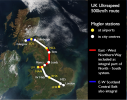
Don't forget that the Maglev proposal in the mid 2000s was to have a reverse S-shaped route that would run London-Birmingham-Manchester-Leeds-Newcastle-Edinburgh-Glasgow. Liverpool would have been on a Maglev spur from Manchester Airport, and thus all of these primary conurbations of the UK would have been served without any need to run on existing rails. Here is a drawing of the route, the full proposals were all well documented at the time.
 

Attachments

  • 1725966563557.png
    1725966563557.png
    1.3 MB · Views: 35

Trainbike46

Established Member
Joined
18 Sep 2021
Messages
4,365
Location
belfast
Don't forget that the Maglev proposal in the mid 2000s was to have a reverse S-shaped route that would run London-Birmingham-Manchester-Leeds-Newcastle-Edinburgh-Glasgow. Liverpool would have been on a Maglev spur from Manchester Airport, and thus all of these primary conurbations of the UK would have been served without any need to run on existing rails. Here is a drawing of the route, the full proposals were all well documented at the time.
and you think this would have actually been built in full, instead of having gotten the same treatment as HS2?
 

Shrop

Established Member
Joined
6 Aug 2019
Messages
1,350
and you think this would have actually been built in full, instead of having gotten the same treatment as HS2?
In stages there should be no reason why not. London to Birmingham by 2020, Birmingham to Manchester by 2025-30, then to Leeds 2030-35, and Newcastle/Edinburgh/Glasgow by 2035-40, but all depending on how the first stage performs, and the availability of finance. People in heavy rail are always quick to dismiss this, but how do you know that the London-Birmingham section wouldn't have generated a great deal of success by attracting passengers from both roads and existing railways, and of course with the great benefits of freeing up space on WCML? Maglev should have been seen as a potential transport asset to the UK, a complement to heavy rail, but people were too quick to see it as the enemy.

Twenty years ago it just needed transport to be given some proper consideration, but instead we had opposition from most of the heavy rail industry who were very dismissive and gave Maglev (and other ideas) very little time or thought. Added to this we have a situation that has prevailed in successive Governments for decades where politicians simply don't want to think seriously about transport unless they're forced to.
 

SynthD

Established Member
Joined
4 Apr 2020
Messages
2,018
Location
UK
You’ve clearly laid out HS2’s problems and added on the extra difficulties of maglev. HSUK uses tried and tested rail that we know how to build, it just goes the wrong way.

360kph isn’t that popular abroad because they didn’t build in that capability. They regret that and specifically advised HS2 to have that.
 

JLH4AC

Member
Joined
15 Jul 2023
Messages
184
Location
Market Rasen
and you think this would have actually been built in full, instead of having gotten the same treatment as HS2?
The UK Ultraspeed was "cancelled" because it would have cost £60 billion (£98 billion in today's prices) in 2007 prices (Based on the costs of the cancelled Munich system.), maglev was an unproven technology especially in the context in which UK Ultraspeed was hoping to use it, and most of the stations would have been far from the city centre. If it got past being an unproven technology it would likely be cancelled sooner than HS2 as that high starting cost would give a lot less room for cost overruns and would have been unlikely to survive the pandemic in any form. It is also worth noting that the only Transrapid system in operation has since been slowed to top speeds less than that of Eurostar on HS1.
 
Last edited:

Trainbike46

Established Member
Joined
18 Sep 2021
Messages
4,365
Location
belfast
The UK Ultraspeed was cancelled because it would have cost £60 million in 2007 prices (Based on the costs of the cancelled Munich system.) and maglev was an unproven technology especially in the context in which UK Ultraspeed was hoping to use it, if it gets past being an unproven technology it would likely be cancelled sooner than HS2 as that high starting cost would give a lot less room for cost overruns and would have been unlikely to survive the pandemic in any form. It is also worth noting that the only Transrapid system in operation has since been slowed to top speeds less than that of Eurostar on HS1.
I'm assuming there's an order of magnitude error in there?

In stages there should be no reason why not. London to Birmingham by 2020, Birmingham to Manchester by 2025-30, then to Leeds 2030-35, and Newcastle/Edinburgh/Glasgow by 2035-40, but all depending on how the first stage performs, and the availability of finance. People in heavy rail are always quick to dismiss this, but how do you know that the London-Birmingham section wouldn't have generated a great deal of success by attracting passengers from both roads and existing railways, and of course with the great benefits of freeing up space on WCML? Maglev should have been seen as a potential transport asset to the UK, a complement to heavy rail, but people were too quick to see it as the enemy.

Twenty years ago it just needed transport to be given some proper consideration, but instead we had opposition from most of the heavy rail industry who were very dismissive and gave Maglev (and other ideas) very little time or thought. Added to this we have a situation that has prevailed in successive Governments for decades where politicians simply don't want to think seriously about transport unless they're forced to.
so, you build your first section, have very fast London-Birmingham service only, no services continuing beyond there because you can't continue on existing tracks. That's a really big disadvantage, because it means you either:
- split services and make everyone transfer
- run direct services completely on existing infrastructure


On top of that, you're making the assumption that project management and cost control would be more effective on a maglev build than on HS2, when the experience shows that untested technologies are worse at cost control etc., because there are more unknowns interfering with your project.
 

JLH4AC

Member
Joined
15 Jul 2023
Messages
184
Location
Market Rasen
I'm assuming there's an order of magnitude error in there?
Yeah is it meant to say billion, I must have forgotten to change the m to a b after choosing to refer to the total price instead of price per kilometre. It is meant to say £60 billion (£98 billion in today's prices).
so, you build your first section, have very fast London-Birmingham service only, no services continuing beyond there because you can't continue on existing tracks. That's a really big disadvantage, because it means you either:
- split services and make everyone transfer
- run direct services completely on existing infrastructure


On top of that, you're making the assumption that project management and cost control would be more effective on a maglev build than on HS2, when the experience shows that untested technologies are worse at cost control etc., because there are more unknowns interfering with your project.
These are all great points.
 
Last edited:

Shrop

Established Member
Joined
6 Aug 2019
Messages
1,350
The UK Ultraspeed was cancelled because it would have cost £60 billion (£98 billion in today's prices) in 2007 prices (Based on the costs of the cancelled Munich system.), maglev was an unproven technology especially in the context in which UK Ultraspeed was hoping to use it, and the most stations would have been far from the city centre. If it got past being an unproven technology it would likely be cancelled sooner than HS2 as that high starting cost would give a lot less room for cost overruns and would have been unlikely to survive the pandemic in any form. It is also worth noting that the only Transrapid system in operation has since been slowed to top speeds less than that of Eurostar on HS1.
£98 billion for a route that runs from London to Glasgow serving Birmingham, Manchester, Leeds, Newcastle and Edinburgh on the way sounds like an absolute bargain compare to the costs of HS2. As for the slowing of the Shanghai Maglev, what is the point of keeping it running at 430kph? It can achieve its present purpose of serving Pudong Airport perfectly well at 300kph, and on a route of just 19 miles that's not much of a penalty. It's already proved everything it needed to in almost 20 years of service, it's hardly the fault of Maglev if so many people chose to dismiss it without trying it.

== Doublepost prevention - post automatically merged: ==

so, you build your first section, have very fast London-Birmingham service only, no services continuing beyond there because you can't continue on existing tracks. That's a really big disadvantage, because it means you either:
- split services and make everyone transfer
- run direct services completely on existing infrastructure
You're looking at this the wrong way. The split and transfer would be no different or catching the Eurostar from Paris or Brussels into St.Pancras and then having to change trains there. And don't forget that all those who wanted HS1 linked into HS2 were shouted down on the basis that not enough people would want to make the through trip to other parts of the UK, so how can you suggest that a transfer is a problem?

But as I said above, London to Birmingham could have just been Phase 1 and so the transfer would have only been temporary. If people had wanted to go further, then one might like to think there would have been pressure to build the next section and thus create less need to transfer.
 
Last edited:

JamesT

Established Member
Joined
25 Feb 2015
Messages
4,833
£98 billion for a route that runs from London to Glasgow serving Birmingham, Manchester, Leeds, Newcastle and Edinburgh on the way sounds like an absolute bargain compare to the costs of HS2. As for the slowing of the Shanghai Maglev, what is the point of keeping it running at 430kph? It can achieve its present purpose of serving Pudong Airport perfectly well at 300kph, and on a route of just 19 miles that's not much of a penalty. It's already proved everything it needed to in almost 20 years of service, it's hardly the fault of Maglev if so many people chose to dismiss it without trying it.
In 2011 the cost of the full HS2 Y implementation was £50bn, including 30% contingency. What makes you think the Maglev proposal wouldn't have suffered the same cost overruns that HS2 has? It's starting off 20% more expensive.
 

JLH4AC

Member
Joined
15 Jul 2023
Messages
184
Location
Market Rasen
£98 billion for a route that runs from London to Glasgow serving Birmingham, Manchester, Leeds, Newcastle and Edinburgh on the way sounds like an absolute bargain compare to the costs of HS2. As for the slowing of the Shanghai Maglev, what is the point of keeping it running at 430kph? It can achieve its present purpose of serving Pudong Airport perfectly well at 300kph, and on a route of just 19 miles that's not much of a penalty. It's already proved everything it needed to in almost 20 years of service, it's hardly the fault of Maglev if so many people chose to dismiss it without trying it.
That £60 billion was only accounting for known/predicted cost overruns so could have easily increased at a much greater rate and was only the construction costs (HS2 costs estimates at the time also did not include rolling stock and land.).

The point is that only the Transrapid system in operation no longer runs at the speed that UK Ultraspeed was making such a big deal about, be it due to technical issues or that high of speed not being suited for a 19-mile-long airport line. A 19-mile-long airport line and a few test tracks are hardly proof that form of high speed maglev works at scale. Why should the UK which has no native high speed maglev development be the first nation to take the major risk of building a long-distance high speed maglev line, Japan which does have native high speed maglev development only started work on their first long-distance high speed maglev line in 2013?
 
Last edited:

Shrop

Established Member
Joined
6 Aug 2019
Messages
1,350
In 2011 the cost of the full HS2 Y implementation was £50bn, including 30% contingency. What makes you think the Maglev proposal wouldn't have suffered the same cost overruns that HS2 has? It's starting off 20% more expensive.
I'm not particularly an expert, I'm just interested. However for the 20% extra expense that you quoted, you'd have been getting a route serving Newcastle, Edinburgh and Glasgow (plus Liverpool if you look at the map in my earlier post), AND a link between Manchester and Leeds which HS2 certainly didn't have. So for what you'd have got for your money, Maglev looked superior.

And of course Maglev might have over-run on its budget, but it would have been going some to beat the over-runs that HS2 had.
 

Kingston Dan

Member
Joined
19 Apr 2020
Messages
341
Location
N Yorks
The h
I'm not particularly an expert, I'm just interested. However for the 20% extra expense that you quoted, you'd have been getting a route serving Newcastle, Edinburgh and Glasgow (plus Liverpool if you look at the map in my earlier post), AND a link between Manchester and Leeds which HS2 certainly didn't have. So for what you'd have got for your money, Maglev looked superior.

And of course Maglev might have over-run on its budget, but it would have been going some to beat the over-runs that HS2 had.
The HS2 cost over runs are somewhat exaggerated and involve a known and trusted technology - Maglev is basically an unknown technology at the intercity scale and would almost certainly have cost far more. God knows what the Chiltern NIMBYS would make of an entire railway built on stilts for its entire length.
 
Status
Not open for further replies.

Top