• Our new ticketing site is now live! Using either this or the original site (both powered by TrainSplit) helps support the running of the forum with every ticket purchase! Find out more and ask any questions/give us feedback in this thread!

Train derailment near Córdoba, Spain

Status
Not open for further replies.

edwin_m

Veteran Member
Joined
21 Apr 2013
Messages
28,749
Location
Nottingham
Excellent report in Railway Gazette on the investigation into this dual derailment in Spain.
The article also mentions that the track spacing on this line is 4.3m.

With the width of the GC gauge being 3.15m, that means that a train derailed to the left would impinge on the envelope of a train on the other track before it was (possibly) restrained by the back of the right-hand wheel contacting the left-hand rail.

For reference, the TSI requires 4.3m for 250km/h to 300km/h and 4.5m above 300km/h. That may not be relevant in this specific case, because it's likely the train derailed to the right before being pulled leftwards by the crossover, but there's possibly a more general point here.
 
Sponsor Post - registered members do not see these adverts; click here to register, or click here to log in
R

RailUK Forums

AlexNL

Established Member
Joined
19 Dec 2014
Messages
1,721
Some updates:

A passenger from the Alvia train who was taken into intensive care, has passed away on Friday. This brings the death toll to 46.
Una mujer de 42 años, natural de La Palma del Condado (Huelva), y que se encontraba en la UCI del Hospital Reina Sofía de Córdoba, se ha convertido este viernes en la víctima número 46 del accidente de Adamuz. Se trata de una de las opositoras a funcionaria de prisiones que viajaba en el vagón número 2 del Alvia que partió desde Madrid con destino a Huelva y descarriló al impactar con otro tren Iryo.

The tracks have been cleared. The first 5 coaches of the Iryo train have been dragged away. Coaches 6, 7 and 8 can no longer be moved by rail. The badly damaged Alvia train has been scrapped on site.
Los enormes brazos de las grúas que retomaban los trabajos en las vías de Adamuz desde primeras horas de este sábado han despejado este mediodía por completo las vías del tren en el lugar del siniestro. Las tareas comenzaron en los carriles con la retirada de los restos del tren Alvia (Madrid-Huelva) siniestrado que había sido prácticamente fragmentado y convertido en chatarra. Además, los últimos vagones del Iryo descarrilado (Málaga-Madrid) han salido ya de Adamuz con una remolcadora. Se trata de los coches 1 a 5 del mismo, que no descarrilaron. Los vagones del 6 al 8, que ya estaban puestos pie a tierra en una finca anexa, han sido cubiertos con enormes enfundas tras ser imposible su traslado en camiones.

The CIAF (accident investigation unit) has released the site, and Adif is working on repairing the infrastructure. Traffic is expected to resume on 7 February.
Los trabajos para recuperar el servicio de la línea ferroviaria entre el centro y el sur peninsular en Adamuz (Córdoba) se centran ya en la adecuación y preparación de la plataforma, con el objetivo de poder instalar las traviesas y el carril.
(...)
Una veintena de vehículos y unos cuarenta técnicos del gestor de la infraestructura ferroviaria, Adif, se encuentran sobre el terreno, con el objetivo, según explicó el ministro Óscar Puente, de retomar la circulación con Andalucía el sábado 7, si bien advirtió de que la fecha no era definitiva y la meteorología podía adelantar o retrasar plazos.

The last ultrasonic inspection of the failed weld took place on 25 June 2025, one month after the welding was performed. While other inspections have taken place since then, these were not as in-depth as an ultrasonic inspection and were unlikely to catch the gradual degradation of the weld.
La soldadura de Adamuz (Córdoba) que se investiga ahora como causa del accidente en el que murieron 46 personas fue revisada por última vez con ultrasonidos durante la obra de reforma «integral» de la vía de alta velocidad Madrid-Sevilla. Se trata de la prueba más fiable para detectar fisuras o cualquier otro defecto de la vía que pueda suponer un riesgo para la seguridad de los pasajeros.

En un dossier elaborado por Adif sobre las revisiones de esta soldadura, el administrador estatal admite explícitamente que «la última inspección» por ultrasonidos «se hizo durante su construcción». Esto es, el 25 de junio del año pasado.
 
Last edited:

John Palmer

Member
Joined
23 Oct 2015
Messages
399
I attach a copy of DeepL's translation of the OK Diario article referred to in @AlexNL's post #212. The translation is 'as is' without alteration on my part. I am unfamiliar with the quality of Spanish reporting generally and that of Ok Diario in particular, so the reliability of the translated article is left to you to assess.

I have embedded in the translated document a still taken from the video that accompanied the article showing a close up of the fracture area from an angle somewhat different from those I have previously seen and which may therefore prove illuminating.
 

Attachments

  • OK Diario online article 31 January 2026.pdf
    179.6 KB · Views: 55

AlexNL

Established Member
Joined
19 Dec 2014
Messages
1,721
From the article:
The Minister of Transport, Óscar Puente, has defended these days that even if the track had been auscultated a day before the accident "nothing would have been seen".

If this were to be true, railways all over the world would basically be ticking timebombs and welds could simply collapse at any given moment without any warning. Of course we know that's not the case, rail is one of the safest modes of transport and disasters like the Adamuz one are incredibly rare.

Gareth Dennis has written on this:
This [seven or eight months] isn't long for a defect to grow - but it is long enough for an ultrasonic test train to have picked it up. Network Rail requires ultrasonic inspection of high speed tracks every 8 weeks as a minimum.
 

Cloud Strife

Established Member
Joined
25 Feb 2014
Messages
2,965
Ok Diario

Politically, it's right to far-right, strongly opposed to the current Spanish government. it's known for publishing fake news, and it aligns itself pretty much with Vox, a far right party in Spain. I'd take anything written there with a large pinch of salt.
 

edwin_m

Veteran Member
Joined
21 Apr 2013
Messages
28,749
Location
Nottingham
"even if the track had been auscultated a day before the accident "nothing would have been seen".

According to a web search, "auscultating" is listening to the body, typically with a stethoscope. If it actually refers to ultrasonics then I would have thought something would be visible a day before. However it's worth noting that a Spanish track geometry recording coach I was involved with some years back carried a legend something like "Coche por auscultacion del via". So the exact Spanish usage in the rail context may refer to geometry recording, which would not show up any problem until the rail actually broke.
 

Annetts key

Established Member
Joined
13 Feb 2021
Messages
3,832
Location
West is best
"even if the track had been auscultated a day before the accident "nothing would have been seen".

According to a web search, "auscultating" is listening to the body, typically with a stethoscope. If it actually refers to ultrasonics then I would have thought something would be visible a day before. However it's worth noting that a Spanish track geometry recording coach I was involved with some years back carried a legend something like "Coche por auscultacion del via". So the exact Spanish usage in the rail context may refer to geometry recording, which would not show up any problem until the rail actually broke.
The whole point of Non Destructive Testing (NDT) such as ultrasonic testing is because it can detect many defects such as cracks or other problems long before the rail breaks or before a crack becomes visable to a human eye. I'm far from an expert, but have chatted to some team members of a Network Rail "ultrasonics" team.

And I know (from experience working for Network Rail) that when a "ultrasonics" team are out and about doing their job on older rail, there is a good likelihood that they will find one or more defects.

That doesn't mean that all defects will always be detected. And it doesn't mean all broken rail breaks can currently be prevented (especially in the U.K. where some of those occur during cold nights).
 

chrisjo

Member
Joined
18 May 2024
Messages
604
Location
Llanishen
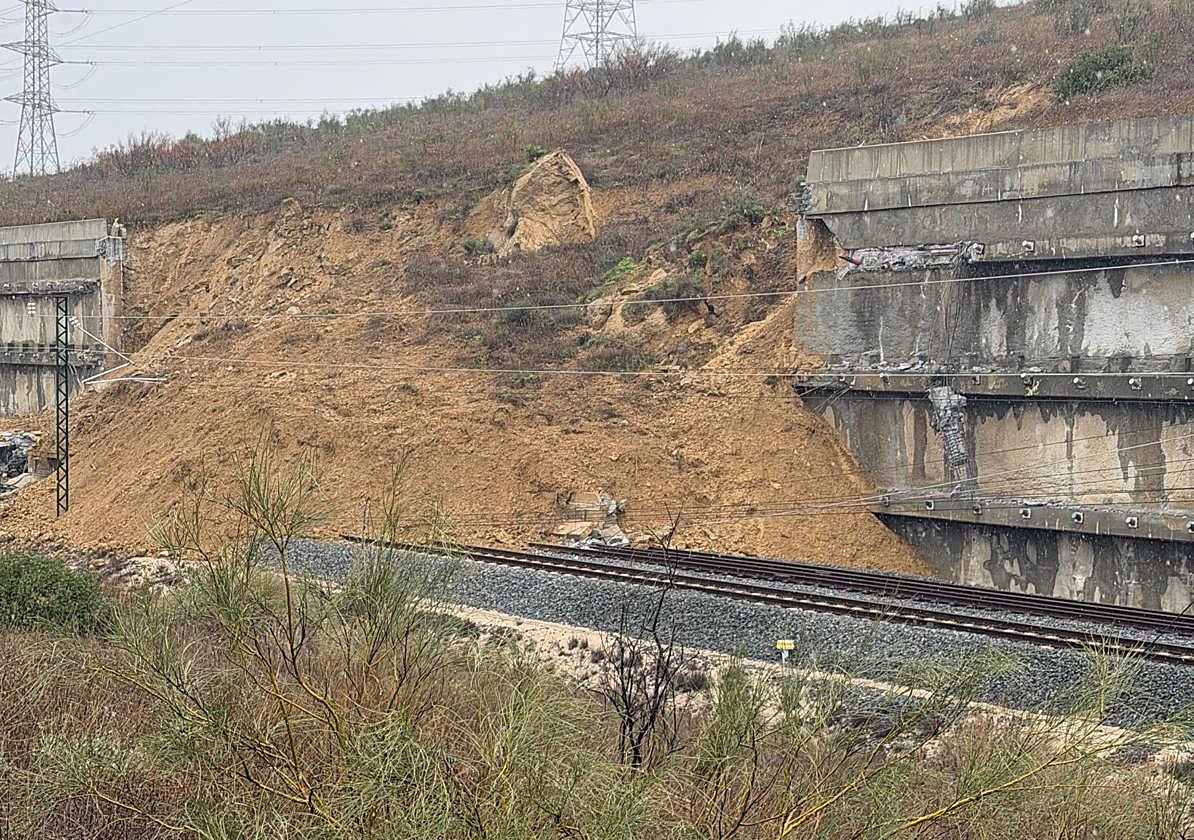
Further delay to re-opening of Malaga-Madrid line due to adverse weather including collapsed retaining wall and landslide....


A landslide on the high-speed rail tracks in the municipality of Álora has further delayed work to recover the Malaga-Madrid high-speed line.
After both deadlines announced by the Ministry of Transport proved impossible, minister Óscar Puente said on Tuesday that they could not promise an exact reopening date.
Technical sources have told SUR that there will be no trains between Malaga and Madrid for at least another week (12-13 February).
The latest storm - Leonardo - brought heavy rains to the province on Wednesday. This led to various landslides, including one that collapsed onto the tracks at the height of Álora, and the suspension of the Malaga-Antequera line.

Numerous photos show the tracks covered in earth. According to rail infrastructure company Adif, the incident has also impacted the catenary and the extent of the damage is still unknown. Technical sources have stated that the ground is still very wet and unstable, which is why it is not possible to make any forecasts.
talud-ave-kQw-U75618870626uLQ-1200x840@Diario%20Sur-DiarioSur.jpg
 

edwin_m

Veteran Member
Joined
21 Apr 2013
Messages
28,749
Location
Nottingham
Further delay to re-opening of Malaga-Madrid line due to adverse weather including collapsed retaining wall and landslide....


talud-ave-kQw-U75618870626uLQ-1200x840@Diario%20Sur-DiarioSur.jpg
That's quite worrying. Network Rail's earthworks problems are said to be down to much of the infrastructure being built when there wasn't much understanding of soil mechanics, but here we see a relatively modern structure brought down by a landslip far bigger than anything we've seen on the British network recently.
 

Shaw S Hunter

Established Member
Joined
21 Apr 2016
Messages
3,497
Location
Over The Hill
That's quite worrying. Network Rail's earthworks problems are said to be down to much of the infrastructure being built when there wasn't much understanding of soil mechanics, but here we see a relatively modern structure brought down by a landslip far bigger than anything we've seen on the British network recently.
Tbf Spain has seen unprecedented amounts of rainfall this winter, hardly surprising if the ground is reacting in unexpected ways. Far more worrying is the suggestion alluded to upthread that Spanish railways are not maintained to quite the exactingly high standards seen in this country despite having a substantial network of genuinely high-speed lines.
 

LNW-GW Joint

Veteran Member
Joined
22 Feb 2011
Messages
21,945
Location
Mold, Clwyd
Looks like the new infrastructure problems are between Malaga and Cordoba.
No mention of Sevilla/Cordoba-Madrid services via the derailment site at Adamuz north of Cordoba - are they now able to run?
 

Sir Felix Pole

Established Member
Joined
21 Oct 2012
Messages
2,210
Location
Wilmslow
Looks like the new infrastructure problems are between Malaga and Cordoba.
No mention of Sevilla/Cordoba-Madrid services via the derailment site at Adamuz north of Cordoba - are they now able to run?
Cordoba to Puertollano LAV was supposed to reopen this weekend, but the torrential rain in Andalucia has caused further delay - no date given yet.
 

john77

Member
Joined
9 Sep 2016
Messages
34
Cordoba to Puertollano LAV was supposed to reopen this weekend, but the torrential rain in Andalucia has caused further delay - no date given yet.
The latest date I saw was for the line to reopen at Adamuz on 7th Feb, but since then it has been suggested that the poor weather will delay it further. The latest landslide will not help.
 

Paul AC

Member
Joined
3 Aug 2025
Messages
243
Location
Timperley
For information, the weather in southern Spain and Portugal has been horrendous over the past few weeks. Storm after storm has brought near continuous rain, and it seems set to continue like this. My sister lives in a small village on the east bank of the River Guadiana about 40 km north of its mouth into the Gulf of Cadiz at Vila Real de Santo Antonio/Ayamonte. I visited her at Christmas, normally at that time of year the ground is dry and brown, this time it was green... the ground already well saturated from rain at the end of 2025. The Guadiana and its tributaries drain much of southern Spain and Portugal - it starts near Ciudad Real and passes through Badajoz before entering Portugal then forms the Portugal/Spain border. Even under normal conditions it's a big navigable river, it used to flood quite regularly but over the years dams have been added further upstream. Now all the reservoirs are full and they are having to let down huge quantities of water into the river to protect the dams, resulting in severe flooding of the riverside villages - made worse by some very high tides over the past few days. The river water flow gauges are showing flow rates 2.5 times the 'danger' level and the river level itself is the highest for over 40 years - longer ago than most of the dams were built. My sister's house is on the hillside well clear of the flooding but others, and some in the village on the Portuguese side, are well under water.
 

Ant1966

Member
Joined
9 May 2021
Messages
255
Location
RG
Update on possible reopening & speed restriction delays etc.
We are booked on the direct iryo Barcelona to Seville, dep 09:50 on 17/2
Had an e-mail from iryo: "your schedule has changed", feared the worst.
Turns out; just retimed to leave Barcelona 30 mins earlier at 09:20. And arriving in Seville a whole 2 minutes later (not sure why they bothered with that tbh)
Obviously things can still change; will keep people posted if so.
 

AlexNL

Established Member
Joined
19 Dec 2014
Messages
1,721
The Spanish investigation board is considering the scenario that there may have been a defect in the rails, rather than a faulty weld, which led to the crash. S

ensors from trains which ran over the same track prior to the Iryo have picked up some irregularities, and during inspection of track adjacent to the weld the investigators noticed a suspicious spot.

The investigation board is looking for a laboratory which can do independent assessments, and which is not associated with any of the stakeholders (Renfe, Iryo, Adif, ArcelorMittal, and so on.)

La investigación de Adamuz analiza una posible degradación en el acero del carril como causa de la rotura que provocó el descarrilamiento
La CIAF tiene aún pendiente la selección de laboratorios que puedan llevar a cabo pruebas sobre las muestras de carril tomadas en el tramo del accidente "evitando conflictos de intereses"

La investigación del accidente ferroviario de Adamuz (Córdoba), con 46 víctimas mortales, estudia si la calidad del material que compone las vías de alta velocidad donde descarriló el Iryo en dirección Madrid el pasado 18 de enero pudo ser la causa de la rotura del carril que desencadenó el siniestro. La Comisión de Investigación de Accidentes Ferroviarios (CIAF) tiene aún pendiente la selección de laboratorios que puedan llevar a cabo pruebas sobre las muestras de carril tomadas en el tramo del accidente "evitando conflictos de intereses con alguna de las entidades relacionadas con el suceso", en referencia a laboratorios como el de Renfe, uno de los más avanzados en este campo.

El Mundo: La investigación de Adamuz analiza una posible degradación en el acero del carril como causa de la rotura que provocó el descarrilamiento
 

Sir Felix Pole

Established Member
Joined
21 Oct 2012
Messages
2,210
Location
Wilmslow
According to 'Sur in English' the line has reopened today. Antequera S.A. to Málaga remains closed, however, due to the landslip.

Sur in English

Spain's rail operator Renfe is restoring the high-speed line between Madrid and Andalucía on Tuesday, one month after the train crash near Adamuz. Not all services will run their full routes by train, however, with the Malaga connection requiring a bus transfer.

State rail infrastructure company Adif authorised the reopening of the tracks following complex repair work and safety tests.

The Madrid-Seville, Madrid-Cadiz, Madrid-Granada and the Alvia Madrid-Granada-Almeria services will resume their normal routes from 17 February.

Only the first Madrid-Huelva train will require a bus transfer to bypass the section between Cordoba and Huelva, while the rest of the services scheduled during the day will be entirely by train.

As SUR reported on Monday, the Madrid-Malaga route will not return to normal operation until the beginning of March due to the recovery of the slope that gave way in Álora.


From Wednesday onwards, passengers using this connection will do so by train from Madrid to Antequera and by bus from Antequera to Malaga. Renfe is currently preparing this alternative plan to accompany train ticket sales.
 

Austriantrain

Established Member
Joined
13 Aug 2018
Messages
1,812
Did RENFE offer any kind of replacement train service on the classic route? I know of course that it is very slow, but still there are travel needs and planes and coaches might very well not cope.

Or did it all run smoothly with most passengers choosing not to travel and the remainder finding space on planes and coaches or using private car?
 

rvdborgt

Established Member
Joined
24 Feb 2022
Messages
2,527
Location
Leuven
Did RENFE offer any kind of replacement train service on the classic route? I know of course that it is very slow, but still there are travel needs and planes and coaches might very well not cope.

Or did it all run smoothly with most passengers choosing not to travel and the remainder finding space on planes and coaches or using private car?
If Renfe don't run any trains, then passengers who have booked don't choose "not to travel" but rather Renfe are obliged to offer an alternative, such as reimburse coach tickets.
Of course, if they're like Eurostar, they won't mention this in any messages sent out, and will only offer refund or rebook, and the latter option may be several days or weeks in the future.
 

Sir Felix Pole

Established Member
Joined
21 Oct 2012
Messages
2,210
Location
Wilmslow
Did RENFE offer any kind of replacement train service on the classic route? I know of course that it is very slow, but still there are travel needs and planes and coaches might very well not cope.

Or did it all run smoothly with most passengers choosing not to travel and the remainder finding space on planes and coaches or using private car?
There were RRBs between Córdoba and Villanueva de Córdoba (the little used AVE station between Córdoba and Puertollano).

These were the trains offered on the classic lines (from my post #118 - 'El Pais' report).

Renfe will also offer passengers a daily conventional train service from Chamartín to Seville (at 7:00 a.m.), Cádiz (at 3:00 p.m.), and Granada and Almería (at 4:25 p.m.). From Andalusia, this service will run at 6:35 a.m. from Cádiz, 8:31 a.m. from Almería, and 3:00 p.m. from Seville.
At the same time, Renfe has increased capacity on the Madrid–Extremadura–Seville Medium Distance line by 736 seats. (EFE)
 

Paul AC

Member
Joined
3 Aug 2025
Messages
243
Location
Timperley
Did RENFE offer any kind of replacement train service on the classic route? I know of course that it is very slow, but still there are travel needs and planes and coaches might very well not cope.

Or did it all run smoothly with most passengers choosing not to travel and the remainder finding space on planes and coaches or using private car?
(I've edited my response as @Sir Felix Pole has put what I was going to) One problem is the restricted capacity on the single track Córdoba - Linares-Baeza route, and it's been academic anyway as one of the many recent storms damaged the infrastructure on this line and it hasn't reopened yet.
 

Acathater

Member
Joined
11 Dec 2025
Messages
756
Location
NorthWest
That's quite worrying. Network Rail's earthworks problems are said to be down to much of the infrastructure being built when there wasn't much understanding of soil mechanics, but here we see a relatively modern structure brought down by a landslip far bigger than anything we've seen on the British network recently.
Something seriously wrong with that retaining wall: what looks like a lot of leached salt and the concrete spalling. I'd question the materials - especially the sand - used in the mix.
On top of which the wall looks remarkably thin and flimsy given what it's supposed to support
 

HS2isgood

Member
Joined
9 Nov 2020
Messages
302
Location
Madrid, Spain
Madrid - Sevilla / Cádiz was running via Linares for slightly over a week, until that line flooded. As of now, the Espeluy - Alcolea section is closed to passenger use due to speeds too slow for service viability. (Espeluy is the junction for Jaén and Alcolea a Córdoba suburb) Rail replacement buses are in operation between Córdoba/Alcolea and Jaén for MD services, while the "Golden Tower" long distance service only runs between Cádiz and Córdoba and Linares and Barcelona respectively. There's a bus bridge, which Renfe isn't selling tickets for online, but it's bookable at stations.
 

Annetts key

Established Member
Joined
13 Feb 2021
Messages
3,832
Location
West is best
Something seriously wrong with that retaining wall: what looks like a lot of leached salt and the concrete spalling. I'd question the materials - especially the sand - used in the mix.
On top of which the wall looks remarkably thin and flimsy given what it's supposed to support
It's not the width of top that matters. The level of pressure increases with the depth. So the width of a retaining wall should increase with depth. And if water may become trapped behind a retaining wall, you either have to build it strong enough to withstand the water pressure or provide drain holes so that the water can flow and not built up.

But looking at the photo, I agree that it doesn't look very good. I have serious doubts about the quality of the concrete.
 

30907

Veteran Member
Joined
30 Sep 2012
Messages
21,988
Location
Airedale
The current timetable shows RRBs Malaga Antequera SA. The historic route via Bobadilla is open.
 

DelW

Established Member
Joined
15 Jan 2015
Messages
6,039
On top of which the wall looks remarkably thin and flimsy given what it's supposed to support

It's not the width of top that matters. The level of pressure increases with the depth. So the width of a retaining wall should increase with depth. And if water may become trapped behind a retaining wall, you either have to build it strong enough to withstand the water pressure or provide drain holes so that the water can flow and not built up.

The wall appears to have three levels of ground anchors with walings spanning horizontally between them, so the bending moments in the wall panels spanning vertically will be relatively small.

But I agree that build up of hydrostatic pressure might have been the cause. Years ago I saw the effect of failed drainage causing groundwater pressure to build up behind a top-anchored sheet pile wall (that I'd designed). Tbe curved bulge in the piles was very visible and worrying - I organised emergency weep-holes, and sorting out the drainage issues asap.

Re the appearance of the wall - it's possible that it was constructed top-down, so poured within a bentonite filled trench rather than formwork; then the face progressively dug down and each level of anchors installed as it's excavated. That gives a much rougher concrete finish than a wall built within formwork.
 
Last edited:

edwin_m

Veteran Member
Joined
21 Apr 2013
Messages
28,749
Location
Nottingham
It's not the width of top that matters. The level of pressure increases with the depth. So the width of a retaining wall should increase with depth. And if water may become trapped behind a retaining wall, you either have to build it strong enough to withstand the water pressure or provide drain holes so that the water can flow and not built up.

But looking at the photo, I agree that it doesn't look very good. I have serious doubts about the quality of the concrete.
Yes, it looks to have failed on the vertical join between successive concrete pours.

I don't see much evidence of drain holes, and with a wall of that length the water has to go somewhere. It appears to be held back by rock bolts, which must go all the way into solid rock to be effective.
 

Ant1966

Member
Joined
9 May 2021
Messages
255
Location
RG
Update.
Travelled from Barcleona to Seville on the direct iryo last Tuesday 17th Feb. I think this may have been the first day it was re-opened, so we were very lucky
(For all you train meal fans out there; we tried their infiniti bistro class; breakfast nice enough, but probably not worth the extra money. Only got the one meal, breakfast after Barcelona, pax joining in Madrid got a lunch)
Anyway, some speed restrictions evident between Barcelona and Madrid, down to 150 km/h in a few places.
Also slow past the site of the accident, then a very severe speed restriction further South nearer Cordoba. 3 of the iryo coaches are sitting in a field next to the line, the other 5 are stabled at a small station some km North. No sign of the RENFE train coaches (although may have missed them). Caught a RENFE AVE back to Madrid yesterday; 1st class (whatever thats called) on a Siemens S103. Not much to choose between 1st class on RENFE or iryo in my view
Ride quality on the S103 seemed fine to me (as did the iryo) - both better than IETs in the UK.
Atocha station is a bit of a mess due to building work. Overall a great weeks holiday, mostly Rail based (London>Paris>Barcelona>Seville>Madrid) then BA flight back to LHR. No real delays or issues at all, and the train trips are part of the holiday for us :)
 
Status
Not open for further replies.

Top