
-
Our new ticketing site is now live! Using either this or the original site (both powered by TrainSplit) helps support the running of the forum with every ticket purchase! Find out more and ask any questions/give us feedback in this thread!
You are using an out of date browser. It may not display this or other websites correctly.
You should upgrade or use an alternative browser.
You should upgrade or use an alternative browser.
GWR Class 230 Information, Movements & Discussion.
- Thread starter FGW_DID
- Start date
Sponsor Post - registered members do not see these adverts; click here to register, or click here to log in
R
RailUK Forums

DavidGrain
Established Member
- Joined
- 29 Dec 2017
- Messages
- 1,488
I was travelling on a TfW class 230 last week and chatting to the guard he said that the AirCon was useless. Because the units were too hot in summer, they had fitted opening windows in the units. They were also too cold in winter so the heating was taking too much power .Regrettably, 230001 won't be going into passenger service this month after all, and probably not for a couple more months yet. My understanding is that the engineers involved have been told to sort out the passenger saloon aircon, as it doesn't work very well at the moment (a Vivarail legacy gremlin), this was really evident in recent media appearances with everybody sweating their b*llocks off (e.g. the Geoff Marshall video, filmed in the middle of the last heatwave). The good news is that a solution to the problem has been designed, fitted to the cab aircon units (that's why the unit has been tucked away at Reading depot for the past two weeks), and has turned out to be a very effective fix. They are now just waiting for the parts to arrive to mod the remaining aircon units, and then time is needed to physically do the mods (so there'll be more visits back to Reading in the coming months). GWR evidently didn't want to risk reputational damage to the battery train project with something as mundane as aircon, which is kind of understandable, just a shame about the delay.

317 forever
Established Member
I've done examples of both, in February and July respectivelyYou do… TfW or Isle of Wight.

Invincible
Member
On the BBC London TV local news a report GWR will attempt to break the battery train distance record

 www.bbc.co.uk
Battery-powered GWR train to attempt distance record from Reading
Great Western Railway is hoping its train can complete 200 miles on one charge to break the record.
www.bbc.co.uk
This Thursday/Friday night/morning. Leaving Reading around 22.30 on a journey to Paddington, Oxford, Paddington again and Reading. (According to the BBC). Easily within normal operating hours at the start and end (06.25) of its journey, so witnessing this trip is relatively simple.On the BBC London TV local news a report GWR will attempt to break the battery train distance record
Battery-powered GWR train to attempt distance record from Reading
Great Western Railway is hoping its train can complete 200 miles on one charge to break the record.
Last edited:

Strangely i can't seem to find any paths in for it's run yet. is this going to be a last minute thing ?This Thursday night. From Reading to Reading via Oxford and Paddington.

TheLastMinute
Member
Thee are these paths running tonight (Wed morning) that I don't think could be anything else, but these timings don't match those in the article linked above. Suppose it could have been retimed from tonight to tomorrow night but the timing haven't been moved yet
 www.realtimetrains.co.uk
www.realtimetrains.co.uk
www.realtimetrains.co.uk
www.realtimetrains.co.uk
www.realtimetrains.co.uk
www.realtimetrains.co.uk
www.realtimetrains.co.uk
Realtime Trains | 3Q80 0008 Reading Traincare Depot to London Paddington | 20/08/2025
Real-time train running information for 3Q80 0008 departure from Reading Traincare Depot to London Paddington on 20/08/2025. From Realtime Trains, an independent source of train running info for Great Britain.
www.realtimetrains.co.uk
Realtime Trains | 3Q81 0117 London Paddington to Oxford | 20/08/2025
Real-time train running information for 3Q81 0117 departure from London Paddington to Oxford on 20/08/2025. From Realtime Trains, an independent source of train running info for Great Britain.
www.realtimetrains.co.uk
Realtime Trains | 3Q82 0302 Oxford to London Paddington | 20/08/2025
Real-time train running information for 3Q82 0302 departure from Oxford to London Paddington on 20/08/2025. From Realtime Trains, an independent source of train running info for Great Britain.
www.realtimetrains.co.uk
Realtime Trains | 3Q83 0512 London Paddington to Reading Traincare Depot | 20/08/2025
Real-time train running information for 3Q83 0512 departure from London Paddington to Reading Traincare Depot on 20/08/2025. From Realtime Trains, an independent source of train running info for Great Britain.
www.realtimetrains.co.uk
Last edited:

rivervale
Member
- Joined
- 28 Feb 2017
- Messages
- 26
Those paths are the ones - it should read 06:28 Wednesday morning.


Please forgive my ignorance, but what does UGL stand for, as in Slough U.G.L? And what on earth is going to be passing between 0412 and 0418?Thee are these paths running tonight (Wed morning) that I don't think could be anything else, but these timings don't match those in the article linked above. Suppose it could have been retimed from tonight to tomorrow night but the timing haven't been moved yet
Realtime Trains | 3Q80 0008 Reading Traincare Depot to London Paddington | 20/08/2025
Real-time train running information for 3Q80 0008 departure from Reading Traincare Depot to London Paddington on 20/08/2025. From Realtime Trains, an independent source of train running info for Great Britain.Realtime Trains | 3Q81 0117 London Paddington to Oxford | 20/08/2025
Real-time train running information for 3Q81 0117 departure from London Paddington to Oxford on 20/08/2025. From Realtime Trains, an independent source of train running info for Great Britain.Realtime Trains | 3Q82 0302 Oxford to London Paddington | 20/08/2025
Real-time train running information for 3Q82 0302 departure from Oxford to London Paddington on 20/08/2025. From Realtime Trains, an independent source of train running info for Great Britain.Realtime Trains | 3Q83 0512 London Paddington to Reading Traincare Depot | 20/08/2025
Real-time train running information for 3Q83 0512 departure from London Paddington to Reading Traincare Depot on 20/08/2025. From Realtime Trains, an independent source of train running info for Great Britain.
Many thanks
TheLastMinute
Member
I'd imagine UGL is Up Goods Loop. Looking at the times through Slough, 3Q82 is due to be passed by 2P07 which is due there 0417.Please forgive my ignorance, but what does UGL stand for, as in Slough U.G.L? And what on earth is going to be passing between 0412 and 0418?
Many thanks
Of course, many thanks. Now I've looked at Slough, as opposed to Slough UGL, it's obvious.I'd imagine UGL is Up Goods Loop. Looking at the times through Slough, 3Q82 is due to be passed by 2P07 which is due there 0417.
And, going off topic, I notice 25 minutes later it's followed by The Night Riviera, which is only three cars. I thought it would need a lot more carriages than that this time of year...
And, going off topic, I notice 25 minutes later it's followed by The Night Riviera, which is only three cars. I thought it would need a lot more carriages than that this time of year...
No idea why 1A50 is showing as three coaches, it's definitely load 7. (Set PZ89)
Anonymous10
Established Member
I think the sleeper only displays seated coaches.No idea why 1A50 is showing as three coaches, it's definitely load 7. (Set PZ89)
Anonymous10
Established Member
All in 1 charge?3Q83 is back on Reading TCD so that should be 230001’s World Record in the bag at approximately 202 miles!
ollyexe2808
Member
Yes! https://www.bbc.com/news/articles/c2l7ry7zp5poAll in 1 charge?
norbitonflyer
Established Member
I guess so, as there is nowhere to charge it at Paddington or OxfordAll in 1 charge?
== Doublepost prevention - post automatically merged: ==
2P07 then runs to Greenford to operate the shuttle.I'd imagine UGL is Up Goods Loop. Looking at the times through Slough, 3Q82 is due to be passed by 2P07 which is due there 0417.
Anonymous10
Established Member
Thats quite the accomplishment, I wonder what % the battery was on at the end and if this could see battery trains become more common.I guess so, as there is nowhere to charge it at Paddington or Oxford
== Doublepost prevention - post automatically merged: ==
2P07 then runs to Greenford to operate the shuttle.
Snow1964
Established Member
It did complete its Reading, Paddington, Oxford, Paddington, Reading trip last nightOn the BBC London TV local news a report GWR will attempt to break the battery train distance record
Battery-powered GWR train to attempt distance record from Reading
Great Western Railway is hoping its train can complete 200 miles on one charge to break the record.
A battery-powered train has broken the world record for the longest railway journey on a single charge.
The Great Western Railway (GWR) train, a specially adapted former District Line train, travelled overnight along a 200-mile (322km) route from Reading and back again via London Paddington and Oxford.
It reached 140 miles (225km), breaking the record on Brunel Maidenhead Bridge at about 04:00 BST.
The previous record of 139 miles (224km) was set by German train company Stadler Deutschland in Berlin on 10 December 2021.
The Rail Performance Society was on board to verify the record attempt.
Vice chairman Nigel Smedley said: "We can confirm that, subject to final checks, the Great Western Railway Class 230 train travelled 200 miles on a return journey from Reading Train Care Depot without charging its batteries from any external energy source."
Great Western Railway (GWR) made the attempt to mark the 200th anniversary of the birth of the railways.
GWR engineering director Dr Simon Green said: "Today's record attempt has been a bit of fun, but it also underlines a serious point: investment in battery technology is essential as we look to replace our ageing diesel fleet."
GWR is exploring if battery trains could replace its diesel fleet as it goes out of service over the next seven to 10 years.
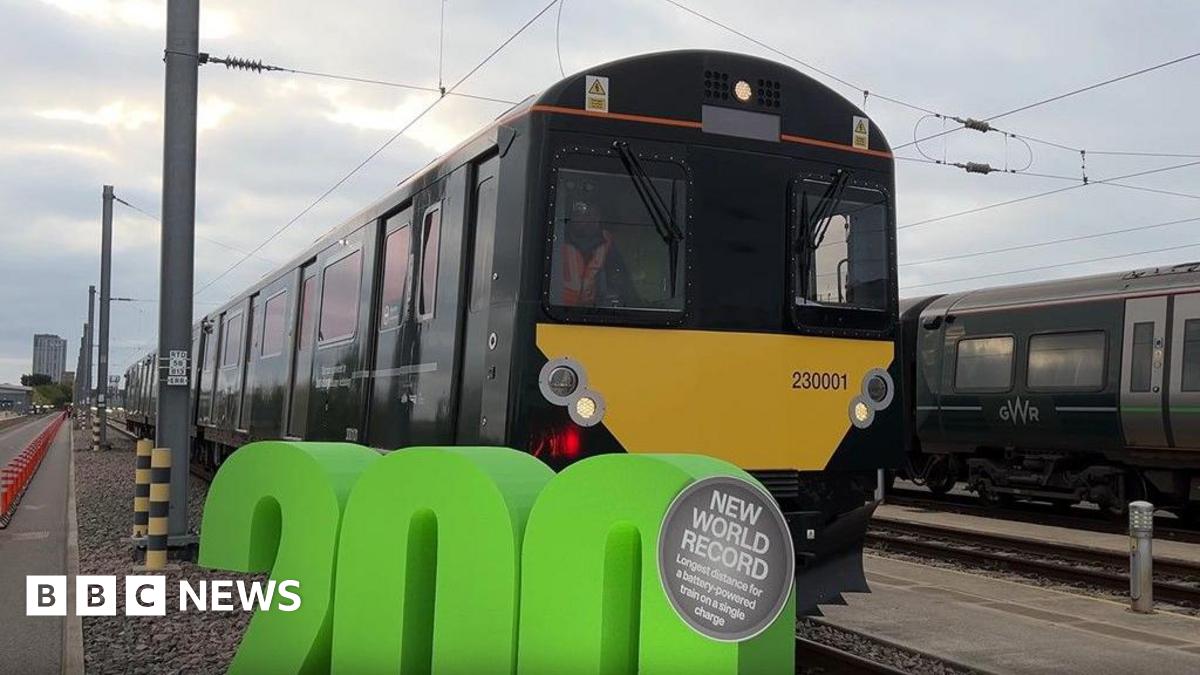
Battery-powered GWR train breaks distance record from Reading
A GWR train completes a 200-mile (322km) return journey from Reading without charging its batteries.
www.bbc.co.uk

pokemonsuper9
Established Member
Does anyone know if the existing record by Stadler was also done without heating/air con.Important to realise that this was done without any internal train lighting, heating or air-con, no doors opening and closing etc.
Still impressive but more a PR stunt than real life.
I would imagine lights and doors would have a relatively low impact (although keeping the doors closed would make heating/air con less power intensive)
none of these are as important as not calling at any stations though!Does anyone know if the existing record by Stadler was also done without heating/air con.
I would imagine lights and doors would have a relatively low impact (although keeping the doors closed would make heating/air con less power intensive)
pokemonsuper9
Established Member
Yes, of course.none of these are as important as not calling at any stations though!
Although I imagine the Stadler test did the same, that's the main thing I'm wondering about.
alf
On Moderation
Or not exceeding 40mph throughout the trip!none of these are as important as not calling at any stations though!
I am a great fan of the 230 project & the people behind it but this is not a fair record breaker.
I believe a German battery unit has clocked up over 100 miles between charges & this record was done with station stops & heating/air con &, I am told, normal service speeds well over 60 mph.
If the 230 travelled at 25 mph instead of 40mph throughout it might well clock 500 miles between charges because of much reduced air resistance.
But it would only be a record if it beat other Battery units doing exactly the same top speed & no door opening & heating.
But good luck to the innovative 230 & its GWR team. We need innovators.
It had 22% charge remaining at the end of the test, enough for anther 58 miles.Thats quite the accomplishment, I wonder what % the battery was on at the end and if this could see battery trains become more common.
FrontSideBus
On Moderation
- Joined
- 11 Feb 2025
- Messages
- 451
Stopping and starting again, like what a train normally does at stations and signals, would use a hell of a lot more energy than just cruising at a constant speed. I see it ran overnight, presumably to avoid all that.
And how long would it take to recharge from fully depleted?
And how long would it take to recharge from fully depleted?
Peter Sarf
Established Member
Regenerative braking would recoup some of the energy from a more stop start journey. I wonder how much ?.Stopping and starting again, like what a train normally does at stations and signals, would use a hell of a lot more energy than just cruising at a constant speed. I see it ran overnight, presumably to avoid all that.
And how long would it take to recharge from fully depleted?
FrontSideBus
On Moderation
- Joined
- 11 Feb 2025
- Messages
- 451
Some, but not enough to cover the subsequent acceleration as nothing is 100% efficient.
Then of course you have the extra load of the passengers, on both the traction motors and the aircon.
Would be interesting to see how far these can go in real world conditions and not just a range cruise.
Then of course you have the extra load of the passengers, on both the traction motors and the aircon.
Would be interesting to see how far these can go in real world conditions and not just a range cruise.