• Our new ticketing site is now live! Using either this or the original site (both powered by TrainSplit) helps support the running of the forum with every ticket purchase! Find out more and ask any questions/give us feedback in this thread!

Wind Power and UK Energy Use

poffle

Member
Joined
11 Oct 2023
Messages
239
Location
Dublin, Ireland
There is probably a lot more power transmission equipment manufacturing capacity available to supply equipment to Europe since the USA cut itself off from the world.

 
Sponsor Post - registered members do not see these adverts; click here to register, or click here to log in
R

RailUK Forums

Bald Rick

Veteran Member
Joined
28 Sep 2010
Messages
35,895
Bumping this - windy day today, Sun near peak intensity and nice temperature so little demand for heating or aircon. Big negative prices in the wholesale market (usual caveats apply!)

We are currently exporting to France, Belgium, Norway, Belgium, Ireland and the Netherlands. Might have been easier to say everywhere but Denmark! No doubt wind is also being constrained.
 

Nicholas Lewis

Established Member
Joined
9 Aug 2019
Messages
8,031
Location
Surrey
Bumping this - windy day today, Sun near peak intensity and nice temperature so little demand for heating or aircon. Big negative prices in the wholesale market (usual caveats apply!)

We are currently exporting to France, Belgium, Norway, Belgium, Ireland and the Netherlands. Might have been easier to say everywhere but Denmark! No doubt wind is also being constrained.
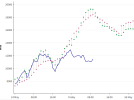
Below demonstrates how much wind is being wasted due to the inadequate grid transmission system the UK has. It would have been less in winter as demand would be higher.

1748166689288.png

Green dots are the latest forecast Blue line is actual output. Note this is only transmission connected windfarms.

Source: https://bmrs.elexon.co.uk/wind-generation

Still despite that its driven prices negative in the wholesale market today as their is still too much renewable generation available compared to demand this time of the year. The battery teams will be rubbing their hands loading up during the day as come the evening price will be back upto 70-80/MWhr. So suppliers like Octopus can offer negative prices but in the round all these subsidies come back to consumers in their bills so its not as generous as it looks. Renewable advocates will also be disingenuous using these days to promote how cheap renewables are when they aren't telling the full story. What really needs to be pushed by them is getting on with expanding the grid and long term storage to ensure we can maximise the output of the renewable investment. Both problems have solution but we still lack the political will to drive it forward. When the 132kV grid was first built out nearly 100 yrs ago there were plenty of nimbys around in the shires then but the government of the day provided the legal route to just get on and build it as the benefits were huge in lowering the price for all consumers.
 

Nicholas Lewis

Established Member
Joined
9 Aug 2019
Messages
8,031
Location
Surrey
ah, i did wonder.

Edit @ 22:50 25/5: Albeit it must be back in line as we are now exporting almost 1GW.
It was a planned outage for two weeks.

Also another big missing piece of electrical infrastructure is Dinorwig pumped storage which has all six units out of service from April 25 to various dates in Q4 for major overhauls as well as NG replacing some of the underground cables.
 

Zomboid

Established Member
Joined
2 Apr 2025
Messages
2,310
Location
Oxford
Bumping this - windy day today, Sun near peak intensity and nice temperature so little demand for heating or aircon. Big negative prices in the wholesale market (usual caveats apply!)

We are currently exporting to France, Belgium, Norway, Belgium, Ireland and the Netherlands. Might have been easier to say everywhere but Denmark! No doubt wind is also being constrained.
To me that makes a case for energy storage of some sort.
 

alf

On Moderation
Joined
1 Mar 2021
Messages
426
Location
Bournemouth
Can someone help?
I looked at Gridwatch 5 mins ago & it showed the Viking interconnector at minus 0.61.
Does the minus indicate we are sending power to Denmark via Viking & + mean we are taking in power from abroad.
 

JamesT

Established Member
Joined
25 Feb 2015
Messages
4,899
Can someone help?
I looked at Gridwatch 5 mins ago & it showed the Viking interconnector at minus 0.61.
Does the minus indicate we are sending power to Denmark via Viking & + mean we are taking in power from abroad.
Yes, that's correct. Positive numbers mean the interconnectors are adding to the grid like the generators, negative the opposite.
 

Nottingham59

Established Member
Joined
10 Dec 2019
Messages
3,341
Location
Nottingham
To me that makes a case for energy storage of some sort.
Though all the interconnectors mean that the Synchronous Grid of Continental Europe is acting as a giant battery. Around 20% of their electricity comes from hydro, so they can switch much of that off, keeping the water in the mountains, when we have wind.

There's a lot of pumped storage hydro in the works too, provided the government confirms how it's going to get paid for.
 

Bald Rick

Veteran Member
Joined
28 Sep 2010
Messages
35,895
It was a planned outage for two weeks.

Also another big missing piece of electrical infrastructure is Dinorwig pumped storage which has all six units out of service from April 25 to various dates in Q4 for major overhauls as well as NG replacing some of the underground cables.

Ah, thanks. That explains a lot.


There's a lot of pumped storage hydro in the works too, provided the government confirms how it's going to get paid for.

Indeed. There’s lots of pumoed storage proposals out there, the largest of which are:

Coire Glas, almost a dead cert, given that SSE have already spent around £100m on it. 1.3GW and 30GWh.

Loch Earba now has consent, 1.8GW and 40GWh

Loch Fearna has the planning application submitted, 1.8GW and 37GWh

Glen Earrach also has the planning application submitted, 2.0GW and 34GWh

Personally, I can’t see all 4 happening, but if they did it would be almost 7GW and 141GWh. Whilst they would rarely if ever all run at max power export, That’s still a significant ‘battery’. However it will be at least 5-6 years before any of it comes on line. Meanwhile…


To me that makes a case for energy storage of some sort.

Battery capacity is being added all the time. Almost every working day, there is a press release about a major battery project gaining planning consent or being energised. Some of them are huge - individually hundreds of megawatts, sometimes a gigawatt, and usually 2-3 hours of storage. Just one of scores of examples, Coalburn 1 near Lesmahagow in Lanarkshire will be commissioned in 4-5 months, 0.5GW and 1GWh. You can see it under construction from the M74 (as you drive past at 30mph).

In total, the consented projects have around 55GW and 120GWh of capacity. The constraint is getting them connected.
 
Joined
28 Oct 2017
Messages
252
On the topic of connection (mainly for onshore wind I think) I was interested to encounter Green Gen Cymru https://greengencymru.com/. An Independent Distribution Network Operator (iDNO), but looking to build out 132kV network across Wales, not a few hundred metres of LV mains as is more often the case for iDNO networks. They seem to be quite serious about it, in that they are recruiting the engineering / design staff they will need to build and operate this network (not just a PR team). iDNOs are light touch regulated by OFGEM (even more so if they don't have any retail customers connected) so I presume they think they can get moving and make connections (thus getting paid by the generators) whilst Ofgem continues to dither about building network capacity in advance of the generation to connect to it. It will be interesting to see how they fair in planning, presumably via the Infrastructure Planning system, as they won't have the legacy wayleave etc. powers of the regulated networks businesses.
 

Nicholas Lewis

Established Member
Joined
9 Aug 2019
Messages
8,031
Location
Surrey
Ah, thanks. That explains a lot.


Indeed. There’s lots of pumoed storage proposals out there, the largest of which are:

Coire Glas, almost a dead cert, given that SSE have already spent around £100m on it. 1.3GW and 30GWh.

Loch Earba now has consent, 1.8GW and 40GWh

Loch Fearna has the planning application submitted, 1.8GW and 37GWh

Glen Earrach also has the planning application submitted, 2.0GW and 34GWh

Personally, I can’t see all 4 happening, but if they did it would be almost 7GW and 141GWh. Whilst they would rarely if ever all run at max power export, That’s still a significant ‘battery’. However it will be at least 5-6 years before any of it comes on line. Meanwhile…
If there serious about Net Zero then we need long term storage at this scale like yesterday so they should just get on with it. Nearly 70GWh of wind constrained off today that could have pumped a lot of water uphill.
Battery capacity is being added all the time. Almost every working day, there is a press release about a major battery project gaining planning consent or being energised. Some of them are huge - individually hundreds of megawatts, sometimes a gigawatt, and usually 2-3 hours of storage. Just one of scores of examples, Coalburn 1 near Lesmahagow in Lanarkshire will be commissioned in 4-5 months, 0.5GW and 1GWh. You can see it under construction from the M74 (as you drive past at 30mph).

In total, the consented projects have around 55GW and 120GWh of capacity. The constraint is getting them connected.
Under the connections reform changes they are proposing to put a cap on battery connections to around 40GW at 2030. This will be further sub allocated to individual parts of the country. There not restricting duration so developers will surely aim for 2-4hr duration I would imagine. The output of the exercise is due later this year.
 

brad465

Veteran Member
Joined
11 Aug 2010
Messages
11,521
Location
Taunton or Kent
Bizarrely the price of electricity overnight has been/is higher than in the middle of day (though not above evening peak prices). This is despite wind dominating power, gas being at the baseline minimum to remain "warm", and being a net exporter overnight. Is the export market skewing prices up?
 

Trainbike46

Established Member
Joined
18 Sep 2021
Messages
4,376
Location
belfast
Bizarrely the price of electricity overnight has been/is higher than in the middle of day (though not above evening peak prices). This is despite wind dominating power, gas being at the baseline minimum to remain "warm", and being a net exporter overnight. Is the export market skewing prices up?
Solar production is very significant during the day, but zero overnight, which explains the lower prices in the middle of the day.
 

poffle

Member
Joined
11 Oct 2023
Messages
239
Location
Dublin, Ireland

Solar production is very significant during the day, but zero overnight, which explains the lower prices in the middle of the day.
Probably also a lot of behind the meter solar generation which shows up as reduced demand during the middle of the day when the sun shines.
This can lead to fossil fuelled power stations required for grid stability but running at low percentage of capacity.
 

HSTEd

Veteran Member
Joined
14 Jul 2011
Messages
20,348
Solar production is very significant during the day, but zero overnight, which explains the lower prices in the middle of the day.
This is the classical "duck curve" phenomenon that has been known in California for many years.
 

Nottingham59

Established Member
Joined
10 Dec 2019
Messages
3,341
Location
Nottingham
Bizarrely the price of electricity overnight has been/is higher than in the middle of day (though not above evening peak prices). This is despite wind dominating power, gas being at the baseline minimum to remain "warm", and being a net exporter overnight. Is the export market skewing prices up?
Looks to me that the market is working as it should.

Gas consumption peaked at around 7.30pm last night at 4.6GW, and prices peaked then too at £95/MWh, as the cost of gas started to set the marginal price. Transfers into GB peaked around the same time, as did Pumped storage generation.
 

HSTEd

Veteran Member
Joined
14 Jul 2011
Messages
20,348
Bizarrely the price of electricity overnight has been/is higher than in the middle of day (though not above evening peak prices). This is despite wind dominating power, gas being at the baseline minimum to remain "warm", and being a net exporter overnight. Is the export market skewing prices up?
Well yes, you'd expect the export market to net increase prices.

The whole point of interconnectors is to arbitrage electricity between markets, which has the effect of causing power prices in each market to trend towards the mean.
 

Nicholas Lewis

Established Member
Joined
9 Aug 2019
Messages
8,031
Location
Surrey
Probably also a lot of behind the meter solar generation which shows up as reduced demand during the middle of the day when the sun shines.
Pretty well the entire solar fleet even the 50MW sites are embeded at the distribution level and NESO has no visibility in real time what they are actually producing so has to 2nd guess the impact and put in place sufficient dynamic response services (frequency management) to manage the consequences of fluctuating output.
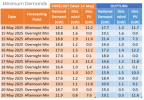
This is last weeks forecast vs outturn for embeded wind and solar. Forecasting is either pretty close or widely apart eg 15/5 PM is nearly a 4GW under performance by solar. That sort of deficit can't be covered by batteries for very long so requires CCGT(gas) to be fired up to deal with it when it extends to hours.

1748370402914.png
This can lead to fossil fuelled power stations required for grid stability but running at low percentage of capacity.
Nuclear also contributes towards inertia needs
 

Nicholas Lewis

Established Member
Joined
9 Aug 2019
Messages
8,031
Location
Surrey
Renewables doing 85% of our energy needs at the moment, to the point we're net exporting and have raw costs as a low as -£28.
That is the merchant power price but not what the windfarm owners actually receive.

Depending on which subsidy regime they are they are on determines how much they actually receive per MWh generated

ROC (Renewable Obligation Certificate) sites get the merchant power price + payout for certificates for MWhr generated. Offshore wind ROC sites actually get two certificates/MWh so with the price in 25/26 at 59/MWh thats 118/MWh plus/minus what they can sell their output for. So below a 100 this afternoon as prices are slightly negative but on a day when gas is setting the price that would be another 70-80 so close to 200/MWh.

CfD (Contract for Difference) work by paying the difference between the strike price and the average price each half hour. Unlike ROCs which are the same price whatever year site was commissioned CfDs strike price was set by delivery year. The strike prices for commissioned offshore wind sites vary from 80-215/MWh. The income a CfD site receives is the difference between the strike price and the reference price for that half hour (basically the day ahead price). If the reference price is positive thats simply strike price - reference price but when reference price is negative as it is this afternoon some generators (AR1/2) only get their strike price but those on AR3 won't get anything if the price is negative for three continuous hours.

So on day like today with high wind and medium solar output but lower summer demand there will be too much generation chasing demand so prices can be forced negative to make sure generators get selected although thats not favourable to AR3 sites and on high wind days we are seeing windfarms voluntarily switch off as they aren't going to give their output away.

The bottom line is the price most consumers are paying isn't going to be negative although you'll be happy if you own a battery site or are on something like Octopus Agile price.
 

brad465

Veteran Member
Joined
11 Aug 2010
Messages
11,521
Location
Taunton or Kent
Currently got circa 80% of our energy coming from all renewables, while also not net importing. The week ahead is also looking at similar wind and sun conditions so should see more of this. Would be good to finally start seeing battery storage usage, I haven't found anywhere with live reporting on when this is charging/discharging, but given it's becoming an increasingly large feature of our grid, this will need to be done promptly.
 

Nicholas Lewis

Established Member
Joined
9 Aug 2019
Messages
8,031
Location
Surrey
Currently got circa 80% of our energy coming from all renewables, while also not net importing. The week ahead is also looking at similar wind and sun conditions so should see more of this. Would be good to finally start seeing battery storage usage, I haven't found anywhere with live reporting on when this is charging/discharging, but given it's becoming an increasingly large feature of our grid, this will need to be done promptly.
Yup that's today but wind production this year is running c15% below last year and that's with more turbines in use so its got a bit of catching up to do. Anyhow with solar we are displacing more and more gas but its already accepted that gas can never be fully displaced and it will need to be held as standby plant. We are also way off levels of battery storage that would be needed to support dark windless days in winter. Existing electrical demand is c1TWh/day in mid winter but if we actually electrify heat and vehicles that will be much higher albeit our deindustrialisation can be said to be helping but only at the expense of offshoring our emissions elsewhere. So battery capacity currently is c8GWh so we have some way to go but by end of decade that should be at 100GWh based on current developments. What the UK needs to do is get on with the pumped storage schemes like Cloire Gas (30GWh) Dinorwic is only 9GWh for comparison.

On live info on batteries many aren't registered in the Balancing Mechanism so don't get captured by the likes of Gridwatch who report them under "Other" on the dashboard but only when they are in export mode. There was an excellent site called bessanalytics.com but a big energy trader spotted what they had produced and paid them for it so its now behind a paywall. As an aside its really lucky that nobody has done the same with Real Time Trains et al sites!!!
 

Ken H

Established Member
Joined
11 Nov 2018
Messages
6,718
Location
N Yorks
So who is paying for the gas installations sitting on spinning standby for the occasions when a cloud covers the sun. This is called 'flexing' and is very bad for old gas turbines.
Also we need electic generated from spinning machines to keep the frequency stable. If we were to lose a generating asset the remaining spinning machines would slow. Static inverters (they convert DC from renewables, batteries and the interconnectors from mainland europe) cant keep the frequency at 50HZ. they will chase the fequency down. Tis happened in 2019 nerly cauign the rid to fail. and something similar happened in Iberia this year.
There are large costs caused by renewabes that are not properly allocated to them.
Read Kathryn Porter on X, LinkedIn, You Tube and in the daily Telegraph. She has higher degrees in physics and business...
The big cloud data servers are looking at their own nuclear power stations to run their operations reliable 24/7 for a reason. Maybe the railway should get one....
 

AndrewE

Established Member
Joined
9 Nov 2015
Messages
7,350
So who is paying for the gas installations sitting on spinning standby for the occasions when a cloud covers the sun. This is called 'flexing' and is very bad for old gas turbines. Also we need electic generated from spinning machines to keep the frequency stable.
You aren't aware of the existence of or the investment going into synchronous condensers then? See e.g. "ABB’s synchronous condensers go live in Liverpool to stabilize the UK’s power grid" https://new.abb.com/news/detail/101...-in-liverpool-to-stabilize-the-uks-power-grid
If we were to lose a generating asset the remaining spinning machines would slow. Static inverters (they convert DC from renewables, batteries and the interconnectors from mainland europe) cant keep the frequency at 50HZ. they will chase the fequency down. Tis happened in 2019 nerly cauign the rid to fail. and something similar happened in Iberia this year.
No it didn't, the company paid to run the grid didn't pay the generators to be on standby, or it did but they took the money and didn't do it. See https://cleantechnica.com/2025/06/18/inside-the-iberian-grid-collapse-what-really-went-wrong
Renewable energy was neither the cause nor the problem, but the incident underscores the urgent need to ensure renewable-rich grids embody robust voltage and frequency management capabilities traditionally provided by synchronous fossil generators. The future, however, clearly belongs to renewables supported by advanced inverter technologies, dynamic voltage stabilization hardware, smart market structures, and robust regulatory frameworks.
There are large costs caused by renewabes that are not properly allocated to them. Read Kathryn Porter
this would be the Katherine Porter, reported elsewhere as " a well known anti-RE propagandist," I presume
on X, LinkedIn, You Tube and in the daily Telegraph. She has higher degrees in physics and business...
and has probably been in the pockets of the fossil fuel industry most of her career, even if she does claim to be an engineer and industry specialist..
 

SynthD

Established Member
Joined
4 Apr 2020
Messages
2,048
Location
UK
Static inverters (they convert DC from renewables, batteries and the interconnectors from mainland europe) cant keep the frequency at 50HZ.
Solar plus wind is still near 80%. As the grid is working now, when will this issue arise?
 

Top