edwin_m
Veteran Member
Which would be very awkward in the event of planned or unplanned closure of one pair of tracks.Or they'd be confined to the Slow lines, with standard platforms on the fast lines.

Which would be very awkward in the event of planned or unplanned closure of one pair of tracks.Or they'd be confined to the Slow lines, with standard platforms on the fast lines.
In view of the various practicalities highlighted by others, the Wessex route seems an unexpected option. Perhaps the GW main line might have offered more attractive possibilities, capitalising on the loading gauge generosity inherited from the broad gauge (if much of this still exists). The GC London Extension might have offered an even more favourable route had it still been available. Oh the benefits of hindsight!Paul Maynard MP (then junior transport minister for rail) answered a written commons question about this subject (increasing capacity in general and and using DD trains in particular) on 22 November 2016:
This first document is the most relevant to this thread, as it is a reasonably thorough feasibility study. Its main conclusion is:
The second does not consider DD trains, it just reports that previous studies rejected the ideas as impractical. The third link no longer works, but it must be the 2015 Wessex Route Study. I have a draft copy of that, and this is the final version (substantially rewritten).
The Wessex route option proposed was for double deck trains too big for the existing gauge to run Basingstoke-Waterloo only, with infrastructure work to allow them to fit. An interesting idea, of which NR concluded:
I find it odd that they are so positive.
The GC being "continental" gauge is essentially an enthusiast myth. While the loading gauge on ex-GWR routes is often a bit larger, this isn't true of platforms which are one of the two main factors for double deck stock. The other factor is overall height, and I don't believe broad gauge trains were significantly higher.In view of the various practicalities highlighted by others, the Wessex route seems an unexpected option. Perhaps the GW main line might have offered more attractive possibilities, capitalising on the loading gauge generosity inherited from the broad gauge (if much of this still exists). The GC London Extension might have offered an even more favourable route had it still been available. Oh the benefits of hindsight!
Fundamentally the idea wasn't pursued because nothing was as effective for getting people on and off trains quickly as giving every ten of them their own door.
Ten! Luxury. You could get seventeen or eighteen in a 4-SUB or 4-EPB compartment, probably more on occasions.

The 4DD concept was aimed at continuing to operate trains of just eight coaches length and although the two prototype units remained in traffic until 1971 no production series followed. Instead, on the South Eastern Division platform lengths were extended for ten car operation by EPB stock.
…in December 1950 it was decreed that the 4DD Class would not go beyond two units. Instead, the expensive platform lengthening exercise was pursued after all, combined with a procurement of new electric multiple units. Platform lengthening occurred along Bexleyheath, Sidcup, and Woolwich lines in 1954, 1955, and 1957 respectively. New EMU stock in the form of 2-EPB and 4-EPB units was delivered to Central, South Western, and South Eastern Divisions from 1951 onwards, the fleet forming part of the ten-car train scheme on the latter.
12 seated in the older EPB/SUB closed compartments, 6 a side on the long benches!
Wasn’t the upshot of the 4-DD trial the lengthening of platforms to 10 cars on the Dartford/N Kent lines? See for example http://extra.southernelectric.org.uk/features/historical-features/seginfohistory3.html
and https://www.kentrail.org.uk/Bulleid_4DD.htm

Which one must admit was a success at the time!I believe it was a factor as to why BR opted for the ten car train scheme.

Which one must admit was a success at the time!
I shudder to think how things might have turned out if the 4DD concept was rolled out for "double-deck" EPBs and their derivatives. Longer trains and extending platforms made more sense.
The overloading through London Bridge was indeed why different schemes were attempted. A particular issue was morning peak overloading at London Bridge on the last stretch to Cannon Street, from those changing there. It was particularly pronounced at the west end, to be first off at Cannon Street. The line was at maximum capacity and extended dwell times in loading were key. Not nearly such an issue at Cannon Street in the evening peak return, which could be controlled by entry gates to each platform.I believe it was a factor as to why BR opted for the ten car train scheme.
Indeed. UIC Gauge GC is just the name of the gauge bigger than GB and smaller than GD. The G stands for gauge (or whatever the French equivalent is)The GCR being "continental" gauge is essentially an enthusiast myth.
Gabarit apparently. See https://shop.uic.org/en/50-general-...abarits-agrandis-ga-gb-gb1-gb2-gc-et-gi3.htmlThe G stands for gauge (or whatever the French equivalent is)
Règles pour l'application des gabarits agrandis GA, GB, GB1, GB2, GC et GI3
The overloading through London Bridge was indeed why different schemes were attempted. A particular issue was morning peak overloading at London Bridge on the last stretch to Cannon Street, from those changing there. It was particularly pronounced at the west end, to be first off at Cannon Street. The line was at maximum capacity and extended dwell times in loading were key. Not nearly such an issue at Cannon Street in the evening peak return, which could be controlled by entry gates to each platform.
The DD units were in truth not really double deck at all, they just had some seats in each compartment up a few steps. Having open saloons instead of full compartments was a better, and less claustrophobic, solution; there wasn't much seating actually 6-across anyway on the bench seats.
The 10-car scheme with new EPB units was part of the SE division upgrade and overall Kent electrification, including 750V third rail supply across the division, which the older SUB and other pre-war units built for 650V could not handle.
For a thread on double decks, pun intended?Interesting detail. The ten car train scheme has to go down as one of BR's resounding success storeys.
so HS2 is UIC GC, except for the platforms? Hopefully the platforms don't foul the UIC GC profile?AIUI All HS2 platforms will be built for UK-Sized trains so although they have the additional vertical clearances the trains won't be any wider in the lower part of the profile. Standard UIC Gauge trains thus won't fit even captive to HS2.
The only trains on the UK HS network that didn't, at the time of procurement, need to run on the regular UK network are the 374s, and they are high-capacity trains with 900 seats anyway, so I guess eurostar didn't see the need to go double-decker at that pointHS1 and HS2 could take double-deck designs as used on SNCF's LGVs, for stock that is captive to HS routes in the UK.
But for various reasons the procurers have gone with lighter single-deck designs.
In HS2's case it is because the trains need to run through on to classic NR infrastructure.
My understanding is that the platforms will foul the UIC profile due to the maximum permitted stepping distance to standard NR profile trains. Not sure if HS2 is UIC-GB+ or GC.so HS2 is UIC GC, except for the platforms? Hopefully the platforms don't foul the UIC GC profile?
AIUI the platform height (1,100mm or 1,200mm) has been specified for step-free boarding.I already thought it was odd that HS2 followed none of the mainland europe standard platform heights (550 and 760 mm), nor the UK standard platform height (915mm), but this is another reason it is increasingly odd.
Double-decker may have also impacted on Eurostar's evacuation plan sign-off for the Channel Tunnel.The only trains on the UK HS network that didn't, at the time of procurement, need to run on the regular UK network are the 374s, and they are high-capacity trains with 900 seats anyway, so I guess eurostar didn't see the need to go double-decker at that point
Here's me hoping the platforms will be build in a way that at least allows that to be changed later on for an affordable price.My understanding is that the platforms will foul the UIC profile due to the maximum permitted stepping distance to standard NR profile trains. Not sure if HS2 is UIC-GB+ or GC.
which should have been done at 915mm (or 760/550, but 915 makes more sense as that is where the standard UK platforms sit), with a gap-filler to meet the platform that is further away from the railsAIUI the platform height (1,100mm or 1,200mm) has been specified for step-free boarding.
That makes a lot of senseDouble-decker may have also impacted on Eurostar's evacuation plan sign-off for the Channel Tunnel.
In view of the various practicalities highlighted by others, the Wessex route seems an unexpected option. Perhaps the GW main line might have offered more attractive possibilities, capitalising on the loading gauge generosity inherited from the broad gauge (if much of this still exists). The GC London Extension might have offered an even more favourable route had it still been available. Oh the benefits of hindsight!
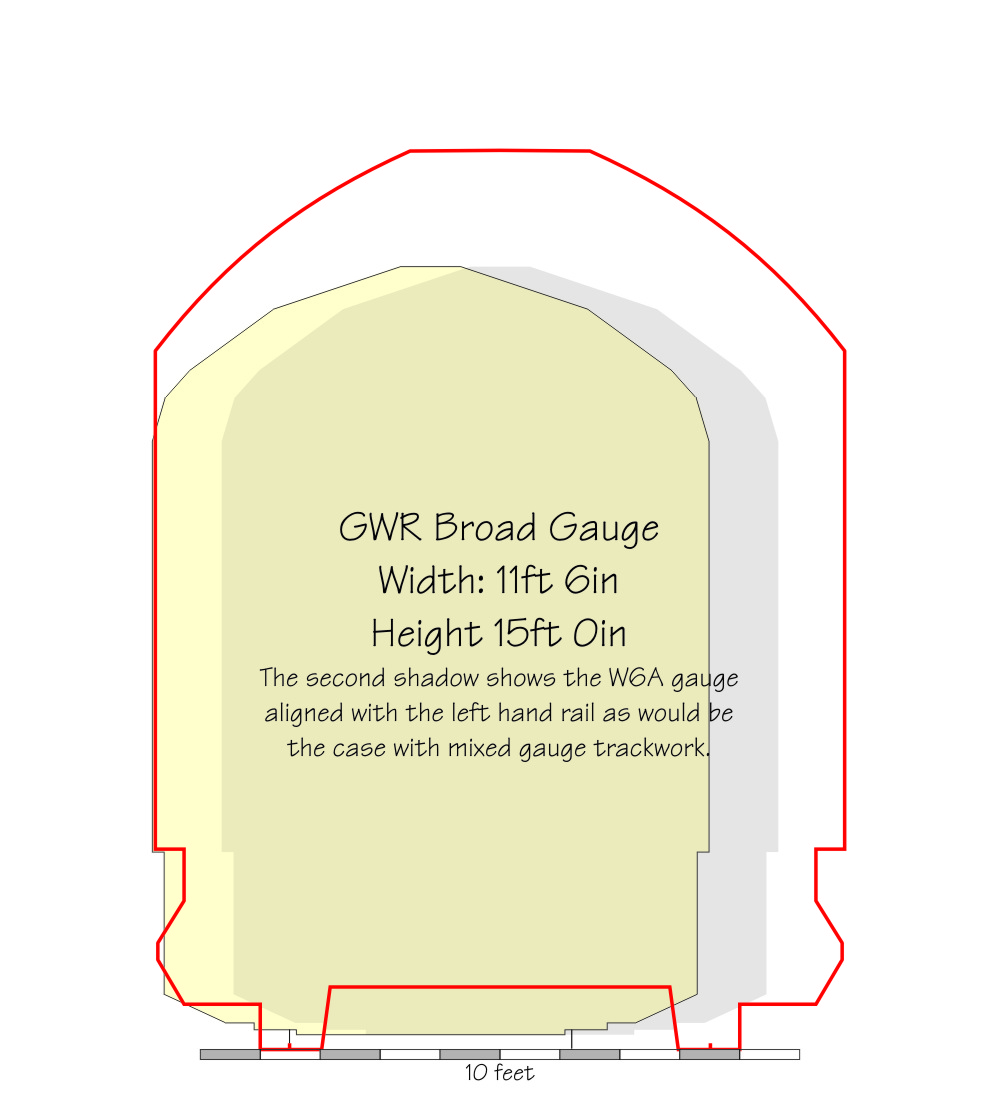

For former GWR steam locomotives which ran onto other former company lines in BR days, sometimes unauthorised, the principal issue was the cylinders of the larger 2-cylinder types, which might graze (hopefully no more) platform edges. Width rather than height was the issue.While the original GW loading gauge was pretty large ( 15' vertically is about 13" more than anyone else & more like 18" on average ), the vertical clearance didn't seem to survive - and I think unmodified GW steam engines are out of gauge vertically even on GW lines these days. The GW standard gauge envelope ( which would cover lines built by absorbed standard gauge companies ) was smaller than the Midland one, although that won't cover routes with their own clearances.
Those cylinders could be problematic on home turf too. Do the cutaways in the platform edges at Worcester Shrub Hill, made to provide clearance for locos using the mid-platform scissors crossovers, still exist?For former GWR steam locomotives which ran onto other former company lines in BR days, sometimes unauthorised, the principal issue was the cylinders of the larger 2-cylinder types, which might graze (hopefully no more) platform edges. Width rather than height was the issue.

I travelled home on this train for a few months shortly before it was withdrawn from the Cannon Street-Dartford route. Always sat on the lower deck and don't recollect it getting too busy as it ran at the beginning of the rush hour. An interesting experience though.Fascinating piece of archive film. Imagine that crush-loaded, doesn’t bear thinking about. The poor standees downstairs would be amongst the knees of those on the stairs…
ISTR the timetabling carefully avoided the height of the peakI travelled home on this train for a few months shortly before it was withdrawn from the Cannon Street-Dartford route. Always sat on the lower deck and don't recollect it getting too busy as it ran at the beginning of the rush hour. An interesting experience though.
For former GWR steam locomotives which ran onto other former company lines in BR days, sometimes unauthorised, the principal issue was the cylinders of the larger 2-cylinder types, which might graze (hopefully no more) platform edges. Width rather than height was the issue.

King George V did once strike the overbridge outside Paddington after some reballasting, and the safety valve cover was sheared off. Another member here was party to the repairs at Old Oak Common and has described it.
One of the over bridges around Salford Crescent, I think. 5972 Olton Hall had a bit of a ding with the concave platform edge at Carlisle at around the same time.I recall it also happened more recently to 6201 Princess Elizabeth somewhere near Manchester although that was due to a tamping error rather than lack of monitoring.


