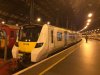
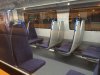
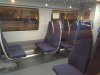
I think the best way to sum up the Class 700 is as having been specified and designed by a group of people who'll never have to use them on a daily basis.
Probably true for most trains.
Certain contributors to this thread can try to put positive spin on the lowering of facilities, but whichever way it is looked at, it is clear that the designers became obsessed with the perceived need to ram as many trains through The Core during peak hours as possible. For these people, Thameslink runs only between St Pancras and Blackfriars/London Bridge.
If you are including my posts then you need to read all of them in context. The planned capacity for the core is based on the expected demand over the next three decades. No responsible person would commit over £6BN on a scheme that just looked at the current situation and added a bit for luck. Given the surveyed need and predictions that nobody here has offered any valid facts to dispute their validity, the task is to develop the existing infrastructure and provide new rolling stock that can deliver that. As I have said, in the real world of capital and service provision budgets, public funds are unsurprisingly limited.
Whilst those whose posts here seem to complaining that their lot might get worse so the planners (whoever they are) have got it totally wrong, there are others to consider here. Saying (or maybe praying) that it will all go wrong just to be able to say "told you so" is just not helpful to any discussion.
Despite those connected with the project giving examples of measures specifically included in the class 700s to minimise the impact of failure, et al, some here continue to invent scenarios that might cause a systematic breakdown. It seems to me that as many of those issues as could be statistically expected to arise have been considerdd in the specification and design stage.
The trains are in full manufacture and delivery and will deployed soon so really there is no chance of them being sent back for anything other than critical safety, performance or reliability issues..
It is nice to read how many thousands of £s Siemens will pay GTR if one of their trains fails in service. How does this arrangement incentivise GTR to try to run a train, when by declaring it a failure they can pocket the cash?
I doubt that Siemens would be daft enough to just pay up on GTR finger trouble, carelessness or misreporting faults. Such user behaviour would be subject to a claim of contractual breach by GTR.
GTR should be forced by law to pass on such penalty payments direct to season ticket holders in direct proportion to the cost of their annual or monthly tickets, by direct credit, straight into their bank accounts. In the same way, season ticket holders shouldn't be forced to go through the bureaucratic "Delay Repay" farce that exists at the moment. Performance below the standard set in the franchise should result in season ticket holders being either reimbursed direct in cash or have the option of extending the validity of their tickets by the appropriate number of days. For example, when GTR fails to deliver an adequate level of service, DfT should declare the whole day as a "default day" for all season ticket holders. This day (or days) could then be added to the validity term of the ticket.
Season ticket holders should be treated the same as any other traveller. A delay or a cancellation affects all travellers equally, so even those who don't get the significant discount on their Anytime travel that season ticket holders do should benefit equally from any recompense.
--- old post above --- --- new post below ---
I was referring more to my impression of your general attitude to how passengers should be treated rather than specifically the table issue. In any case, the number of commuters travelling to London by car greatly outweighs the number by train, so the railways really had better watch how they treat their passengers.
My posts are about the way it is. I don't expect my travel from the busiest Thameslink station on the line to be luxurious, - just more reliable which I hope will be so. The number of passengers travelling to central London far outweighs those driving there. Most of the drivers clogging up the approaches to London through the suburbs do not drive into the congestion zone.
By way of contrast to much railway thinking, the bus industry, hardly an shining example of excellent customer service itself, responded to requests for free WiFi by fitting it and fitting it extensively, rather than moaning and whinging about how it would be all too difficult/expensive.
Buses are in competition with each other where most rail route don't have any competition at all, except when tendering. It's a commercial decision.
Regarding tables and armrests, I have yet to read one coherent explanation as to how their inclusion would slow down dwell times. TfL have specified armrest throughout (ie including transverse seats) on Class 345s, so these experts at mass urban transit clearly don't consider it's such an issue.
I has been explained here, - not by me though (I believe in the Class 700 original thread).