• Our new ticketing site is now live! Using either this or the original site (both powered by TrainSplit) helps support the running of the forum with every ticket purchase! Find out more and ask any questions/give us feedback in this thread!

Thameslink/ Class 700 Progress

Status
Not open for further replies.

petersi

Member
Joined
24 Apr 2012
Messages
453
The platform a St Pancras low level are quite wide crowding may well only be a problem in times of disruption

I agree the gate line is two short and I can believe the station will not cope. As it seams to struggle at times even now

But this is not a discussion for this thread as this is for the rolling stock
 
Last edited:
Sponsor Post - registered members do not see these adverts; click here to register, or click here to log in
R

RailUK Forums

asylumxl

Established Member
Joined
12 Feb 2009
Messages
4,260
Location
Hiding in your shadow
The platform a St Pancras low level are quite wide crowding may well only be a problem in times of disruption

I agree the gate line is two short and I can believe the station will not cope. As it seams to struggle at times even now

But this is not a discussion for this thread as this is for the rolling stock

Despite their width, the platforms struggle when there is disruption in peak as it is. Add in the GN passengers and it's going to be snug to say the least. Forget about having standing space on the trains, you'll have trouble on the platform and be squished tightly against a stranger on the platform. [emoji14]

Then of course there's the issue of the escalators. Whomever designed the low level station felt one escalator in each direction for each platform would be enough. Current usage would indicate it isn't enough even now

I do feel this is relevant to discussion about the rolling stock, as people are concerned about the effect a failure will have. While they may have high levels of redundancy and modularisation, they're still machines at the end of the day and can go wrong. I'm predicting one will fail on their first day of service.
 

JaJaWa

Established Member
Joined
14 Feb 2013
Messages
1,730
Location
They are not class 700s any more than the new SWT 5-car sets are. They are all Siemens Desiro City trains in various customer specified versions. Trains are modular in construction so that the customer can specify what they need. Trains like those used on the Moorgate services and the class 707 metro stock on order for services running out of Waterloo don't need toilets.

The Great Northern version are Class 700.
The South West Trains version are Class 707.
 

jon0844

Veteran Member
Joined
1 Feb 2009
Messages
30,846
Location
UK
Don't forget the lifts at St Pancras low level. Especially the one serving three floors.

I'd argue that they regulate flows but in practice they just encourage people to take large bags and buggies in those escalators.
 
Last edited:

swt_passenger

Veteran Member
Joined
7 Apr 2010
Messages
34,237
The Great Northern version are Class 700.

You cannot really state that with any 100% certainty. Recent announcements have used the phrase 'class 700 variants' for the GN units.

If you go back to 2014 this is how the SWT units (now known as 707s) were announced, well before 707 was ever mentioned:

"The Desiro City EMUs would be ‘similar in style to the Class 700 units being produced for the Thameslink route’."
 

AM9

Veteran Member
Joined
13 May 2014
Messages
16,019
Location
St Albans
Don't forget the lifts at St Pancras low level. Especially the one serving three floors.

Which are painfully slow. It's quite funny to see passengers thinking that they are dodging the queues at the escalators by usng the lifts that are best left for those with accessibilty issues. They stand in the lift fuming at its pedestrian pace and then sprint away when the doors open.
--- old post above --- --- new post below ---
I do have concerns about the suitability of St Pancras Low Level station once the GN trains start running through.

Now, I know that the whole Thameslink programme is meant to see big changes to the places where people change from national rail to the underground - so for many it'll make sense to change for to the Metropolitan/Circle/H&C at Farringdon rather than St Pancras, for example, but for many (particularly off-peak 'tourists') it'll take years for them to realise this and I suspect the majority will continue to change at St Pancras out of habit. ...

Not forgetting the enourmous impact of Crossrail of couse which will raise the profile of Farringdon as an interchange stop in about 3 years, - unless its current 'odd' status of not being a 'London Terminal' isn't fixed by then.
 
Last edited:

jon0844

Veteran Member
Joined
1 Feb 2009
Messages
30,846
Location
UK
Another thing St Pancras low level needs is better toilets. Now you've gone through the gates and have to use one well hidden and often left-in-a-horrid-stats accessible toilet.

I've seen the toilets so dirty you'd only go if you were absolutely desperate, or closed because staff were told or noticed. Either way, a lot of people really better make sure they go upstairs!

Apologies that this is off topic, although it is related. To get back on, I'd say the GN 700s to Moorgate will definitely have their own sub class. That has to be a definite given the different layout and lack of toilets.
 

Goldfish62

Veteran Member
Joined
14 Feb 2010
Messages
13,129
So all those passengers on Thameslink will drive to London? I don't think so given that the new trains, the service, the signalling and the platform extensions are being geared to handle the ever increasing demand for capacity.
The 700s are table free (in standard class) to:
a) keep the weight to a minmimum, as explained in an earlier post
and
b) keep dwell times within reasonable limits which is critical in the core

In 5-10 years time, Thameslink will be carrying far more passengers than at present, - those passengers may not all have seats, tables, cup holders, perfect views out of the windows etc,, but they will actually be able to get on the trains and stand in comfort and safety, to complete their journey in as little time as can be expected.
Don't forget, the purpose of a high density railway is to carry the required number of passengers safely within whatever limitations the infrastructure has, not give a few passengers more comfort at the expense of others not being able to board overloaded trains.

If, after reading the detailed reasons why tables et al are not included, you have any better (affordable) solutions for the route, please share them on this thread. I would be interested to read them.

I was referring more to my impression of your general attitude to how passengers should be treated rather than specifically the table issue. In any case, the number of commuters travelling to London by car greatly outweighs the number by train, so the railways really had better watch how they treat their passengers.

By way of contrast to much railway thinking, the bus industry, hardly an shining example of excellent customer service itself, responded to requests for free WiFi by fitting it and fitting it extensively, rather than moaning and whinging about how it would be all too difficult/expensive.

Regarding tables and armrests, I have yet to read one coherent explanation as to how their inclusion would slow down dwell times. TfL have specified armrest throughout (ie including transverse seats) on Class 345s, so these experts at mass urban transit clearly don't consider it's such an issue.

On the weight issue, if indeed that is one of the reasons for lack of tables, the Fainsa seats have backs that are above the laid down minimum height, so reducing the height would save weight which would then be available to install seat-back tables.
 
Joined
24 Mar 2009
Messages
592
I think the best way to sum up the Class 700 is as having been specified and designed by a group of people who'll never have to use them on a daily basis.

The trains have been specified down to the lowest tender price with passenger accommodation being the least important criteria. The trains are leased from Cross London Trains (XLT) consisting of Siemens Project Ventures, 3i Infrastructure and Innisfree based on the tender issued by DfT. A National Audit Office report questioned the DfT's attempt to take leadership in the project, contrary to general policy, without any prior experience of large-scale rolling stock procurement.

Certain contributors to this thread can try to put positive spin on the lowering of facilities, but whichever way it is looked at, it is clear that the designers became obsessed with the perceived need to ram as many trains through The Core during peak hours as possible. For these people, Thameslink runs only between St Pancras and Blackfriars/London Bridge.

It is nice to read how many thousands of £s Siemens will pay GTR if one of their trains fails in service. How does this arrangement incentivise GTR to try to run a train, when by declaring it a failure they can pocket the cash?

GTR should be forced by law to pass on such penalty payments direct to season ticket holders in direct proportion to the cost of their annual or monthly tickets, by direct credit, straight into their bank accounts. In the same way, season ticket holders shouldn't be forced to go through the bureaucratic "Delay Repay" farce that exists at the moment. Performance below the standard set in the franchise should result in season ticket holders being either reimbursed direct in cash or have the option of extending the validity of their tickets by the appropriate number of days. For example, when GTR fails to deliver an adequate level of service, DfT should declare the whole day as a "default day" for all season ticket holders. This day (or days) could then be added to the validity term of the ticket.
 

jon0844

Veteran Member
Joined
1 Feb 2009
Messages
30,846
Location
UK
Do more people really commute into London by car than train, tube, bus etc?
 

radamfi

Established Member
Joined
29 Oct 2009
Messages
9,267
Do more people really commute into London by car than train, tube, bus etc?

To central London car is only a small player. But for commuting trips within outer London and between outer London and further out, car is probably the main mode.
 

AM9

Veteran Member
Joined
13 May 2014
Messages
16,019
Location
St Albans
I think the best way to sum up the Class 700 is as having been specified and designed by a group of people who'll never have to use them on a daily basis.

Probably true for most trains.

Certain contributors to this thread can try to put positive spin on the lowering of facilities, but whichever way it is looked at, it is clear that the designers became obsessed with the perceived need to ram as many trains through The Core during peak hours as possible. For these people, Thameslink runs only between St Pancras and Blackfriars/London Bridge.

If you are including my posts then you need to read all of them in context. The planned capacity for the core is based on the expected demand over the next three decades. No responsible person would commit over £6BN on a scheme that just looked at the current situation and added a bit for luck. Given the surveyed need and predictions that nobody here has offered any valid facts to dispute their validity, the task is to develop the existing infrastructure and provide new rolling stock that can deliver that. As I have said, in the real world of capital and service provision budgets, public funds are unsurprisingly limited.
Whilst those whose posts here seem to complaining that their lot might get worse so the planners (whoever they are) have got it totally wrong, there are others to consider here. Saying (or maybe praying) that it will all go wrong just to be able to say "told you so" is just not helpful to any discussion.
Despite those connected with the project giving examples of measures specifically included in the class 700s to minimise the impact of failure, et al, some here continue to invent scenarios that might cause a systematic breakdown. It seems to me that as many of those issues as could be statistically expected to arise have been considerdd in the specification and design stage.
The trains are in full manufacture and delivery and will deployed soon so really there is no chance of them being sent back for anything other than critical safety, performance or reliability issues..

It is nice to read how many thousands of £s Siemens will pay GTR if one of their trains fails in service. How does this arrangement incentivise GTR to try to run a train, when by declaring it a failure they can pocket the cash?

I doubt that Siemens would be daft enough to just pay up on GTR finger trouble, carelessness or misreporting faults. Such user behaviour would be subject to a claim of contractual breach by GTR.

GTR should be forced by law to pass on such penalty payments direct to season ticket holders in direct proportion to the cost of their annual or monthly tickets, by direct credit, straight into their bank accounts. In the same way, season ticket holders shouldn't be forced to go through the bureaucratic "Delay Repay" farce that exists at the moment. Performance below the standard set in the franchise should result in season ticket holders being either reimbursed direct in cash or have the option of extending the validity of their tickets by the appropriate number of days. For example, when GTR fails to deliver an adequate level of service, DfT should declare the whole day as a "default day" for all season ticket holders. This day (or days) could then be added to the validity term of the ticket.

Season ticket holders should be treated the same as any other traveller. A delay or a cancellation affects all travellers equally, so even those who don't get the significant discount on their Anytime travel that season ticket holders do should benefit equally from any recompense.
--- old post above --- --- new post below ---
I was referring more to my impression of your general attitude to how passengers should be treated rather than specifically the table issue. In any case, the number of commuters travelling to London by car greatly outweighs the number by train, so the railways really had better watch how they treat their passengers.

My posts are about the way it is. I don't expect my travel from the busiest Thameslink station on the line to be luxurious, - just more reliable which I hope will be so. The number of passengers travelling to central London far outweighs those driving there. Most of the drivers clogging up the approaches to London through the suburbs do not drive into the congestion zone.

By way of contrast to much railway thinking, the bus industry, hardly an shining example of excellent customer service itself, responded to requests for free WiFi by fitting it and fitting it extensively, rather than moaning and whinging about how it would be all too difficult/expensive.

Buses are in competition with each other where most rail route don't have any competition at all, except when tendering. It's a commercial decision.

Regarding tables and armrests, I have yet to read one coherent explanation as to how their inclusion would slow down dwell times. TfL have specified armrest throughout (ie including transverse seats) on Class 345s, so these experts at mass urban transit clearly don't consider it's such an issue.

I has been explained here, - not by me though (I believe in the Class 700 original thread).

 
Joined
24 Mar 2009
Messages
592
I accept that an annual season ticket offers travel at a discount compared to purchasing a ticket each time I want to use the train. However, GTR has the use of my £5,172 straight away, even if I don't put them to the trouble of having to take me into London and home again each day. So I think that I and my fellow annual season ticket holders deserve to be treated with a bit more respect than we get at present. I have to earn £6,206 in salary (not taking into account NI) over the year, just to pay GTR for the privilege of warming one of their (increasingly less comfortable) seats.
 

southern442

Established Member
Joined
20 May 2013
Messages
2,266
Location
Surrey
Buses are in competition with each other where most rail route don't have any competition at all, except when tendering. It's a commercial decision.

The rail network is at competition from other modes of transport, such as air (not a good example for this situation) and coaches. I know lots of people that would get the train but choose to take buses or coaches instead because of several reasons, some of those including cost and comfort. A coach into London is far cheaper (and more comfortable when the 700's come in) than a train.

I has been explained here, - not by me though (I believe in the Class 700 original thread).

Could you explain it to us now? Or quote somewhere where it is explained?
 

Hadders

Veteran Member
Associate Staff
Senior Fares Advisor
Joined
27 Apr 2011
Messages
18,107
GTR should be forced by law to pass on such penalty payments direct to season ticket holders in direct proportion to the cost of their annual or monthly tickets, by direct credit, straight into their bank accounts. In the same way, season ticket holders shouldn't be forced to go through the bureaucratic "Delay Repay" farce that exists at the moment. Performance below the standard set in the franchise should result in season ticket holders being either reimbursed direct in cash or have the option of extending the validity of their tickets by the appropriate number of days. For example, when GTR fails to deliver an adequate level of service, DfT should declare the whole day as a "default day" for all season ticket holders. This day (or days) could then be added to the validity term of the ticket.

Season ticket holders are important but remember they generally pay less than the off-peak fare!

The people who pay the highest fares are those that travel in the peak on an occasional basis and have to pay the full Anytime fare.
 

D365

Veteran Member
Joined
29 Jun 2012
Messages
13,159
The people who pay the highest fares are those that travel in the peak on an occasional basis and have to pay the full Anytime fare.

Or if one travels irregularly, e.g. less than four days during a regular week.
 

Class377/5

Established Member
Joined
19 Jun 2010
Messages
5,594
I think the best way to sum up the Class 700 is as having been specified and designed by a group of people who'll never have to use them on a daily basis.

Not true actually.

The trains have been specified down to the lowest tender price with passenger accommodation being the least important criteria. The trains are leased from Cross London Trains (XLT) consisting of Siemens Project Ventures, 3i Infrastructure and Innisfree based on the tender issued by DfT. A National Audit Office report questioned the DfT's attempt to take leadership in the project, contrary to general policy, without any prior experience of large-scale rolling stock procurement.

Actually not true. The designers had to show 1,000 people moving on/off within the dwell times. Use of tables decreases this, look at how many people only start getting ready once the train has stopped and doors are open.

This was all researched and checked prior to tenders coming on. Again people on here are obsessed with the current situation and not the next 30 years which is what the TLP is attempting to deal with. Numbers are only increasing and there hasn't been a single idea proposed by anyone that actually deals with 2040 traffic level for the growth predicted.

Certain contributors to this thread can try to put positive spin on the lowering of facilities, but whichever way it is looked at, it is clear that the designers became obsessed with the perceived need to ram as many trains through The Core during peak hours as possible. For these people, Thameslink runs only between St Pancras and Blackfriars/London Bridge.

That's because the issue is rising passenger numbers. Seems to be ignoring the fact that there are more seats in the peak overall (St Albans is about 40% increase in seats alone, that massive plus the extra standing capacity) as well as more standing space. Ok all routes don't get a seat increase but those routes are already struggling with 12 cars and lack of paths to increase service. Its quite easy to complain but what are people's actual real alternative plans?

It is nice to read how many thousands of £s Siemens will pay GTR if one of their trains fails in service. How does this arrangement incentivise GTR to try to run a train, when by declaring it a failure they can pocket the cash?

Again no true. GTR do not keep any of the money generated. Its a management contract meaning they hand over everything to the DfT then get a set sum with performance and standards having an affect on that. Any money GTR gets goes straight to the DfT.

There are set rules rules on what is a failure with every incident being looked at and explained.

GTR should be forced by law to pass on such penalty payments direct to season ticket holders in direct proportion to the cost of their annual or monthly tickets, by direct credit, straight into their bank accounts. In the same way, season ticket holders shouldn't be forced to go through the bureaucratic "Delay Repay" farce that exists at the moment. Performance below the standard set in the franchise should result in season ticket holders being either reimbursed direct in cash or have the option of extending the validity of their tickets by the appropriate number of days. For example, when GTR fails to deliver an adequate level of service, DfT should declare the whole day as a "default day" for all season ticket holders. This day (or days) could then be added to the validity term of the ticket.

Er as far as I'm aware you can get most of this. There's no automatic refund as the DfT didn't want the franchise to do it. It believed that they had enough to deal with the TLP and day to day running.

However your issues with DfT and GTR in general are starting to go off topic which is the units themselves not the operators of them.
 

Goldfish62

Veteran Member
Joined
14 Feb 2010
Messages
13,129
Do more people really commute into London by car than train, tube, bus etc?

Now, I didn't actually say that. I was referring to rail only, which is a comparatively small player, accounting for just 9% of journeys to / from and within London. Car is about 35‰.
 

physics34

Established Member
Joined
1 Dec 2013
Messages
4,083
The table issue is as has been said related to weight. Anything that is fitted to the train is carried for the life of the train. The cost is more to do with the additional track charges and the cost of additional maintenance of the core infrastructure, (see post #2114).
Wi-fi is notheing to do with tables or the seat types. There is a government call for universal wi-fi installation in trains and it adds very little weight to the trains so doesn't impact on the core maintenance issue.

just cannot see why the weight if tables is an issue when they want to squeeze as many people on to the train as possible, its not as if a table weight 600kilos!

Seems barmy to me!

Should the track charges be altered based on a few extra passengers on the train too - adding to the weight - in that case?!
 

Class377/5

Established Member
Joined
19 Jun 2010
Messages
5,594
Getting back to the actual point of this thread, 700106 and 700108 will be out tonight.
 

IrishDave

Member
Joined
30 Jun 2009
Messages
471
Location
Brighton
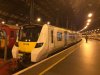
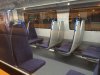
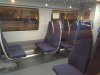
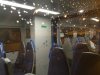
700108 was indeed out tonight - and it happened to be sat at Brighton precisely when I arrived back there at 2323. I haven't had a chance to check through the thread for other pictures, but I managed to grab a few internal pictures, so here they are. Sorry for the rain on the windows!

The internal photos are all of the second carriage from the buffer stops (one of the PTOSL, I didn't get the number) - the seats in the carriage nearest the buffer stops were still wrapped in plastic. The lack of armrests and tables I can (just about) understand, but the lack of plug sockets still baffles me. At least the gangways are full-width like the 378s.
 

Attachments

  • IMG_3040r.jpg
    IMG_3040r.jpg
    127.3 KB · Views: 184
  • IMG_3041r.jpg
    IMG_3041r.jpg
    138.7 KB · Views: 210
  • IMG_3043r.jpg
    IMG_3043r.jpg
    123.9 KB · Views: 192
  • IMG_3046r.jpg
    IMG_3046r.jpg
    110.8 KB · Views: 216

Class377/5

Established Member
Joined
19 Jun 2010
Messages
5,594
First night of testing of 2016 saw three units out all doing thier own thing last night working the following...

700106
5X01 22+04 Three Bridges Up Depot to Bedford
5X02 00+30 Bedford to Brighton
5X03 03+10 Brighton to Three Bridges Up Depot

700107
5X16 00+33 Three Bridges Up Depot to West Hampstead
5X17 02+47 West Hampstead to Three Bridges

700108
5X90 22+44 Three Bridges Up Depot to Brighton
5X91 23+32 Brighton to Three Bridges
5X92 00+17 Three Bridges to Brighton
5X93 00+58 Brighton to Three Bridges
5X94 01+44 Three Bridges to Brighton
5X95 02+57 Brighton to Haywards Heath
5X96 03+24 Haywards Heath to Brighton
5X97 03+56 Brighton to Three Bridges
5X98 04+42 Three Bridges to Brighton
5X01 05+26 Brighton to Three Bridges Up Depot
 
Status
Not open for further replies.

Top