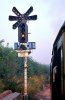
The situation has become somewhat complicated with regards to the arrangements applied at signals which had routes recovered from them.
In BR/Railtrack days, there were two situations, either a full recovery of the interlocking and lineside equipment or what was known as a partial recovery.
A partial recovery itself had the option for what was known as "minimal recoveries".
Historically it was a requirement that all route indicators, redundant signal arms, stencil indicators, and other similar equipment was removed from each signal when a route was recovered. The redundant equipment in the interlocking was also recovered.
Without going into details, there are occasions when it is not desirable to go into an operational interlocking and undertake a full recovery of all the equipmentand therefore what is known as a partial recovery is undertaken. This would normally involve all redundant equipment from the signal being removed, together with the immediate operational relays, etc.
Where this is not desirable, we had a minimal recoveries strategy which in addition to the recovery of the lineside signal equipment, consisted of the minimal recovery of the control equipment. Mostly this consisted of recovering tail cables from the location cases to the equipment and then implementing a number of alterations to the wiring in those locations cases, which fed back only "normal" indications to the interlocking. Thus there was no need to alter the interlocking.
Whilst it was always the norm to always recover the physical signalling equipment visible to the Driver, this appears to have lapsed since Network Rail took over, so that we now have signals with junction indicators, stencils, etc which remain on the signal head although the track is no longer there.
Whilst this is not desirable, of course there is no Standard that I am aware prohibits this, and of course because Network Rail write those Standards I rather much doubt there will be one.
What has complicated signalling has been the signal sighting changes that have arisen following the Ladbroke Grove Collision. Now anyone in their right mind would not consider that an OHL contact wire or registration arm passing across the line of sight of a Driver for a fleeting part of a second would (a) be the source of a distraction, and (b) cause the Driver to miss the signal :roll:
That is of course unless you are a member of the Judiciary or a reptile seeking a quick headline.
Following the Ladbroke Grove Inquiry, we as an Industry received yet another series of completely irrelevant and pointless "Recommendations" most of which have conspired to make the Railway less safe because infrastructure alterations and improvements are made so complex and have so many irrelevant requirements as to make even the most basic of changes a strategic and logistical nightmare.
For example we hae all seen the massive increase in banner repeaters, especially on the WCML ?
Well the original purpose of a banner repeater was to give the Driver an early warning that the signal was OFF. We now have the ridiculous situation where banner repeaters are treated completely the opposite, in that the On position needs to be sighted to the same standard as the main aspect :roll:
This is despite the fact that the train will already be preparing to stop and thus running sufficiently slow. From a Driver's point of view a banner adds nothing to his stopping but means everything to allowing him to apply power if the signal has cleared as he approaches. Thus the banner has absolutely nothing to do with controlling the train to a stand. The Driver will know the position of the signal and if he needs to sight the banner in order to work out where the main signal is then God help us all.
The big issue is that because of these ridiculous sighting rules, signals which have existed for years and have never incurred an SPAD, suddenly become high risk signals when an alteration is required, and the sighting rules require the signal to be relocated, and thus we have an exponentially increasing number of signals that require work rather than just the one signal.
So today and ad infinitum the signal is perfectly safe under existing rules and will probably never inbcur a SPAD but as soon as for example you want to do a small modification to it, a full signal sighting process has to be applied, and of course invariably practically every signal will fail the "new" rules, which then suggest that trains will be SPADding by the minute.
In electrified areas there may well be the need to change OHL strucures and equipment as well, even though the signal may be perfectly fine, simply because of the rules.
You can see therefore why even the slightest signalling alterations can suddenly run into £100,000s, and larger schemes simply exist as cash generators for a whole army of people and procedural documents which are neither needed nor add value other than to allow someone to respond to the Media.
Clapham Junction, Purley, Southall, and Ladbroke Grove as accidents have resulted in a huge and unecessary overhead costs on the Railway in many cases because their Recommendations went far beyond what was sensible and reasonable simply to address PR issues, allow self-serving Politicians to further their own positions, ambulance chasing Solicitors to gain ever greater profits amd become millionaires, the gutter dwelling scum of the Media to gain senesationalist headlines, underpinned by soundbite solutions, and grieving relatives to gain a form of "justice" which can best be aligned to a Greek Tragedy.
Thus we go forward in a society that gives not two monkeys about the relative safety of trains compared to other forms of transport and fails to recognise that you are several times more likely to suffer a fatal accident in your living room reading this, than you ever will in several lifetimes of rail travel.
Apologies about the rant, but as a Country we have concentrated our attention and our investment in the Railways on completely the wrong things, and whilst everybody in the know understands this we have no-one within the Industry with any backbone to tell the media and other self servers to go forth and multiply.