has Hitachi supplied any bi/tri-mode AT200s to an operator anywhere? Whilst I have no doubt such a train would work well here, if it isn't a tried and tested product that could be easily demonstrated, it would get little support from TS.What about a bi-mode AT200? The 385s share quite a bit with the 80xs (I've heard) so a bi-mode one could work. Also, fleet commonality and all that. If it's a 100mph line then I don't think you even need 125mph stock.

-
Our new ticketing site is now live! Using either this or the original site (both powered by TrainSplit) helps support the running of the forum with every ticket purchase! Find out more and ask any questions/give us feedback in this thread!
You are using an out of date browser. It may not display this or other websites correctly.
You should upgrade or use an alternative browser.
You should upgrade or use an alternative browser.
Should Scotrail have ordered 802s instead of HSTs?
- Thread starter Indigo Soup
- Start date
- Status
- Not open for further replies.
Sponsor Post - registered members do not see these adverts; click here to register, or click here to log in
R
RailUK Forums

Transilien
Member
An AT200 perhaps redesigned to be more comfortable for longer journeys like the 444 to the 450, using more comfortable seats might work. I don't think TS wants the Inter7City services to be provided by commuter stock, if that had been the case then the HSTs would have never been brought on.What about a bi-mode AT200? The 385s share quite a bit with the 80xs (I've heard) so a bi-mode one could work. Also, fleet commonality and all that. If it's a 100mph line then I don't think you even need 125mph stock.
Indigo Soup
Established Member
- Joined
- 17 May 2018
- Messages
- 1,488
There's a very strong feeling that using suburban stock - which the 170s are perceived as - on services from Inverness and Aberdeen to the Central Belt is (a) uncomfortable and (b) undignified.I don't think TS wants the Inter7City services to be provided by commuter stock, if that had been the case then the HSTs would have never been brought on.
The former is hard to disagree with when you're on a stopping service up the Highland Main Line in the dead of winter. There's a reason the number one request of virtually everyone using those services is for vestibule doors.
== Doublepost prevention - post automatically merged: ==
For that matter, has Hitachi sold any AT200s to anyone at all other than the Scotrail 385s?has Hitachi supplied any bi/tri-mode AT200s to an operator anywhere? Whilst I have no doubt such a train would work well here, if it isn't a tried and tested product that could be easily demonstrated, it would get little support from TS.
stevieinselby
Established Member
Is that a fair perception? A lot of 170s were originally bought for regional express services, including Anglia services from London to Norwich, MML services from London to Nottingham and Sheffield, and the Central routes that have now transferred to XCountry.There's a very strong feeling that using suburban stock - which the 170s are perceived as - on services from Inverness and Aberdeen to the Central Belt is (a) uncomfortable and (b) undignified.

DanNCL
Established Member
80xs are absolutely not the solution. Expensive, over specified for the work in question and have known production issues. Not to mention the level boarding requirement.
Taking the level boarding requirement into account, it’s probably Stadler that win this unless either the new Adessia from Alstom or Desiro Verve from Siemens meet the level boarding criteria. Neither Hitachi nor CAF are interested in level boarding.
I think it’s worth mentioning that Hitachi don’t actually seem interested in trying to survive in the UK market. They recently had a perfect opportunity to get an urgently needed extra order at Newton Aycliffe with LNER and they deliberately priced themselves out of it.
Taking the level boarding requirement into account, it’s probably Stadler that win this unless either the new Adessia from Alstom or Desiro Verve from Siemens meet the level boarding criteria. Neither Hitachi nor CAF are interested in level boarding.
I think it’s worth mentioning that Hitachi don’t actually seem interested in trying to survive in the UK market. They recently had a perfect opportunity to get an urgently needed extra order at Newton Aycliffe with LNER and they deliberately priced themselves out of it.
Transilien
Member
To be honest I never really liked Hitachi's UK trains. They always seem cheap, nasty and outdated with their lack of level boarding, so I think it would be a good development.I think it’s worth mentioning that Hitachi don’t actually seem interested in trying to survive in the UK market. They recently had a perfect opportunity to get an urgently needed extra order at Newton Aycliffe with LNER and they deliberately priced themselves out of it.

anthony263
Established Member
I don't know. It's in the Welsh press today grand union are having another go negotiating with Hitachi to order some new bi modes units for the Carmarthen to London service so maybe other Hitachi are starting to reconsider it especially if other operators are also interested we know first are especially as they want to lengthen the 803s and I'm sure I read somewhere they wanted an additional unit for hull trainsThey could but that is a new design for a small order and that is unlikely when they are reluctant to sell off the shelf 80X. I am a fan of the 80X but I think the suggestions of new build Hitachi units for Scotrail are a reflection of enthusiasm rather than reality. It will be cascaded units or cheap new build.
Trainbike46
Established Member
What are you basing this statement on?I'm still not convinced that Flirts could provide enough power up the long hills without overheating and still have the passenger doors in platform lengths - not such a problem if the power cars can hang over the ends.
The fast accelleration seen in East Anglia suggests that there is plenty of power in the FLIRTS, which would suggest they'd do fine uphill. Being light is an advantage as well
Indigo Soup
Established Member
- Joined
- 17 May 2018
- Messages
- 1,488
Perhaps not, but it's the perception nonetheless!Is that a fair perception? A lot of 170s were originally bought for regional express services, including Anglia services from London to Norwich, MML services from London to Nottingham and Sheffield, and the Central routes that have now transferred to XCountry.
It's also the perception that the routes only get English cast-offs, despite the 170/4s and the 158s before them being procured specifically for the service.
Power/weight of a 755/4 is 15.7 hp/tonne, compared to 13.9 hp/tonne for a 5-car HST. Assuming the cooling is up to running at full power for extended periods, performance should be pretty sprightly. I can't see why Stadler couldn't add a second (or bigger) engine pod if needed to meet the requirements of a longer train.What are you basing this statement on?
Worth noting that the gradients on the Highland Main Line are no joke - Slochd is sea level to 1,315 feet from a dead stop, at 1 in 60 most of the way. It's not unusual for a Class 170 flat out to get overtaken by road traffic on the parallel A9. The difficulty isn't so much how steep it is, as how long it is, which dictates running at full power and relatively low speed for an extended period.
Last edited:
Dont they have overheating issues? Acceleration in a flat area isnt the same as thrashing up the long drags in Scotland.What are you basing this statement on?
The fast accelleration seen in East Anglia suggests that there is plenty of power in the FLIRTS, which would suggest they'd do fine uphill. Being light is an advantage as well
Trainbike46
Established Member
They had overheating issues, modifications were made to resolve those. Any new units for Scotrail would be fitted with the improvements from the start.Dont they have overheating issues? Acceleration in a flat area isnt the same as thrashing up the long drags in Scotland.
Accelleration in a flat points to there being power, which is what you need to get up hills. Of course, @Indigo Soup has now provided the information on HP per tonne, which is more informative, though possibly the hp per tonne of the 755/3 (with two gensets) would be more informative, as it would be closer to what a 6-car (with 4 gensets) would have. Obviously, a design with more gensets would be possible if needed for the inclines in Scotland
Indigo Soup
Established Member
- Joined
- 17 May 2018
- Messages
- 1,488
Comes out at about 9.8 HP/tonne, which is comparable to the 170/4s at 9.5 HP/tonne. More power would probably be wanted to accelerate schedules - Voyager or 2+4 HST performance (i.e. about 16 HP/tonne) is indicative of what was wanted. The 755/4s hit that level, maintaining it in a 6-car (or possibly up to 8-car) train would need more generator capacity, but I'm sure that's possible. It's not like Stadler hasn't seen a hill before!Accelleration in a flat points to there being power, which is what you need to get up hills. Of course, @Indigo Soup has now provided the information on HP per tonne, which is more informative, though possibly the hp per tonne of the 755/3 (with two gensets) would be more informative, as it would be closer to what a 6-car (with 4 gensets) would have. Obviously, a design with more gensets would be possible if needed for the inclines in Scotland
gensets powering traction motors are superior to hydraulic transmissions. Of course, as a bi mode set there's nothing to stop TS stringing some wires up at strategic locations to help with climbing hills.....Comes out at about 9.8 HP/tonne, which is comparable to the 170/4s at 9.5 HP/tonne. More power would probably be wanted to accelerate schedules - Voyager or 2+4 HST performance (i.e. about 16 HP/tonne) is indicative of what was wanted. The 755/4s hit that level, maintaining it in a 6-car (or possibly up to 8-car) train would need more generator capacity, but I'm sure that's possible. It's not like Stadler hasn't seen a hill before!

43096
On Moderation
- Joined
- 23 Nov 2015
- Messages
- 18,889
If you have to put another engine car, you'd probably be better putting all the engines in one vehicle, using a single (or two) larger engines and move it to one end of the train. We could call it something different, like "power car" or "locomotive"...Power/weight of a 755/4 is 15.7 hp/tonne, compared to 13.9 hp/tonne for a 5-car HST. Assuming the cooling is up to running at full power for extended periods, performance should be pretty sprightly. I can't see why Stadler couldn't add a second (or bigger) engine pod if needed to meet the requirements of a longer train.
Trainbike46
Established Member
Of course! The reason I asked is because a /3 would have similar performance to a 6-car with one genset, while a /4 would match an 8-car with 2 gensets. Stadler certainly has experience with inclines, that is for sure!Comes out at about 9.8 HP/tonne, which is comparable to the 170/4s at 9.5 HP/tonne. More power would probably be wanted to accelerate schedules - Voyager or 2+4 HST performance (i.e. about 16 HP/tonne) is indicative of what was wanted. The 755/4s hit that level, maintaining it in a 6-car (or possibly up to 8-car) train would need more generator capacity, but I'm sure that's possible. It's not like Stadler hasn't seen a hill before!
And this is also an option!gensets powering traction motors are superior to hydraulic transmissions. Of course, as a bi mode set there's nothing to stop TS stringing some wires up at strategic locations to help with climbing hills.....

The intention is for the whole of the Highland mainline to Inverness to be OHLE electrified around the mid-2030s, but this consideration could influence which sections were wired first. For short bursts of acceleration and hill climbing elsewhere, batteries will be able to supplement diesel output, and will be able to harvest at least some of the regenerative braking energy from long descents. That could help define the battery capacity, i.e. at least capable of taking the entire braking energy (minus hotel load) of the most extreme descent.gensets powering traction motors are superior to hydraulic transmissions. Of course, as a bi mode set there's nothing to stop TS stringing some wires up at strategic locations to help with climbing hills.....
New Stadler trains for Saudi Arabia will have end power cars.If you have to put another engine car, you'd probably be better putting all the engines in one vehicle, using a single (or two) larger engines and move it to one end of the train. We could call it something different, like "power car" or "locomotive"...
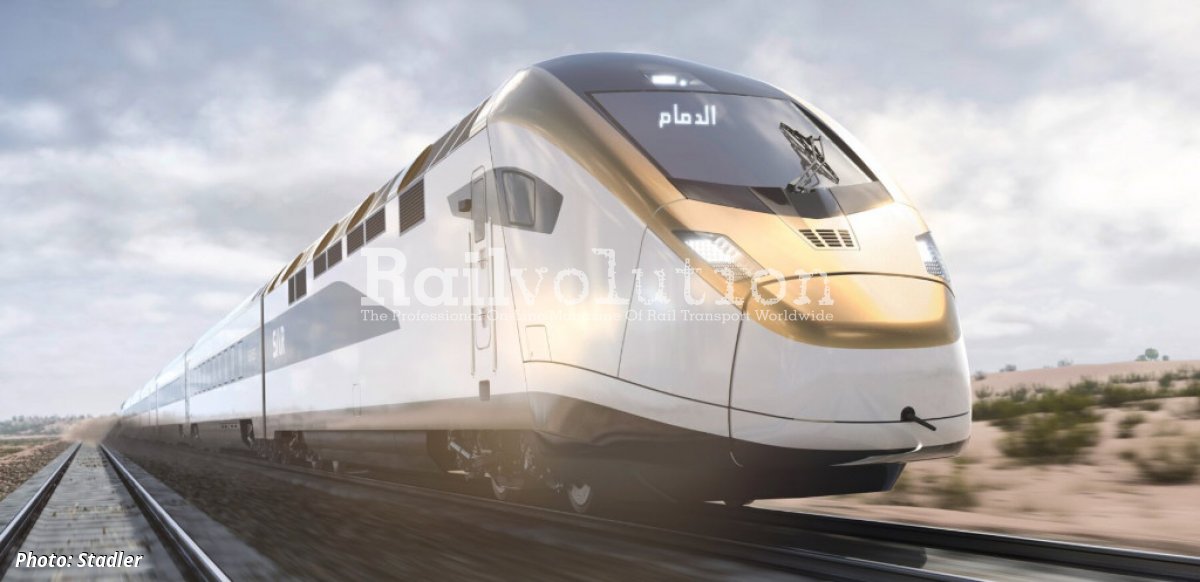
Stadler will supply Next Generation Intercity Trains to Saudi Arabia
On 5 February 2024, Saudi Arabia Railways (SAR) and Stadler have signed contracts for the supply and the maintenance of the Next Generation Passenger Trains for the operation on the growing network in the Kingdom of Saudi Arabia.
 www.railvolution.net
Some Nordic Express units to be delivered to Norway will be bi-mode with a diesel power car in an 8-car set. Not obvious where in the following renderings, but they might be only illustrating the all-electric version.On 5 February 2024, Saudi Arabia Railways (SAR) and Stadler have signed contracts for the supply and the maintenance of the Next Generation Passenger Trains for the operation on the growing network in the Kingdom of Saudi Arabia.
...
The new trainsets will be designed according to latest European and international Standards while being equipped particularly for the climatic and ambient conditions in Saudi Arabia. The units with a length of about 175 m will consist of two powered end cars with diesel-electric power transmission and five intermediate cars, with a capacity of about 320 passengers.
The design of the end cars is derived from the SMILE high-speed trains (referred to as Giruno by SBB), suggesting that the maximum speed could be 200 km/h, similar to the previously supplied SAR‘s CAF trains. Stadler told us that the trains will have a power of 6,000 kW, and deliveries will start from 2028 to around 2029/30.

FLIRT Nordic Express Status and updates Norske tog Train Academy Oslo, 04.06.20
Status and progress
High public expectations
Updates from mock-ups and new solutions
Latest renderings from ongoing design review
Last edited:

Can someone please elaborate for me as I'm getting confused. A few folk are commenting that any Class 8XX variant already out there would be overkill for ScotRail. On what basis is this on?
If it's the maximum speed, then this can be corrected with adequate tractioning that aligns with what ScotRail needs. This can be accommadated within the 8XX design, which is modular and flexible to design changes on traction as well as the base shell design (look no further than every 8XX order after the DfTs design for LNER/GWR).
If it's the crash worthiness in respect to a 140mph design limit, then the gripe is simply about how slanted/shallow the cab angle is?
In any of the above two cases, does that really make the base idea of using the 8XXs obsolete? Or is it just perception that because ScotRail don't run above 100mph and don't go through big cities, therefore they can't have what is perceived to be 'big' trains - hence the AT200 suggestions akin to 385s. If it's not any of the above two, then it appears like it's just an argument of illusion of 'big' trains on 'big' lines, versus 'little' trains on 'little' lines.
8XXs to ScotRail (so long as it is direct carbon copies of what exists currently) will not happen anyway with the current specifications under the requirements for the new stock. But it is interesting to see the dyanmics at play in some folk's views on it all.
If it's the maximum speed, then this can be corrected with adequate tractioning that aligns with what ScotRail needs. This can be accommadated within the 8XX design, which is modular and flexible to design changes on traction as well as the base shell design (look no further than every 8XX order after the DfTs design for LNER/GWR).
If it's the crash worthiness in respect to a 140mph design limit, then the gripe is simply about how slanted/shallow the cab angle is?
In any of the above two cases, does that really make the base idea of using the 8XXs obsolete? Or is it just perception that because ScotRail don't run above 100mph and don't go through big cities, therefore they can't have what is perceived to be 'big' trains - hence the AT200 suggestions akin to 385s. If it's not any of the above two, then it appears like it's just an argument of illusion of 'big' trains on 'big' lines, versus 'little' trains on 'little' lines.
8XXs to ScotRail (so long as it is direct carbon copies of what exists currently) will not happen anyway with the current specifications under the requirements for the new stock. But it is interesting to see the dyanmics at play in some folk's views on it all.

Imagine a 397 in TfW spec interior.One thing that may be an option is a follow-on of the Civity units LNER are ordering. Those are basically the same thing, indeed for a few reasons (such as full window alignment in Standard and the lack of window blinds to cause arguments) I think the 397 is a cut above the 80x so that might even be preferable. The ride is a bit rubbish and there are slightly too many tables, but aside from that the 397 is a very nice unit indeed.

HSTEd
Veteran Member
- Joined
- 14 Jul 2011
- Messages
- 20,373
They may have calculated that, when they actually need/want an order, they will just be able to threaten the closure of the plant to obtain one.I think it’s worth mentioning that Hitachi don’t actually seem interested in trying to survive in the UK market. They recently had a perfect opportunity to get an urgently needed extra order at Newton Aycliffe with LNER and they deliberately priced themselves out of it.
That strategy has been shown to be quite effective, as seen with Derby in recent years.
== Doublepost prevention - post automatically merged: ==
Although I believe Stadler has offered such an option, using the generating set from a Class 68, I doubt it would actually be attractive in a day-train compared to just using more MU engines.If you have to put another engine car, you'd probably be better putting all the engines in one vehicle, using a single (or two) larger engines and move it to one end of the train. We could call it something different, like "power car" or "locomotive"...
The axle loading issues alone would be a significant problem, let alone reliability.
They certainly won't want to surrender distributed traction.
Last edited:
Indigo Soup
Established Member
- Joined
- 17 May 2018
- Messages
- 1,488
While the potential cost of doing so isn't clear, it also probably wasn't necessary - the HSTs have a 125mph traction package unchanged from their GWR days.If it's the maximum speed, then this can be corrected with adequate tractioning that aligns with what ScotRail needs. This can be accommadated within the 8XX design, which is modular and flexible to design changes on traction as well as the base shell design (look no further than every 8XX order after the DfTs design for LNER/GWR).
There seems to be a perception that the 80x structure is designed to withstand the higher loads arising from a crash at 140mph as compared to 100mph, and that it's therefore heavier than necessary. This may well be correct. The extent to which this, rather than anything else (like being new trains) would have made them unaffordable isn't obvious.If it's the crash worthiness in respect to a 140mph design limit, then the gripe is simply about how slanted/shallow the cab angle is?
I believe there's an element of this. Set against it is the perception of the people who live on the routes in question, who believe that their cities are just as valid as York or Oxford, and that a route connecting between three and five of them with an end-to-end journey time of several hours can't reasonably be called 'little'.Or is it just perception that because ScotRail don't run above 100mph and don't go through big cities, therefore they can't have what is perceived to be 'big' trains - hence the AT200 suggestions akin to 385s. If it's not any of the above two, then it appears like it's just an argument of illusion of 'big' trains on 'big' lines, versus 'little' trains on 'little' lines.
There are still people around who remember when a 7-car loco-hauled train with a buffet (or even restaurant car!) was replaced by a DMU, and don't consider the increased frequency to be full compensation. It's no accident that the HST service was branded 'Inter7City', even if Dunfermline's new city charter undermined it slightly!
Yep, which is why when I started the thread I explicitly discussed the actual documented consideration of Transport Scotland procuring 80x units as part of the original Intercity Express Programme. It was clearly a serious possibility at some point around 2009. Exactly why it was dropped, or what they were intended for, isn't clear. But given the proposed numbers, operating in place of the HSTs would have a lot of sense.8XXs to ScotRail (so long as it is direct carbon copies of what exists currently) will not happen anyway with the current specifications under the requirements for the new stock. But it is interesting to see the dyanmics at play in some folk's views on it all.
Trainbike46
Established Member
I think you have gotten the wrong end of the stick here; it's not about 'big trains' vs 'little trains', it's about what serves Scotrail best.Can someone please elaborate for me as I'm getting confused. A few folk are commenting that any Class 8XX variant already out there would be overkill for ScotRail. On what basis is this on?
If it's the maximum speed, then this can be corrected with adequate tractioning that aligns with what ScotRail needs. This can be accommadated within the 8XX design, which is modular and flexible to design changes on traction as well as the base shell design (look no further than every 8XX order after the DfTs design for LNER/GWR).
If it's the crash worthiness in respect to a 140mph design limit, then the gripe is simply about how slanted/shallow the cab angle is?
In any of the above two cases, does that really make the base idea of using the 8XXs obsolete? Or is it just perception that because ScotRail don't run above 100mph and don't go through big cities, therefore they can't have what is perceived to be 'big' trains - hence the AT200 suggestions akin to 385s. If it's not any of the above two, then it appears like it's just an argument of illusion of 'big' trains on 'big' lines, versus 'little' trains on 'little' lines.
8XXs to ScotRail (so long as it is direct carbon copies of what exists currently) will not happen anyway with the current specifications under the requirements for the new stock. But it is interesting to see the dyanmics at play in some folk's views on it all.
what scotrail needs for the I7C services, in my view is:
- Bimode with option to be turned into a (B)EMU in the future
- Comfortable interior
- Level boarding
- fast acceleration
- good hillclimbing ability
- top speed of at least 100mph
- meets all the relevant railway standards
- maybe a buffet?
And all that for a reasonable price.
The 80x isn't the best place to start for this, because as a 140mph design, it makes several design compromises in other areas, including cost, lack of level boarding, no gangways, etc.
The FLIRT is much closer to what Scotrail needs, though some things would likely be somewhat different. And of course, other manufacturers will be able to deliver something that meets Scotland's needs, but it seems highly unlikely that such a design would start from the 80x family, since there's a lot of fundamental design choices in there that don't fit right.
Gerald Fiennes
Member
- Joined
- 7 Jan 2009
- Messages
- 1,031
And good cycle storage space. The 80x series date from the 'let's pretend bikes don't like being on trains' era and so would be pretty hopeless taking over the Scotrail domestic long distance services. The space they offer for prams and luggage is not great either but (level boarding aside...) although wheelchair spaces are a bit of squeeze they generally seem to work.
In addition, it would be good to get some actual data on fleet availability from LNER or GWR: it seems that these fleets are someway below the designed levels, another reason why a few more seets might need to be ordered for the English TOCs....
In addition, it would be good to get some actual data on fleet availability from LNER or GWR: it seems that these fleets are someway below the designed levels, another reason why a few more seets might need to be ordered for the English TOCs....

Mikey C
Established Member
- Joined
- 11 Feb 2013
- Messages
- 8,279
Well Switzerland is a notoriously flat countryIt's not like Stadler hasn't seen a hill before!

To be fair, that's down to how they were specced by the DfT. I'm sure a variant could be produced with a "pseudo guard's van" type area for bikes, prams and luggage.And good cycle storage space. The 80x series date from the 'let's pretend bikes don't like being on trains' era and so would be pretty hopeless taking over the Scotrail domestic long distance services. The space they offer for prams and luggage is not great either but (level boarding aside...) although wheelchair spaces are a bit of squeeze they generally seem to work.
In addition, it would be good to get some actual data on fleet availability from LNER or GWR: it seems that these fleets are someway below the designed levels, another reason why a few more seets might need to be ordered for the English TOCs....
All electrified though isn’t it?Well Switzerland is a notoriously flat country
supervc-10
Member
- Joined
- 4 Mar 2012
- Messages
- 763
Once again, I feel like a bimode 444 might fit the bill! Hell... a bimode 444 might be very useful for quite a few operators across the country. Make that bimode suitable for 25kV or 3rd rail and it would work great for SWR replacing the 158/159 fleet, for example.

AlastairFraser
Established Member
- Joined
- 12 Aug 2018
- Messages
- 4,188
Trimode 25kv OHLE/diesel/battery 897 similar to LNER's new units would make more sense, because with a 50 mile battery, you could then easily reach Perth from the end of the wires at Dunblane on Edinburgh/Glasgow-Inverness services or Glasgow - Aberdeen services, or with Haymarket to Dalmeny wires energised, Dalmeny to Dundee would be possible on Edinburgh to Aberdeen services (further phases of Fife Circle electrification would perhaps even extend the battery capability to Arbroath).I think you have gotten the wrong end of the stick here; it's not about 'big trains' vs 'little trains', it's about what serves Scotrail best.
what scotrail needs for the I7C services, in my view is:
- Bimode with option to be turned into a (B)EMU in the future
- Comfortable interior
- Level boarding
- fast acceleration
- good hillclimbing ability
- top speed of at least 100mph
- meets all the relevant railway standards
- maybe a buffet?
And all that for a reasonable price.
The 80x isn't the best place to start for this, because as a 140mph design, it makes several design compromises in other areas, including cost, lack of level boarding, no gangways, etc.
The FLIRT is much closer to what Scotrail needs, though some things would likely be somewhat different. And of course, other manufacturers will be able to deliver something that meets Scotland's needs, but it seems highly unlikely that such a design would start from the 80x family, since there's a lot of fundamental design choices in there that don't fit right.
That would up to nearly 70 miles off diesel on some services, so definitely worthwhile.

Helvellyn
Established Member
- Joined
- 28 Aug 2009
- Messages
- 2,587
About twenty years too late with the design unfortunately. I do think an ac version might have been a good option for Liverpool Street to Norwich back in the 2000s though.Once again, I feel like a bimode 444 might fit the bill! Hell... a bimode 444 might be very useful for quite a few operators across the country. Make that bimode suitable for 25kV or 3rd rail and it would work great for SWR replacing the 158/159 fleet, for example.

And they were unsuitable for the longer distance, higher volume ones of those from the word “go”.Is that a fair perception? A lot of 170s were originally bought for regional express services, including Anglia services from London to Norwich, MML services from London to Nottingham and Sheffield, and the Central routes that have now transferred to XCountry.
- Status
- Not open for further replies.