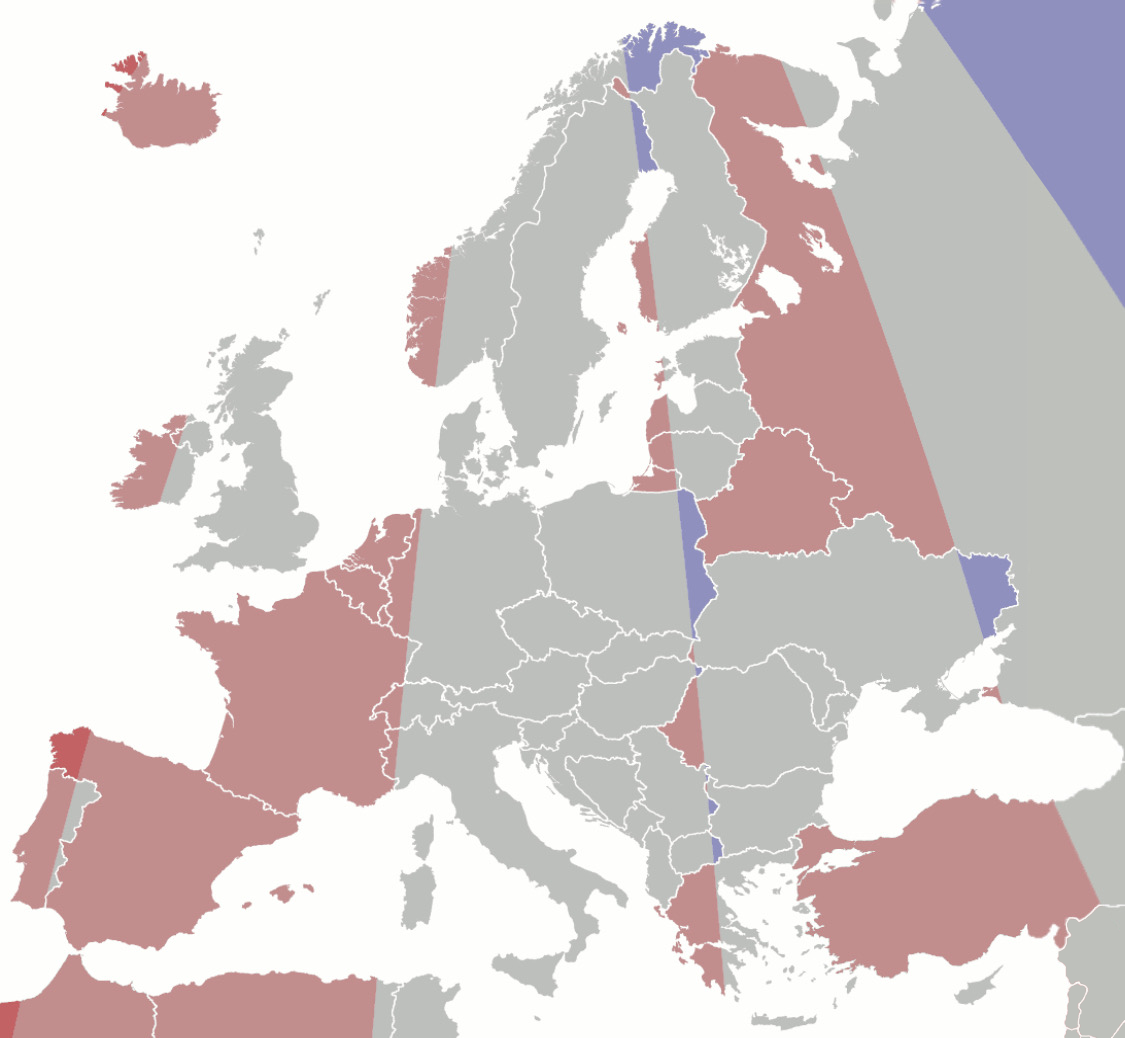
Any possible change of time zones at the border between post-secession Scotland and the UK will be easily handled by Serco – their GSR operation in Australia handles three time zones during winter and four during summer when the Northern Territory stays on ACST while South Australia goes forward an hour to ACDT.
If you want to use an accurate model shouldn't some countries be on GMT+0.5 opposed to GMT+1? I think it's only in Europe that every country is on GMT or a full number hours ahead of it.
The continent of Africa is equal with Europe in having no offset time zones, and both North America and South America has only one very small area (Newfoundland) using an offset time zone.
As a person who lives in an offset time zone (UTC+9.5/10.5 – Australian Central Standard/Daylight Time) I can assure you it's a pain in the a®$e which should be avoided at all costs. It certainly creates some interesting timetabling of east-west trains where the changeover point from CST/CDT to WST at Cook is also a fuel stop – see if you can pick out the only east-west operator to not stop there (because they have mastered inline refuelling)
from the current master train plan.
It would be better if we simply adopted UTC+10/11 (Eastern Standard/Daylight Time) to have the same time zone as the populated eastern states of Australia which is where business is centred. The Greeks have done this right – by choosing UTC+2 it means they have the same time as some of their neighbouring countries, which is far better than having the same time as none of their neighbours.
The choice of the Benelux countries to all go for UTC+1 is quite understandable, with the exception of the agricultural areas of western Flanders they are all within the range from 3°45'E to 11°15'E where UTC+0.5 would be the most accurate time zone, assuming that we're only allowing offsets of 30 minutes and not 45 minutes as in Nepal and the Chatham Islands to the east of New Zealand. Therefore it makes sense to pick the full hour time zone which corresponds to the greatest convenience for cross-border travel, rather than the one which is slightly closer to being most accurate.
It's important to remember that GMT/UTC is an arbitrary time that doesn't actually correspond to solar noon (solar noon varies by 31 minutes across the year) and therefore there's no point in being too obsessive about the accuracy of time zones when that accuracy has already been lost.
It is historical and cultural reasons - there is a great deal of attachment to GMT.
If the economic reasons to join Europe on UTC+1 (CET) were for real (i.e. not simply resolved by businesses getting those people whose jobs revolve around links with European businesses to turn up to work at 8am) then the solution would be simple – redefine GMT from being UTC+0 to being UTC+1. You would get the best of both worlds, joining Europe on the same time zone but still getting to call it GMT for sentimental purposes.