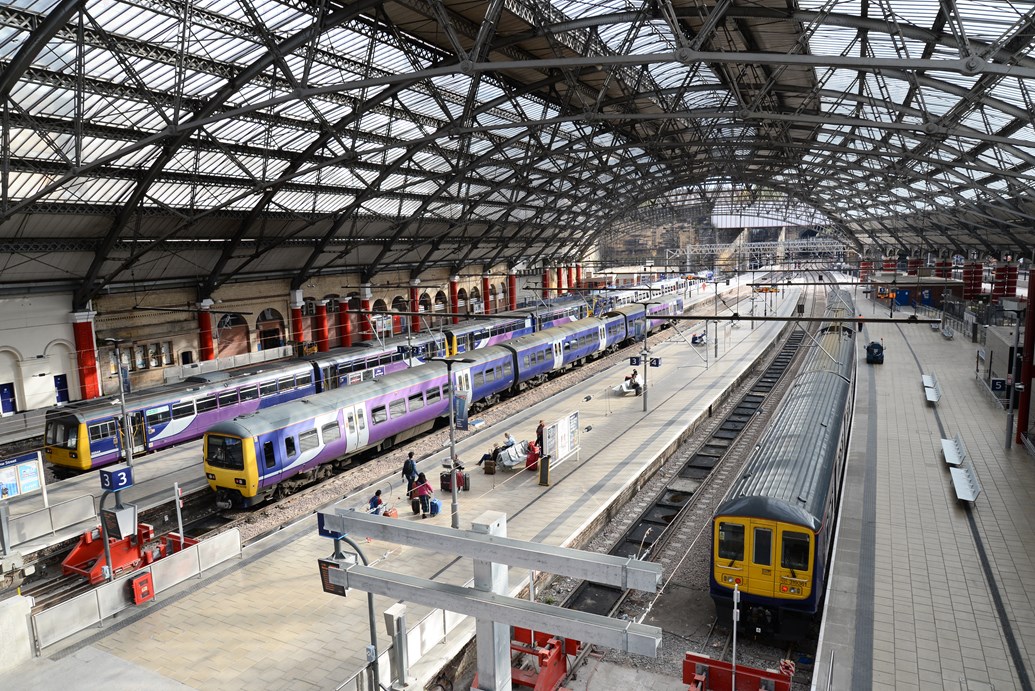
If you are worried about NW connections further south then maybe be asking why XC don't provide any trains from the NW to the south west. Id say Plymouth Torbay and Cornwall are of more use to most people in the North west than Rugby and Watford! If the money from HS2 was redistributed we could have a decent fleet of long XC bi mode trains connecting the nation up , including cities such as Liverpool which is scandalously not served by XC.
You actually wouldn't be any HS2 money, you'd just need the powers to be to accept that XC could cover the costs of the extra leases (which they almost certainly would as the cost per seat would fall due to the trains, assuming 80x's, would be higher density and needing "less staff" - in that one driver would be needed for 302 seats rather than 250 seats).
Arguably lengthening XC services would result in a faster increase in passenger numbers - and therefore actually make the justification for HS2 easier. As such it's unlikely you'd find those in favour of HS2 even thinking (least alone arguing) that XC or other TOC's shouldn't be allowed additional rolling stock. Rather they are probably fairly vocal for more rolling stock to be provided to XC.
Are all of those Manchester to London trains full? No they are not. This project smacks more and more as a political gesture . There are other less expensive ways of opening up capacity for freight and local trains. But going back to my original point, I was agreeing with another poster that Hs2 is politically unpopular to the majority because it doesn't seem to benefit anyone all that much (to the man on the street anyway who doesn't understand capacity increases etc etc).
HS2, by building new platforms, bit only shows longer HS2 services but also longer local services.
For example CityC has 4 platforms (not through platforms), one used by long distance services (80x/390/HST), two by local services (1xx/3xx) and one by regional express services (TPE/XC services).
Platform 1 sees two express trains an hour (9 coaches long)
Platform 2 sees four semi fast services an hour (5 coaches long, 2 sharing a platform)
Platforms 3&4 each see nine local services (3 coaches long, 3 sharing a platform).
Super Express 2 (SE2) comes along and removes the long distance services but also had capacity for upgraded regional services at part of Power Regional Rail (PRR) which will link CityC with other regional cities.
There'll be a need for local services to replicate some of the express trains, but with shorter turn around times, so you can increase the frequency of those from 2tph to 3tph.
The regional express trains move across to the new platforms (and could lengthen to become 1/2 of 16 rather than 1/2 of 12, so if comparing against 400m and 280m would allow 200m Vs 140m, so realistically, assuming that there's actually 420m of platform, 9 x 23m trains Vs 6 x 23m) given 3 platforms for local services, as these no longer have to squeeze into 2 platforms, they can all be lengthened to 5 coaches long as you only need 2 trains sharing a platform to have the same frequency.
It's this sort of capacity increase which, unless you look into it, which is easy to overlook when looking at
SE2 HS2.
Now the reality is (and actual planners will probably tell me that I've over simplified things) that such a simple model is probably over started the increase in capacity (not least due to other platform lengths along the lines which the services call at and accessing the platforms).
However, the point is that just lengthening InterCity trains (which even to Manchester at 3tph would need 165 coaches just to have an 11 coach fleet of 80x's, compared to HS2 services which would need 144 coaches for 16 coach services, but would provide far less seating per train - 826 of which 70 first class seats compared with 1,100 with a higher percentage of first class seats) wouldn't give you that potential for extra capacity for local and regional express services.
Perhaps people might like to consider again in which direction the traffic will flow if both Manchester and Leeds are reinstated. I can tell you (without evidence! to back it up) It'll be Mancunians and loiners going to London return. Very few Londoners will be excited at the prospect of going to Manchester or Leeds... just trust me on this. All the best jobs and attractions are in London. People won't travel north without a reason and a fast train service from London to Bradford won't offset the dire state of many northern towns and cities.
It depends on the reason for travel. I've worked for several companies located about an hour for London. The reason they were successful was not only could they work locally but they could access the London projects without the high staff and office costs of being based in London.
What that hour of travel is a pain, it's only undertaken when needed - which could be off peak (unlike commuting). You also tend to be able to employ better quality staff for the same or less pay (or actually be able to employ staff - not necessarily an issue for management or technical roles, but admin and support staff - and that was an issue 10 years ago so nothing to do with Brexit).
That will open up opportunities for those within (say) 40 minutes of Manchester to be employed there and bring their pay back to their home town to spend locally. It may not be many but money spent locally is likely to benefit locals who will spend it locally. It may not restore a town, but it is likely to improve it.
Whilst it's true that there's lots in London, there's also a lot of people and so it's not always easy to do the things you want to do. The time we went a week before COVID lockdowns came into place was about the best ever time we've been at there were far less people (but was still fairly busy).
I live about an hour from London by rail, we go to local places far more often than we do go to London. Yes people will go to London, but likely a few times a year.
Whilst it's likely that it'll be less likely the other way, there's still likely to be a reasonable amount.
For example, the last train from London is suitable to go to the theater, however we are as likely to go to one of the local/regional theaters as to go to a London one (cost being a significant factor, even ignoring the train costs).
Leeds, Manchester and Liverpool are cities, not towns.
In terms of regenerating places like Blackburn, Burnley and their ilk - places that haven't really recovered from the loss of mills and coal mining - then rail investment would certainly make a difference - but not HS2, rather South East style 4tph electric commuter services into major cities like Manchester and Leeds, rather than mucky, run down 1980s DMUs once or twice an hour and that's if it isn't cancelled.
Indeed, however (no matter how much anyone may wish it) it's going to be hard to justify 3tph when the current 2tph is 3 coaches long.
It's why (see my point above about station capacity) HS2 could actually be useful for local services, as if the services are lengthened from 3 coaches to (say) 6 coaches and the cost of lengthening lots of small stains to allow 9 coach trains was significant then the works required to make it 3tph (or even 4tph) of 6 coaches could probably be an easier thing to justify.
When anything Osborne said would bring benefit to the UK has been proven in the fullness of time to be nothing more than destructive, why believe this just because it's about a train line?
As HS2, as is, is directly damaging to Liverpool's economy (both already experienced by us, and forecast into the future) so how can it be beneficial to us?
Our city has been deemed expendable, for some reason.
Simply not being actively undermined with negative messaging to potential investors would be a step up.
Hello again, are you going to answer the question about the 400m platforms in Liverpool:
When were these 400m stations announced given that the first meeting about 400m station options was reported in December 2020:
The Liverpool City Region Station Commission is drawing up proposals for a rail station that would link Liverpool city centre with High Speed Two and Northern Powerhouse Rail services.

www.placenorthwest.co.uk
With this report from September 2021 confirming that the commission was still yet to report:
HS2, the planned high speed rail route from London to the North, is a controversial project. National media bombard us with stories of costs out of control, natural habitats being devastated and eco warriors being evicted from tunnels and tree houses. There are also the persistent rumours that all o

www.liverpolitan.co.uk
Therefore it's not unreasonable for not everyone (including myself) to be aware of these suggested sites. Especially given that I've not been able to easily find any follow up information on this commission from the last two years.
As an aside it also reports the economic impact on Liverpool as:
Whilst that's not a great range of figures to be expected, it's not certain that Liverpool would see a reduction in GDP due to HS2.
However at I've said before, Liverpool is an area where future schemes to connect it to the core HS2/NPR network to overcome these issues should have been put forwards much earlier in the process than now.