• Our new ticketing site is now live! Using either this or the original site (both powered by TrainSplit) helps support the running of the forum with every ticket purchase! Find out more and ask any questions/give us feedback in this thread!

Low-speed, empty stock derailment at Bletchley (26/06)

Status
Not open for further replies.

bramling

Veteran Member
Joined
5 Mar 2012
Messages
20,397
Location
Hertfordshire / Teesdale
Sorry for being thick but I took the RAIB report as saying the signaller set an impossible route from US to DS line. How did the signalling system allow this?

The signalling didn’t allow it, which is why they were attempting the desired move as an unsignalled one.

What they did was key the various set of points into that they thought was a viable means of making the move, however in fact it wasn’t viable as the track layout physically didn’t allow what they were attempting to do.

The screen display in the SCC should have made clear that there was essentially a hole in the route that had been arranged, however either the display was slightly unclear, or the staff simply didn’t understand what they were seeing. It’s notable that one signaller did apparently feel something “didn’t look quite right”.

It seems the signallers all thought that the switch diamond was in fact a different set of points called a slip, where it is possible for diverging moves to be made.
 
Sponsor Post - registered members do not see these adverts; click here to register, or click here to log in
R

RailUK Forums

Horizon22

Established Member
Associate Staff
Jobs & Careers
Joined
8 Sep 2019
Messages
11,005
Location
London
I have a few layman observations:

1) Would the driver be expected to have the route knowledge that an impossible route was being set? The report seems to focus on the training procedures for switch diamonds when making an unsignalled move, but would they be expected to know that there is no route from the up slow to the down slow at this location, without necessarily knowing the minutiae of why? Or, to put it another way, if the signaller attempted to set an impossible route across a fixed diamond, would the driver be expected to have the route knowledge to question it?

I would say it is unlikely, especially as it was a wrong-directional move. Maybe checking switch diamonds, but as stated there was no training about that.

2) The report mentions in paragraph 158 a previous incident which involved running through an incorrectly-set switch diamond in the same way. In the Forum discussion linked here, which related to a previous RAIB report into a SPAD at Stafford (report is here), a few august members of the Forum reported that it was extremely rare for a train to run through switch diamonds without derailing. Would there be a speed at which a train could reliably traverse incorrectly-set switch diamonds, or is it solely extreme good fortune that so few of these incidents have resulted in derailment?

Good fortune probably, or the swiss cheese didn't align.

3) Is it unusual for the train to have three driver changes in such a short space of time, at Northampton, Milton Keynes Central, and Bletchley?

It certainly seems unusual (certainly at both MKC and then Bletchley!) as is the sort of ineffiecient crew resourcing that makes me baulk! But it might be common at WMT. Also there was a lot of driver fault-finding before engaging with the SMC, which is a rarer practice on more modern stock (drivers trained to go straight to fleet control). It was quite clear the issue with the DRA was seen to be "just one of those niggles" previously.

== Doublepost prevention - post automatically merged: ==

It seems the signallers all thought that the switch diamond was in fact a different set of points called a slip, where it is possible for diverging moves to be made.

Somewhat, although in the report it seems Signaller 2 knew they were a diamond, but were not directly involved but only observed the move.
 
Last edited:

MadMac

Established Member
Joined
13 Jun 2008
Messages
1,498
Location
Moorpark, CA
One other thing that jumped out at me was in Paragraph 47, and I quote:

“As the train proceeded along the Up Slow line in the wrong direction, the driver accelerated up to 36 mph (58 km/h) before they applied the train’s brakes about 180 metres before Denbigh Hall South Junction”

Notwithstanding it being an unsignalled move, moving at 36 MPH in the circumstances seems to me to be, at a minimum, outwith the spirit of “proceed with caution prepared to stop short of any obstruction“…..
 

NSEWonderer

Established Member
Joined
5 Dec 2020
Messages
2,903
Location
London
One other thing that jumped out at me was in Paragraph 47, and I quote:

“As the train proceeded along the Up Slow line in the wrong direction, the driver accelerated up to 36 mph (58 km/h) before they applied the train’s brakes about 180 metres before Denbigh Hall South Junction”

Notwithstanding it being an unsignalled move, moving at 36 MPH in the circumstances seems to me to be, at a minimum, outwith the spirit of “proceed with caution prepared to stop short of any obstruction“…..
But what is the actual speed of caution? And also in that case what was the visible obstruction? By the time the train bogies came into contact with the "obstruction" being the track itself it was already too late even if lets say the train speed was 20mph.

Arguably potentially a lower speed may have allowed the driver to check if the track was set for the movement visually but only if they knew what they were meant to be looking for track wise
 
Last edited:

edwin_m

Veteran Member
Joined
21 Apr 2013
Messages
28,678
Location
Nottingham
The screen display in the SCC should have made clear that there was essentially a hole in the route that had been arranged, however either the display was slightly unclear, or the staff simply didn’t understand what they were seeing. It’s notable that one signaller did apparently feel something “didn’t look quite right”.
The photo of the screen in the report does show a gap in the grey line at the switch diamond, but being grey on a black background it's not particularly obvious. However, it's the same width as the gap that would appear at any other set of points on that particular screen setup, and signallers should be used to checking for this when setting up an unsignalled route.
But what is the actual speed of caution? And also in that case what was the visible obstruction? By the time the train bogies came into contact with the "obstruction" being the track itself it was already too late even if lets say the train speed was 20mph.

Arguably potentially a lower speed may have allowed the driver to check if the track was set for the movement visually but only if they knew what they were meant to be looking for track wise
The report notes that the speed was down to 15mph on reaching the diamond, as required by the rules. But they were probably braking anyway as the diamond came into view, so if they'd seen the incorrect setting and applied the emergency brake then it wouldn't have helped much with stopping before it.
 

Vexed

Member
Joined
12 Jan 2020
Messages
661
Location
Herts / Hants
By the time the train bogies came into contact with the "obstruction" being the track itself it was already too late even if lets say the train speed was 20mph.

Arguably potentially a lower speed may have allowed the driver to check if the track was set for the movement visually but only if they knew what they were meant to be looking for track wise
As required by the rule book, the report says the driver slowed down to 15mph before the pointwork. This rule exists for a visual check of the points, but the report suggests both the driver and driver manager in the cab only checked one of the two point ends so they didn't see the issue.
118 The driver knew the requirement to proceed over points at no more than 15 mph
(or 25 km/h) when making a wrong-direction movement. While the train had
reached a speed of 36 mph (58 km/h) during the movement, the driver had applied
the train’s brakes and slowed down to 15 mph (24 km/h) when about 40 metres
from the switch diamond point ends (paragraph 47). Analysis by RAIB suggests
that this probably gave the driver and driver manager about 6 seconds to check
their position and stop the train if they saw a problem.
119 When the front of the train was lifted and then derailed (paragraph 50), the driver
and driver manager could not initially understand what had happened. Witness
evidence indicated that both agreed that the points were set at the junction for the
train to cross to the Down Slow line, which matched what the driver had been told
by signaller 1. Witness evidence also indicated that both saw the position of the
further away TK262B point ends, which were facing. These were set in the reverse
position to divert the train towards the Down Slow line. However, neither identified
the position of the nearer TK262A point ends, which were trailing. Being in the
reverse position meant the train would incorrectly run through them.
120 The design and position of the switch rails for a switch diamond (paragraph 18)
make it much more difficult for a driver to see the position of both point ends
from their cab. The driver and driver manager had about 6 seconds to view and
determine the position of the point ends once the train was travelling at 15 mph
(24 km/h). However, at the start of this time, both point ends would have been
about 40 metres away from them, and difficult to see. As the train got closer,
the positions of the point ends would have become easier to see, but the period
remaining to observe them and draw a conclusion as to their position would have
been shorter. This would also have left the driver without much time to act should
they have become aware of a problem.
121 Approaching more slowly than 15 mph (24 km/h) would have increased the
amount of time that the driver and driver manager had to view the point ends
positions, draw conclusions, and take any necessary action. It would also have
given the driver more time to view the point ends when closer to them, when it
would have been easier to determine their position. However, the driver and driver
manager may still have focused on the facing part of the switch diamond, which
was easier to see, and made an assumption from the position of the facing point
ends alone that the switch diamond as a whole was in the correct position. The
training of drivers on switch diamond points is discussed further in the next section.

The screen display in the SCC should have made clear that there was essentially a hole in the route that had been arranged, however either the display was slightly unclear, or the staff simply didn’t understand what they were seeing. It’s notable that one signaller did apparently feel something “didn’t look quite right”.
Figure 21 on page 40 shows the gap quite clearly to me, the report does mention the signallers focusing on having the points and reminders set rather than checking the actual route chosen is valid.

Screenshot_20260415_093955_Chrome.jpg

== Doublepost prevention - post automatically merged: ==

Oops, I think I've said exactly the same as edwin_m :lol:
 

swt_passenger

Veteran Member
Joined
7 Apr 2010
Messages
34,282
Is the orange dotted line something RAIB have drawn, or is it something the system has added. I’m not too sure about this. Presumably the signalling system wouldn’t ‘draw’ an impossible route on the screen?
 

Benjwri

Established Member
Joined
16 Jan 2022
Messages
3,313
Location
Bath
Is the orange dotted line something RAIB have drawn, or is it something the system has added. I’m not too sure about this. Presumably the signalling system wouldn’t ‘draw’ an impossible route on the screen?
Yes the orange line is added by RAIB to show what was proposed.
 

Bigfoot

Established Member
Joined
2 Dec 2013
Messages
1,422
Also there was a lot of driver fault-finding before engaging with the SMC, which is a rarer practice on more modern stock (drivers trained to go straight to fleet control)
I was quite shocked at the level of self fault finding before contacting for assistance, and also the physical log book for recording defects. My toc hasnt had that for so many years.
 

Horizon22

Established Member
Associate Staff
Jobs & Careers
Joined
8 Sep 2019
Messages
11,005
Location
London
My TOC doesn't even have a fleet control that drivers can call :'(

Surely you have to call someone and they patch you through or similar?

On a separate note for the signallers or those that know the area, where was the suitable place to cross back over? Denbigh Hall North? I may have missed it but didn’t see that in the report
 
Last edited:

Efini92

Established Member
Joined
14 Dec 2016
Messages
2,137
Surely you have to call someone and they patch you through or similar?

On a separate note for the signallers or those that know the area, where was the suitable place to cross back over? Denbigh Hall North? I may have missed it but didn’t see that in the report
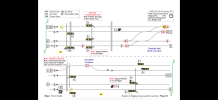
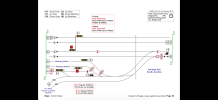
The next set of points north of denbigh hall south. Which would’ve been a signalled move.
 

Attachments

  • IMG_5737.png
    IMG_5737.png
    302 KB · Views: 122
  • IMG_5736.png
    IMG_5736.png
    281.2 KB · Views: 120
Last edited:

martin2345uk

Established Member
Joined
21 Sep 2011
Messages
2,402
Location
Essex
Surely you have to call someone and they patch you through or similar?
No we’re expected to resolve faults on our own using the on board computer and/or a separate fault guide that we have.

We can call an on-call driver manager if we need some extra pointers but that’s it unfortunately :lol:
 

tumbledown

Member
Joined
5 Nov 2024
Messages
276
Location
UK
The next set of points north of denbigh hall south. Which would’ve been a signalled move.
But to get to Denbigh Hall North you have to go via Bletchley Relief 1, as far as I can tell from the Sectional Appendix - the US immediately north of Platform 4 is not bi-directional, only north of TK1468.
 

Nippy

Member
Joined
13 Aug 2013
Messages
740
Correct. But they could have made an un-signalled wrong direction move without derailing the train to get them out of the problem. There would also be route cards to assist them for the straight route in the correct direction.
 

Harpo

Established Member
Joined
21 Aug 2024
Messages
3,874
Location
Newport
My two takeaways from this are that first, the signallers had apparently never noticed that the signalling system only ever called straight routes across the diamond and that it never functioned as a turnout. That’s not great knowledge of your area of control.

Second, I’m somewhat amazed by the driver’s blind faith. My experience of degraded modes (with others) up front always came with driver mantras such as ‘trust nobody, check everything’.

In a world of increasingly micro-managed operations personnel, it feels as if process has replaced independent thinking.
 

Annetts key

Established Member
Joined
13 Feb 2021
Messages
3,816
Location
West is best
My two takeaways from this are that first, the signallers had apparently never noticed that the signalling system only ever called straight routes across the diamond and that it never functioned as a turnout. That’s not great knowledge of your area of control.

Second, I’m somewhat amazed by the driver’s blind faith. My experience of degraded modes (with others) up front always came with driver mantras such as ‘trust nobody, check everything’.

In a world of increasingly micro-managed operations personnel, it feels as if process has replaced independent thinking.
I see a number of problems.

Now with modern signalling systems and working practices, signallers are somewhat (maybe too far) removed from the reality of the real railway that exists outside the building where they work. As I said in an earlier post, how many have actually been on track and seen a real switch diamond? Or seen a double slip. Once you have seen these with your own eyes, it's clear what the differences are.

With regards to a signaller knowing their area of control, how often is manual route setting done? And how often does the signaller actually stay looking at that route while the interlocking calls all the relevant points to move and once that's done, waits to see the signal clear to a proceed aspect?

Even on the older NX panels, signallers don't always do that. They set the route then go do something else. Fair enough if it's a busy area / busy day / busy time. Sometimes if they are not watching, it's only when they later notice a problem or the driver calls in asking why they are stood at a red signal that they discover an issue.

Is there an over reliance on automation such as automatic route setting systems?

On the drivers side, it's still the duty of the driver to ensure that when passing over any points (which would include switch diamonds), that the points are set correctly for the move that is being made. Given the number of run-throughs where point operating equipment (point machines, clamp locks) and rails have been damaged that I attended when I worked on the S&T, it's clear that either they are not looking, don't know or are caught out because they are going too fast so they can't stop the train / loco / machine short of the points.

Once, in the area where I worked, there was even a case of a driver being talked past a red signal (the signaller gave permission for the wrong train to move), it was not the drivers fault for passing the signal. But the driver continued even after passing over the junction even though the train was now travelling in the up direction on the down line, where there was no bi-directional / reversible signalling (hence no signals). The train was eventually stopped because there happened to be someone on the ground at a ground frame one mile further along the line and they presumably showed a hand stop signal.

I've also had a driver report an expansion joint as a broken rail.

Hence, my view for many years has been that (a) the existing training is poor or insufficient and (b) I strongly believe that railway staff should be able to experience life on the other side. So drivers should get to spend at least a couple of days in a signal box / on the operating floor of a signalling centre. Signallers should get to experience what it's like in the cab of a train. Both should get to experience a day with the P.Way and a day with the S&T. You get the idea.

And to your final point, yes, if you have a defined process, the vast majority of people won't think outside the box or have independent thinking. They instead just follow the process or procedure. Then, if it doesn't work or goes wrong, they have no idea what to do. Or the problem is never identified. I've seen this for myself.

What is even worse is that often the supervisor or manager does exactly the same... Once it took me over an hour to get a manager to understand that there was a problem that wasn't being identified by people just blindly following the procedure in the official documentation.

 

Efini92

Established Member
Joined
14 Dec 2016
Messages
2,137
But to get to Denbigh Hall North you have to go via Bletchley Relief 1, as far as I can tell from the Sectional Appendix - the US immediately north of Platform 4 is not bi-directional, only north of TK1468.
As a fully signalled move you’re correct. The train could’ve made a wrong direction move to Denbigh hall north rather than trying to use a switch diamond.

== Doublepost prevention - post automatically merged: ==

I see a number of problems.

Now with modern signalling systems and working practices, signallers are somewhat (maybe too far) removed from the reality of the real railway that exists outside the building where they work. As I said in an earlier post, how many have actually been on track and seen a real switch diamond? Or seen a double slip. Once you have seen these with your own eyes, it's clear what the differences are.

With regards to a signaller knowing their area of control, how often is manual route setting done? And how often does the signaller actually stay looking at that route while the interlocking calls all the relevant points to move and once that's done, waits to see the signal clear to a proceed aspect?

Even on the older NX panels, signallers don't always do that. They set the route then go do something else. Fair enough if it's a busy area / busy day / busy time. Sometimes if they are not watching, it's only when they later notice a problem or the driver calls in asking why they are stood at a red signal that they discover an issue.

Is there an over reliance on automation such as automatic route setting systems?

On the drivers side, it's still the duty of the driver to ensure that when passing over any points (which would include switch diamonds), that the points are set correctly for the move that is being made. Given the number of run-throughs where point operating equipment (point machines, clamp locks) and rails have been damaged that I attended when I worked on the S&T, it's clear that either they are not looking, don't know or are caught out because they are going too fast so they can't stop the train / loco / machine short of the points.

Once, in the area where I worked, there was even a case of a driver being talked past a red signal (the signaller gave permission for the wrong train to move), it was not the drivers fault for passing the signal. But the driver continued even after passing over the junction even though the train was now travelling in the up direction on the down line, where there was no bi-directional / reversible signalling (hence no signals). The train was eventually stopped because there happened to be someone on the ground at a ground frame one mile further along the line and they presumably showed a hand stop signal.

I've also had a driver report an expansion joint as a broken rail.

Hence, my view for many years has been that (a) the existing training is poor or insufficient and (b) I strongly believe that railway staff should be able to experience life on the other side. So drivers should get to spend at least a couple of days in a signal box / on the operating floor of a signalling centre. Signallers should get to experience what it's like in the cab of a train. Both should get to experience a day with the P.Way and a day with the S&T. You get the idea.

And to your final point, yes, if you have a defined process, the vast majority of people won't think outside the box or have independent thinking. They instead just follow the process or procedure. Then, if it doesn't work or goes wrong, they have no idea what to do. Or the problem is never identified. I've seen this for myself.

What is even worse is that often the supervisor or manager does exactly the same... Once it took me over an hour to get a manager to understand that there was a problem that wasn't being identified by people just blindly following the procedure in the official documentation.
I completely agree with this, I have also been saying the same about training for drivers. It does help that there is also big knowledge gaps in the people who manage competencies.
 
Status
Not open for further replies.

Top