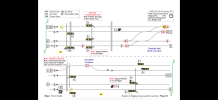
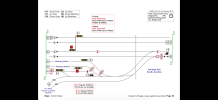
My two takeaways from this are that first, the signallers had apparently never noticed that the signalling system only ever called straight routes across the diamond and that it never functioned as a turnout. That’s not great knowledge of your area of control.
Second, I’m somewhat amazed by the driver’s blind faith. My experience of degraded modes (with others) up front always came with driver mantras such as ‘trust nobody, check everything’.
In a world of increasingly micro-managed operations personnel, it feels as if process has replaced independent thinking.
I see a number of problems.
Now with modern signalling systems and working practices, signallers are somewhat (maybe too far) removed from the reality of the real railway that exists outside the building where they work. As I said in an earlier post, how many have actually been on track and seen a real switch diamond? Or seen a double slip. Once you have seen these with your own eyes, it's clear what the differences are.
With regards to a signaller knowing their area of control, how often is manual route setting done? And how often does the signaller actually stay looking at that route while the interlocking calls all the relevant points to move and once that's done, waits to see the signal clear to a proceed aspect?
Even on the older NX panels, signallers don't always do that. They set the route then go do something else. Fair enough if it's a busy area / busy day / busy time. Sometimes if they are not watching, it's only when they later notice a problem or the driver calls in asking why they are stood at a red signal that they discover an issue.
Is there an over reliance on automation such as automatic route setting systems?
On the drivers side, it's still the duty of the driver to ensure that when passing over any points (which would include switch diamonds), that the points are set correctly for the move that is being made. Given the number of run-throughs where point operating equipment (point machines, clamp locks) and rails have been damaged that I attended when I worked on the S&T, it's clear that either they are not looking, don't know or are caught out because they are going too fast so they can't stop the train / loco / machine short of the points.
Once, in the area where I worked, there was even a case of a driver being talked past a red signal (the signaller gave permission for the wrong train to move), it was not the drivers fault for passing the signal. But the driver continued even after passing over the junction even though the train was now travelling in the up direction on the down line, where there was no bi-directional / reversible signalling (hence no signals). The train was eventually stopped because there happened to be someone on the ground at a ground frame one mile further along the line and they presumably showed a hand stop signal.
I've also had a driver report an expansion joint as a broken rail.
Hence, my view for many years has been that (a) the existing training is poor or insufficient and (b) I strongly believe that railway staff should be able to experience life on the other side. So drivers should get to spend at least a couple of days in a signal box / on the operating floor of a signalling centre. Signallers should get to experience what it's like in the cab of a train. Both should get to experience a day with the P.Way and a day with the S&T. You get the idea.
And to your final point, yes, if you have a defined process, the vast majority of people won't think outside the box or have independent thinking. They instead just follow the process or procedure. Then, if it doesn't work or goes wrong, they have no idea what to do. Or the problem is never identified. I've seen this for myself.
What is even worse is that often the supervisor or manager does exactly the same... Once it took me over an hour to get a manager to understand that there was a problem that wasn't being identified by people just blindly following the procedure in the official documentation.