You can’t exactly expect the railway to ‘run its timetable’ given such a major incident like this. Capacity is halved, it’s surprising as much as is running is if you had contingency for an incident like this built into the timetable nothing would go anywhere.If the railway can't actually run its timetable and everybody is travelling for free, makes you think.
(I've enjoyed a fair few cheap journeys over the years courtesy of the purely imaginary teimetable)

-
Our new ticketing site is now live! Using either this or the original site (both powered by TrainSplit) helps support the running of the forum with every ticket purchase! Find out more and ask any questions/give us feedback in this thread!
You are using an out of date browser. It may not display this or other websites correctly.
You should upgrade or use an alternative browser.
You should upgrade or use an alternative browser.
Low-speed, empty stock derailment at Bletchley (26/06)
- Thread starter Vexed
- Start date
- Status
- Not open for further replies.
Sponsor Post - registered members do not see these adverts; click here to register, or click here to log in
R
RailUK Forums
MidlandRail
Member
Has the train been removed?

Annetts key
Established Member
1Z99 is still showing on the signalling maps, so assuming the unit hasn't been cleared yet? Is the extent of the damage to the track known in full yet?
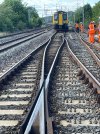
The track - It's all a bit bendy. As shown in the attached photo. Which shows part of the train still present and between it and the person that took the photo, the rails through the points are bent/distorted due to the forces imparted from the derailment. The switch diamonds/elbows are likely also in need of repair work (out of view).
Last edited:
MidlandRail
Member
I imagine it will be moved overnight?
The track - It's all a bit bendy. As shown in the attached photo. Which shows part of the train still present and between it and the person that took the photo, the rails through the points are bent/distorted due to the forces imparted from the derailment. The switch diamonds/elbows are likely also in need of repair work (out of view).
View attachment 182773
Also a driver that happily posted their journeys on YouTube…. Hopefully they have reviewed this after such a serious incident where they were regularly speeding.
He’s no longer a driver. He became a guard recently.
Falcon1200
Established Member
But of course it’s possible that if they fail in some way what you describe might be possible.
Not failure - see below!
The smaller the crossing angles, the longer the gap in the running surface necessary for the flange to pass through. Wheels drop further into longer gaps, creating impact damage, increasing wear to wheel and crossing, and causing a nasty jolt onboard.
Agree that is a reason for switch diamonds, but so is the risk of wheels taking the wrong path; In the Haymarket East Junction incident I alluded to above, a train making an unsignalled move, therefore without the route correctly set, was diverted at switch diamonds onto the wrong line. It didn't derail - Until it was moved to clear the line whereupon it did! Was the move at Bletchley also an unsignalled move?

NSEWonderer
Established Member
Interesting. Hoping it works out as planned but I also do hope that they've got the skates on standby, incase.New plan or even back to the old plan, no skates, move south tomorrow morning after 0900
zwk500
Veteran Member
Delay repay is counted as compensation rather than a refund so does not affect the revenue figures directly. Passenger numbers and revenue are indirectly affected by disruption in how it causes people to either not travel or to change travel habits to avoid the worst of it.A possibly tangential question.
Much is made of the passenger number and revenue figures.
How is delay repay factored into these?
I imagine many trevellers will have had free or much reduced fairs over the past few days.
If the railway can't actually run its timetable and everybody is travelling for free, makes you think.
(I've enjoyed a fair few cheap journeys over the years courtesy of the purely imaginary teimetable)
Government does publish the amount of Delay Repay paid: https://www.gov.uk/government/publi...ing-companies-passengers-charter-compensation
The total in 2023/24 was £138m, of which LNER, GWR and Avanti together paid just shy of £95m. There's other compensation also paid above delay repay (such as taxis to get people home if stranded) that probably isn't covered.
For context, in 2023-24:
Passenger numbers: 1.612b
Passsenger-km: 60.2b
Passenger ticket Revenue: £10.336b
(ORR data)
So delay repay from the rail industry was worth approximately 1% of ticket revenue.
Annetts key
Established Member
Based on what we know, yes. Because there is apparently no signalling route provided for the move that occurred. Therefore, if the driver was verbally authorised to proceed, the switch diamonds/elbows cannot have been set correctly for this move.Was the move at Bletchley also an unsignalled move?
It's not the first time that a signaller has failed to ensure that all the points in the route that a train has been authorised to take have been set correctly.

Signallers should have route cards available, check lists that detail the point numbers required to be set in specific positions for a particular move from signal to signal when the normal route setting methods fail to work, but these are only prepared for routes that exist in the interlocking. If the intended move has no signalling route then a route card for it will not exist.Based on what we know, yes. Because there is apparently no signalling route provided for the move that occurred. Therefore, if the driver was verbally authorised to proceed, the switch diamonds/elbows cannot have been set correctly for this move.
It's not the first time that a signaller has failed to ensure that all the points in the route that a train has been authorised to take have been set correctly.
zwk500
Veteran Member
We are getting dangerously close to treading on the toes of the investigating authorities, I fear.
rheingold103
Member
(Deleted)If the intended move has no signalling route then a route card for it will not exist.
Last edited:
Silverlinky
Member
- Joined
- 3 Feb 2012
- Messages
- 876
The unit is now on Bletchley relief Road 2 having moved there under its own power.

Robin Edwards
Member
- Joined
- 1 Dec 2013
- Messages
- 688
BBC Look East showed the said derailed 350 whilst indicating it was a freight train 

rogercov
Member
I'm guessing that 0Z37 is the rescue loco returning to Leicester (currently between Bletchley and Bedford).
Last edited:
I'm guessing that 0Z37 is the rescue loco returning to Leicester (currently between Bletchley and Bedfoed).
It is 37901 and made a fine sight and sound a couple of minutes across through Wellingborough.

We are getting dangerously close to treading on the toes of the investigating authorities, I fear.
Yes I agree. We need to let them get on with their task. Maybe suggest moderators pause this thread until any more official updates?
Yes. This probably is a good place to put hold on things for the time being.
Thanks everyone. We’ll reopen it when there’s further updates.
Just a brief update from the RAIB confirming they are investigating and the scope of that investigation:
 www.gov.uk
When there are further updates please let us know so we can post them or open the thread if appropriate. You can do this by reporting this post (bottom left).
Derailment at Denbigh Hall South Junction
Investigation into a derailment at Denbigh Hall South Junction, near Bletchley, Buckinghamshire, 26 June 2025.
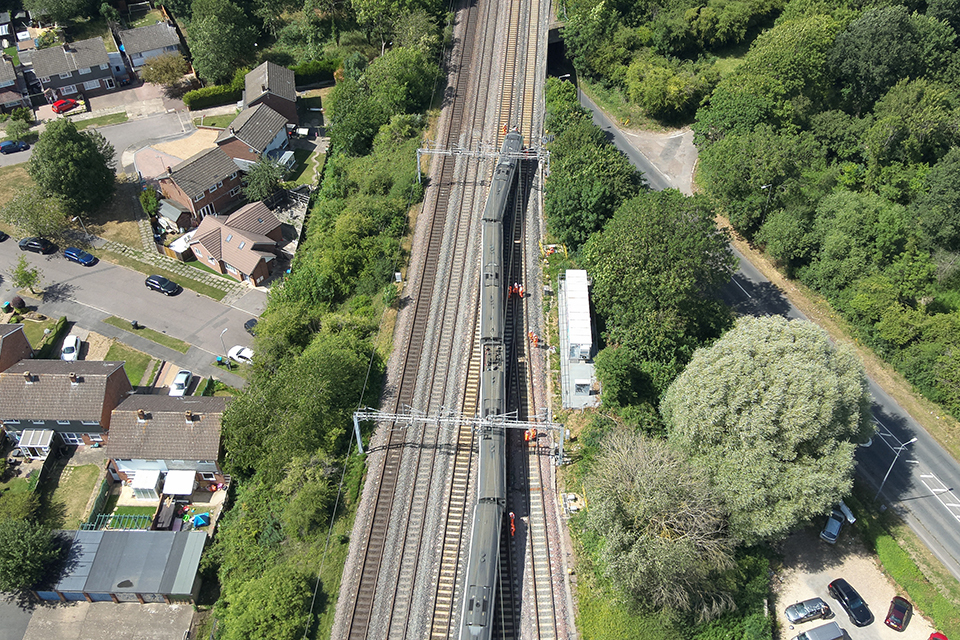
At around 12:27 on 26 June 2025, the front bogie of an out-of-service London Northwestern Railway passenger train derailed at Denbigh Hall South Junction on the West Coast Main Line. The derailment occurred on a switch diamond crossing at approximately 15 mph (24 km/h) as the train travelled north on the up slow line shortly after leaving Bletchley station. There were no reported injuries to the four members of staff on the train, however some lines through the junction remained out of use until 16:05 on 29 June 2025 for train recovery and infrastructure repair.
The train had earlier encountered a technical problem, while forming a southbound passenger service, making it unable to depart southwards from platform 4 at Bletchley. However, it was operational if driven northwards from the opposite end, allowing it to be moved away from the platform. A failed on-track machine had been stabled earlier that day on the only signalled route from the north end of platform 4, so staff at Rugby Rail Operating Centre decided to allow the train to travel in the wrong direction on the up (southbound) slow line. This wrong direction movement required the signaller to instruct the driver to pass the north end platform signal at danger and travel to Denbigh Hall South Junction without the protection normally afforded by the signalling interlocking. The intention was the train would then cross onto the down slow line at the junction and return it to normal signal control for its onward journey northwards to Kings Heath depot near Northampton.
Our investigation will determine the sequence of events which led to the derailment and will include consideration of:
Our investigation is independent of any investigation by the railway industry or by the industry’s regulator, the Office of Rail and Road.
- the actions of those involved and any factors that may have influenced them
- how out of course movements are determined and validated
- the management of the staff involved in the accident, including the preparation through training and assessment of those undertaking such movements
- any relevant underlying factors which might have contributed to the derailment.
Derailment at Denbigh Hall South Junction
Investigation into a derailment at Denbigh Hall South Junction, near Bletchley, Buckinghamshire, 26 June 2025.
When there are further updates please let us know so we can post them or open the thread if appropriate. You can do this by reporting this post (bottom left).
Full report now released:

 www.gov.uk
Report 04/2026: Derailment at Denbigh Hall South Junction
RAIB has today released its report into a derailment at Denbigh Hall South Junction, near Bletchley, Buckinghamshire, 26 June 2025.
RAIB has today released its report into a derailment at Denbigh Hall South Junction, near Bletchley, Buckinghamshire, 26 June 2025.
Summary
At about 12:27 on 26 June 2025, an out-of-service passenger train travelling at 15 mph (24 km/h) derailed as it passed over Denbigh Hall South Junction, on the West Coast Main Line, between Bletchley and Milton Keynes Central stations. At the time of the derailment, soon after the start of its journey from Bletchley station to a depot at Northampton, the train was making a wrong-direction movement over the junction. There were no injuries to any of the four members of train crew on the train but damage was caused to the train and to railway infrastructure.
The train derailed on switch diamond points which were in an unsafe position for the direction that the train was travelling over them. It had been necessary for the train to make a wrong-direction movement due to a fault which had prevented the driver from moving the train from the cab at one end. Once the need for the wrong-direction movement was identified and agreed, signalling staff at Rugby Signalling Control Centre proposed and then implemented a path for the train which they did not realise was invalid. Subsequent checking activities by these signalling staff did not identify this. When the train then arrived at the junction, no one in the train’s leading cab noticed that the switch diamond points were in an unsafe position for the train to pass over them.
Last edited:
MadMac
Established Member
So, essentially a number of experienced people who didn’t understand what a switch diamond is…..Full report now released:
Report 04/2026: Derailment at Denbigh Hall South Junction
RAIB has today released its report into a derailment at Denbigh Hall South Junction, near Bletchley, Buckinghamshire, 26 June 2025.
A number of people who where never trained as to what a switch diamond is more of an appropriate summary.So, essentially a number of experienced people who didn’t understand what a switch diamond is…..
Annetts key
Established Member
I wonder how many people in a "signalling centre", "control centre" or "ROC" have actually stood on a real railway line and seen for themselves what a switch diamond (or "elbows") actually looks like?A number of people who where never trained as to what a switch diamond is more of an appropriate summary.
In the past (under BR), signallers could go on track to manually operate points when required, so they got to see the real world. But in the "modern" world, most only ever see a diagram on a VDU, or on a panel or on a drawing/schematic.
And points not being correctly being set for an unsignalled move that resulted in a derailment or damage to track, point operating equipment (including run-throughs) or other infrastructure has happened before, multiple times.
Purple Train
Established Member
Not really. One experienced person made a stress-induced mistake (paragraph 90). Two relatively inexperienced people had been poorly trained (paragraphs 126 and 127). One not inexperienced driver and one experienced driver manager had also been poorly trained (paragraphs 130 and 134). Plus, very small holes in the Swiss cheese had already started aligning given the normal route was unusually blocked by a damaged road-rail vehicle.So, essentially a number of experienced people who didn’t understand what a switch diamond is…..
I have a few layman observations:
1) Would the driver be expected to have the route knowledge that an impossible route was being set? The report seems to focus on the training procedures for switch diamonds when making an unsignalled move, but would they be expected to know that there is no route from the up slow to the down slow at this location, without necessarily knowing the minutiae of why? Or, to put it another way, if the signaller attempted to set an impossible route across a fixed diamond, would the driver be expected to have the route knowledge to question it?
2) The report mentions in paragraph 158 a previous incident which involved running through an incorrectly-set switch diamond in the same way. In the Forum discussion linked here, which related to a previous RAIB report into a SPAD at Stafford (report is here), a few august members of the Forum reported that it was extremely rare for a train to run through switch diamonds without derailing. Would there be a speed at which a train could reliably traverse incorrectly-set switch diamonds, or is it solely extreme good fortune that so few of these incidents have resulted in derailment?
3) Is it unusual for the train to have three driver changes in such a short space of time, at Northampton, Milton Keynes Central, and Bletchley?
All quotes attached here. Paragraph 90:
Paragraph 126:The SSM was working while dealing with significant personal issues, both long-term and more recent. Witness evidence indicates the SSM did not realise the impact this was having on them and how it was affecting their concentration and decision-making at work. No one at Rugby SCC, including signaller 1 and signaller 2, had noticed any issues with the SSM’s performance or behaviour, nor had anyone asked them how they were. Witness evidence suggests that, if the SSM had declared their personal issues to their manager, they would have been taken off duty on compassionate grounds. Had their manager been made aware, Network Rail could also have reviewed the SSM’s personal circumstances and taken action, such as providing additional monitoring and support. However, the SSM thought at the time that they were coping, so they did not say anything to anyone.
Paragraph 127:Signaller training on switch diamond points is limited and the knowledge each signaller had about them tended to be related to the amount of experience they had gained while working as a signaller. The initial signaller training course
includes some basic information on points, but the focus is on explaining what trailing points and facing points are, in relation to setting routes. There is a picture of switch diamond points shown in the training material, within a short section that provides an overview of track infrastructure. However, this was one presentation slide in a 10 to 12-week course (paragraph 98).
Paragraph 130:Network Rail stated that it expected new signallers to learn about switch diamond points as part of their local training if this type of infrastructure was present in the geographical control area covered by the signal box or signalling centre they were working at. RAIB found that the systems training at Rugby SCC did not include any specific training material about switch diamond points and that neither signaller 1, nor signaller 2, had received any specific training about switch diamond points during their local training.
Paragraph 134:The West Midlands Trains training material for new drivers, which covered points in a section about track infrastructure, was focused on understanding basic
information about points such as what facing and trailing means. It also covered the different types of points a driver might encounter such as powered points, hand operated points and trap points. The training material aligned with the driver’s experience from the training they had received on the types of points. The driver had no recollection of being told in any depth about switch diamond points during their training.
Paragraph 158:The current training provided to new drivers at West Midlands Trains does not include any specific information about switch diamond points. West Midlands Trains stated to RAIB that it believed that information about switch diamond points had been added to the training after the Hemel Hempstead derailment, but it had since been taken out when the training materials were updated.
The Stafford Trent Valley Junction No. 1 report summary:RAIB identified one further incident in the data which involved switch diamond points. It happened at Bushbury Junction on 16 July 2019. A freight train was diverted onto the wrong line via switch diamond points after only one of the point ends was secured in the correct position (figure 23). At the time, a trainee signaller was managing a points failure which required the freight train to be authorised to pass a signal at danger in accordance with Rule Book module S5.
As per custom I have not attached the report link as that is provided in post #170.At about 16:41 hrs on 22 August 2023, an electric locomotive operated by Freightliner passed a signal at danger (red) on the approach to Stafford Trent Valley Junction No. 1. The locomotive was on a test run, after repair work, and continued for 740 metres beyond the signal, before running through points as it came to a stand at the junction.
The position where the locomotive stopped conflicted with a route that had been set for a southbound train, although that train was not in the immediate vicinity at the time
that the locomotive stopped. A second, northbound, train had passed the junction a few seconds before the locomotive reached the points, but the locomotive did not foul the line that the northbound train had been travelling on.
No one was injured in the incident and the locomotive did not derail, although some damage was sustained to the points which were run through.
The investigation found that the locomotive had been travelling too quickly as it approached the red signal before the junction, meaning it was unable to stop before passing it. This was because the driver’s focus was diverted from the aspects showing at previous signals which warned that a red signal should be expected ahead.
This took place while the driver was dealing with a fault that had occurred on the locomotive and which had caused the driver to bring the locomotive to a stand at a
previous signal. It is possible that this previous signal was not clearly visible to the driver when they restarted the train after resetting the fault, and that the presence of the fault, and the need to rectify it, distracted the driver, who had not experienced that scenario before.
Annetts key
Established Member
If the signalling system was being used rather than setting the points via their individual controls, it shouldn't be possible to set a route with switch diamonds set incorrectly.I have a few layman observations:
1) Would the driver be expected to have the route knowledge that an impossible route was being set? The report seems to focus on the training procedures for switch diamonds when making an unsignalled move, but would they be expected to know that there is no route from the up slow to the down slow at this location, without necessarily knowing the minutiae of why? Or, to put it another way, if the signaller attempted to set an impossible route across a fixed diamond, would the driver be expected to have the route knowledge to question it?
For fixed diamonds, the signallers display (VDU) diagram, drawing etc. is different, so it's less likely that there would be a similar mistake. And importantly, there are no point control switches for them!
It's luck / extreme good fortune, as the rails, fittings and the rest of the track and point work etc. are not designed for anything other than the "straight on" or "crossing over" directions. They are not and are not designed or supposed to be used as turn outs.2) The report mentions in paragraph 158 a previous incident which involved running through an incorrectly-set switch diamond in the same way. In the Forum discussion linked here, which related to a previous RAIB report into a SPAD at Stafford (report is here), a few august members of the Forum reported that it was extremely rare for a train to run through switch diamonds without derailing. Would there be a speed at which a train could reliably traverse incorrectly-set switch diamonds, or is it solely extreme good fortune that so few of these incidents have resulted in derailment?
Dave W
Member
I found it intriguing that RAIB intimated that - although no route card existed for the reason you gave here - it might have been appropriate to use the route card "in reverse" (paragraph 99). I'm not a signaller (or on the railway) but that seems to me to be a potential trap (para 99 quoted):Signallers should have route cards available, check lists that detail the point numbers required to be set in specific positions for a particular move from signal to signal when the normal route setting methods fail to work, but these are only prepared for routes that exist in the interlocking. If the intended move has no signalling route then a route card for it will not exist.
As there was no signalled route from TK9821 signal along the Up Slow line, no one involved thought there would be a relevant route card, so they did not think to use one. However, the train had used a signalled route to get to where it was at platform 4 at Bletchley station and the route card for that route could have been used in reverse for the wrong-direction movement back along the Up Slow line.
This was a strange sequence of events and shows a lot of people doing their best to keep the railway moving falling foul of them despite the best of intentions. Glad that it wasn't attended with injury or worse - good learning points all round. Even one for the RSSB!
Paragraphs 155 and 156 are interesting. RSSB state that because the move was an unsignalled one, there was no requirement for the signaller to authorise the driver to pass the signal at danger. It sounds like both the signallers and driver managers politely told them what they think of that idea!
MadMac
Established Member
Signal Engineer here: I recall being asked some 30 years ago to provide what was then called a “Section E Chart” listing for a movement which had no signalled route. After some fairly high-level discussions, we declined to do so.I found it intriguing that RAIB intimated that - although no route card existed for the reason you gave here - it might have been appropriate to use the route card "in reverse" (paragraph 99). I'm not a signaller (or on the railway) but that seems to me to be a potential trap (para 99 quoted)
== Doublepost prevention - post automatically merged: ==
Lots of good points here: the part about the manager’s personal issues had completely slid past me. Incidents of this nature are generally never down to one single issue, but a combination of circumstances coming together as a “perfect storm”.Not really. One experienced person made a stress-induced mistake (paragraph 90). Two relatively inexperienced people had been poorly trained (paragraphs 126 and 127). One not inexperienced driver and one experienced driver manager had also been poorly trained (paragraphs 130 and 134). Plus, very small holes in the Swiss cheese had already started aligning given the normal route was unusually blocked by a damaged road-rail vehicle.
Purple Train
Established Member
Indeed, this does seem like an absolutely classic "perfect storm". I hope the SSM is doing well.Lots of good points here: the part about the manager’s personal issues had completely slid past me. Incidents of this nature are generally never down to one single issue, but a combination of circumstances coming together as a “perfect storm”.
geoffikent
New Member
Sorry for being thick but I took the RAIB report as saying the signaller set an impossible route from US to DS line. How did the signalling system allow this?
- Status
- Not open for further replies.