• Our new ticketing site is now live! Using either this or the original site (both powered by TrainSplit) helps support the running of the forum with every ticket purchase! Find out more and ask any questions/give us feedback in this thread!

Is Hydrogen dead as a power source for trains?

Status
Not open for further replies.

Andrew*Debbie

Member
Joined
1 Feb 2017
Messages
323
Location
Llanfairpwllgwyngyll ...
They weren't very good, but it has been done.

well I know, but as you say - not very good, and not being pursued.

JCB are. They've built a hydrogen combustion engine based on their existing diesel. The top end is all new, but the motor drops into their exising vehicles. There might be a buisness case for a few edge cases. My guess is JCB are inovating themselves in to administration.

Most construction locations have or will have power nearby which could be used to recharge batteries. In the end lower cost will win out.
 
Sponsor Post - registered members do not see these adverts; click here to register, or click here to log in
R

RailUK Forums

Energy

Established Member
Joined
29 Dec 2018
Messages
5,135
JCB are. They've built a hydrogen combustion engine based on their existing diesel. The top end is all new, but the motor drops into their exising vehicles. There might be a buisness case for a few edge cases. My guess is JCB are inovating themselves in to administration.

Most construction locations have or will have power nearby which could be used to recharge batteries. In the end lower cost will win out.
JCB are doing both, they have some battery ones on the smaller end. Hydrogen is for the larger machines on sites without clear charging infrastructure and often not the time to recharge. Fuel cells don't handle the dust well apparently.
 

GRALISTAIR

Established Member
Joined
11 Apr 2012
Messages
10,520
Location
Preston Lancs
This is an interesting area of research for me - and others too.


There is no perfect energy source, nothing that will power our vehicles without some kind of catch. Consider hydrogen. For decades it’s been propped up as a worthy alternative to oil, even if infrastructure-related hiccups seem to always hold it back from reaching its full potential. Nevertheless, there seems to be a bit of space left for hydrogen-powered vehicles even in a battery electric-dominated world. But new research indicates that hydrogen buildup could have adverse effects on the climate, not terribly unlike the fuel it’s meant to replace.
 

AndrewE

Established Member
Joined
9 Nov 2015
Messages
7,350
Another nail in the coffin: https://www.hydrogeninsight.com/tra...year-opts-for-all-electric-future/2-1-1495801 says

No more hydrogen trains | Rail company that launched world's first H2 line last year opts for all-electric future​

State-owned LNVG to buy 102 battery trains and 27 catenary-connected models in order to phase out diesel, says Lower Saxony government​

LNVG, which is owned by the government of Lower Saxony, had invested more than €93m ($85m) in 14 hydrogen fuel-cell trains, which began operating in August 2022.
The federal government also contributed a further €8.4m — €4.3m of which was spent on the world’s first H2 train refuelling station, built by Linde in the town of Bremervörde.

The state’s Ministry for Economic Affairs, Transport, Building and Digitisation explains that battery trains can be powered by overhead electricity lines (ie, catenary systems), or be charged by what it calls “charging islands” — and can operate without constant contact with the overhead cables.
“The basis for the purchase of the new battery-powered is market research into alternative drives, which LNVG carried out,” the ministry said in a statement. “In particular, trains with hydrogen drives and batteries were considered. Result: battery trains are cheaper to operate.”
The quoted bit finishes with "Result: battery trains are cheaper to operate."

== Doublepost prevention - post automatically merged: ==

and a late addition, about a different area of Germany: https://www.hydrogeninsight.com/tra...al-six-months-after-service-began/2-1-1462885
is worth reading in full

The 'misery' line | World’s largest hydrogen train fleet still not fully operational six months after service began​

German transport authority will provide free travel for two months to compensate fed-up passengers for the ‘incredible amount of bad public transport’

A new €500m ($530m) fleet of 27 hydrogen trains was scheduled to be in operation on four railway lines to the German city of Frankfurt last December, but only 12 trains are currently in use on one line, with the full complement not expected to be ready until September at the earliest.
Reassures me that the people who say that UK engineers /railway people are uniquely incompetent are wrong!
 
Last edited:

fandroid

Established Member
Joined
9 Nov 2014
Messages
2,566
Location
Hampshire
"80% cheaper to operate" That is battery powered trains in comparison with hydrogen according to the transport authority in Germany's Niedersachsen state.

That's been known for a while by anyone who can do basic arithmetic, but the hydrogen lobby insisted on their product's "advantages".
 

Invincible

Member
Joined
23 Apr 2022
Messages
856
Location
Surrey
Modern Railways 2-3 months back mentioned a parliamentary committee meeting on this topic. The decision was that Hydrogen wouldn't be viable until 2050 - and therefore they should _continue_ research into it with prototypes etc. You couldn't make this up.. there is plenty of time to look at it in the next 20 years, not now..
Of the 3 UK prototypes based on old MK3 EMUs:
1. The Scottish one has had its fuel cells removed
2. Alstom's demonstrator train seems to have been scrapped in favour of new 10 Aventuras which have yet to be ordered.
3. From another thread (class 230 movements) the Birmingham of University and Porterbrock's demonstrator train has been moved from Long Marston to a station near to the Uni. It's not certain what's happening with it?
 
Last edited:

Rhydgaled

Established Member
Joined
25 Nov 2010
Messages
4,861
The realistic range is also lower than that of a battery train & cannot benefit from OLE / 3rd rail top ups to a sufficient degree
I thought the issue was that, where there is a very long stretch without any electrified sections to recharge batteries, a BEMU doesn't have sufficient range. TfW's tri-mode FLIRTs have a diesel engine because they are not completely confident of being able to manage the Vale Of Glamorgan line (where no electrification is currently funded/authorised/planned) on batteries alone.

Certainly if a route involves part running over exiting electrification then BEMUs definitely the way forward. BEMUs could be used on longer distance non electrified routes if the schedule would cope with extended durations for in route recharging otherwise hydrogen remains the only non polluting option. Mind you for the miniscule amount of emissions a few diesel trains would have I wouldn't be going to all the effort and expense.
I imagine it's the recharging time (and/or difficultly finding sufficent power for a charger) in places like the Heart Of Wales or Scottish highlands that means BEMUs don't quite cut it.

There is a point where a hydrogen train trumps a battery train as the volume/weight ratio of carrying the batteries required for a Certain distance is trumped by hydrogen. I'm not sure it may be feasible in the UK other than the Scottish Highland / far north lines and the heart of Wales routes. In other larger countries it may be feasible imo.
Which is almost exactly the conclusion Network Rail's Traction Decarbonisation Network Strategy (TDNS) interim programme business case comes to. TDNS Executive Summary link here - there's a map in there showing the recommended decarbonisation solution for each route. The only routes earmarked for hydrogen are:
  • Shrewsbury - Aberystwyth/Pwllheli (Cambrian Lines)
  • Craven Arms - Llangennech (Heart Of Wales Line)
  • Westerfield - Lowestoft (East Suffolk Line)
  • Norwich - Great Yarmouth / Lowestoft (Wherry Lines)
  • Norwich - Sheringham (Bittern Line)
(in Scotland battery and hydrogen are grouped as 'alternative traction' since the TDNS just used the existing decarbonisation plan already developed in Scotland, otherwise I suspect hydrogen would also have been recomended for some of those).

What about a bimode hydrogen/electric unit for the London Waterloo to Exeter st davids service
Nope; the TDNS recomendation is electrification, with Basingstoke-Salisbury being 'Core Electrification' and Salisbury-Exeter 'Ancillary Electrification' which I think means the business case is marginal but still comes out better than battery or hydrogen trains.

The Barton Branch would be a possible candidate
Nope; in the TDNS Barton on Humber is just a very short stub of unelectrified line so is the TDNS recommends BEMUs.

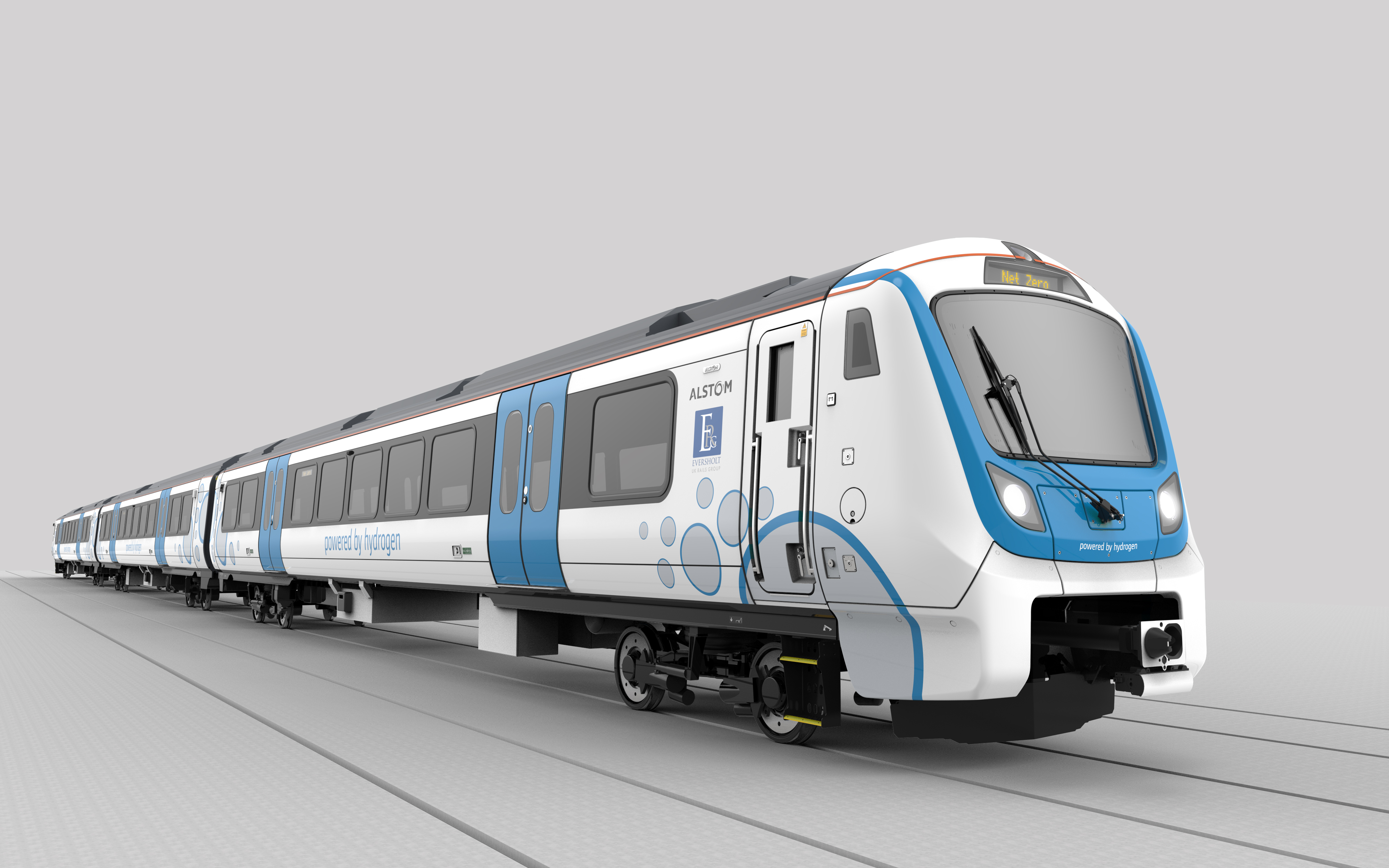
Alstom is still pushing the technology. They announced an Aventra version in 2021, but has not seem to have progressed?

== Doublepost prevention - post automatically merged: ==


In a hydrogen train batteries can be charged by the fuel cell, but think the drive motors can also act as alternators topping up batteries when the train brakes.
The batteries can then help boost the output of the fuel cells to the drive motors when accelerating to aid efficiency.
Apparently, the Hydrogen Aventras are/were planned to be built without pantographs so, as reddragon said above, cannot benefit from existing OLE / 3rd rail. That is absolutely nuts in my view; the range of a hydrogen unit before having to refuel, while expected to be longer than batteries, is still less than a DMU. Thus, hydrogen bi-modes seem to be a possible way forward - by interworking diagrams with under-wires routes you could limit the total mileage on unwired routes (thus avoiding the need to take units out of service for refueling in the middle of the day). For example once Aberdeen-Inverness-Tain is all wired up (which is in Scotland's plan, but not until after 2035) they could interwork Kyle Of Lochalsh and Wick/Thurso services with Aberdeen-Inverness ones meaning each unit spends less time consuming hydrogen over the course of the day.

Alstom's demonstrator train seems to have been scrapped in favour of new 10 Aventuras which have yet to be ordered.
I thought the Aventra announcement was an order announcement?

actually implementing proven options rather than increasing the shopping list of possible options.
Agreed, it's time to be getting on with things.
 

Bald Rick

Veteran Member
Joined
28 Sep 2010
Messages
35,867
The TDNS has long since been put out of its misery.

Hydrogen has only very marginal possibilities. I’d suggest likely none.
 

Invincible

Member
Joined
23 Apr 2022
Messages
856
Location
Surrey
there's a map in there showing the recommended decarbonisation solution for each route. The only routes earmarked for hydrogen are:
  • Shrewsbury - Aberystwyth/Pwllheli (Cambrian Lines)
  • Craven Arms - Llangennech (Heart Of Wales Line)
  • Westerfield - Lowestoft (East Suffolk Line)
  • Norwich - Great Yarmouth / Lowestoft (Wherry Lines)
  • Norwich - Sheringham (Bittern Line)
(in Scotland battery and hydrogen are grouped as 'alternative traction' since the TDNS just used the existing decarbonisation plan already developed in Scotland, otherwise I suspect hydrogen would also have been recomended for some of those).


Nope; the TDNS recomendation is electrification, with Basingstoke-Salisbury being 'Core Electrification' and Salisbury-Exeter 'Ancillary Electrification' which I think means the business case is marginal but still comes out better than battery or hydrogen trains.


Nope; in the TDNS Barton on Humber is just a very short stub of unelectrified line so is the TDNS recommends BEMUs.


Apparently, the Hydrogen Aventras are/were planned to be built without pantographs so, as reddragon said above, cannot benefit from existing OLE / 3rd rail. That is absolutely nuts in my view; the range of a hydrogen unit before having to refuel, while expected to be longer than batteries, is still less than a DMU. Thus, hydrogen bi-modes seem to be a possible way forward - by interworking diagrams with under-wires routes you could limit the total mileage on unwired routes (thus avoiding the need to take units out of service for refueling in the middle of the day). For example once Aberdeen-Inverness-Tain is all wired up (which is in Scotland's plan, but not until after 2035) they could interwork Kyle Of Lochalsh and Wick/Thurso services with Aberdeen-Inverness ones meaning each unit spends less time consuming hydrogen over the course of the day.


I thought the Aventra announcement was an order announcement?


Agreed, it's time to be getting on with things.

The announcement was just a Memorandum of Understanding.
Perhaps time for the DfT and Eversholt to agree to get one hydrogen/battery Aventra ordered as a test unit in East Anglia with a refueling facility on the routes mentioned. This way the technology can be trialled to see if the problems in Germany also apply to the UK?
But after the home boiler trial in Whitby never took off, there is a lot to do to make hydrogen acceptable as a safe fuel to the public.
Rachel Riley has been hired by the boiler industry, but will need more than just Rachel.
 
Last edited:

Energy

Established Member
Joined
29 Dec 2018
Messages
5,135
  • Westerfield - Lowestoft (East Suffolk Line)
  • Norwich - Great Yarmouth / Lowestoft (Wherry Lines)
  • Norwich - Sheringham (Bittern Line)
The latter two already pan up at Norwich and the first one terminates under the wires at Ipswich. None are particularly long and could be done by batteries.
 

Meerkat

Established Member
Joined
14 Jul 2018
Messages
9,276
The latter two already pan up at Norwich and the first one terminates under the wires at Ipswich. None are particularly long and could be done by batteries.
IIRC they were picked because of a hydrogen hub being built round there…(Lowestoft??)
 

Energy

Established Member
Joined
29 Dec 2018
Messages
5,135
IIRC they were picked because of a hydrogen hub being built round there…(Lowestoft??)
Could make sense as a trial line. Otherwise hydrogen is more expensive than batteries so should only be used where the latter isn't possible.
 

Nicholas Lewis

Established Member
Joined
9 Aug 2019
Messages
8,024
Location
Surrey
I imagine it's the recharging time (and/or difficultly finding sufficent power for a charger) in places like the Heart Of Wales or Scottish highlands that means BEMUs don't quite cut it.
Not a real issue as you just recharge from battery storage which is trickle charged between services. Its not as if there are many trains requiring to be recharged so plenty of time to store energy. The termini in North of Scotland can easily provide a sub 500kW charging supply and probably more given they are awash with excess wind generation all too often.
 

Invincible

Member
Joined
23 Apr 2022
Messages
856
Location
Surrey
IIRC they were picked because of a hydrogen hub being built round there…(Lowestoft??)
Found the press release
They expect to be producing green Hydrogen in 2024.
This hydrogen could be used in E Anglia with a test demonstration Aventra with Alstom Lint hydrogen technology if the DfT and Eversholt provided some funding?

Ideally alongside another Aventra, Siemens or Flirt test demonstration train with lots of batteries, using fast and braking charging, as in the East Ealing trial, but over 20 miles, rather than 3.
Then it will prove the future technology to use in the UK in service.

The worrying thing is the date of Conrad Energies press release being April 1st. But other that Conrad Energies seem genuine about the new plant.
 
Last edited:

mike57

Established Member
Joined
13 Mar 2015
Messages
2,400
Location
East coast of Yorkshire
I always thought Hydrogen was a 'dead end', there are too many problems. The chemical and physical properties make it problematic at best and down right dangerous at worst. Hydrogen embrittlement of metals means material selection for the contact areas is limited, and potentially expensive. It has one of the widest explosive ranges of any gas in air, and the resulting explosions are energetic, so any loss of containment is serious. Efficencies in terms of conversion into rail horsepower from energy input to make the hyrdogen are very poor.

It may have niche applications outside railways but for rail use there are other alternatives, with the simplest being 2 or 4 stroke Diesel engines using biodiesel if available. Assuming we are in a parallel universe where only the remote branch lines remain un-electrified then the rail contribution to emissions are miniscule. If money is available to upgrade on the basis of a reduction in emissions then dealing with remote branch lines where there are few trains per day must be the lowest priority, and it seems like these were the routes where Hydrogen was intended for.

I have to say it felt like a waste of money at the time it was first proposed, and my view hasn't changed.
 

AndrewE

Established Member
Joined
9 Nov 2015
Messages
7,350
I always thought Hydrogen was a 'dead end', there are too many problems. The chemical and physical properties make it problematic at best and down right dangerous at worst. Hydrogen embrittlement of metals means material selection for the contact areas is limited, and potentially expensive. It has one of the widest explosive ranges of any gas in air, and the resulting explosions are energetic, so any loss of containment is serious. Efficencies in terms of conversion into rail horsepower from energy input to make the hyrdogen are very poor.

It may have niche applications outside railways but for rail use there are other alternatives, with the simplest being 2 or 4 stroke Diesel engines using biodiesel if available. Assuming we are in a parallel universe where only the remote branch lines remain un-electrified then the rail contribution to emissions are miniscule. If money is available to upgrade on the basis of a reduction in emissions then dealing with remote branch lines where there are few trains per day must be the lowest priority, and it seems like these were the routes where Hydrogen was intended for.

I have to say it felt like a waste of money at the time it was first proposed, and my view hasn't changed.
Nail. Head. Hit.
It is just a money-making game to suck up development subsidies. And a bit of Fossil-fuel delaying tactic and smoke-screen.
 

Meerkat

Established Member
Joined
14 Jul 2018
Messages
9,276
Green hydrogen isn’t really green until the whole power generation system is green, otherwise it’s just a displacement of ungreen power use.
Unless the green hydrogen plant runs as a sort of battery, only working when there is spare renewable power to mop up. But I struggle to see that as viable - presumably the capital cost in the plant and extra storage buffer to provide a predictable hydrogen supply would cost too much??
 

JamesT

Established Member
Joined
25 Feb 2015
Messages
4,888
Green hydrogen isn’t really green until the whole power generation system is green, otherwise it’s just a displacement of ungreen power use.
Unless the green hydrogen plant runs as a sort of battery, only working when there is spare renewable power to mop up. But I struggle to see that as viable - presumably the capital cost in the plant and extra storage buffer to provide a predictable hydrogen supply would cost too much??
That is pretty much the idea. Hydrogen provides a way to store excess renewable electricity production. Rather than turning off wind farms because the grid can't cope, you can divert into hydrogen production.
As to whether it's viable, lots of companies/countries appear to be trying it, so they must believe there's something in it.
 

HSTEd

Veteran Member
Joined
14 Jul 2011
Messages
20,344
As to whether it's viable, lots of companies/countries appear to be trying it, so they must believe there's something in it.
A lot of those companies happen to have huge investments tied in gas distribution assets, so a cynic might suggest they are desperate to avoid those assets being stranded
 

Rhydgaled

Established Member
Joined
25 Nov 2010
Messages
4,861
Not a real issue as you just recharge from battery storage which is trickle charged between services. Its not as if there are many trains requiring to be recharged so plenty of time to store energy. The termini in North of Scotland can easily provide a sub 500kW charging supply and probably more given they are awash with excess wind generation all too often.
An hourly service is 'not many trains' is it? Because that's the level of service on some of the routes where the TDNS recommended hydrogen (in Wales and Anglia - in Scotland they just left it as 'alternative traction' without specifying whether that would be battery or hydrogen yet). If you recharge everything at the halfway point on the route that is two trains an hour (one in each direction). If the batteries give sufficient range to only need to charge the batteries at termini then a battery train might be workable (although the turnaround time at Aberystwyth can be less than 10 minutes if the train is delayed). However if you also need to recharge mid-route then you are potentially increasing the journey time by having to stop to 'fill up'. Since most (perhaps all?) of the routes in question involve single track sections you might also find that the timetable no longer works because charging time makes the train miss it's slot over the single line and isn't at the passing loop when it needs to be to pass an oncoming service.
 

Nicholas Lewis

Established Member
Joined
9 Aug 2019
Messages
8,024
Location
Surrey
An hourly service is 'not many trains' is it? Because that's the level of service on some of the routes where the TDNS recommended hydrogen (in Wales and Anglia - in Scotland they just left it as 'alternative traction' without specifying whether that would be battery or hydrogen yet). If you recharge everything at the halfway point on the route that is two trains an hour (one in each direction). If the batteries give sufficient range to only need to charge the batteries at termini then a battery train might be workable (although the turnaround time at Aberystwyth can be less than 10 minutes if the train is delayed). However if you also need to recharge mid-route then you are potentially increasing the journey time by having to stop to 'fill up'. Since most (perhaps all?) of the routes in question involve single track sections you might also find that the timetable no longer works because charging time makes the train miss it's slot over the single line and isn't at the passing loop when it needs to be to pass an oncoming service.
I was responding to the ability to provide charging capability in more rural areas not assessing the impact on schedules but your observations on operational issues are entirely relevant and would suggest are the key issues that undermine battery operation in this country. In Europe they would be content with having extra units that have time to layover to ensure fully charged.
 

Rhydgaled

Established Member
Joined
25 Nov 2010
Messages
4,861
I was responding to the ability to provide charging capability in more rural areas not assessing the impact on schedules but your observations on operational issues are entirely relevant and would suggest are the key issues that undermine battery operation in this country.
Fair enough.

In Europe they would be content with having extra units that have time to layover to ensure fully charged.
They would still need sufficient range to get to the end of the line in order to have the long layover to recharge (here in Wales, the battery would need to last from Shrewsbury to Pwllheli*) and may also need an additional siding to hold the extra unit being charged. Going back to the topic title - there are very few cases where a hydrogen train makes any sense but they aren't quite zero.

* personally, I think the Cambrian mainline between Shrewsbury and Dovey Junction warrants at least the 5 coaches per direction per hour that I consider makes a line worthy of electrification eventually (which might put Pwllheli within battery range of the wires), but this seems to be one of the few routes where I don't entirely agree with the TDNS recommendation.
 

Turtle

Member
Joined
18 Mar 2013
Messages
468
Fair enough.


They would still need sufficient range to get to the end of the line in order to have the long layover to recharge (here in Wales, the battery would need to last from Shrewsbury to Pwllheli*) and may also need an additional siding to hold the extra unit being charged. Going back to the topic title - there are very few cases where a hydrogen train makes any sense but they aren't quite zero.

* personally, I think the Cambrian mainline between Shrewsbury and Dovey Junction warrants at least the 5 coaches per direction per hour that I consider makes a line worthy of electrification eventually (which might put Pwllheli within battery range of the wires), but this seems to be one of the few routes where I don't entirely agree with the TDNS recommendation.
Going back to basics here, wasn't the hydrogen thing something of a distraction to shut up those annoying train spotter types who were always banging on about further electrification. I have a recollection from the previous decade of someone's query about further electrification being airily dismissed by a remark that by the 2020s hydrogen powered trains would be the norm.
 

renegademaster

Established Member
Joined
22 Jun 2023
Messages
2,217
Location
Croydon
The simple fact is that the Oil & Gas industry is pouring hundreds of £millions into lobbying for Hydrogen to save their bacon, absolutely no other reason than the financial gain of the super rich shareholders & beneficiaries, that's it!
They have plenty of fingers in the lithium industry too, it's not a conspiracy theory it's just people who don't understand energy density who think they can fix the weak points of an electric car
 

eldomtom2

On Moderation
Joined
6 Oct 2018
Messages
2,387
Going back to basics here, wasn't the hydrogen thing something of a distraction to shut up those annoying train spotter types who were always banging on about further electrification. I have a recollection from the previous decade of someone's query about further electrification being airily dismissed by a remark that by the 2020s hydrogen powered trains would be the norm.
Oh absolutely, especially in countries like the US. There's a reason why the term "bionic duckweed" exists.
 
Last edited:

Bald Rick

Veteran Member
Joined
28 Sep 2010
Messages
35,867
They would still need sufficient range to get to the end of the line in order to have the long layover to recharge (here in Wales, the battery would need to last from Shrewsbury to Pwllheli*) and may also need an additional siding to hold the extra unit being charged. Going back to the topic title - there are very few cases where a hydrogen train makes any sense but they aren't quite zero.

Not so. Absolutely no reason why units with, say, a 70km battery range couldn’t be charged on short islands of electrification en route. Just like is being done elsewhere in Wales.

If hydrogen gets any serious main line application on the passenger railway, it will be because of politics, not economics (or physics).
 

AndrewE

Established Member
Joined
9 Nov 2015
Messages
7,350
Not so. Absolutely no reason why units with, say, a 70km battery range couldn’t be charged on short islands of electrification en route. Just like is being done elsewhere in Wales.

If hydrogen gets any serious main line application on the passenger railway, it will be because of politics, not economics (or physics).
It won't (shouldn't) because of the shockingly poor round-trip efficiency if made from renewable energy, and because otherwise it is either made (using lots of power) from natural gas or is an industrial by-product from the fossil-fuel industry.
Its only real use is to mop up renewable electricity which would otherwise go to waste, such as on a distant Hebridean island where the power can't be exported...
 
Status
Not open for further replies.

Top