Our new ticketing site is now live! Using either this or the original site (both powered by TrainSplit) helps support the running of the forum with every ticket purchase! Find out more and ask any questions/give us feedback in this thread!
Is this because of different floor heights between GWR stock and the 345s? You can't build a platform higher than the lowest floor height (grandfathered exceptions aside).
Is this because of different floor heights between GWR stock and the 345s? You can't build a platform higher than the lowest floor height (grandfathered exceptions aside).
Yeah the floor height of a 387 is lower, but they aren’t using the same platforms. It would reduce the ability to use relief lines for maintenance or disruption.
Yeah the floor height of a 387 is lower, but they aren’t using the same platforms. It would reduce the ability to use relief lines for maintenance or disruption.
The 387s will be required to use the relief lines during 2-tracks, surely? Which means the outer lines at the very least need the platform height lowered, and then there's regulations about the cross-fall and intersection of platform gradients that means if you're building a new island it's going to be the same height both sides.
Could they just say that GWR won’t stop at OOC when it’s relief line only running? Or is this a gauge issue that would prevent them from running through at all? In which case I suggest they non-stop one pair of main line platforms per work day. (Edit assuming they can get to and from lines they can separate from track workers)
Having checked, the floor heights appear to be only 6mm different. That will have no meaningful effect on either gauging or level boarding. The issue is then presumably the need for freight access to Westbourne Park aggregate terminal
HS2 initiated an enormously expensive (and hopeless) court battle with the EU (terminated by Brexit) to win the right to not use a standard platform height!
Such standards are not really something the UK rail industry believes in in any real sense.
From memory Bakerloo line trains are a big step down between Queens Park & Stonebridge Park because the platform heights are designed as a compromise so 313 units & later main line trains & tube stock can share them.
No one has suggested the Bakerloo line be banned because of the step down, & as far as I know no one has been hurt as a result of stepping down into the Bakerloo line train.
From memory Bakerloo line trains are a big step down between Queens Park & Stonebridge Park because the platform heights are designed as a compromise so 313 units & later main line trains & tube stock can share them.
No one has suggested the Bakerloo line be banned because of the step down, & as far as I know no one has been hurt as a result of stepping down into the Bakerloo line train.
Old Oak Common is expected to be one of, if not the busiest railway station in the UK and with all the traffic going through time can't be wasted with ramps
From memory Bakerloo line trains are a big step down between Queens Park & Stonebridge Park because the platform heights are designed as a compromise so 313 units & later main line trains & tube stock can share them.
No one has suggested the Bakerloo line be banned because of the step down, & as far as I know no one has been hurt as a result of stepping down into the Bakerloo line train.
The 387s will be required to use the relief lines during 2-tracks, surely? Which means the outer lines at the very least need the platform height lowered, and then there's regulations about the cross-fall and intersection of platform gradients that means if you're building a new island it's going to be the same height both sides.
I don't know if this is possible but given that trains have different door layouts is not possible to create platforms with different humps depending upon the door position of trains?
ie a Class 345 / 387 hump aligned for for Class 387s / Class 345s and separate hump aligned for IETs?
I don't know if this is possible but given that trains have different door layouts is not possible to create platforms with different humps depending upon the door position of trains?
ie a Class 345 / 387 hump aligned for for Class 387s / Class 345s and separate hump aligned for IETs?
At that point you may as well just raise the entire platform up rather than having it go up and down.
I don't see any solution to this on general-purpose lines that doesn't involve gap fillers. In principle, a gap filler could also provide a ramp down to the standard platform height. Retrofitting them to existing trains would be a challenge, but it might be overall the smallest possible intervention. If nothing else, having it on the train reduces the amount of complex infrastructure work needing done to platforms across the network, and provides a solution for lines with heterogeneous traffic.
Surely this issue has nothing to do with differences in train floor height. Level boarding requires platform and train floor at the same height, with an acceptably small gap horizontally between them. That has never been possible on the general rail network, due to the historical range of train widths and platforms to match them. There are also a lot of curved platforms where a safe horizontal gap just isn't possible.
As a consequence, standard practice has been for the train's floor (usually a step outside the doors) to oversail the platform edge. That replaces a variable horizontal gap, which can be too wide, by a vertical gap that is even more variable, but which is seen as acceptably safe.
If you choose all the trains, and can build only straight platforms, you can make the horizontal gaps small. Crossrail have done that, but to work outside the core they also have to conform to heavy rail PTI "standards". That fixes their train floor and standard platform height somewhere above whatever they find on the GE and GW. Actually, as reported earlier on in the project, the existing platform heights aren't at NR's desired standard of 915 mm, but more like 850 mm on the western side and 1000 mm to the east. Crossrail has thus had to use 1100 mm for their platforms and trains.
Hence their argument about what is to be provided at OOC - platforms at 850 mm, 915 mm or Crossrail's 1100 mm?
== Doublepost prevention - post automatically merged: ==
What I said above rather simplistic, intended to show how the approach to platform/train coordination on the national rail network isn't consistent with level boarding. I thought there would some kind of route map towards level boarding I could refer to, from RSSB, but it seems to be too difficult a subject for anyone to touch it.
The closest is study T610 from 2007, "An assessment of the cost and benefits of adopting a standard uniform platform height of 1115 mm". That height is close to the typical train floor height, if there is such a thing. (Some trains of the period were a lot higher - mark III and class 442 at 1300 mm, and mark IV at 1350 mm). T610 concludes that simply doing that across the network would have all manner of expensive side effects, such as on lifts and escalators left 200 mm adrift of platforms in height. And there's a lot more of those now than in 2007!
The Step-Free London web site has a lot on this subject, and is worth a look for a general description of the issues. OK, it's a campaign and can't be assumed to be objective, but their analysis of the difficulties is pretty realistic.
From memory Bakerloo line trains are a big step down between Queens Park & Stonebridge Park because the platform heights are designed as a compromise so 313 units & later main line trains & tube stock can share them.
No one has suggested the Bakerloo line be banned because of the step down, & as far as I know no one has been hurt as a result of stepping down into the Bakerloo line train.
If the issue is about Accessibility at OOC, the problems will be away from the new platforms (which I would imagine would comply- height, width, lifts etc) but with associated/ nearby stations eg North Acton Central Line, Willesden Junction Bakerloo, North London- stepfree, heights, curvatures, etc- Mind the Gap; never mind the fuss?
That has never been possible on the general rail network, due to the historical range of train widths and platforms to match them. There are also a lot of curved platforms where a safe horizontal gap just isn't possible.
The entire Merseyrail network was adjusted to meet the Network Rail standard platform height and offset (915mm/730mm).
The 507/508 step height wasn’t adversely affected due to the change (with the underground stations already being ‘right’) and it doesn’t lead to any gauge restrictions. The 777s have a gap filler and low floor design, so the entire network has become step free and remains accessible to any other train that might turn up.
If projects keep building inconsistent infrastructure then the problem will never get solved. If the entire network was at the same standard, then rolling stock replacements over time could be specified to make use of it like Merseyrail have done. It’s a solvable problem.
HS2 is looking to award a platform door contract (will also cover the station at Birmingham Airport interchange) with options for Manchester airport station
The new contract opportunity is for a framework agreement which covers the platform barrier and automatic doors along the edge of the platforms. These will line up with the train doors – similar to those used at London’s new Elizabeth Line stations.
The platform edge doors improve safety for passengers on the platform while boarding, support operators in managing safe train dispatch and improve accessibility, wayfinding and comfort across the whole user population.
HS2 will improve rail links between London, Birmingham and the north, help level-up the economy and provide a zero carbon alternative to car and air travel. Construction is now ramping up across the UK with almost 30,000 jobs now supported by the project.
Four major stations will be built on the first phase of the project between London and Birmingham – allowing passengers to interchange with links to local transport as well as connections to Heathrow and Birmingham airports.
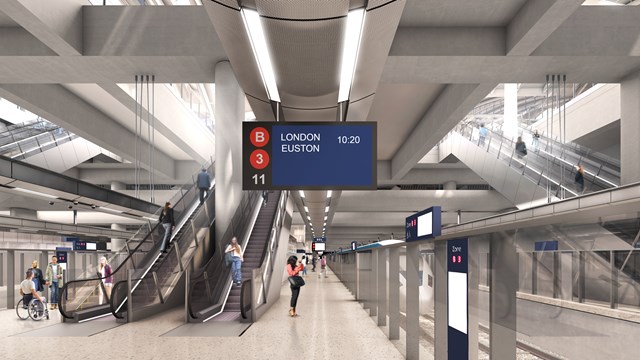
Platform edge doors will be provided at Old Oak Common station, in west London, and Interchange station, near Birmingham Airport. The framework agreement will also have an option to supply the same system for the proposed Manchester Airport station in Phase 2b leg from Birmingham to Manchester.
HS2 today began the search for a specialist contractor to deliver platform edge doors for the new high speed railway’s Old Oak Common and Interchange stations.
So am I correct in thinking that the classic lines are going to have to have platform doors? If so then surely all GWR mainline trains will have to be driven by autopilot (ie like crossrail). Drivers cannot expect to stop that accurately 100 percent of the time. This would add millions to the project surely equipping the GWR fleet with automatic control. Or am I reading this wrong?
OOC classic lines won’t have any platform doors or level boarding because when the fast line closes, GWR use the Elizabeth line platforms. I wish there was a way around this due to the pair of islands they each have.
So am I correct in thinking that the classic lines are going to have to have platform doors? If so then surely all GWR mainline trains will have to be driven by autopilot (ie like crossrail). Drivers cannot expect to stop that accurately 100 percent of the time. This would add millions to the project surely equipping the GWR fleet with automatic control. Or am I reading this wrong?
I think I must have misunderstood, I thought the first batch of trains were going to be UK gauge so they could continue over conventional lines to Manchester etc. UIC size ones would only follow when line reaches Manchester allowing the earlier ones to continue to serve cities off the HS route
I also thought they were supposed to be making it future proof for 120 years hence standard ECTS and ability for European new generation TGVs etc to run if they meet long tunnel safety rules and eventually UK joins Schengen (even if it is 20, 30, 40 years from today)
All of which suggests won't be one standard fleet for decades