
Any idea on the rough figure for Motts Lane (Witham?) I bet that wasn’t cheap.To add further colour, when all the footpaths level crossings were closed on the WCML during the upgrade, a deal was done with a steel fabricator to supply x bridges to a broadly standard design (varied by length and rise) over the course of two years. A favourable proce was negotiated as they could be fabricated at any time during those two years (in a priority order) to fill in ’troughs’ in the fabricator’s order book. Sort of like an off peak advance.
Even then, the highest cost component was the legals of getting the crossings actually closed and footaghs diverted onto the bridge.

-
Our new ticketing site is now live! Using either this or the original site (both powered by TrainSplit) helps support the running of the forum with every ticket purchase! Find out more and ask any questions/give us feedback in this thread!
You are using an out of date browser. It may not display this or other websites correctly.
You should upgrade or use an alternative browser.
You should upgrade or use an alternative browser.
Footbridge costs
- Thread starter jthjth
- Start date
- Status
- Not open for further replies.
Sponsor Post - registered members do not see these adverts; click here to register, or click here to log in
R
RailUK Forums
Any idea on the rough figure for Motts Lane (Witham?) I bet that wasn’t cheap.
Over £2m. And that was about 12 years ago? Had to be built to bridleway standards. A freind who lived next to it had never seen a horse there…
fat_boy_pete
Member
And yet it wasn't built wide enough to allow the Witham loops to be extended.Over £2m. And that was about 12 years ago? Had to be built to bridleway standards. A freind who lived next to it had never seen a horse there…
And yet it wasn't built wide enough to allow the Witham loops to be extended.
Because there is no prospect of them ever being needed to be extended.
I think this is a significant problem tbh and government (local or central) seem to be very unwilling to downgrade bridleways to footpaths in order to facilitate cheaper bridges.Had to be built to bridleway standards.
MatthewHutton
Member
Depends on where of course but not much of the country would the land cost several million for something as small as a footbridge - even one with ramps.Depends what is allowed for. Land acquisition can also be expensive.
Can't really compare to housebuilding which is a different beast in terms of scale / complexity.
Part of that is because bicycles can use bridleways but not footpaths. Downgrading so bicycles are allowed to use them might be a possible compromise but would need a new status.I think this is a significant problem tbh and government (local or central) seem to be very unwilling to downgrade bridleways to footpaths in order to facilitate cheaper bridges.
== Doublepost prevention - post automatically merged: ==
The legals cost far far too much in this country. I wanted to get a road narrowing outside a school put in and you were still talking many tens of thousands of costs presumably the vast majority of which is legals. I mean an electricity supply for the sign, plus a post, sign and some curbstone and tarmac would surely all be less than £5k and we were getting quotes of 10x that.Even then, the highest cost component was the legals of getting the crossings actually closed and footaghs diverted onto the bridge.
Last edited:
I mean an electricity supply for the sign, plus a post, sign and some curbstone and tarmac would surely all be less than £5k and we were getting quotes of 10x that.
To be fair, £5k is nowhere near enough for that work.
10 years ago I moved the power supply to my house. I was quoted £3k for that alone by the local electricity distribution company. So I did the bits I could do myself. Still cost almost £1000 for the company to come and dig the hole over the live cable, swap the supplies, and reinstate 1 sqm of tarmac.
MatthewHutton
Member
Even if the trades stuff would be £20k for such a project in today’s money then as the quote from the council would be more like £100k we are still talking 80% of the money being spent on red tape. And the question still is why on earth you need to spend the better part of a person years time doing the paperwork to deliver something so small.To be fair, £5k is nowhere near enough for that work.
10 years ago I moved the power supply to my house. I was quoted £3k for that alone by the local electricity distribution company. So I did the bits I could do myself. Still cost almost £1000 for the company to come and dig the hole over the live cable, swap the supplies, and reinstate 1 sqm of tarmac.
I get the feeling the same applies to footbridges. Yes clearly the trades bit on the railway might be 2-4x more expensive than elsewhere and there is also the cost of rail replacement buses etc and the cost of organising them and the red tape is probably also legitimately more complex. But still it is hard to believe it is all truly necessary. Why do we need to spend years and years on legals to make a footpath safer and still usable?

DerekC
Established Member
Having been volunteer footpaths & rights of way warden for a rural parish where many of the footpaths and bridleways were little used, I can tell you that any attempt to change the network of rights of way is extremely bureaucratic and attracts volumes of protest, some from people who don't know the area at all. Moving up from a footpath to a bridleway was bad enough - the opposite would prompt howls of protest from the horse and cycling fraternities.I think this is a significant problem tbh and government (local or central) seem to be very unwilling to downgrade bridleways to footpaths in order to facilitate cheaper bridges.
The footpath lines established in 1949 under the Access to the Countryside Act were pretty arbitrary in places. All our County Council (Hampshire) did was to get the old OS maps out, mark up as a proposed right of way every footpath and track shown from fifty or sixty years before and send it to the Parish Council asking for confirmation (or not) that these were valid public rights of way. The Parish appointed a subcommittee of the local landowners and the vicar, who suppressed quite a few of them and confirmed the rest although pointing out that some were out of date because field boundaries, hedgerows etc had changed and that one or two of the footpaths were really bridleways. The County accepted the deletions and ignored the comments, so the lines weren't right even from the beginning. Since then the actual footpath lines have shifted around, especially when hedgerows went in the 1950s and 60s. Because there isn't a flexible process to make small changes, the network on paper stays frozen and when you want to make a legitimate change it can get really complicated if the footpath on the ground isn't where the map says should be in the first place! The process for change needs to be reformed and there was a committee sitting to look at that about ten years ago, but I think it was binned by the last government.

Spaceship323
Member
The new (opened 2021) Soham station cost £21M and that's just a single 100m platform - obviously built next to a live railway, which severely limits productivity
DBTrainFan
New Member
Methinks expensive crane hire for the Stowmarket bridge installation:

Is the correct answer. Road and rail use the same value for fatality avoided (non-passenger at least).The only true comparator would be installing a footbridge over an existing motorway (remembering to add in the time costs for diversions which are just “absorbed” by road users but have to be paid /accounted for on the railway.)
But motorways were not built to 19th century safety standards. Rail has a massive ‘catch up’ cost embedded. A massive off-balance sheet creditor is one way to view it. What’s bad is not so much the cost as the near-random way the debt is called.
zwk500
Veteran Member
The only true comparator would be installing a footbridge over an existing motorway (remembering to add in the time costs for diversions which are just “absorbed” by road users but have to be paid /accounted for on the railway.)

Pedestrian bridge installed successfully during closure of A189 Spine Road in Northumberland
The installation of a £3.3m pedestrian bridge over the A189 Spine Road has been completed as part of the Northumberland Line project.
 www.northumberlandgazette.co.uk
Blyth Bebside bridge over the A189 (an 'expressway' dual-carriageway) was costed at £3m in this article. In this particular case, the cost was justified by the additional passenger traffic to Blyth Bebside station it added to the rail project rather than solely safety benefits. It also probably has had some efficiencies for being part of the wider Northumberland line project.
I think you should be aware that Stowmarket is a sizeable town and rail head, with 5 or 6 departures in the off peak hours plus 2 or 3 freight passes. So for this station location a footbridge with lifts is much needed. Using the barrow crossing with staff assistance is really not appropriate in this day and age.
It didn't replace a barrow crossing, it replaced an existing footbridge but one without disabled facilities. This meant that any one with mobility issues, i.e. couldn't climb stairs, had to leave the station go round over the level crossing then back again onto the other platform.
It also took an extraordinarily long time to complete the foundations with nothing happening for months. When I was there on 17th October work had recommenced. I took the opportunity to ask what the problem had been and was told that the piles were in the wrong place. I don't know if that was just the rebar or the piles themselves or whether the design changed.
Here's a photo taken in 2022 showing the original footbridge.

Last edited:
fat_boy_pete
Member
It didn't replace a barrow crossing it replaced an existing footbridge but one without disabled facilities. This meant that any one with mobility issues, i.e. couldn't climb stairs, had to leave the station go round over the level crossing then back again onto the other platform.View attachment 193560
Fair enough. My point was however that given the location and traffic volume, a footbridge with lifts is a much needed enhancement.
Fair enough. My point was however that given the location and traffic volume, a footbridge with lifts is a much needed enhancement.
Agreed. If I had to go all the way round over a level crossing in pouring rain I wouldn't be too pleased. My only concern (purely personal) is that Stowmarket is a great station to take photographs from and I have a fear that ticket barriers will now appear. Mind you, I have always found the staff at Stowmarket to be very helpful and friendly so I am hoping that a polite request will get me on the station should the need arise!

fat_boy_pete
Member
I think only Manningtree and Diss are currently the only other non barriered stations on the LST-NRW route.Agreed. If I had to go all the way round over a level crossing in pouring rain I wouldn't be too pleased. My only concern (purely personal) is that Stowmarket is a great station to take photographs from and I have a fear that ticket barriers will now appear. Mind you, I have always found the staff at Stowmarket to be very helpful and friendly so I am hoping that a polite request will get me on the station should the need arise!
I think only Manningtree and Diss are currently the only other non barriered stations on the LST-NRW route.
And Witham. Or at least it was when I last visited on 19th September.

fat_boy_pete
Member
I meant Stations that the regular Norwich service stops at. I don't think Witham gets a 745 service now outside of rail replacement. I was alluding to the possibility that the 745 conductors might go in the future if some or all of those 3 get barriers. After all non conductor manned 720's stop at Marks Tey, Kelevdon, Hatfield Peveral and Ingatestone, all of which don't have barriers. There's occasional RPI patrols on the trains instead.
Anyway to get back on topic, modern footbridge lifts have remote CCTV, so once accessibility is improved at Diss and Manningtree, with the 745 level boarding capabilities, I could see a future push to remove the conductors
Snow1964
Established Member
Got an old book on Wiltshire Railways from my local library, and amongst the old photos is Bulford station on Salisbury plain. There is also a drawing of proposed footbridge by Eastleigh drawing office dated 1916
Bulford was obviously busy in First World War, and Labour was cheap, but at the top of the drawing a price has been added £297 which is probably just materials cost, not installation.
Using Bank of England inflation calculator, £297 in 1916 is now £22,550
Bulford was obviously busy in First World War, and Labour was cheap, but at the top of the drawing a price has been added £297 which is probably just materials cost, not installation.
Using Bank of England inflation calculator, £297 in 1916 is now £22,550
thenorthern
Established Member
- Joined
- 27 May 2013
- Messages
- 4,710
You have to remember that building a railway footbridge is not the same as building a normal footbridge. There are many reasons such
- It's got to be built by an approved company, Network Rail can't just get any company to build it.
- The line has to be closed when it's installed, often they will try and do it overnight when the line is closed. The staff are also often specialist teams who travel around the country, meaning labour costs are quite high.
- Bridges have to be fully accessible for wheelchair users (I am aware most non railway footbdiges are now) however the ramps or elevators do add to the cost.
- Railway bridges are specially built for the railways, meaning there is a much higher costs in designing and building them due to it being a unique market. Health and safety standards are much higher than for other bridges and the bridges are now built semi-enclosed to stop people thowing things onto the track. All this adds to the costs.
You have to remember that building a railway footbridge is not the same as building a normal footbridge. There are many reasons such
I am not going to post the image here as it's copyrighted but this image of Tamworth station's temporary footbridge from 1962 made me chuckle. You could never get away with a bridge like that today.
- It's got to be built by an approved company, Network Rail can't just get any company to build it.
- The line has to be closed when it's installed, often they will try and do it overnight when the line is closed. The staff are also often specialist teams who travel around the country, meaning labour costs are quite high.
- Bridges have to be fully accessible for wheelchair users (I am aware most non railway footbdiges are now) however the ramps or elevators do add to the cost.
- Railway bridges are specially built for the railways, meaning there is a much higher costs in designing and building them due to it being a unique market. Health and safety standards are much higher than for other bridges and the bridges are now built semi-enclosed to stop people thowing things onto the track. All this adds to the costs.
It reminds me a bit of the ‘temporary’ footbridge at Brading.

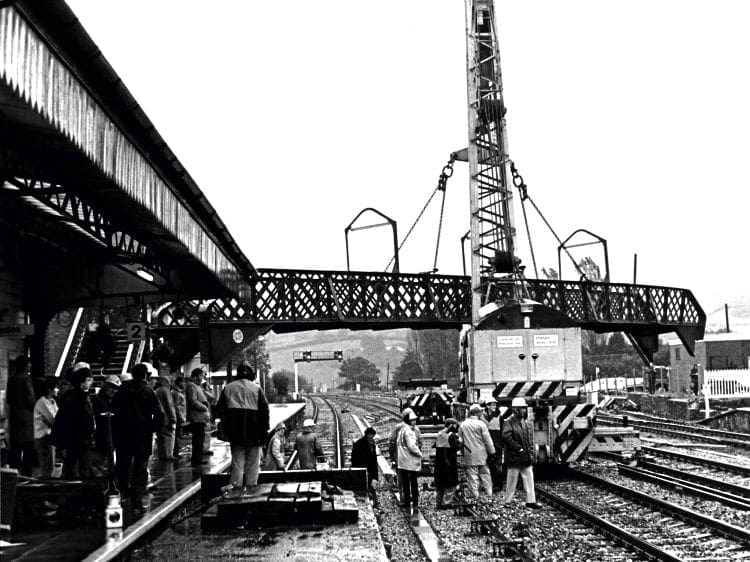
In 1987, at Totnes, Devon, the historic GWR footbridge at the London end was accidentally demolished by a track crane during engineering works. It was quickly replaced by temporary scaffolding while the original bridge remains were dismantled and a new structure was built. In, 2019 an accessible bridge with lifts was completed at the other end of the platforms, and the previous one was removed. So three permanent bridges within the last 40 years, plus a temporary one for a while. Is this a record?It reminds me a bit of the ‘temporary’ footbridge at Brading.
THE AREA MANAGER’S DIARY | The Railway Magazine
Career railwayman and Practice & Performance contributor John Heaton kept a detailed diary of the events – good and bad – during his role as a BR area m ...
 www.railwaymagazine.co.uk
THE AREA MANAGER’S DIARY by Sam Hewitt 11th July 2018
...One memorable incident at Totnes is recalled here while maintaining an operational railway.
In 1987, at Totnes, Devon, the historic GWR footbridge at the London end was accidentally demolished by a track crane during engineering works. It was quickly replaced by temporary scaffolding while the original bridge remains were dismantled and a new structure was built. In, 2019 an accessible bridge with lifts was completed at the other end of the platforms, and the previous one was removed. So three permanent bridges within the last 40 years, plus a temporary one for a while. Is this a record?
THE AREA MANAGER’S DIARY | The Railway Magazine
Career railwayman and Practice & Performance contributor John Heaton kept a detailed diary of the events – good and bad – during his role as a BR area m ...
A shame they could not have left the (post 1987) bridge particularly as it was integrated with the access to the signal box/cafe. The new bridge is a long walk along the platform esp. from the up side car park.
I see John Heaton's four books are still in print (but not cheap at £15.99 paperback) https://www.amazon.co.uk/The-Area-Managers-Diary/dp/B08L9K5VNJ, ideal Xmas present, thanks.
Merle Haggard
Established Member
In 1987, at Totnes, Devon, the historic GWR footbridge at the London end was accidentally demolished by a track crane during engineering works. It was quickly replaced by temporary scaffolding while the original bridge remains were dismantled and a new structure was built. In, 2019 an accessible bridge with lifts was completed at the other end of the platforms, and the previous one was removed. So three permanent bridges within the last 40 years, plus a temporary one for a while. Is this a record?
THE AREA MANAGER’S DIARY | The Railway Magazine
Career railwayman and Practice & Performance contributor John Heaton kept a detailed diary of the events – good and bad – during his role as a BR area m ...
Northampton? Station 'modernisation' in 1966, temporary footbridge built, old footbridge demolished and new permanent one built further down the platform. Those buildings were themselves replaced ca 2010, new temporary footbridge built (on exactly the site of the 1966 temporary footbridge), 1966 footbridge demolished, new footbridge built, as it happened, very close to the footprint of the one demolished in 1966. O.k., it is a bit more than 40 years but it was circular.
Agreed. Its removal makes going over for a bacon sandwich en route to the South Devon Railway a longer trek from the down side! The SB operating floor entrance was from the first landing of the old GWR bridge, and the 1980s structure replicated that, so it was very quick to pop over for snacks. On removal, the staircase on the up side was partly retained to maintain cafe access.A shame they could not have left the (post 1987) bridge particularly as it was integrated with the access to the signal box/cafe. The new bridge is a long walk along the platform esp. from the up side car park.
Last edited:
It goes without saying that RAIB are investigating the fatality at Chestnut Grove foot crossing in Burton Joyce on 26 Nov:
https://www.gov.uk/government/news/fatal-accident-at-chestnut-grove-footpath-crossing
I know this crossing extremely well and am very much aware of the concerns NR have had with that specific crossing, and resulting previous attempts at closure. The public footpath is currently subject of a temporary closure notice and the crossing is very much closed (multiple fences, padlocks, etc.)
https://www.nottinghamshire.gov.uk/media/eppfgwrf/notice-burton-joyce-fp6xing-cont.pdf
https://www.gov.uk/government/news/fatal-accident-at-chestnut-grove-footpath-crossing
At around 19:05 on 26 November 2025, a young person was struck by a train and fatally injured while crossing the railway on Chestnut Grove footpath crossing, which is situated in Nottinghamshire between Lowdham and Burton Joyce stations. The train was travelling at about 60 mph (97 km/h) at the time of the accident.
Chestnut Grove footpath crossing provides pedestrians with access between the village of Burton Joyce and footpaths leading to the river Trent. The crossing has gates on either side of the railway and is provided with signage which instructs users how to cross.
I know this crossing extremely well and am very much aware of the concerns NR have had with that specific crossing, and resulting previous attempts at closure. The public footpath is currently subject of a temporary closure notice and the crossing is very much closed (multiple fences, padlocks, etc.)
https://www.nottinghamshire.gov.uk/media/eppfgwrf/notice-burton-joyce-fp6xing-cont.pdf
NOTICE IS HEREBY GIVEN that the Nottinghamshire County Council HAS MADE an ORDER, under Sections 14 and 15(8) of the Road Traffic Regulation Act 1984, the effect of which will be:
To continue the effects of THE NOTTINGHAMSHIRE COUNTY COUNCIL (BURTON JOYCE PUBLIC FOOTPATH NO.6) (TEMPORARY PROHIBITION) NOTICE 2025.
That Notice came into force on 27th November 2025.
The effects are that:-
No person shall: - Proceed on foot,
in the following length of Footpath at Burton Joyce in the Borough of Gedling - Burton Joyce Footpath No.6, from Chestnut Grove, over the level crossing to Burton Joyce Footpath No.8.
AND NOTICE IS HEREBY FURTHER GIVEN that during the period of restriction the most direct alternative route available for pedestrians will be as follows: - Chestnut Grove, Church Street, St Helens Crescent, Burton Joyce Footpath No.7 (which goes under the railway tracks and includes a number of steps) and Burton Joyce Footpath No.8 and vice versa
There are other alternative routes shown on the accompanying plan.
IT IS INTENDED that the prohibition respecting the above highway or highways will apply as follows: -
To 26th May 2026 inclusive.
The Continuation Order will come into force on 18th December 2025 and any prohibition contained in the continued Order shall apply on that day and on any subsequent day or days when it shall be necessary for the prohibition to apply to enable works to be carried out and the Order shall continue in full force until the works it is proposed to carry out are completed The duration of this Order may be extended with the approval of the relevant Secretary of State.
The prohibition is required to protect public safety following an incident over the railway footpath crossing.
The 1947 footbridge at Havant had been supported by scaffolding for several years whilst the authorities sorted out who was responsible for it and who was going to pay for a replacement.
Funding has now been agreed between Network Rail, Hampshire County Council and Havant. Borough Council.
The cost - £11.5 million!!

 www.bbc.co.uk
Funding has now been agreed between Network Rail, Hampshire County Council and Havant. Borough Council.
The cost - £11.5 million!!
Havant Station footbridge to be replaced in £11.5m project - BBC News
The bridge in Havant was built in 1947 and is reaching the "end of its structural life"
www.bbc.co.uk
Deepgreen
Established Member
While the complications around installing a 'simple' footbridge are far greater than meet the eye, let's also not pretend that rail contractor costs aren't generally greatly inflated 'because it's the railway = license to print money'!
I also refer to my thread about the Chiswick station footbridge and its replacement's huge overrun which has has no response so far after a couple of weeks (a dubious possible record to claim!). Perhaps no-one here genuinely knows or cares anything about it...
I also refer to my thread about the Chiswick station footbridge and its replacement's huge overrun which has has no response so far after a couple of weeks (a dubious possible record to claim!). Perhaps no-one here genuinely knows or cares anything about it...
Not quite a full temporary footbridge, however for a while during the Ayr station Hotel debacle a couple of years ago temporary staircases built from scaffolding were built in order to have the staircases run the other way, i.e. away from the unsafe area.
- Status
- Not open for further replies.