• Our new ticketing site is now live! Using either this or the original site (both powered by TrainSplit) helps support the running of the forum with every ticket purchase! Find out more and ask any questions/give us feedback in this thread!

Driver Near Miss ECML

Status
Not open for further replies.

AlterEgo

Verified Rep - Wingin' It! Paul Lucas
Joined
30 Dec 2008
Messages
29,407
Location
LBK
It's quite common to have the Fast lines inside the Slow lines over here.

Indeed it depends on the platform layout at some stations. Many "local stations" on the ECML (and the SWML) have two single platforms on the outermost tracks only, so there's your decision made for you already.
 
Sponsor Post - registered members do not see these adverts; click here to register, or click here to log in
R

RailUK Forums

tsr

Established Member
Joined
15 Nov 2011
Messages
7,400
Location
Between the parallel lines
On Youtube i watched London Euston - Northampton where untill Milton Keynes it used the left railwaytracks and than moved 2 to the right to be over taken by a faster train at 42:50. 75 seconds that faster train has dissapeared!

https://www.youtube.com/watch?v=g9pye6N7aK0

One of the many inconsistencies of the National Rail network is that there is great variance in how lines are laid out. Sometimes they are paired by direction, other times by use. In other words, you can have something like Up Slow - Up Fast - Down Fast - Down Slow, where you have a pair of Up lines and a pair of Down lines. Or you can have Up Slow - Down Slow - Up Fast - Down Fast, where you can have a pair of Slow lines in parallel with Fast lines. Local naming, uses, bidirectional working, and additional tracks (eg. additional relief lines) provide further differences around the network.

Perhaps the easiest way to spot this is on a tour around the Southern network (if such a thing is possible with current reliability...!). From East Croydon, once you head over the tangled web of Windmill Bridge Jn et al, you then have lines paired by use going towards Victoria, and paired by direction towards London Bridge.

Broadly speaking, pairing by direction often results in greater segregation of the Fast lines from passengers, which allows somewhat greater safety, but somewhat worse abilities to stop at intermediate stations during disruption, when the other line of the pair is closed. Pairing lines by use does allow a more separate diversion in the event that one pair is closed for whatever reason. These are just two points among many. Debates do occur around topics such as which allows the better use of junction layouts, which in any case often varies by service pattern and location. You get the picture - it's complicated. This detail is one of the many factors which train crew know specifically for their area as part of their route knowledge, alongside names and positions of major structures which present limited clearances for safe working, junction layouts and so on.

 

ac6000cw

Established Member
Joined
10 May 2014
Messages
3,910
Location
Cambridge, UK
On Youtube i watched London Euston - Northampton where untill Milton Keynes it used the left railwaytracks and than moved 2 to the right to be over taken by a faster train at 42:50. 75 seconds that faster train has dissapeared!

https://www.youtube.com/watch?v=g9pye6N7aK0

It's because on that part of the WCML the four tracks are paired by use/speed i.e. from east to west, up slow/down slow/up fast/down fast (the slow lines go to Rugby via Northampton, the fasts go direct). On the four track parts of the ECML, they are paired by direction i.e. up slow/up fast/down fast/down slow.
 

Deepgreen

Established Member
Joined
12 Jun 2013
Messages
7,471
Location
Gomshall, Surrey
One of the many inconsistencies of the National Rail network is that there is great variance in how lines are laid out. Sometimes they are paired by direction, other times by use. In other words, you can have something like Up Slow - Up Fast - Down Fast - Down Slow, where you have a pair of Up lines and a pair of Down lines. Or you can have Up Slow - Down Slow - Up Fast - Down Fast, where you can have a pair of Slow lines in parallel with Fast lines. Local naming, uses, bidirectional working, and additional tracks (eg. additional relief lines) provide further differences around the network.

Perhaps the easiest way to spot this is on a tour around the Southern network (if such a thing is possible with current reliability...!). From East Croydon, once you head over the tangled web of Windmill Bridge Jn et al, you then have lines paired by use going towards Victoria, and paired by direction towards London Bridge.

Broadly speaking, pairing by direction often results in greater segregation of the Fast lines from passengers, which allows somewhat greater safety, but somewhat worse abilities to stop at intermediate stations during disruption, when the other line of the pair is closed. Pairing lines by use does allow a more separate diversion in the event that one pair is closed for whatever reason. These are just two points among many. Debates do occur around topics such as which allows the better use of junction layouts, which in any case often varies by service pattern and location. You get the picture - it's complicated. This detail is one of the many factors which train crew know specifically for their area as part of their route knowledge, alongside names and positions of major structures which present limited clearances for safe working, junction layouts and so on.

I think one of the odder ones these days is the Windsor lines from Barnes towards London, where the arrangement (N to S) is Up Slow, Up Fast, Down Slow, Down Fast (except on Sundays!).
 

edwin_m

Veteran Member
Joined
21 Apr 2013
Messages
28,652
Location
Nottingham
I read on another site (BBC) that the train was doing 105mph at the time of the photograph. Dispassionate logic says that as long as you're inside the kinematic envelope of the stopped train you will not be hit - split second thinking says; 'panic'! Fortunately, a mixture of both may have saved him here.

Many many years ago when I last did a PTS course, it included the advice to lie down if ever caught in the six-foot between two approaching trains. I don't know if that is still in the current training, considering that another part of the course was how the six-foot was by far the most dangerous place to be.
 

scott118

Member
Joined
24 Feb 2015
Messages
928
Location
East Anglia
Many many years ago when I last did a PTS course, it included the advice to lie down if ever caught in the six-foot between two approaching trains. I don't know if that is still in the current training, considering that another part of the course was how the six-foot was by far the most dangerous place to be.

Correct.
 

Garmoran

Member
Joined
27 Sep 2011
Messages
92
Location
Not UK Mainland (ie: north of Perth)
Many many years ago when I last did a PTS course, it included the advice to lie down if ever caught in the six-foot between two approaching trains. I don't know if that is still in the current training, considering that another part of the course was how the six-foot was by far the most dangerous place to be.
According to an article about this incident in today's Glasgow Herald, this is exactly what the driver of the HST did.
 

gavin

Member
Joined
25 Dec 2006
Messages
1,006
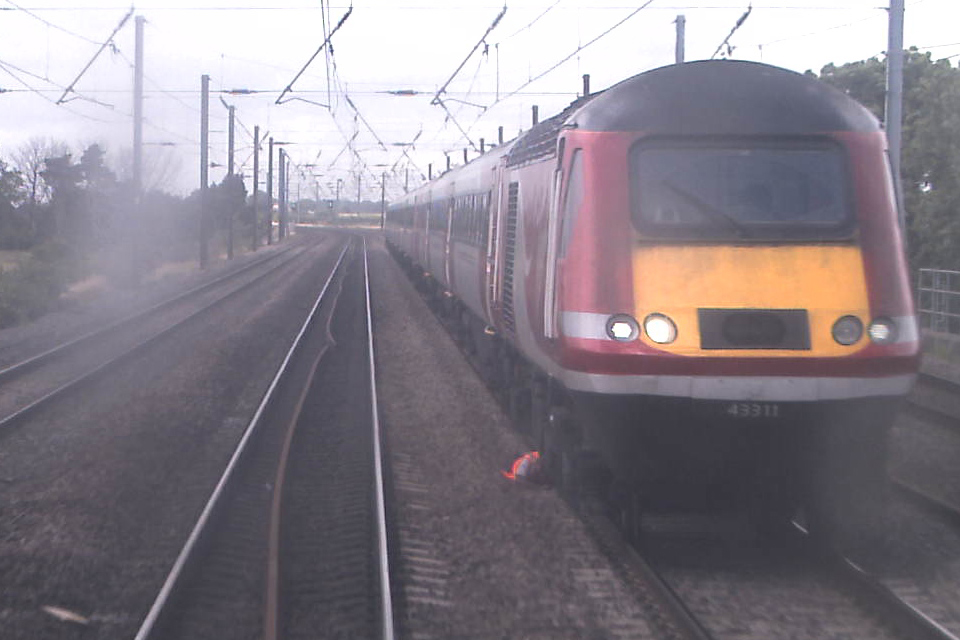
Due to a speed restriction the passing train was still getting back to full speed and passed at 105MPH the driver sounded the horn for 6 seconds

Figure_2.jpg
 

alxndr

Established Member
Joined
3 Apr 2015
Messages
1,690
Many many years ago when I last did a PTS course, it included the advice to lie down if ever caught in the six-foot between two approaching trains. I don't know if that is still in the current training, considering that another part of the course was how the six-foot was by far the most dangerous place to be.

Was still in it two years ago when I did mine, although I'd argue that the four-foot was the most dangerous place to be! I think it was mentioned as well (although I might have made it up) that if you were stuck in the four-foot with no way out and a train approaching the only thing to do is to lay down, hang on, and pray.

Signaller partially fills in a Line Blockage form, but there is no Authority Number, and Train Crew do not have a form to complete either.

I find the lack of authority number the most concerning part. Why is it that a COSS is given an authority number but not a driver (I'm assuming it's related to GSM-R vs a telephone which anyone could pick up, but that's just a guess)? I'm not a COSS myself, but all the same I find it reassuring to hear them repeat back the authority number, as it's hard for that to be misunderstood.
 

endecotp

Member
Joined
23 Apr 2014
Messages
340
Sounds like an unfortunate breakdown of communications, hopefully the trainee doesn't feel too guilty as it could quite have easily happened to anyone!

I can't agree with "could have happened to anyone"; they are supposed to repeat back what they've been told, and they didn't - neither of them. And the driver then didn't report the actual near miss when he next phoned! It was the driver of the other train who reported it. If he had somehow not noticed the orange-clad body, we might never have known about the incident.
 

swt_passenger

Veteran Member
Joined
7 Apr 2010
Messages
34,271
I think one of the odder ones these days is the Windsor lines from Barnes towards London, where the arrangement (N to S) is Up Slow, Up Fast, Down Slow, Down Fast (except on Sundays!).

The line names are still conventional though; in the sectional appendix they are shown as paired by direction in the typical (or usual) way with both fasts in the middle from West London Jn to Barnes.

The day to day operational usage is the key difference here...
 

E&W Lucas

Established Member
Joined
21 Jan 2010
Messages
1,358
Was still in it two years ago when I did mine, although I'd argue that the four-foot was the most dangerous place to be! I think it was mentioned as well (although I might have made it up) that if you were stuck in the four-foot with no way out and a train approaching the only thing to do is to lay down, hang on, and pray.
.

Your training would have explicitly stated not to lie down in the four foot!!!!!
To lie down in the six foot is totally correct.

Re the questions about the layout of the four track formation, DS - DF - UF - US is the safest (As used there), as a move from slow to fast or vice versa does not cause a conflicting movement. The other option, US - DS - UF - DF does precisely that.
 
Last edited:

alxndr

Established Member
Joined
3 Apr 2015
Messages
1,690
Your training would have explicitly stated not to lie down in the four foot!!!!!
To lie down in the six foot is totally correct.

Not as good practice no. On further reflection I suspect it was probably said after some smart alec comment about if you weren't able to get into the six-foot. In which case the only other alternative would be to be stood up in the four-foot, so for that (very very unlikely) scenario it probably would be best.
 

ComUtoR

Established Member
Joined
13 Dec 2013
Messages
9,562
Location
UK
Cheers Mike.
--- old post above --- --- new post below ---
The new sectional appendix for LNE actually does have details of a text message facility for cautioning trains, which must be acknowledged for the signaller to allow the train(s) concerned to proceed.

Ok, I have looked but still cannot find reference to it. Are you talking about the new Berth triggered messages where you have to acknowledge by using the ST button ?
 

Atishyou

Member
Joined
1 Jan 2012
Messages
486
Location
North West
Cheers Mike.
--- old post above --- --- new post below ---


Ok, I have looked but still cannot find reference to it. Are you talking about the new Berth triggered messages where you have to acknowledge by using the ST button ?

Are you trying to be pedantic? I assure you it's there.
 

ComUtoR

Established Member
Joined
13 Dec 2013
Messages
9,562
Location
UK
Are you trying to be pedantic? I assure you it's there.

No. I asked a very simple question. 'Are you talking about the Berth Triggered messages'. Which you haven't answered. I hate the Sectional Appendix at the best of times and I trawled through it and couldn't find any reference to a text based message system for GSMR. The 'Berth Triggered' are still broadcast based and you get a verbal message.

So yes please, point out your reference to a text based system because I'm very interested to read about it.
 

Atishyou

Member
Joined
1 Jan 2012
Messages
486
Location
North West
No. I asked a very simple question. 'Are you talking about the Berth Triggered messages'. Which you haven't answered. I hate the Sectional Appendix at the best of times and I trawled through it and couldn't find any reference to a text based message system for GSMR. The 'Berth Triggered' are still broadcast based and you get a verbal message.

So yes please, point out your reference to a text based system because I'm very interested to read about it.

Yes, it's the berth triggered messages.

I submit to your superior knowledge, my brief stated it was broadcast and text based.
 

redbutton

Member
Joined
5 Sep 2013
Messages
461
Yes, it's the berth triggered messages.

I submit to your superior knowledge, my brief stated it was broadcast and text based.

It is and it isn't. The signaller records a berth triggered voice message to be played to the driver, who then acknowledges the contents of the message by pressing the "ST" button on the GSM-R. This sends an acknowledgement text message (I don't know the wording) back to the signaller's GSM-R terminal.

The driver hears a voice message, the signaller sees a text response.

So in a way you and ComUtoR are both correct.
 

MichaelAMW

Member
Joined
18 Jun 2010
Messages
1,021
Cheers Mike.
--- old post above --- --- new post below ---


Ok, I have looked but still cannot find reference to it. Are you talking about the new Berth triggered messages where you have to acknowledge by using the ST button ?

In that pdf I referred to:

http://www.networkrail.co.uk/browse%...20appendix.pdf

the details are on page 7 of the file. (Presumably it is also present in the other sectional appendices in the corresponding sections.)
 
Last edited:
Status
Not open for further replies.

Top