• Our new ticketing site is now live! Using either this or the original site (both powered by TrainSplit) helps support the running of the forum with every ticket purchase! Find out more and ask any questions/give us feedback in this thread!

Derailment at Kirkby (Merseyside) - 13/03/2021

Status
Not open for further replies.

GC class B1

Member
Joined
19 Jun 2021
Messages
460
Location
East midlands
You've started this by saying your a signalling layman, and now you're declaring the Railway Industry Standard isn't fit for purpose?
TPWS is designed to catch the train if the driver gets it slightly wrong, it isn't designed to prevent incidents when there is a major departure from the anticipated behaviour. Only a PTC system can do so.
What would your solution be to prevent this incident?
I am a layman in terms of signalling but i have been in this industry for over 50 years. In signalling terms I am an interested observer and I carried out research in order to understand the topic.
 
Sponsor Post - registered members do not see these adverts; click here to register, or click here to log in
R

RailUK Forums

Falcon1200

Established Member
Joined
14 Jun 2021
Messages
6,627
Location
Neilston, East Renfrewshire
Presumably when Merseyrail extend to the new terminus at Headbolt Lane, friction buffer stops and perhaps enhanced TPWS will be provided ? (Will that station be an end-on arrangement like Kirkby and Ormskirk ?)
 

Tomnick

Established Member
Joined
10 Jun 2005
Messages
5,935
The OSS are around 300 m from the 15 mph commencement. This covers 10 mph above line speed at 12 percent g, excepting brake force build time. The grids are actually too close. The trip speed could easily be set at 38 mph and fall inline with the TOC policy of step one braking.
Is the TOC's policy definitely step one braking throughout? The only mention I can see is that drivers are generally trained to start braking at the motorway bridge for a step one approach in this specific case, but that doesn't bar drivers from braking later and harder once they find their feet and deem it appropriate to do so.

I suggest that it'd be foolish to enforce this policy in such an irreversible fashion. Policies change, and indeed new trains might bring about a change in policy?
 

ainsworth74

Forum Staff
Staff Member
Global Moderator
Joined
16 Nov 2009
Messages
31,139
Location
Redcar
What would your solution be to prevent this incident?
Driverless trains? Can't have a driver fail to break if there's no driver to break! <:D


I'm kidding! I'm kidding! Put down the pitch forks! Put them down!!!
 

zwk500

Veteran Member
Joined
20 Jan 2020
Messages
18,679
Location
Northampton
Driverless trains? Can't have a driver fail to break if there's no driver to break! <:D


I'm kidding! I'm kidding! Put down the pitch forks! Put them down!!!
No pitchforks from me, Merseyrail as quasi metro could benefit in many ways from driverless trains, if issues at the fringe points can be resolved.
 

Dai Corner

Established Member
Joined
20 Jul 2015
Messages
6,998
No pitchforks from me, Merseyrail as quasi metro could benefit in many ways from driverless trains, if issues at the fringe points can be resolved.
I have to agree there. In this particular case it was the biological interface between the train, signalling and infrastructure that failed. An automated one wouldn't have.
 

zwk500

Veteran Member
Joined
20 Jan 2020
Messages
18,679
Location
Northampton
I have to agree there. In this particular case it was the biological interface between the train, signalling and infrastructure that failed. An automated one wouldn't have.
In this specific incident, PTC (i.e. ETCS L2) would have also prevented the incident. Discussion of DOO/ATO is off-topic and for another thread.
 

ainsworth74

Forum Staff
Staff Member
Global Moderator
Joined
16 Nov 2009
Messages
31,139
Location
Redcar
Yes and I'm going to slap myself for making a joke which has taken us in an off-topic direction. A roll out of ATO or similar is definitely off-topic so we should probably leave it here. Apologies for setting a bad example :oops:
 
Joined
29 Oct 2021
Messages
180
Location
Newton Abbot
Is the TOC's policy definitely step one braking throughout? The only mention I can see is that drivers are generally trained to start braking at the motorway bridge for a step one approach in this specific case, but that doesn't bar drivers from braking later and harder once they find their feet and deem it appropriate to do so.

I suggest that it'd be foolish to enforce this policy in such an irreversible fashion. Policies change, and indeed new trains might bring about a change in policy?
Yes indeed, step 2 or nominal 6 percent g is deemed as defensive driving. The report states normal braking point as the bridge 900 m from Kirkby. This distance less freewheel will require about 4.5 percent g, nominal step 1. The difference between step 1 and step 2 braking is around 16 seconds to full stop uniform deceleration.
 

MR-507508

Member
Joined
17 Jan 2020
Messages
1,024
Location
North West
Was there ever any indication, out of the 12 passengers on board the train, how many where located in the unit (507006) which collided with buffer stop and how many where in the trailing unit (507021).
I guess, fortunately, no passengers where in the leading carriage?
 

Purple Train

Established Member
Joined
16 Jul 2022
Messages
2,487
Location
Exile or exile
(Will that station be an end-on arrangement like Kirkby and Ormskirk ?)
(Wouldn't it be more space-efficient (and, perhaps, safer in the case of a buffer-stop collision) to have one platform either side of an island platform, rather than the end-on arrangement? Anyway, that's a discussion for another thread so I'll leave it there.)

Yes indeed, step 2 or nominal 6 percent g is deemed as defensive driving. The report states normal braking point as the bridge 900 m from Kirkby. This distance less freewheel will require about 4.5 percent g, nominal step 1. The difference between step 1 and step 2 braking is around 16 seconds to full stop uniform deceleration.
RAIB report paragraph 58: Merseyrail trains its drivers to begin applying the brakes on the approach to Kirkby station as the train passes over the M57 motorway (paragraph 40). Applying the lowest braking setting at this point typically results in a gradual reduction in a train’s speed to around 10 mph (16 km/h) by the time the train reaches the 15 mph (24 km/h) permanent speed restriction sign located at the start of the platform.

This in turn seems to imply, as others have said further up the thread, that TOC policy is step 1 braking from the M57 bridge to Kirkby station. To me, this provides a little bit of background to the speed for the first TPWS loop being set so high, given the TOC's policy for light braking may lead to variations in the braking curves between TOC policy and drivers who might employ a slightly more aggressive approach.

The report states that the the train accelerated to 50mph upon departure from Fazakerley (it doesn't state when it reached 50mph, but, from the other timings, I think it would have been at fairly close to 18.50). The report then states that it was recorded as travelling at 46mph at 18.51.35 hours, and 42mph at 18.51.58 hours. Mathematically speaking, I presume this indicates that there is a rising gradient approaching Kirkby; can anyone confirm whether there is? This may also mean that there could be variations in the braking curve with drivers who brake later (using the rising gradient to aid their deceleration). The report states that the TPWS loops are placed 300 metres from the beginning of the 15mph PSR, which would be ample distance to achieve a reduction in speed of 27mph (from 42mph down to 15mph) on a rising gradient. The issue is not with the placement and set speed of the OSS loops, it's about ensuring compliance with the braking curve. And "ensuring compliance with the braking curve" is the main safety feature that was dropped in the decision to roll out TPWS instead of ATP. It would cost a great deal to implement, whether in the form of ATP or ETCS, for comparatively little benefit. Yes, it would prevent incidents like this, but this is an atypical incident. The only incidents I can think of that might have a similar speed curve are those involving low adhesion, to which an ATP-style system would make no difference.

 
Last edited:

John Luxton

Established Member
Joined
23 Nov 2014
Messages
2,041
Location
Liverpool
Was there ever any indication, out of the 12 passengers on board the train, how many where located in the unit (507006) which collided with buffer stop and how many where in the trailing unit (507021).
I guess, fortunately, no passengers where in the leading carriage?
I seem to recall on a Merseyside Railway FB group claiming the driver had exited the cab into the passenger area before the impact as has been confirmed by RAIB. Thus presumably someone saw it from within unless they just picked up on it afterwards?
 

zwk500

Veteran Member
Joined
20 Jan 2020
Messages
18,679
Location
Northampton
(Wouldn't it be more space-efficient (and, perhaps, safer in the case of a buffer-stop collision) to have one platform either side of an island platform, rather than the end-on arrangement? Anyway, that's a discussion for another thread so I'll leave it there.)
Depends on your site, of course. An island platform is wider than the Kirkby solution, of course. ISTR Kirkby has an overbridge that restricted platforms running opposite each other.
 

ainsworth74

Forum Staff
Staff Member
Global Moderator
Joined
16 Nov 2009
Messages
31,139
Location
Redcar
I seem to recall on a Merseyside Railway FB group claiming the driver had exited the cab into the passenger area before the impact as has been confirmed by RAIB. Thus presumably someone saw it from within unless they just picked up on it afterwards?
RAIB say it was from internal CCTV that they identified the driver leaving the cab:

46 At 18:52:23 hrs, one second before the collision with the buffer stop, internal CCTV shows the driver vacating the driving cab and moving into the saloon of the first vehicle.
 

pdeaves

Established Member
Joined
14 Sep 2014
Messages
5,932
Location
Gateway to the South West
I seem to recall on a Merseyside Railway FB group claiming the driver had exited the cab into the passenger area before the impact as has been confirmed by RAIB. Thus presumably someone saw it from within unless they just picked up on it afterwards?
The report says that CCTV showed the driver leaving the cab. No indication of whether there were any passengers there, or not.

(Oh, as ainsworth74 just said!)
 

GC class B1

Member
Joined
19 Jun 2021
Messages
460
Location
East midlands
(Wouldn't it be more space-efficient (and, perhaps, safer in the case of a buffer-stop collision) to have one platform either side of an island platform, rather than the end-on arrangement? Anyway, that's a discussion for another thread so I'll leave it there.)


RAIB report paragraph 58: Merseyrail trains its drivers to begin applying the brakes on the approach to Kirkby station as the train passes over the M57 motorway (paragraph 40). Applying the lowest braking setting at this point typically results in a gradual reduction in a train’s speed to around 10 mph (16 km/h) by the time the train reaches the 15 mph (24 km/h) permanent speed restriction sign located at the start of the platform.

This in turn seems to imply, as others have said further up the thread, that TOC policy is step 1 braking from the M57 bridge to Kirkby station. To me, this provides a little bit of background to the speed for the first TPWS loop being set so high, given the TOC's policy for light braking may lead to variations in the braking curves between TOC policy and drivers who might employ a slightly more aggressive approach.

The report states that the the train accelerated to 50mph upon departure from Fazakerley (it doesn't state when it reached 50mph, but, from the other timings, I think it would have been at fairly close to 18.50. The report then states that it was recorded as travelling at 46mph at 18.51.35 hours, and 42mph at 18.51.58 hours. Mathematically speaking, I presume this indicates that there is a rising gradient approaching Kirkby; can anyone confirm whether there is? This may also mean that there could be variations in the braking curve with drivers who brake later (using the rising gradient to aid their deceleration). The report states that the TPWS loops are placed 300 metres from the beginning of the 15mph PSR, which would be ample distance to achieve a reduction in speed of 27mph (from 42mph down to 15mph) on a rising gradient. The issue is not with the placement and set speed of the OSS loops, it's about ensuring compliance with the braking curve. And "ensuring compliance with the braking curve" is the main safety feature that was dropped in the decision to roll out TPWS instead of ATP. It would cost a great deal to implement, whether in the form of ATP or ETCS, for comparatively little benefit. Yes, it would prevent incidents like this, but this is an atypical incident. The only incidents I can think of that might have a similar speed curve are those involving low adhesion, to which an ATP-style system would make no difference.
I have estimated that to decelerate from 53 MPH at the OSS loops to 15 MPH for the start of the speed restriction, an Emergency brake application initiated by the OSS would require a deceleration rate of at least 10%g. My understanding is that class 507 EMUs have a deceleration rate of 9% g in Emergency. At the OSS set speed therefore it is unlikely that the train would decelerate to 15 MPH by the time it reached the permanent speed restriction in the event it passed over the loops above the set speed. If the train was running at line speed it would be unlikely to have slowed to 15MPH by the start of the PSR(Permanent speed restriction).
 

John Luxton

Established Member
Joined
23 Nov 2014
Messages
2,041
Location
Liverpool
RAIB say it was from internal CCTV that they identified the driver leaving the cab:
Thanks missed the CCTV bit so perhaps it was someone who was privvy to this?

On subject of CCTV it was interesting just how quickly the Kirkby station CCTV images of the collision appeared on YouTube and there were suggestions that this was filmed off a monitor.

Wonder if any action was taken about that?
 

Baxenden Bank

Established Member
Joined
23 Oct 2013
Messages
4,761
(Wouldn't it be more space-efficient (and, perhaps, safer in the case of a buffer-stop collision) to have one platform either side of an island platform, rather than the end-on arrangement? Anyway, that's a discussion for another thread so I'll leave it there.)
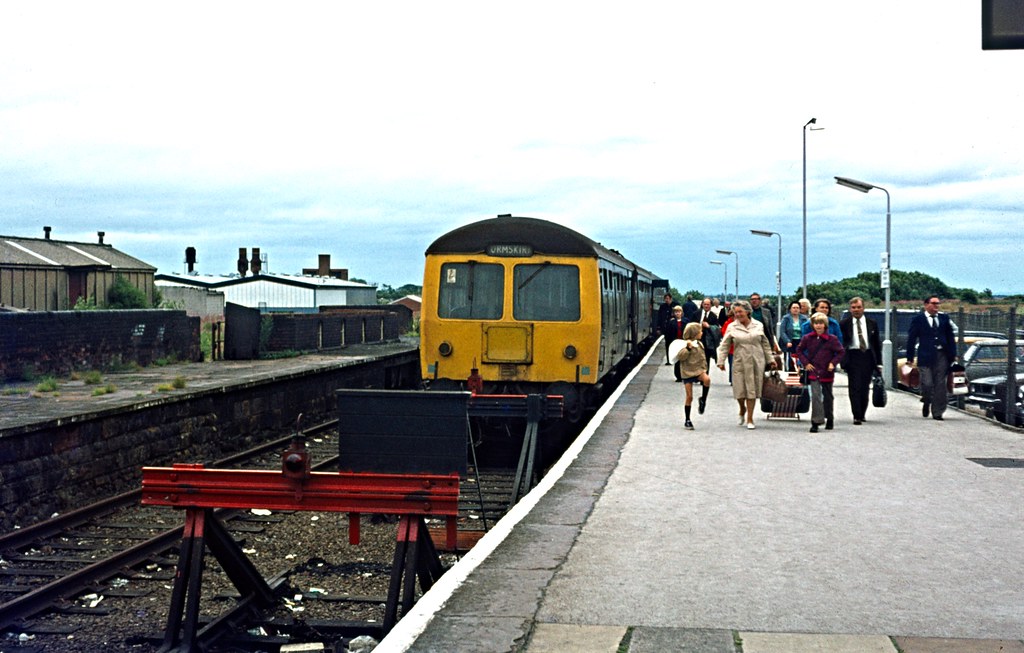
It's relevant to the thread because such a layout would have altered the effect of the over-run. Similarly if the two platforms had remained in use, one for Merseyrail and one for Northern with passengers crossing over the bridge rather than the walkway built under the bridge.

I guess it all comes down to what was considered satisfactory at the time the through route was severed.

My 1977 rail atlas has Kirkby as 'two black dots' with no link between, plus the 'red line' serving the freight terminal.

At Ormskirk, a similar situation, the 1977 rail atlas shows a crossing loop on a single line. The 1978 atlas has it as 'two black dots' with no link in between with the loop line retained for through running for freight. I remember that arrangement but cannot recall whether the passenger 'terminus' line was actually severed or whether two buffers stops were simply placed upon it. Again, with the loop having existed before (and after) severing, it would have been possible to reduce the risk of an end-on collision by use of the two platforms but causing inconvenience to passengers as a result.
 

John Luxton

Established Member
Joined
23 Nov 2014
Messages
2,041
Location
Liverpool
I rember that arrangement but cannot recall whether the passenger 'terminus' line was actually severed or whether two buffers stops were simply placed upon it. Again, with the loop having existed before (and after) severing, it would have been possible to reduce the risk of an end-on collision by use of the two platforms but causing inconvenience to passengers as a result.
Yes track was severed two of my photos on Flickr show it.


John Luxton

Established Member
Joined
23 Nov 2014
Messages
2,041
Location
Liverpool
and the extra expense of looking after a bridge. At the time the route was cut, I expect cost was the number 1 consideration and passenger (in)convenience the number 2.
What I always thought strange at Ormskirk was the way that the former electrified bay platform was not retained for the EMUs with the diesels using the main platform face to effect cross platform interchange. Then the bridge could still have been dispensed with. But if I recall correctly the bay platform had been lifted sometime before the through line was severed. Today the track bed there forms part of a path through to the bus station and town centre.

Obviously given the space at Ormskirk there were obviously possibilities for a different approach but Kirkby would be limited as it is in the confines of a cutting.
 

Baxenden Bank

Established Member
Joined
23 Oct 2013
Messages
4,761
and the extra expense of looking after a bridge. At the time the route was cut, I expect cost was the number 1 consideration and passenger (in)convenience the number 2.
I was being polite by suggesting that they had considered it acceptable, rather than simply going for the cheapest and easiest! Looking at @John Luxton 's pictures of Ormskirk, the loop platform was not in passenger use - no white edge to it.
 

jamesst

Established Member
Joined
4 May 2011
Messages
1,377
Location
Merseyside
Policy is to start braking in step 1 at most stations where practical, not just use step 1 all the way.
 

John Luxton

Established Member
Joined
23 Nov 2014
Messages
2,041
Location
Liverpool
I was being polite by suggesting that they had considered it acceptable, rather than simply going for the cheapest and easiest! Looking at @John Luxton 's pictures of Ormskirk, the loop platform was not in passenger use - no white edge to it.
In the early days some railtours and diversionary workings used the loop. Not sure when it was lifted though. Until recently the other platform at Ormskirk had become something of a jungle with the still extant building becoming almost invisible!
 

tomuk

Established Member
Joined
15 May 2010
Messages
2,009
Yes, it would prevent incidents like this, but this is an atypical incident.
It would appear from the RAIBs recommendation that they think that setups like at Kirkby need review and that the history of the four? previous buffer stop collisions there need to be considered. Of course Headbolt Lane does rather change the situation.
 

MadMac

Established Member
Joined
13 Jun 2008
Messages
1,508
Location
Moorpark, CA
Off topic, so I'll keep it brief.

Merseyside was carved out of south west Lancashire and decided to modernise and electrify their bit of the Liverpool-Preston line. Lancashire/BR/DfT didn't want to follow suit so through trains no longer ran and the odd arrangements now in place appeared. There are other examples at the extremities of the Merseyrail area I believe.
Ormskirk is similar.
 

LPJOHN

Member
Joined
13 May 2019
Messages
81
Off topic, so I'll keep it brief.

Merseyside was carved out of south west Lancashire and decided to modernise and electrify their bit of the Liverpool-Preston line. Lancashire/BR/DfT didn't want to follow suit so through trains no longer ran and the odd arrangements now in place appeared. There are other examples at the extremities of the Merseyrail area I believe.
Liverpool-Ormskirk was electrified in 1913 a few years before Merseyside was created I think.

Liverpool-Kirkby was electrified in about 1977. I cannot remember the year, but I remember getting woken up during the night when the line was being singled.

The “Northern” DMU used what was the original Liverpool bound platform.
 
Status
Not open for further replies.

Top