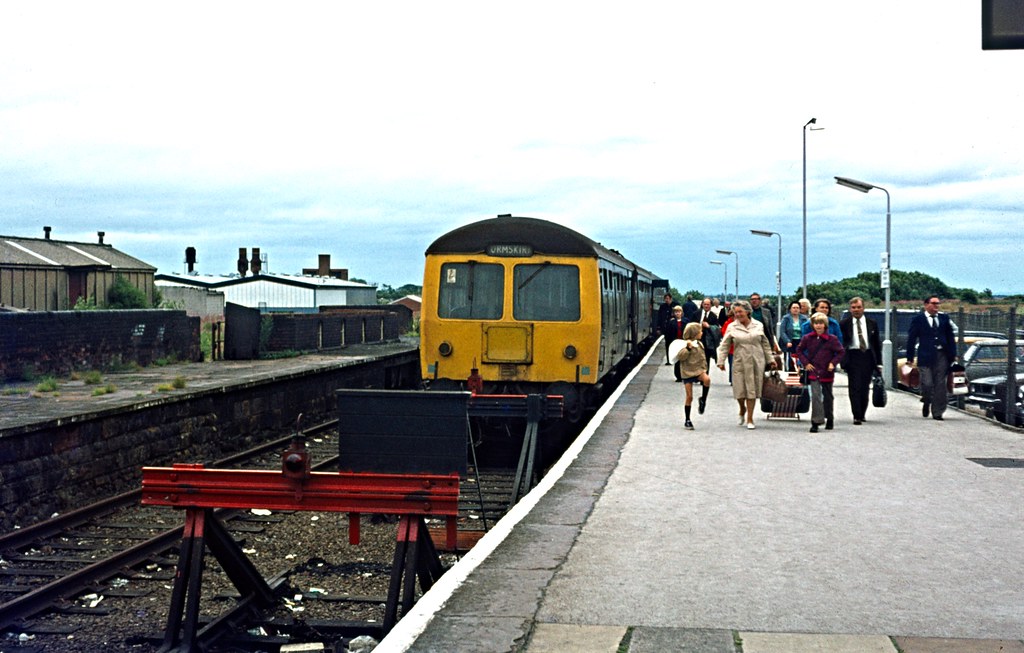
(Wouldn't it be more space-efficient (and, perhaps, safer in the case of a buffer-stop collision) to have one platform either side of an island platform, rather than the end-on arrangement? Anyway, that's a discussion for another thread so I'll leave it there.)
RAIB report paragraph 58: Merseyrail trains its drivers to begin applying the brakes on the approach to Kirkby station as the train passes over the M57 motorway (paragraph 40). Applying the lowest braking setting at this point typically results in a gradual reduction in a train’s speed to around 10 mph (16 km/h) by the time the train reaches the 15 mph (24 km/h) permanent speed restriction sign located at the start of the platform.
This in turn seems to imply, as others have said further up the thread, that TOC policy is step 1 braking from the M57 bridge to Kirkby station. To me, this provides a little bit of background to the speed for the first TPWS loop being set so high, given the TOC's policy for light braking may lead to variations in the braking curves between TOC policy and drivers who might employ a slightly more aggressive approach.
The report states that the the train accelerated to 50mph upon departure from Fazakerley (it doesn't state when it reached 50mph, but, from the other timings, I think it would have been at fairly close to 18.50. The report then states that it was recorded as travelling at 46mph at 18.51.35 hours, and 42mph at 18.51.58 hours. Mathematically speaking, I presume this indicates that there is a rising gradient approaching Kirkby; can anyone confirm whether there is? This may also mean that there could be variations in the braking curve with drivers who brake later (using the rising gradient to aid their deceleration). The report states that the TPWS loops are placed 300 metres from the beginning of the 15mph PSR, which would be ample distance to achieve a reduction in speed of 27mph (from 42mph down to 15mph) on a rising gradient. The issue is not with the placement and set speed of the OSS loops, it's about ensuring compliance with the braking curve. And "ensuring compliance with the braking curve" is the main safety feature that was dropped in the decision to roll out TPWS instead of ATP. It would cost a great deal to implement, whether in the form of ATP or ETCS, for comparatively little benefit. Yes, it would prevent incidents like this, but this is an atypical incident. The only incidents I can think of that might have a similar speed curve are those involving low adhesion, to which an ATP-style system would make no difference.