Buzby
Established Member
It was indeed - bus station interiors were created on a studio set (with a single vehicle for set dressing) at the original Associated Rediffusion building at Wembley Park.I think the interior shots were a set.

It was indeed - bus station interiors were created on a studio set (with a single vehicle for set dressing) at the original Associated Rediffusion building at Wembley Park.I think the interior shots were a set.
That seemed to be a design feature of covered bus stations. I used Doncaster South quite often and it always seemed to have various drips going on.although it was delayed action - all was dry for an hour or two after it started raining, and buses / passengers continued getting wet for an hour or two after it stopped raining.
It was mentioned up thread, and yes, very much still in use.Have we had Belper, Derbyshire yet? That was another combined depot / bus station - not sure if it's still in business, I've not been to that part of the world for many years now.
Yes, Belper has been mentioned. Still in use as a bus station and depot. Buses now enter from the front, rather than using the passage from Campbell Street to the rear. Changes to the front entrance stops double deckers using it.Fairly sure it has been - it closed in 2006 and there was a mini running day (not sure if it was much more than a couple of London Transport / Country Routemasters.)
No, I was going to mention it - and also had a nightclub then later bingo hall above it, so Longton wasn't quite unique in that respect. (from memory, the Longton one was at various times a bowling alley, 'the chancery grill' and 'jollees night club')
Although in its later years, when it was revived for rail replacement, Reading didn't quite meet this requirement -
although it was delayed action - all was dry for an hour or two after it started raining, and buses / passengers continued getting wet for an hour or two after it stopped raining. i always wore a hat when i was looking after rail replacements there...
Have we had Belper, Derbyshire yet? That was another combined depot / bus station - not sure if it's still in business, I've not been to that part of the world for many years now.


Much appreciated. I did try to look up various maps on the National Library for Scotland site but, for some strange reason, my browser wasn't playing ball!Killermont Street Bus Station
As can be seen from the map below, the bus station (bordered in red) mostly handled northbound routes and was close to Buchanan Street station, vehicles entered from Port Dundas Road, turning into Germiston Street and entering the building. Buses exited into Killermont Street before turning into Parliamentary Road. (Marked in green). Not relevant to this thread, was the adjacent ‘open to the elements’ Parliamentary Road Bus Station (marked in yellow) which handled the more local buses. It is worth noting that ‘new’ bus station often incorrectly called Buchanan Street when it is simply ‘Buchanan’.
View attachment 180989
Waterloo Street Bus Station
Operationally working the same way as Killermont (above), buses entered at Wellington Street to reach 6 (or possibly 8) platforms each having a stairway up to a mezzanine level with seats and vending machines as well as an area for passengers to circulate and walk down to whichever platform they required; it was only yards away from Glasgow Central. Egress was via Waterloo Street
View attachment 180990
Finally, I‘ve omitted Anderson Bus Station, the building under which it was located - Anderson Shopping Centre still exists and operated similar to Buchanan with saw-tooth platforms but was a scary place at night with the bus areas open to the sky.
Thanks to NLS Maps for the resource.
== Doublepost prevention - post automatically merged: ==
See the map - it was Parliamentary Road!

The last time I went to Whitehaven, albeit it many years ago in the days of the NBC, there was a covered bus station. On a curve in the road, opposite the bus depot.Sincw we are allowing long gone bus stations, then Durham was originally covered, in a similar manner to Newcastle Worswick Street. Wasn't Whitehaven (now Wetherspoons) covered too?

It closed a good time ago but was mentioned in post #4 - now a cafe as already mentioned.The last time I went to Whitehaven, albeit it many years ago in the days of the NBC, there was a covered bus station. On a curve in the road, opposite the bus depot.
Worswick Street was as you describe - covered but open to the elements. It was a horrid place, windy and cold with a resident flock of pigeons. It always made me laugh when enthusiasts would suggest, as it was stood derelict for years, that it should be reopened.Worswick St was covered in the style of a market hall with one side completely open and a fairly high roof supported by pillars. I recall it as definitely not a fume-filled hellhole like the first Eldon Square nearby or the Midland Red Bull Ring, but as windswept and cold - gey snell, were it to have been in Edinburgh. And as an aside on the quality of current so-called journalism, a fairly recent piece in the local rag on the subject of photos of the past referred to it as Warwick St bus station.
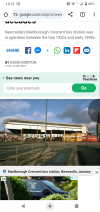
Ah, Marlborough Crescent bus station in the early 1970s.Worswick Street was as you describe - covered but open to the elements. It was a horrid place, windy and cold with a resident flock of pigeons. It always made me laugh when enthusiasts would suggest, as it was stood derelict for years, that it should be reopened.
In the mid 1980s, Newcastle had four main bus stations and they were all awful. One of those was Marlborough Crescent that was open air by then, but on older photos (early 1970s?), it also had a canopy over some of it at least.

As mentioned in #4About half? of Rotherham Interchange is covered
Market Gates in Great Yarmouth has a number of stands that are fully undercover, as does Worcester Crowngate, though both have some outside too. Think Rotherham is also in that category.
It's in the original postCan't see it mentioned but both the old and new Nottingham Broadmarsh are covered.

Haha, so it was!It's in the original post

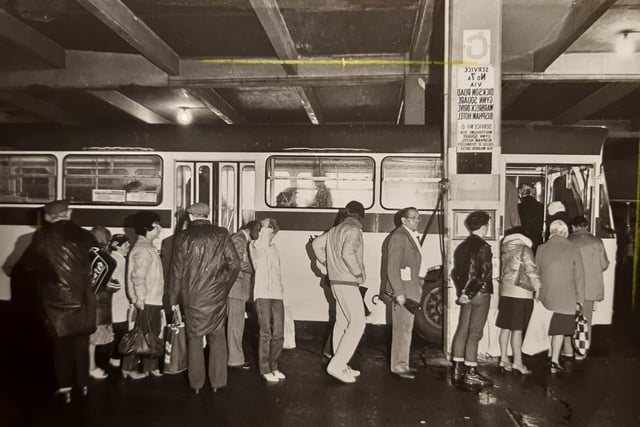
Talbot Road bus station was a weird one, you didn't know whether you were on the roadway or not, as passengers & buses wearn't segregated, health & safety would have a fit if they saw that bus station today.Conveniently, this story has recently appeared on the Blackpool Gazette website, with several photos of Blackpool's undercover 'Talbot Road' bus station in and prior to the 1980s.
RE picture #4 (copied below) - who knew that Blackpool once operated left hand drive AEC swifts!!!

I've just been to Jersey and spent some time at the Liberation Station, as it's called. Access to the buses is through sliding doors spaced out along the concourse and which are covered in advertising so that the bus is "revealed" only at the last moment. As TheSel has mentioned, the headroom inside does not admit double deckers and the few services which use these - principally the 15 to Jersey Airport - operate from stands on the street immediately outside the entrance. Buses were very busy at times and long queues formed but the design seemed to work. In contrast, the Town Terminus at St. Peter Port, Guernsey, had limited cover for waiting passengers other than shelters.... and not strictly "... in the UK..." as the initial post requested, but 'Liberation' in St Helier, Jersey, is undercover, save for a couple of outside stands. And thus, is inaccessible to the fleet's double deckers, although this link shows that one driver did try (unsuccessfully) earlier this year.
[My pic below shows CT Plus Optare Solo 1717 - J122017 - emerging from the murky depths in April 2024]
View attachment 181074
This picture just came up todayLivingston and Dalkeith were both combined depots and bus stations.
I remember the row which broke out when LRT (as Lothian was called then) started running to Livingston in the early nineties. LRT were unhappy at having to pay SMT departure fees every time a service 9 called at the bus station and, after a few years, had a stop erected on the street outside. The issue was resolved shortly afterwards, when SMT was bought by the GRT group and
How far back are we talking for Durham to be covered? And I guess are we talking North Road, or was there an older one?Sincw we are allowing long gone bus stations, then Durham was originally covered, in a similar manner to Newcastle Worswick Street.
The same photo is also on flickr along with this one
There was one with an ornate wrought iron canopy that was there until c.1975 IIRC, which is what you are referring to. Perhaps not offering the greatest protection but not dissimilar to Worswick Street or Marlborough Crescent in Newcastle. It was said that the ironwork was dismantled and given to Beamish open air museum but I don't know if that's some urban myth.How far back are we talking for Durham to be covered? And I guess are we talking North Road, or was there an older one?
The previous one wasn't covered - passenger area was, but not the buses. I can find a very old photo of a canopy with 'Omnibus Station' on it, but that seems tenuous to class it as covered - more like a fancy petrol station canopy with little weather protection.

I think Edinburgh bus station is one of them.How many under cover indoor bus stations are there in the UK?
For the benefit of the doubt, this is where if a bus is parked on the stand and it starts raining, the bus will stay dry, so bus stations where its nose sticks under an overhanging roof don’t count
First ones that spring to mind are
Workington, Cumbria
Nottingham Broadmarsh
Doncaster Interchange
There were of course loads more in the past like Newcastle Eldon Square and Manchester Arndale
There is a photo of this in the Northern Echo archive. I think I only went to Worswick Street a handful of times - the X5 we normally got to Newcastle went to Eldon Square, but we more often got the 230 to Sunderland and went by train. From memory it was a lot more enclosed than that canopy at Durham. I don't recall ever going to Marlborough Crescent, but photos also show it a lot more enclosed.There was one with an ornate wrought iron canopy that was there until c.1975 IIRC, which is what you are referring to. Perhaps not offering the greatest protection but not dissimilar to Worswick Street or Marlborough Crescent in Newcastle. It was said that the ironwork was dismantled and given to Beamish open air museum but I don't know if that's some urban myth.
Yes, I spent far too long in there when at 6th Form waiting for the X40 to take me home. The number of times my heart sank when a Merc minibus turned up for a service that often filled a VR...The replacement was a bleak one with a simple canopy for passengers but not enclosed; it was later upgraded (twice) before it was demolished a few years back.
Worswick Street and Marlborough Crescent may have been more enclosed but as I say, they didn't provide much shelter from the elements.There is a photo of this in the Northern Echo archive. I think I only went to Worswick Street a handful of times - the X5 we normally got to Newcastle went to Eldon Square, but we more often got the 230 to Sunderland and went by train. From memory it was a lot more enclosed than that canopy at Durham. I don't recall ever going to Marlborough Crescent, but photos also show it a lot more enclosed.
I suspect Beamish was rather overwhelmed in the early years. We went quite often and there was a lot of stuff lying around obviously with no idea what to do with it. There is bound to be a lot that was simply left too long for restoration to be viable.
Yes, I spent far too long in there when at 6th Form waiting for the X40 to take me home. The number of times my heart sank when a Merc minibus turned up for a service that often filled a VR...