• Our new ticketing site is now live! Using either this or the original site (both powered by TrainSplit) helps support the running of the forum with every ticket purchase! Find out more and ask any questions/give us feedback in this thread!

Battery powered trains

Status
Not open for further replies.

NLC1072

Member
Joined
17 May 2010
Messages
649
Location
Ireland/London
This is a subject of fantasy, but what would the prospect of there being trains that can run off of OHLE/DC Rails and charge batteries for use off of electrified lines?... like an alternative to the Bi-Mode proposition. An example of where this would be useful is the summer services on the Greater Anglia franchise where they run trains from Liverpool Street to Great Yarmouth, which are dragged from Norwich onwards where the line speed isnt all that high.

NLC1072
 
Sponsor Post - registered members do not see these adverts; click here to register, or click here to log in
R

RailUK Forums

judethegreat

Member
Joined
21 Mar 2011
Messages
163
This is a subject of fantasy, but what would the prospect of there being trains that can run off of OHLE/DC Rails and charge batteries for use off of electrified lines?... like an alternative to the Bi-Mode proposition. An example of where this would be useful is the summer services on the Greater Anglia franchise where they run trains from Liverpool Street to Great Yarmouth, which are dragged from Norwich onwards where the line speed isnt all that high.

NLC1072
Plaster the roof with solar panels aswell (I've thought this anyway before..). Still, a LOT of batteries would needed, but really good idea.
 

NLC1072

Member
Joined
17 May 2010
Messages
649
Location
Ireland/London
With the wider acceptance of eletric/hybrid cars in the automotive industry, there have been great advances in battery capacity and endurance etc, might be time to reconsidder this idea? Also we know about the hydrogen powered buses in London that used to operate the RV1, maybe this could be a way forward if the hydrogen production process becomes efficient enough so that you use less engergy gathering hydrogen compared to what the hydrogen has to offer in the first place! Could be an excuse for loco hauled services that?
 

DXMachina

Member
Joined
24 Oct 2011
Messages
652
I bet a diesel engine plus generator and fuel tank weighs less than a battery pack and would give greater range....
 

bangor-toad

Member
Joined
20 Feb 2009
Messages
671
Hi there,
The SR intoduced these some time ago is the form of the MLV Motor Luggage Van.

These were battery powered to allow them to shunt away from the electrified 3rd rail. The linked article says that they were just capable of operating along the then non electrified Redhill to Tonbridge route.

Obviously this isn't quite up to modern requirements but maybe the newer batteries and lightweight materials could make the concept a viable Class 153 replacement?

Cheers,
Jason
 

Nym

Established Member
Joined
2 Mar 2007
Messages
9,780
Location
Somewhere, not in London
And a hydrogen fuel cell weighs less than a diesel engine :P

But as I keep getting shouted down by people for every time I mention fuel cell power packs for trains, storing hydrogen is too hard... Aparently.

If they can prove a safety case in california for it on the public roads, then use in rail vehicles with much less chance of colision shouldn't be hard.

It would also mean we could take an off the shelf EMU and install this kit in one or two of the trailers to have a HEMU (Hydrogen-Electric Multipule Unit).

With say, one panto/transformer carriage, two fuel cell carriages and a motor carriage...

Or if we're basing it on something like a 350 where there are two motored vehicles, a transformer vehicle and a trailer, installing the equipment in the trailer...
 

NLC1072

Member
Joined
17 May 2010
Messages
649
Location
Ireland/London
I bet a diesel engine plus generator and fuel tank weighs less than a battery pack and would give greater range....

Yes, a DEMU...

But I was thinking of using less parts as a diesel engine is far more maintanance heavy/prone to go wrong etc and not relying on diesel would be a good thing I think considering where in the world it tends to comes from. And with the rising cost of diesel, electricity is becoming so much cheaper in comparison year on year.

This would also pave the way to electrify some other secondary main lines etc, as the only modification required to the stock is to remove the batteries. Instead of being stuck with Bi-Mode trains and waiting for their service life to run out.
 

Nym

Established Member
Joined
2 Mar 2007
Messages
9,780
Location
Somewhere, not in London
Let us chemists deal with that; we're working hard. I think the first experimental HMUs aren't too far down the line.

Like I said, Honda got a safety case and managed it in California, so why the hell can't we just strap 20 of them together under a couple of carriages of an EMU and have done with the whole diesel thing I don't know...

(I do know why, it isn't THAT simple, but it isn't far off that simple...)
 

judethegreat

Member
Joined
21 Mar 2011
Messages
163
Another thought is (I think it's called) regenerative braking, which some buses, such as the new(ish) hybrids, have. I don't fully understand the physics of it (or EXACTLY how those buses) work, but basically the energy lost when braking is fed back into the engine/batteries.
 

Eagle

Established Member
Joined
20 Feb 2011
Messages
7,106
Location
Leamingrad / Blanfrancisco
Like I said, Honda got a safety case and managed it in California, so why the hell can't we just strap 20 of them together under a couple of carriages of an EMU and have done with the whole diesel thing I don't know...

The main stumbling block is generating hydrogen in the first place. Commercially most hydrogen is derived from catalytic oxidization of methane from natural gas, but of course that involves fossil fuels (and its byproduct is carbon monoxide, which is normally burnt off to form carbon dioxide). Better perhaps would be water electrolysis; it's less energy efficient, and of course there's still the matter of where the electricity is coming from, but it's a simple, cheap, and potentially infinitely renewable method.
 

NLC1072

Member
Joined
17 May 2010
Messages
649
Location
Ireland/London
Let us chemists deal with that; we're working hard. I think the first experimental HMUs aren't too far down the line.

If they can store it on a single deck Mercedes Citaro BZ running in central London they can safely and easily install it on an EMU is my guess?
 

Nym

Established Member
Joined
2 Mar 2007
Messages
9,780
Location
Somewhere, not in London
Another thought is (I think it's called) regenerative braking, which some buses, such as the new(ish) hybrids, have. I don't fully understand the physics of it (or EXACTLY how those buses) work, but basically the energy lost when braking is fed back into the engine/batteries.

Do you want the basic explanation or the full 10 hour lecture?

Regenerative breaking basically turns the electric motor into a generator and feeds this back onto the batteries, but this does not work at low speed as there isn't enough torque produced from the forward motion of the vehicle to make it worth it.

You can take the top end of speed off with regenerative braking and put it back into the batteries, and then use friction braking to actually stop.

It also depends on the type of hybrid, if it's an in line electrically assisted diesel then it's a very different setup to a full diesel electric configuration.

The former uses an electric motor to assist the smaller diesel in setting off / stopping etc. (This is what Stagecoach Manchester uses)

The latter is a Diesel Generator with batteries and all torque to the rear axle is provided by an electric motor, meaning the diesel is much smaller, sits on it's side and always runs at it's most efficent revs, unless the batteries are running low, then produces more torque. Some also have an overdrive facility where you can see anything up to 450 - 600bhp (equivilant) at the rear axle. (Most buses are 250 - 350hp)
These are used by Bullocks on the 147 Route.
--- old post above --- --- new post below ---
The main stumbling block is generating hydrogen in the first place. Commercially most hydrogen is derived from catalytic oxidization of methane from natural gas, but of course that involves fossil fuels (and its byproduct is carbon monoxide, which is normally burnt off to form carbon dioxide). Better perhaps would be water electrolysis; it's less energy efficient, and of course there's still the matter of where the electricity is coming from, but it's a simple, cheap, and potentially infinitely renewable method.

Well, the hydrogen generation thing using electrolysis is very 'rampable' ie. it's easy to stop and start. (From what I remember of A Level Chemistry)

With the way our UK generating profile is going, with increasing reliance on wind, and hopefully nuclear, we will not be able to ramp the national grid half as fast as we used to, but we can generate hydrogen in a method linked to the grid, so that H2 electrolosis only takes place when there is 'spare electricity'. Such as at nights, when wind is all in full capacity etc.

So if we have a supply that is rather unpredictable and a draw that we know roughly where the profile is (It's a 66% load gap last time I checked) then when we're in low demand stages, knock on the H2 plants and generate (and store) the hydrogen, when demand increases, start stutting down the H2 plants. Just make sure we're producing enough and we have enough space in the generating profile to make enough hydrogen for the country, and to export! And of course, with this Hydrogen we can make other fuels...
 
Last edited:

NLC1072

Member
Joined
17 May 2010
Messages
649
Location
Ireland/London
The main stumbling block is generating hydrogen in the first place. Commercially most hydrogen is derived from catalytic oxidization of methane from natural gas, but of course that involves fossil fuels (and its byproduct is carbon monoxide, which is normally burnt off to form carbon dioxide). Better perhaps would be water electrolysis; it's less energy efficient, and of course there's still the matter of where the electricity is coming from, but it's a simple, cheap, and potentially infinitely renewable method.

Unfortunatly with this method we are better just sticking to electricity because you get less energy out than what you invest to get it. Basic physics, energy will be lost in the process from heat and friction etc... and seeing as trains run from electricity already...

BUT if we can produce hydrogen from renewable electricity energy sources using this method, even though it is less efficient it still does have its place i.e. lines far away from any electrified network.
 

Eagle

Established Member
Joined
20 Feb 2011
Messages
7,106
Location
Leamingrad / Blanfrancisco
Well, the hydrogen generation thing using electrolysis is very 'rampable' ie. it's easy to stop and start. (From what I remember of A Level Chemistry)

It is literally as simple as turning the electricity on and off. (Oh, and shutting down whatever pumping mechanism feeds water into the chamber and extracts the gases.)
--- old post above --- --- new post below ---
Unfortunatly with this method we are better just sticking to electricity because you get less energy out than what you invest to get it.

Yes of course, no fuel-based engine is better than electrification. I was thinking of hydrogen use to replace diesel in places that'll never be electrified; and also of course for its use in road transport, which is ultimately a more pressing concern. :P
 

NLC1072

Member
Joined
17 May 2010
Messages
649
Location
Ireland/London
It is literally as simple as turning the electricity on and off. (Oh, and shutting down whatever pumping mechanism feeds water into the chamber and extracts the gases.)
--- old post above --- --- new post below ---


Yes of course, no fuel-based engine is better than electrification. I was thinking of hydrogen use to replace diesel in places that'll never be electrified; and also of course for its use in road transport, which is ultimately a more pressing concern. :P

My thoughts exactly, but I may of poorly worded it, sorry! =(
 

Nym

Established Member
Joined
2 Mar 2007
Messages
9,780
Location
Somewhere, not in London
BUT if we can produce hydrogen from renewable electricity energy sources using this method, even though it is less efficient it still does have its place i.e. lines far away from any electrified network.

See above...

I can't go into the whole renewable network, generating profile etc stuff now, half because it's commercially sensitive, half because I havn't got time to type it, and also partly because I get the feeling that not many people would understand it so it adds little value.

It is literally as simple as turning the electricity on and off. (Oh, and shutting down whatever pumping mechanism feeds water into the chamber and extracts the gases.)
Out of intrest, do you need a fully rectified DC current to make this work, or would a rectified AC or even an AC signal work?

If one can just use a non stabalised rectified AC current, and have several reaction tanks running at say, 3.3kV 100A, then these can be just turned on and off with switches and work very nicely from the POV of the grid thankyou very much...

Yes of course, no fuel-based engine is better than electrification. I was thinking of hydrogen use to replace diesel in places that'll never be electrified; and also of course for its use in road transport, which is ultimately a more pressing concern. :P

And this hydrogen wouldn't just be used for rail, it would be a new national fuel source, and potentially be used to produce legacy fuels like petrol and diesel for use in legacy (classic) vehicles.
 

Trog

Established Member
Joined
30 Oct 2009
Messages
1,546
Location
In Retirement.
Anyone else remember the 501 based battery loco, about 100 tons of batteries to give a power output similar to a class 25, but at a low speed and with a maximum range of about 20 miles.
 

NLC1072

Member
Joined
17 May 2010
Messages
649
Location
Ireland/London
See above...

I can't go into the whole renewable network, generating profile etc stuff now, half because it's commercially sensitive, half because I havn't got time to type it, and also partly because I get the feeling that not many people would understand it so it adds little value. ...

How about if the renewable electricity production was just localised and off of the grid? say the Hydrogen plant worked off of a small wind farm or tidal barrage of its own?

And agreed I'd have no idea if you were to go into that technical detail you mentioned!
 

Nym

Established Member
Joined
2 Mar 2007
Messages
9,780
Location
Somewhere, not in London
How about if the renewable electricity production was just localised and off of the grid? say the Hydrogen plant worked off of a small wind farm or tidal barrage of its own?

And agreed I'd have no idea if you were to go into that technical detail you mentioned!

Because then we don't solve any other poblems at the same time, tieing it to the grid means we can migrate to more unpredictable and less rampable generating sources, such as Nuclear, Tidal and Wind.

This will give you some idea of what I mean about grid demand.

The reason I'd tie it to the grid is because of the drops in demand that this shows, this is REAL data from January this year...

The top graph is the grid demand (less pumping, interconnectors, import/export etc) for 3JAN12 to 5JAN12 and the lower one is from 1JAN12 to 31JAN12 sampled at datum point 36.

nationalgriddata.png

The points with the lower demands mean that coal and OCGT plants need to turn off and on to cover this (and pumping stations etc work).

These lower demand points is where I would be turning on Hyrdogen production so we wouldn't need to turn the OCGT and Coal plants on and off a lot (this wastes a lot), and then the OCGT plants can migrate to CCGT (Much more efficent) or onto nuclear that cannot be turned on or off.

This also covers the basic unknowns of when will wind power generate and how much, by tieing the switching of H2 production into the grid and only activating it when the grid has enough generating capacity to fund it, ie. Wind is working and it's low demand period (weekends and nights)...
 

Eagle

Established Member
Joined
20 Feb 2011
Messages
7,106
Location
Leamingrad / Blanfrancisco
Would a current and voltage ripple around the 7% mark for a 12pulse/cycle at 50Hz be much of an issue, or does it need to be pure DC?

As long as the p.d. exceeds the reduction potential of the cell (given by the Nernst equation), electrolysis will occur, so a DC+AC signal will be okay. But a p.d. that keeps changing sign is no use, of course.
 

NLC1072

Member
Joined
17 May 2010
Messages
649
Location
Ireland/London
...The reason I'd tie it to the grid is because of the drops in demand that this shows, this is REAL data from January this year...

The top graph is the grid demand (less pumping, interconnectors, import/export etc) for 3JAN12 to 5JAN12 and the lower one is from 1JAN12 to 31JAN12 sampled at datum point 36....

Amazingly high quality content in your post there, I understand now!

Seems to tie in with hydrogen production perfectly in your model.

Now to convince the Tories...
 

judethegreat

Member
Joined
21 Mar 2011
Messages
163
How about if the renewable electricity production was just localised and off of the grid? say the Hydrogen plant worked off of a small wind farm or tidal barrage of its own?

And agreed I'd have no idea if you were to go into that technical detail you mentioned!
Renewables actually work more efficiently being local to where the power will be used. Another benefit is no need for more pylons everywhere. Plaster all roofs (moving and stationery - south facing ones atleast) with solar panels, small (12inch) turbines everywhere, on every signal and OHLE gantry, for example. Hydro however is the most efficient (and safe*)form of renewable. *lets stop this obsession with nuclear please - to put it EXTREMELY simply, dabbling in all that is one of the dodgiest things we do.
By the way, cheers Nym for the explanation of regenerative braking. I was thinking of the Enviro 400s, guess they're the latter of the two. Could reg. braking be used on trains?
 

Nym

Established Member
Joined
2 Mar 2007
Messages
9,780
Location
Somewhere, not in London
As long as the p.d. exceeds the reduction potential of the cell (given by the Nernst equation), electrolysis will occur, so a DC+AC signal will be okay. But a p.d. that keeps changing sign is no use, of course.

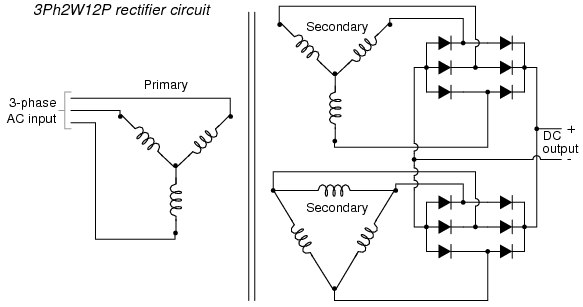
No massively expensive power electronics needed then, we can just strap a 12 pulse transformer/rectifier in the way and use that, so long as the current ripple is above what is needed.

This:

03270.png


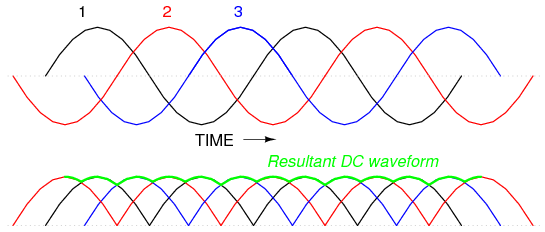
Produces this:

03269.png


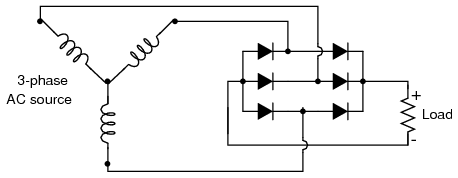
But the wavy bits on the top are half as long, this is from a 6 pulse rectifier.

That is one of these (Half of a 12 pulse rectifier)

03267.png


Also, if you don't beleive me on the grid thing, the data is available,
here: http://www.nationalgrid.com/uk/Electricity/Data/Realtime/Demand/Demand8.htm
and here: http://www.nationalgrid.com/uk/Electricity/Data/Demand+Data/

Renewables actually work more efficiently being local to where the power will be used. Another benefit is no need for more pylons everywhere. Plaster all roofs (moving and stationery - south facing ones atleast) with solar panels, small (12inch) turbines everywhere, on every signal and OHLE gantry, for example. Hydro however is the most efficient (and safe*)form of renewable. *lets stop this obsession with nuclear please - to put it EXTREMELY simply, dabbling in all that is one of the dodgiest things we do.
By the way, cheers Nym for the explanation of regenerative braking. I was thinking of the Enviro 400s, guess they're the latter of the two. Could reg. braking be used on trains?

The problem with local generation is the load profile will not match the generating profile, especially on renewables, hence why all local generation is grid tied, and people have to pay for £3,000 worth of power electronics to connect themselves to the grid and their renewable source.

Remember, turbines would need to be grid tied, and if we slap them on OHLE pylons we'd need to either move to a dirty DC grid (Not gonna happen!) or strap non-standard power electronics onto each one, and then the current phase inbalance problems get made worse by the generators on each phase being different, rather than just loads, that one can plan around easyer.

Nuclear is required in the UK, end of, once we run out of gas for CCGT plants we will need a baseline generating profile from somwhere, tidal and wind can go some way toward this, but the major baseline needs to come from nuclear, coal or CCGT. Until we get massive offshore plants for wind and tidal sorted. Even then, I dowbt we can build enough.

Regenerative braking IS used on trains... A lot of EMUs use this now.

Amazingly high quality content in your post there, I understand now!

Seems to tie in with hydrogen production perfectly in your model.

Now to convince the Tories...

That would need joined up thinking and hydrogen production to be braught into the National Grid planning office, it's not that unrealistic to be honest, we just need to get hydrogen promoted as a national resource as much as petrol was. A disribution and production network needs to be set up, and that is a lot harder than you'd think.

PS: I won't show you what anything that is needed to produce clean signals looks like, it's VERY complex!

 
Last edited:
Status
Not open for further replies.

Top