As long as the p.d. exceeds the reduction potential of the cell (given by the Nernst equation), electrolysis will occur, so a DC+AC signal will be okay. But a p.d. that keeps changing sign is no use, of course.
No massively expensive power electronics needed then, we can just strap a 12 pulse transformer/rectifier in the way and use that, so long as the current ripple is above what is needed.
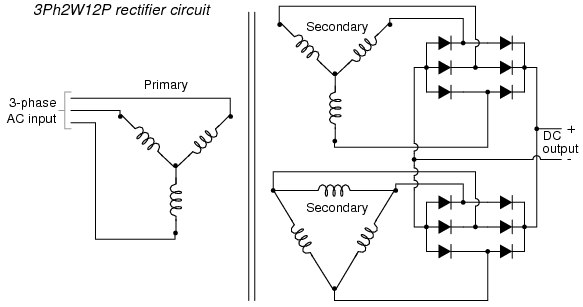
This:
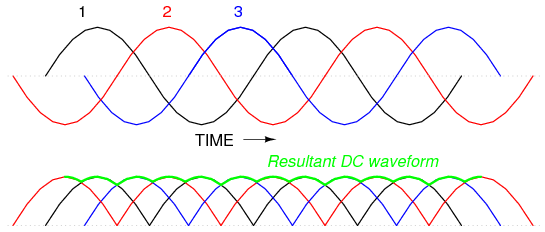
Produces this:
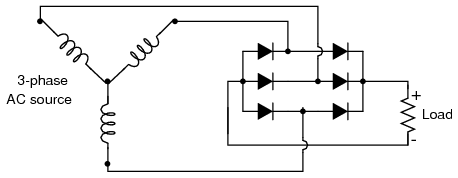
But the wavy bits on the top are half as long, this is from a 6 pulse rectifier.
That is one of these (Half of a 12 pulse rectifier)
Also, if you don't beleive me on the grid thing, the data is available,
here:
http://www.nationalgrid.com/uk/Electricity/Data/Realtime/Demand/Demand8.htm
and here:
http://www.nationalgrid.com/uk/Electricity/Data/Demand+Data/
Renewables actually work more efficiently being local to where the power will be used. Another benefit is no need for more pylons everywhere. Plaster all roofs (moving and stationery - south facing ones atleast) with solar panels, small (12inch) turbines everywhere, on every signal and OHLE gantry, for example. Hydro however is the most efficient (and safe*)form of renewable. *lets stop this obsession with nuclear please - to put it EXTREMELY simply, dabbling in all that is one of the dodgiest things we do.
By the way, cheers Nym for the explanation of regenerative braking. I was thinking of the Enviro 400s, guess they're the latter of the two. Could reg. braking be used on trains?
The problem with local generation is the load profile will not match the generating profile, especially on renewables, hence why all local generation is grid tied, and people have to pay for £3,000 worth of power electronics to connect themselves to the grid and their renewable source.
Remember, turbines would need to be grid tied, and if we slap them on OHLE pylons we'd need to either move to a dirty DC grid (Not gonna happen!) or strap non-standard power electronics onto each one, and then the current phase inbalance problems get made worse by the generators on each phase being different, rather than just loads, that one can plan around easyer.
Nuclear is required in the UK, end of, once we run out of gas for CCGT plants we will need a baseline generating profile from somwhere, tidal and wind can go some way toward this, but the major baseline needs to come from nuclear, coal or CCGT. Until we get massive offshore plants for wind and tidal sorted. Even then, I dowbt we can build enough.
Regenerative braking IS used on trains... A lot of EMUs use this now.
Amazingly high quality content in your post there, I understand now!
Seems to tie in with hydrogen production perfectly in your model.
Now to convince the Tories...
That would need joined up thinking and hydrogen production to be braught into the National Grid planning office, it's not that unrealistic to be honest, we just need to get hydrogen promoted as a national resource as much as petrol was. A disribution and production network needs to be set up, and that is a lot harder than you'd think.
PS: I won't show you what anything that is needed to produce clean signals looks like, it's VERY complex!