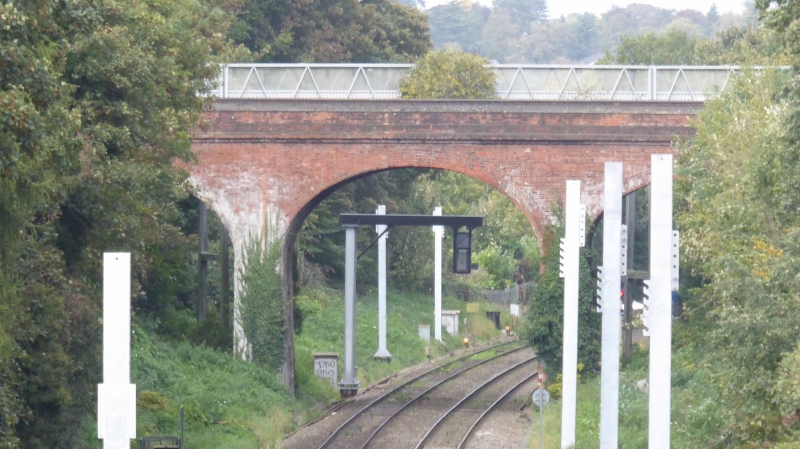
It doesn't. Widening the cutting is difficult irrespective of what happens at the station.
Depends, short term earthworks can be fairly steep and protected with lightweight structures.
For example (and it's a little extreme) but if you needed to hold back circa 300mm a paving slab on end (well 80 degree slope) is sufficient as a long term solution.
As others have said, it was broad gauge, so my estimation of 4m on both sides may even be too much.
Don't forget that you are starting with a cutting where the base is only 2 tracks wide. Adding up to 4m either side means moving a lot of earth, without compromising the stability of what remains.
Stability issues disappear if it's in a tunnel, which is what I'm suggesting if it's 4 tracked.
Although, I'm not opposed to creating only a 3rd track by widening on one side (looking at photos I link to later and the aerial photos the eastern side may be the easier side to do) as an interim option, as whilst that would need more long term stabilisation, given that we may not need the full 4m of widening to fit in a 3rd track there might be scope to:
- create lightweight structures to support maybe 1.2m to gain something like 2m to add to what looks like it might be 2m already to the east which is already looking like it's already stone
- add a third track on one side
- finally (optionally) create a very low (circa 300mm) support on the western side to provide a bit more space
Then just leave it as that until a 4th track is needed and we can revisit what's needed to get to it being a full 4 track line.
Trains don't end for the day, there is a procession of intermodals going to and from Southampton that run all night, and some Mendips aggregate trains too.
In a built up area noise nuisance will be an issue for overnight work.
Besides, very little can be achieved in an overnight possession, because of the amount of time taken to set it up and take it down again.
Even weekend closures are a challenge because of the amount of Saturday traffic to and from Southampton.
Even without restoring to the reopening of the line between Winchester and Didcot there's options for freight.
A more expensive option could be to create a chord to allow trains to travel Farnborough to Frimley (used to exist) with a single reverse at Ascot you can bypass Reading West for freight from Southampton at any time you need to in the future as well as to create these works (please forget that I've previously suggested that this could be a very useful grade separated junction to create an urban metro for the circa 250,000 people in the Aldershot Urban Area).
I'm also assuming you missed where I said that given the works could be done one side at a time that freight could use the opposite side track with the track near the works being the safely margin between the works site and the active railway. Obviously, that would limit capacity, although transition across a 1km length isn't likely to mean a massive limitation (5km at 25kph is 5 trains per hour).
And we haven't even started on how those two bridges will be replaced.
Here's a link to a photo of the eastern side of the Tilehurst Road Bridge, whilst there's might be a need to do some works to the eastern side of that secondary arch it looks like that a third line could pass through there.
With a description http://www.historicengland.org.uk/listing/the-list/list-entry/1409246 to match the A4 road bridge a little to the south, this carries a minor road through the suburbs. "Forms an impressive pair with the similar and contemporary Bath Road Bridge."

www.geograph.org.uk
Link to photo showing the central arch with two tracks passing under and the right hand arch with limited earthworks under.
Whilst the western side is likely to be a bit more complex:
Tilehurst Road Bridge (BKE3709) is a Grade II listed building in Battle, Reading, England. See why it was listed, view it on a map, see visitor comments and photos and share your own comments and photos of this building.
britishlistedbuildings.co.uk
Link to photo of the same bridge but showing the western arch where there's much more soil around the base.
Likewise the Bath Road Bridge is likely to be as complex asthe western portal above:
From a train approaching Reading West station. The line is in a cutting for about 1300 metres. The bridge carries the A4 and is listed: "A triple-arch skew overbridge with semi-elliptical arches; ... unusually high" http://www.historicengland.org.uk/listing/the-list/list-entry/1409263 . See...
www.geograph.org.uk
Link to a photo of the bridge showing significant earthworks.
However, and obviously subject to structural design, there's potential for modifying the outer portals without the need to remove the bridges.
Reading West is busier than one might expect; closing it would be a great inconvenience (especially to me). But, playing devil's advocate, might it be possible to open platforms north of Oxford Road instead, in the area of the traincare depot, which would allow services to avoid the station?
Sounds a sensible option.
What goal are we trying to reach that is assisted by closing or moving Reading West station?
Losing around 450,000 passenger journeys a year or spending tens of millions on a complex reconstruction would need some very important goal to justify it.
Given that the access is only from one end of the platforms, switching it to North of the bridge, maybe with a bit of a little walk to get to North of the track to the area inside the triangle, isn't going to have a large impact on user experience.
Although it does remove a stop in an area where doing that may limit capacity. Doing so creates capacity as freight generally uses the western arm to bypass Reading station.