
• Our new ticketing site is now live! Using either this or the original site (both powered by TrainSplit) helps support the running of the forum with every ticket purchase! Find out more and ask any questions/give us feedback in this thread!

Basingstoke-Reading upgrade possibilities

brad465

Veteran Member
Joined
11 Aug 2010
Messages
11,578
Location
Taunton or Kent
While this route being electrified has been the main suggestion in plenty of discussions (including the ill-fated electric spine project), have there been any proposals to upgrade the line in other ways?

Given this is a core freight and passenger route, combined with being mostly 3-aspect signalling and 75mph max, I certainly think other things could be explored, including:

- A 4-track section somewhere along the route, such as between the M4 and Bramley, encompassing a rebuilt Mortimer station.
- 4-aspect signalling
- 90/100mph max speed, enabled with extra 4-tracking
- A new station at Chineham
- In proper pipe dream territory, a dive-under/flyover for down trains at Basingstoke, passing under/over Gresley Road and surfacing on land currently occupied by down carriage sidings. (A dive-under would avoid the perpendicular Norn Hill road but burrowing under the SWML will be very disruptive).
 
Sponsor Post - registered members do not see these adverts; click here to register, or click here to log in
R

RailUK Forums

The Planner

Veteran Member
Joined
15 Apr 2008
Messages
19,744
While this route being electrified has been the main suggestion in plenty of discussions (including the ill-fated electric spine project), have there been any proposals to upgrade the line in other ways?

Given this is a core freight and passenger route, combined with being mostly 3-aspect signalling and 75mph max, I certainly think other things could be explored, including:

- A 4-track section somewhere along the route, such as between the M4 and Bramley, encompassing a rebuilt Mortimer station.
- 4-aspect signalling
- 90/100mph max speed, enabled with extra 4-tracking
- A new station at Chineham
- In proper pipe dream territory, a dive-under/flyover for down trains at Basingstoke, passing under/over Gresley Road and surfacing on land currently occupied by down carriage sidings. (A dive-under would avoid the perpendicular Norn Hill road but burrowing under the SWML will be very disruptive).
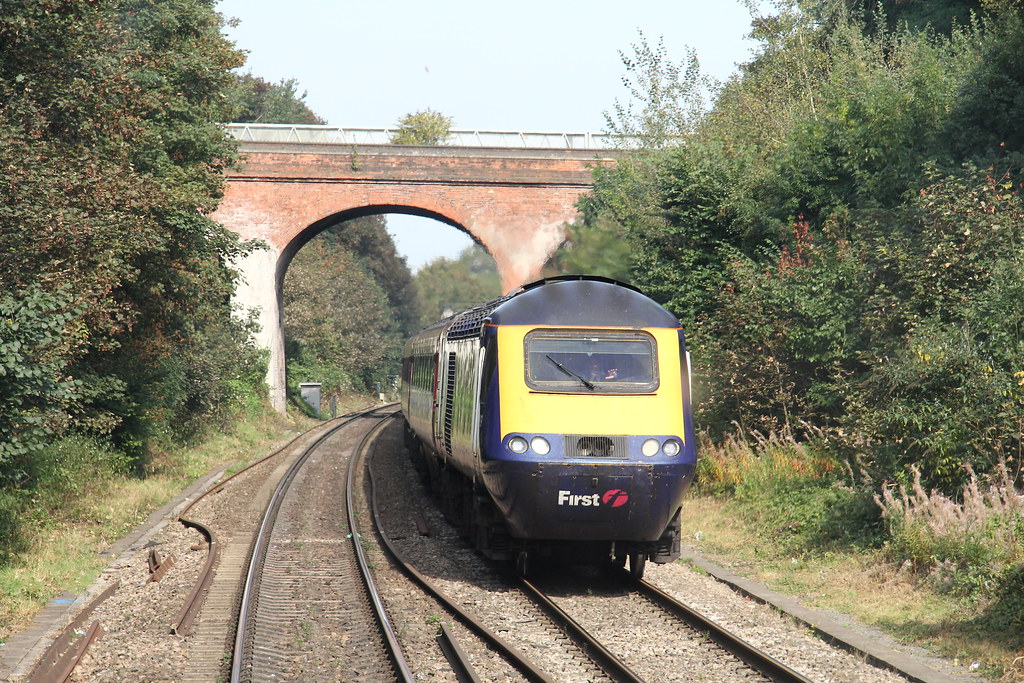
4 aspect signalling doesn't get you more capacity unless the overall signal spacing is reduced, its not the panacea people think. It needs resignalling to get the headways down, but it doesn't necessarily need to be 4 aspect.
Ideally you would try and speed Oxford Road and Southcote Junctions up. Its also only 10 miles, so getting it up to 90mph is only 1½ minutes, probably only touching 1 minute if you factor in acceleration from Basingstoke and the aforementioned Southcote Jn if they are left alone.
 

brad465

Veteran Member
Joined
11 Aug 2010
Messages
11,578
Location
Taunton or Kent
4 aspect signalling doesn't get you more capacity unless the overall signal spacing is reduced, its not the panacea people think. It needs resignalling to get the headways down, but it doesn't necessarily need to be 4 aspect.
Yes this is what I meant, combining 4-aspect with reduced headways. I might be misremembering, but I recall the section of the National Railway Museum on signalling stating that 4-aspect is primarily used on busy mixed-traffic lines, which would definitely apply to Reading-Basingstoke.
 

TheGrew

Member
Joined
31 Jul 2012
Messages
519
How much of a constraint does the flat junction at the Basingstoke end impose? I can see the logic for a passing loop at Mortimer, and resignaling would certainly have some advantages, but I suspect the main challenge is the mixed-traffic nature, especially with the freight to/from Southampton Docks.
 

The Planner

Veteran Member
Joined
15 Apr 2008
Messages
19,744
How much of a constraint does the flat junction at the Basingstoke end impose? I can see the logic for a passing loop at Mortimer, and resignaling would certainly have some advantages, but I suspect the main challenge is the mixed-traffic nature, especially with the freight to/from Southampton Docks.
Its probably the stopper as it chews through occupancy, it takes 21 minutes of the hour.
 

TheGrew

Member
Joined
31 Jul 2012
Messages
519
Its probably the stopper as it chews through occupancy, it takes 21 minutes of the hour.
Fair enough, I guess that makes the case of an overtaking loop at Mortimer more valid especially if it doesn't need to be long enough to accommodate a freight train.
 

JonathanH

Veteran Member
Joined
29 May 2011
Messages
23,403
Fair enough, I guess that makes the case of an overtaking loop at Mortimer more valid especially if it doesn't need to be long enough to accommodate a freight train.
Would this be a long dynamic loop, or would the stopper have to wait time for the overtaking service to follow at headway, then progress far enough for the stopper to follow. Presumably fast turnouts needed as well?

Does land already exist in the railway's ownership?

Mortimer station is grade 2* listed which also suggests some issues with trying to change it.
 

The Ham

Veteran Member
Joined
6 Jul 2012
Messages
12,050
Its probably the stopper as it chews through occupancy, it takes 21 minutes of the hour.

It's why IF there was a way to send it to a reopened station at Oakley(might just be able to be run without new coaches needed) or even (with more stock) to Andover it may solve some of the capacity issues for freight and XC at Basingstoke (at a much lower cost than adding 2 lines north of the station).

As I understand it, the bigger issue is Southcote Junction (Newbury, Bedwyn, Exeter and Plymouth/Cornwall services as well as other freight on top of that going to/from the Basingstoke direction) and then between there and Reading West.
 

brad465

Veteran Member
Joined
11 Aug 2010
Messages
11,578
Location
Taunton or Kent
It's why IF there was a way to send it to a reopened station at Oakley(might just be able to be run without new coaches needed) or even (with more stock) to Andover it may solve some of the capacity issues for freight and XC at Basingstoke (at a much lower cost than adding 2 lines north of the station).

As I understand it, the bigger issue is Southcote Junction (Newbury, Bedwyn, Exeter and Plymouth/Cornwall services as well as other freight on top of that going to/from the Basingstoke direction) and then between there and Reading West.
Is there any part of that section that could increase capacity through extra tracks, assuming Reading West station complicates 3-4 track throughout? I was thinking if a short section of 4-track existed from Southcote Jct to almost Reading West, freight trains heading south could get out of the way of a Newbury-bound service quicker, while a northbound freight could be routed closer to Reading West ahead of a stopper and be less likely to have to stop, clearing the area quicker ahead of any fast service.

A more simpler option though that would deliver results is if all stopper services were BEMU, and all freight trains passing through there during the daytime hours were 99s or equivalent and able to accelerate off OHLE (which would mean extending wires towards Reading Green Park).
 

swt_passenger

Veteran Member
Joined
7 Apr 2010
Messages
34,313
How much of a constraint does the flat junction at the Basingstoke end impose? I can see the logic for a passing loop at Mortimer, and resignaling would certainly have some advantages, but I suspect the main challenge is the mixed-traffic nature, especially with the freight to/from Southampton Docks.
Enough for it to be covered in some detail in a route study document not that long ago. Wessex Route study of 2015, basically a ‘freight capacity’ driven scheme to provide an additional hourly freight path in each direction. Flyover just east of the station, and additional loops west of the station.
 
Last edited:

Magdalia

Established Member
Joined
1 Jan 2022
Messages
7,434
Location
The Fens
I was thinking if a short section of 4-track existed from Southcote Jct to almost Reading West
Most of Southcote Junction-Reading West is in a deep cutting in a built up area. The line is passing through a headland between the Thames and Kennet valleys.


Widening to 4 tracks would be very disruptive and expensive.
 

cle

Established Member
Joined
17 Nov 2010
Messages
5,666
This to be is a no brainer - XC should not be going along at 75mph for such a sustained, uncpmplicated route. It needs signal upgrades, line speed and then ideally junction works. Ideally another passenger tph could run along here (3tph shuttles? A Wessex SWT hourly to Reading? Something else from like a 80x from London GWML direction?) - as well as more freight.

Passing places would be helpful too but as mentioned, widening throughout would be hard. Opportunities exist either side of Green Park at least.
 

Snow1964

Established Member
Joined
7 Oct 2019
Messages
11,263
Location
West Wiltshire
Would this be a long dynamic loop, or would the stopper have to wait time for the overtaking service to follow at headway, then progress far enough for the stopper to follow. Presumably fast turnouts needed as well?

Does land already exist in the railway's ownership?

Mortimer station is grade 2* listed which also suggests some issues with trying to change it.
It would be possible to have a third track, with a reversible loop as centre track. The trackbed was originally broad gauge, so there is extra width, but not 3 track width

Mortimer station could probably have a third track (converting the southbound platform to an island), as it is only fields that side, but a new span on the road bridge would be needed
 

The Planner

Veteran Member
Joined
15 Apr 2008
Messages
19,744
Wouldn't it make sense to do any upgrades when infrastructure renewal is due, then they don't have to be done twice?
Renewals and enhancements are very different things. If its due track renewal etc in the short to mid term, its not going to wait.

== Doublepost prevention - post automatically merged: ==

This to be is a no brainer - XC should not be going along at 75mph for such a sustained, uncpmplicated route. It needs signal upgrades, line speed and then ideally junction works. Ideally another passenger tph could run along here (3tph shuttles? A Wessex SWT hourly to Reading? Something else from like a 80x from London GWML direction?) - as well as more freight.

Passing places would be helpful too but as mentioned, widening throughout would be hard. Opportunities exist either side of Green Park at least.
Its 10 miles and you would save 60-90 seconds at best without doing Southcote.
 

cle

Established Member
Joined
17 Nov 2010
Messages
5,666
I thought it was a bit longer, like 15 or so...it's still a long time at slow speed. I didn't say or think it was a massive journey time hack by any means, but it should be way better.
 

The Ham

Veteran Member
Joined
6 Jul 2012
Messages
12,050
Most of Southcote Junction-Reading West is in a deep cutting in a built up area. The line is passing through a headland between the Thames and Kennet valleys.


Widening to 4 tracks would be very disruptive and expensive.

I do wonder if places like this (likewise around Winchester) where effectively 80% of the cut for a cut and cover tunnel has been undertaken already could be way to increase the number of tracks.

You'd ideally want at least a 1+2 pair of tunnels so that one bore could be worked on without totally closing rail use.

Whist we won't mention that supermarket project failure, it does highlight that there's the potential for above tunnel land use.

Although ideally a new liner park with good active travel facilities could create a cental core which other facilities could then be extended from.
 

Magdalia

Established Member
Joined
1 Jan 2022
Messages
7,434
Location
The Fens
I do wonder if places like this (likewise around Winchester) where effectively 80% of the cut for a cut and cover tunnel has been undertaken already could be way to increase the number of tracks.

You'd ideally want at least a 1+2 pair of tunnels so that one bore could be worked on without totally closing rail use.

Whist we won't mention that supermarket project failure, it does highlight that there's the potential for above tunnel land use.

Although ideally a new liner park with good active travel facilities could create a cental core which other facilities could then be extended from.
But where would the trains go during the long period of construction?

I remember the construction of the Hatfield tunnel on the A1(M), from many journeys through the roadworks. It was a nightmare, and it is much easier to provide a temporary road route through a construction site than it is for a railway.
 

TheGrew

Member
Joined
31 Jul 2012
Messages
519
It's a shame really that the Didcot, Newbury and Southampton got closed and much of the track bed was built over, as that would be a very useful bypass for freight.
 

Helvellyn

Established Member
Joined
28 Aug 2009
Messages
2,590
There was suggestion at one point to basically run two lines through the back of the station and use the four track section between there and Worting Junction to get trains across to the Down Lines, possibly adding a fifth line for some distance on the Up side (partly taken up by an EMU siding now)

As well as the Freight and CrossCountry services you also have two Waterloo stopping services crossing the Fast Libes each hour.

There's space at Micheldever (where it used to be four platforms/four tracks) for a turnback siding/platform to be built on the Up side of the Island if the former Up Slow was rebuilt as the through Fast line. Stopper would then run through Basingstoke platform 1, use the turnback platform at Micheldever, and on return to Basingstoke run through platform 4.

I mention that because less disruptive than building a flyover/dive under could be to just reduce the number of crossing moves in the station area through more dynamic use of the section between Basingstoke and Worting Junction if Reading Line traffic was routed through the back part of the station.
 

The Planner

Veteran Member
Joined
15 Apr 2008
Messages
19,744
It's a shame really that the Didcot, Newbury and Southampton got closed and much of the track bed was built over, as that would be a very useful bypass for freight.
As well as going across the entire job at Didcot and the very steep gradients, it was far from a problem solver.
 

The Ham

Veteran Member
Joined
6 Jul 2012
Messages
12,050
But where would the trains go during the long period of construction?

I remember the construction of the Hatfield tunnel on the A1(M), from many journeys through the roadworks. It was a nightmare, and it is much easier to provide a temporary road route through a construction site than it is for a railway.

I'm not sure that it's that much of a thing as it sounds.

That's not to say it's not sufficient

To begin with a lot of the work wouldn't be touching the tracks, so potential for a lot to be done without really messing with timetables.
 

fgwrich

Established Member
Joined
15 Apr 2009
Messages
10,663
Location
Hampshire
There was suggestion at one point to basically run two lines through the back of the station and use the four track section between there and Worting Junction to get trains across to the Down Lines, possibly adding a fifth line for some distance on the Up side (partly taken up by an EMU siding now)

As well as the Freight and CrossCountry services you also have two Waterloo stopping services crossing the Fast Libes each hour.

There's space at Micheldever (where it used to be four platforms/four tracks) for a turnback siding/platform to be built on the Up side of the Island if the former Up Slow was rebuilt as the through Fast line. Stopper would then run through Basingstoke platform 1, use the turnback platform at Micheldever, and on return to Basingstoke run through platform 4.

I mention that because less disruptive than building a flyover/dive under could be to just reduce the number of crossing moves in the station area through more dynamic use of the section between Basingstoke and Worting Junction if Reading Line traffic was routed through the back part of the station.
This is still I feel the most pragmatic and sensible solution for solving the Basingstoke issue, possibly allowing some space for a turn back on the other side of the existing Platform 5 face. There is far more space to the western side of Basingstoke station for a flyover (or if you can squeeze it in between the station and the ring road a dive under) than trying to push a flyover in to the east of the station.

A station at Chineham - Yes Please. I’m not sure however where you could add in a Dynamic Loop as much of the line is built on an embankments (and largely built on ash (a common and cheap GWR solution) which has caused some issues with subsidence in the Grazeley area, however any solution to speeding up Southcote Junction to Oxford Road would be welcome.
 

Ashley Hill

Established Member
Joined
8 Dec 2019
Messages
5,683
Location
The West Country
I really don’t think the passenger numbers are there to bother increasing the service for Bramley, Mortimer and Green Park. The current service to me seems perfectly adequate.
 

Magdalia

Established Member
Joined
1 Jan 2022
Messages
7,434
Location
The Fens
To begin with a lot of the work wouldn't be touching the tracks, so potential for a lot to be done without really messing with timetables.
The work doesn't need to be touching the tracks to rule out running trains. There are risks to manage, during excavation and lifting and construction. There is also the issue of getting raw material in and waste out, in a built up area. All according to 21st century health and safety requirements.

By way of example, constructing Cambridge South station required more than 50 days of closures, what you are proposing here is a much bigger construction project.
 

The Ham

Veteran Member
Joined
6 Jul 2012
Messages
12,050
The work doesn't need to be touching the tracks to rule out running trains. There are risks to manage, during excavation and lifting and construction. There is also the issue of getting raw material in and waste out, in a built up area. All according to 21st century health and safety requirements.

By way of example, constructing Cambridge South station required more than 50 days of closures, what you are proposing here is a much bigger construction project.

I didn't say that the trains would be running at the same time as the works.

It also depends on if we're 4 tracking through Reading West station or stopping just short of it. Obviously going through the station is a LOT more work, especially given the lack of obvious land available.

If we're looking at up to 4m either side that's enough of a work zone that kit can sit trackside and have a haul road between much of it and the track.

As such:
- trains end for the day
- a tipper lorry goes in with a digger driver as passenger
- tipper empties stone load to extend haul road from the night before
- digger works it's way along clearing the extra material
- tipper removes the material and digger driver at the end of the normal overnight shutdown
- site returns to active railway

Yes there'll be a need for sheet piling, but that could be done with segments after the digger has cleared 2m of space (maybe even a little more if earthworks are supported using temporary gabion baskets, which the digger can just move along from place to place as needed).

Once you've done one side, and laid you new first line track (to the West or East), again we're taking 1km so wouldn't take many overnights to get between the new junction locations.

Obviously you'd need to close to sort the junctions and connect up the wires, although the junctions at each end can be worked on at the same time.

Then you'll be able to build the 4th track, although unlike the 1st track you can have one track clear between the work site and the active railway, so those earthworks can potentially be done during the day.

Then you'll want to slew the tracks of at least one of the existing tracks across to create the space to create the cover bit of the 2 bores. Which will take a while, but can be done to a non live line so doesn't need to be reconnected at the end of each night, meaning far more work can be done each time.

Yes it'll probably be over 50 days of closures but lots of the works of it could be done overnight, so maybe not as bad as it might appear from looking at it.

As I said, if there's even one extra track through Reading West Station, that's going to make things so much more complicated but then does give more flexibility and capacity in the future.
 

The Planner

Veteran Member
Joined
15 Apr 2008
Messages
19,744
I didn't say that the trains would be running at the same time as the works.

It also depends on if we're 4 tracking through Reading West station or stopping just short of it. Obviously going through the station is a LOT more work, especially given the lack of obvious land available.

If we're looking at up to 4m either side that's enough of a work zone that kit can sit trackside and have a haul road between much of it and the track.

As such:
- trains end for the day
- a tipper lorry goes in with a digger driver as passenger
- tipper empties stone load to extend haul road from the night before
- digger works it's way along clearing the extra material
- tipper removes the material and digger driver at the end of the normal overnight shutdown
- site returns to active railway

Yes there'll be a need for sheet piling, but that could be done with segments after the digger has cleared 2m of space (maybe even a little more if earthworks are supported using temporary gabion baskets, which the digger can just move along from place to place as needed).

Once you've done one side, and laid you new first line track (to the West or East), again we're taking 1km so wouldn't take many overnights to get between the new junction locations.

Obviously you'd need to close to sort the junctions and connect up the wires, although the junctions at each end can be worked on at the same time.

Then you'll be able to build the 4th track, although unlike the 1st track you can have one track clear between the work site and the active railway, so those earthworks can potentially be done during the day.

Then you'll want to slew the tracks of at least one of the existing tracks across to create the space to create the cover bit of the 2 bores. Which will take a while, but can be done to a non live line so doesn't need to be reconnected at the end of each night, meaning far more work can be done each time.

Yes it'll probably be over 50 days of closures but lots of the works of it could be done overnight, so maybe not as bad as it might appear from looking at it.

As I said, if there's even one extra track through Reading West Station, that's going to make things so much more complicated but then does give more flexibility and capacity in the future.
You would have a set of blockades. Overnight closures would be ridiculously inefficient and the only set times Basingstoke to Reading is closed is for 8 hours on a Sunday morning. That is probably 4-5 hours tops working time in reality.
 

MogtheDog

Member
Joined
3 Jul 2026
Messages
7
Location
Berkshire
I do wonder if places like this (likewise around Winchester) where effectively 80% of the cut for a cut and cover tunnel has been undertaken already could be way to increase the number of tracks.
Do you mean, put a lid above the current tracks and put more tracks on top? I was thinking about that yesterday; it might mean turning the Tilehurst Rd and Bath Rd bridges into level crossings....
 

martin butler

Member
Joined
9 Oct 2018
Messages
885
What scope is there though to improve on the actual routes , for example, would a Reading to Salisbury via Basingstoke, or even Paddington to Salisbury through service using 800's changing over to diesel at Reading supplementing the stoppers, be viable? it would replace some of the Waterloo to Salisbury services, and create more paths between Waterloo and Basingstoke, for SWR, as well as introducing direct London Paddington services as well.
 

Top