• Our new ticketing site is now live! Using either this or the original site (both powered by TrainSplit) helps support the running of the forum with every ticket purchase! Find out more and ask any questions/give us feedback in this thread!

Basingstoke-Reading upgrade possibilities

brad465

Veteran Member
Joined
11 Aug 2010
Messages
11,585
Location
Taunton or Kent
What sort of linespeed increase could be possible at Oxford Road and Southcote Junctions? At the latter it's 60mph on the Westbury route and 45-50mph for the Basingstoke route, which doesn't seem to have much potential for improvement. At Oxford Road the Reading avoiding and dive-under routes are 30mph, which definitely would see huge benefit if improved, so if 50mph was possible through here instead that should allow trains with a clear route to maintain that sort of speed.
 
Sponsor Post - registered members do not see these adverts; click here to register, or click here to log in
R

RailUK Forums

coppercapped

Established Member
Joined
13 Sep 2015
Messages
3,336
Location
Reading
What scope is there though to improve on the actual routes , for example, would a Reading to Salisbury via Basingstoke, or even Paddington to Salisbury through service using 800's changing over to diesel at Reading supplementing the stoppers, be viable? it would replace some of the Waterloo to Salisbury services, and create more paths between Waterloo and Basingstoke, for SWR, as well as introducing direct London Paddington services as well.
Some prolific posters on this forum frequently suggest that Paddington is poorly situated for a central London terminus by being essentially out in the sticks. So why would passengers for Salisbury schlepp out there...? (Giving Crossrail as part of the answer is not valid...!!)

Back in the day, for some years, there used to be a through Reading - Salisbury service operated by the Southern's Hampshire DEMUs ('Thumpers') so it has been done. Increasing traffic on the line west of Basingstoke became an issue as the trains had to use one of the Southern's Down line platforms at Basingstoke and cross all the traffic on the Up lines to reach the Down Salisbury line.

This bottleneck, albeit in a modified form since the resignalling, still exists.

== Doublepost prevention - post automatically merged: ==

You would have a set of blockades. Overnight closures would be ridiculously inefficient and the only set times Basingstoke to Reading is closed is for 8 hours on a Sunday morning. That is probably 4-5 hours tops working time in reality.
Rebuild the Didcot Newbury and Southampton railway first (with, of course a flyover at Didcot) as a diversionary route and then one can blockade the Reading - Basingstoke line to one's heart's content!
 
Last edited:

MarkyT

Established Member
Joined
20 May 2012
Messages
7,620
Location
Torbay
Here's my Reading West - Southcote concept to remove much of the conflict in this area, incorporating a double-track flyover at Southcote Jn and 4 tracks through Reading West station. This assumes Basingstoke and Newbury stoppers are routed over to the relief side to form services heading for Heathrow via the western connection. With platforms 1 and 2 no longer required, they might be removed and platform 3 at Reading extended over Caversham Road bridge to accommodate a double voyager set.

Train colour code.

Passenger
dark green - GWR express
aqua - GWR Newbury local
red - Cross Country express
light green - GWR Basingstoke local

Freight
yellow - Mendip stone
white - South Coast Ports intermodal.


MarkyT

Established Member
Joined
20 May 2012
Messages
7,620
Location
Torbay
I can see how another track could be fitted on the western platform, but four tracks under the bridges seems a tight fit
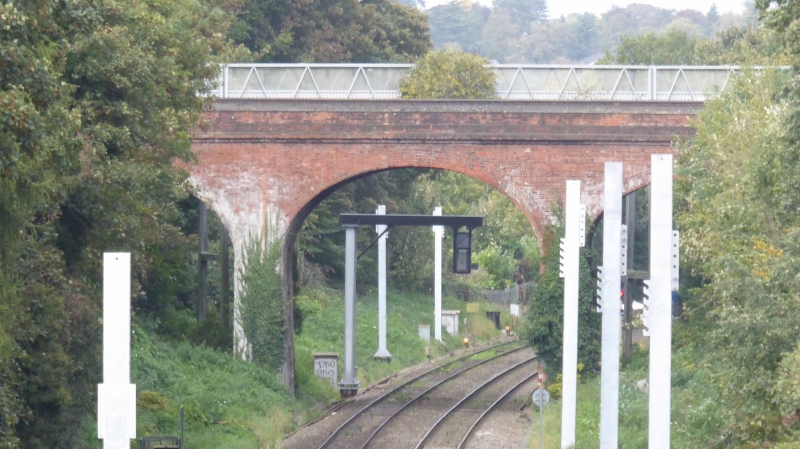
The cutting is deep and thus wide at the top, so at the alignment level it might be widened where necessary by cutting back the existing slope and building retaining walls. The width at the top also results in the bridges having 'spare' openings to either side, which could be possible to use for the extra tracks if new abutments to support the structures can be incorporated in the retaining wall construction, so it might be possible to avoid the complete reconstruction of these large bridges.

The boundary is tightest to the south end of Reading West station, where the work might encroach on some back gardens. Behind the west platform today is a car park and McDonald's drive-through loop which may need some adjustments to accommodate a new retaining wall and bridge abutment. Other buildings on Oxford Road in the vicinity of the bridge are well set back from the alignment.

Here are some indicative lines sketched on Google Earth. Aqua is the new flyover.
1791635031140.png
 
Last edited:

Helvellyn

Established Member
Joined
28 Aug 2009
Messages
2,592
A station at Chineham - Yes Please. I’m not sure however where you could add in a Dynamic Loop as much of the line is built on an embankments (and largely built on ash (a common and cheap GWR solution) which has caused some issues with subsidence in the Grazeley area, however any solution to speeding up Southcote Junction to Oxford Road would be welcome.
Chineham has been mooted for years, and now three units cover the diagrams it should be doable. I can't recall though, was a site ringfenced for the station and if so is it towards Basingtsoke (so on an embankment), or towards Bramley (and in a cutting). The latter makes it suitable for Sherfield on Loddon as well, but is probably a more expensive build. Either way, it wouldn't be a cheap station likely needing lifts for both platforms.
 

Snow1964

Established Member
Joined
7 Oct 2019
Messages
11,269
Location
West Wiltshire
What scope is there though to improve on the actual routes , for example, would a Reading to Salisbury via Basingstoke, or even Paddington to Salisbury through service using 800's changing over to diesel at Reading supplementing the stoppers, be viable? it would replace some of the Waterloo to Salisbury services, and create more paths between Waterloo and Basingstoke, for SWR, as well as introducing direct London Paddington services as well.
A lot would depend on Heathrow Express using 4 fast line paths each hour to Paddington. If these continue (and track access rights have not been extended beyond next year, yet) then little room.

If these continue Heathrow western line towards Slough is ever built then more of a case for the Express to be merged with a continuation as a semi-fast to beyond Reading.

This is still I feel the most pragmatic and sensible solution for solving the Basingstoke issue, possibly allowing some space for a turn back on the other side of the existing Platform 5 face. There is far more space to the western side of Basingstoke station for a flyover (or if you can squeeze it in between the station and the ring road a dive under) than trying to push a flyover in to the east of the station.
Originally the GWR station was completely separate, but would be relatively easy to extend subway and alter the extra platforms to make these new through platforms. Athough some industrial units have been built on old engine shed site, there used to be a very long reception road to the now disused yard, from Winklebury, and it would be easy to build a flyover in this area. The A340 Ringway West bridge has the extra trackbed of the yard reception line. Being a former 5 track area, it would not be hard to slew the tracks to construct a flyover approach

Since the Bournemouth line was electrified 1966-67, there has been big expansion of Andover area, and logically new turnbacks should be at Andover and the Basingstoke stoppers extended to Andover. Nowadays they do not continue to edge of built up area
 

brad465

Veteran Member
Joined
11 Aug 2010
Messages
11,585
Location
Taunton or Kent
The cutting is deep and thus wide at the top, so at the alignment level it might be widened where necessary by cutting back the existing slope and building retaining walls. The width at the top also results in the bridges having 'spare' openings to either side, which could be possible to use for the extra tracks if new abutments to support the structures can be incorporated in the retaining wall construction, so it might be possible to avoid the complete reconstruction of these large bridges.

The boundary is tightest to the south end of Reading West station, where the work might encroach on some back gardens. Behind the west platform today is a car park and McDonald's drive-through loop which may need some adjustments to accommodate a new retaining wall and bridge abutment. Other buildings on Oxford Road in the vicinity of the bridge are well set back from the alignment.

Here are some indicative lines sketched on Google Earth. Aqua is the new flyover.
View attachment 213100
As nice as grade-separation there might be, without also grade-separating Oxford Road this won't bring much, and the built-up area makes this expensive. The junction that would most benefit from grade-separation is at Basingstoke, as it involves more tracks and also benefits more services. You could also realign the down lines to have a turnback siding in the middle for London-Basingstoke terminators (or put batteries on the 450s and send them to Andover/Salisbury).
 

HSTEd

Veteran Member
Joined
14 Jul 2011
Messages
20,380
It seems that the slowest trains on the route are the two-per-hour stoppers, which are several minutes slower than the randomly selected Southampton container train on realtimetrains, at least between Basingstoke and Reading West.

Perhaps, before doing anything with expensive infrastructure, it would be better to obtain a handful of the highest performance multiple units available. The service seems to be just a Reading-Basingstoke stopper, so could be made self contained, so only a handful of vehicles would be required. It seems likely to be far cheaper than doing anything to the infrastructure.


Unfortunately the third rail does not run into the relevant platform at the Basingstoke end, so charging of a BEMU would have to be solely at the Reading end, at least without work to install a suitable charger. A charger could probably be a 750V overhead contact linked to the third rail, but still!
 

The Ham

Veteran Member
Joined
6 Jul 2012
Messages
12,055
You would have a set of blockades. Overnight closures would be ridiculously inefficient and the only set times Basingstoke to Reading is closed is for 8 hours on a Sunday morning. That is probably 4-5 hours tops working time in reality.

The thing is for each side, there's likely only 4,000m3 of soil to cart away (assuming 1 in 2 slopes and 4m of coriander width needed), as I said a single vehicle going along the corridor to access.

At 10m3 per hour that's 2 years of only Sunday overnight works, but no closures, so no payments to operators. Yes you'd probably want it faster than that, which might require trying to see if you could arrange some other windows, given that it's mostly overnight freight and 1km in length there's a fair chance you could run some single track working (with the out of use line being a safety zone between the works and the active railway)


Do you mean, put a lid above the current tracks and put more tracks on top? I was thinking about that yesterday; it might mean turning the Tilehurst Rd and Bath Rd bridges into level crossings....

I mean building a tunnel with two side by side bores (each with 2 tracks in) and then creating new urban land above.
 

Snow1964

Established Member
Joined
7 Oct 2019
Messages
11,269
Location
West Wiltshire
It seems that the slowest trains on the route are the two-per-hour stoppers, which are several minutes slower than the randomly selected Southampton container train on realtimetrains, at least between Basingstoke and Reading West.

Perhaps, before doing anything with expensive infrastructure, it would be better to obtain a handful of the highest performance multiple units available.
The turbos can only accelerate at 0.58 m/s and it's often lower if not all diesels are in fine fettle, or air conditioning is drawing lots of power causing an engine cooling restriction.

For comparison the class 345s can accelerate at 1 m/s

If assume about quarter of the time is accelerating (remainder, coasting, braking, at platforms) then probably save 4 minutes on a stopper by using decent EMU or BEMU rather than existing sluggish (by modern standards) diesels.
 

brad465

Veteran Member
Joined
11 Aug 2010
Messages
11,585
Location
Taunton or Kent
The turbos can only accelerate at 0.58 m/s and it's often lower if not all diesels are in fine fettle, or air conditioning is drawing lots of power causing an engine cooling restriction.

For comparison the class 345s can accelerate at 1 m/s

If assume about quarter of the time is accelerating (remainder, coasting, braking, at platforms) then probably save 4 minutes on a stopper by using decent EMU or BEMU rather than existing sluggish (by modern standards) diesels.
If the route was wired to Basingstoke, even if only into the bay platforms, then you'd have 2tph EMUs doing the stoppers and if 99s or similar get intermodal work from Southampton, those freight services can utilise the wires as well once on the line. Ditto for XC services if bi-modes ever takeover from Voyagers, but the former two would bring the most time-saving potential.
 

The Ham

Veteran Member
Joined
6 Jul 2012
Messages
12,055
If the route was wired to Basingstoke, even if only into the bay platforms, then you'd have 2tph EMUs doing the stoppers and if 99s or similar get intermodal work from Southampton, those freight services can utilise the wires as well once on the line. Ditto for XC services if bi-modes ever takeover from Voyagers, but the former two would bring the most time-saving potential.

I do wonder, if there was wires to Basingstoke and extra capacity if it could then work that the units run Newbury/Basingstoke via Reading or better yet batteries/wires to Bedwyn so 1tph could be extended to there.

The ideal would be 3tph, although I suspect that could be at the expense of the potential to reintroduce the 0.5tph for XC.

Although in a post HS2 world it might be off peak Newbury/through Basingstoke share a 1tph Paddington path (either by or being 0.5tph but having a Reading service when there's no through service, or by splitting/joining at Reading/Reading West).

Being able to access a direct service from (maybe as far away as Poole) SWR stations to connect with HS2 services could be very helpful in generating passenger usage for the railway.

Southampton to Old Oak Common direct (obviously would carry on to Paddington) would be something like 70 minutes, even with a 20 minute change, thats Southampton to Manchester in 2:30 vs 4:15 currently, even if you wait a full hour because it's the wrong hour for the direct service to Old Oak Common that's still 45 minutes less time traveling (more likely to be a 1:15 sooner arrival time as it'll be 30 minutes adrift from the direct XC service, which would mean rather than the 7:15 (XC) getting in at 11:29 the 7:45 (GWR/HS2) would get you there for 10:15, so an extra 30 minutes in bed but still an extra hour in Manchester).

OK, we might lose a few minutes vs the XC times for the local stops, but maybe 6 minutes and maybe gaining back 1 minute if we can get some small line speed improvements, however less than 10 minutes, so not a big difference overall in the times above.

Yes, I went there as to why there's should be a direct Paddington service from/through Basingstoke, it's just not that London is the justification (although places like Bramley (Hampshire) and Mortimer would also benefit from the direct London services)
 

Magdalia

Established Member
Joined
1 Jan 2022
Messages
7,437
Location
The Fens
It also depends on if we're 4 tracking through Reading West station or stopping just short of it. Obviously going through the station is a LOT more work, especially given the lack of obvious land available.
It doesn't. Widening the cutting is difficult irrespective of what happens at the station.

If we're looking at up to 4m either side that's enough of a work zone that kit can sit trackside and have a haul road between much of it and the track.
Don't forget that you are starting with a cutting where the base is only 2 tracks wide. Adding up to 4m either side means moving a lot of earth, without compromising the stability of what remains.

As such:
- trains end for the day

Yes it'll probably be over 50 days of closures but lots of the works of it could be done overnight, so maybe not as bad as it might appear from looking at it.
Trains don't end for the day, there is a procession of intermodals going to and from Southampton that run all night, and some Mendips aggregate trains too.

In a built up area noise nuisance will be an issue for overnight work.

Besides, very little can be achieved in an overnight possession, because of the amount of time taken to set it up and take it down again.

Even weekend closures are a challenge because of the amount of Saturday traffic to and from Southampton.

it might mean turning the Tilehurst Rd and Bath Rd bridges into level crossings....
And we haven't even started on how those two bridges will be replaced.
 

Falcon1200

Established Member
Joined
14 Jun 2021
Messages
6,615
Location
Neilston, East Renfrewshire
Could a simpler, and somewhat cheaper, way of increasing capacity between Reading and Southcote Junction be reducing the number of trains calling at Reading West (if not closing the station altogether, for the Greater Good.....)?
 

Class15

Established Member
Joined
30 Dec 2021
Messages
4,192
Location
North London or Mildmay line
Trains don't end for the day, there is a procession of intermodals going to and from Southampton that run all night, and some Mendips aggregate trains too.
Mendip trains are extremely simple to divert via Melksham, especially overnight, as has been done numerous times.

Southampton I agree isn’t as easy.
 

cle

Established Member
Joined
17 Nov 2010
Messages
5,667
Yes, I went there as to why there's should be a direct Paddington service from/through Basingstoke, it's just not that London is the justification (although places like Bramley (Hampshire) and Mortimer would also benefit from the direct London services)
I agree and this has been looked at in the past, when there were some excess fast paths in the GWML. It’s doable but fiddly re Basingstoke - sending on to eg Salisbury is probably easiest. Winchester route is very busy w mixed patterns.

Other options were around HEx / WRaTH type services vs 80x, as you didn’t mention the other major draw which is Heathrow. And the third is the Thames Valley/M4 Corridor itself and the many employers located from Reading through Slough to West London.

No peak Clapham calls on SWML exacerbates the London connectivity. Waterloo is not that central for many, equally.
 

brad465

Veteran Member
Joined
11 Aug 2010
Messages
11,585
Location
Taunton or Kent
Could a simpler, and somewhat cheaper, way of increasing capacity between Reading and Southcote Junction be reducing the number of trains calling at Reading West (if not closing the station altogether, for the Greater Good.....)?
I would certainly be aspiring to close that station if I could get away with it, but wouldn't be surprised if there's uproar over this.
 

MogtheDog

Member
Joined
3 Jul 2026
Messages
9
Location
Berkshire
Reading West is busier than one might expect; closing it would be a great inconvenience (especially to me). But, playing devil's advocate, might it be possible to open platforms north of Oxford Road instead, in the area of the traincare depot, which would allow services to avoid the station?
 

brad465

Veteran Member
Joined
11 Aug 2010
Messages
11,585
Location
Taunton or Kent
Reading West is busier than one might expect; closing it would be a great inconvenience (especially to me). But, playing devil's advocate, might it be possible to open platforms north of Oxford Road instead, in the area of the traincare depot, which would allow services to avoid the station?
By this point passengers are practically on top of Reading station so might as well just go there.

I wonder if re-siting it closer to Southcote Jct would allow an island platform in a 3-track formation; one line would have no platform, with the centre line bi-directional and behaving in a way similar to Beaulieu Park. Then closing the existing Reading West could assist in re-signalling/track modifications to allow a higher linespeed through Oxford Road Jct.
 

HSTEd

Veteran Member
Joined
14 Jul 2011
Messages
20,380
What goal are we trying to reach that is assisted by closing or moving Reading West station?

Losing around 450,000 passenger journeys a year or spending tens of millions on a complex reconstruction would need some very important goal to justify it.
 

The Ham

Veteran Member
Joined
6 Jul 2012
Messages
12,055
It doesn't. Widening the cutting is difficult irrespective of what happens at the station.

Depends, short term earthworks can be fairly steep and protected with lightweight structures.

For example (and it's a little extreme) but if you needed to hold back circa 300mm a paving slab on end (well 80 degree slope) is sufficient as a long term solution.

As others have said, it was broad gauge, so my estimation of 4m on both sides may even be too much.

Don't forget that you are starting with a cutting where the base is only 2 tracks wide. Adding up to 4m either side means moving a lot of earth, without compromising the stability of what remains.

Stability issues disappear if it's in a tunnel, which is what I'm suggesting if it's 4 tracked.

Although, I'm not opposed to creating only a 3rd track by widening on one side (looking at photos I link to later and the aerial photos the eastern side may be the easier side to do) as an interim option, as whilst that would need more long term stabilisation, given that we may not need the full 4m of widening to fit in a 3rd track there might be scope to:
- create lightweight structures to support maybe 1.2m to gain something like 2m to add to what looks like it might be 2m already to the east which is already looking like it's already stone
- add a third track on one side
- finally (optionally) create a very low (circa 300mm) support on the western side to provide a bit more space

Then just leave it as that until a 4th track is needed and we can revisit what's needed to get to it being a full 4 track line.

Trains don't end for the day, there is a procession of intermodals going to and from Southampton that run all night, and some Mendips aggregate trains too.

In a built up area noise nuisance will be an issue for overnight work.

Besides, very little can be achieved in an overnight possession, because of the amount of time taken to set it up and take it down again.

Even weekend closures are a challenge because of the amount of Saturday traffic to and from Southampton.

Even without restoring to the reopening of the line between Winchester and Didcot there's options for freight.

A more expensive option could be to create a chord to allow trains to travel Farnborough to Frimley (used to exist) with a single reverse at Ascot you can bypass Reading West for freight from Southampton at any time you need to in the future as well as to create these works (please forget that I've previously suggested that this could be a very useful grade separated junction to create an urban metro for the circa 250,000 people in the Aldershot Urban Area).

I'm also assuming you missed where I said that given the works could be done one side at a time that freight could use the opposite side track with the track near the works being the safely margin between the works site and the active railway. Obviously, that would limit capacity, although transition across a 1km length isn't likely to mean a massive limitation (5km at 25kph is 5 trains per hour).

And we haven't even started on how those two bridges will be replaced.

Here's a link to a photo of the eastern side of the Tilehurst Road Bridge, whilst there's might be a need to do some works to the eastern side of that secondary arch it looks like that a third line could pass through there.


Link to photo showing the central arch with two tracks passing under and the right hand arch with limited earthworks under.

Whilst the western side is likely to be a bit more complex:


Link to photo of the same bridge but showing the western arch where there's much more soil around the base.

Likewise the Bath Road Bridge is likely to be as complex asthe western portal above:


Link to a photo of the bridge showing significant earthworks.

However, and obviously subject to structural design, there's potential for modifying the outer portals without the need to remove the bridges.

Reading West is busier than one might expect; closing it would be a great inconvenience (especially to me). But, playing devil's advocate, might it be possible to open platforms north of Oxford Road instead, in the area of the traincare depot, which would allow services to avoid the station?

Sounds a sensible option.

What goal are we trying to reach that is assisted by closing or moving Reading West station?

Losing around 450,000 passenger journeys a year or spending tens of millions on a complex reconstruction would need some very important goal to justify it.

Given that the access is only from one end of the platforms, switching it to North of the bridge, maybe with a bit of a little walk to get to North of the track to the area inside the triangle, isn't going to have a large impact on user experience.

Although it does remove a stop in an area where doing that may limit capacity. Doing so creates capacity as freight generally uses the western arm to bypass Reading station.

 

Magdalia

Established Member
Joined
1 Jan 2022
Messages
7,437
Location
The Fens
Here's a link to a photo of the eastern side of the Tilehurst Road Bridge

Likewise the Bath Road Bridge is likely to be as complex asthe western portal above
You will see from the captions that both bridges are listed structures.


Tilehurst Road Bridge (BKE3709)​

Tilehurst Road Bridge, Tilehurst Road, Reading

Listed on the National Heritage List for England.


Bath Road Bridge (BKE3729)​

Bath Road Bridge, Bath Road, A4, Reading

Listed on the National Heritage List for England.


Stability issues disappear if it's in a tunnel, which is what I'm suggesting if it's 4 tracked.
You are not going to be able to bury listed bridges in a tunnel.

However, and obviously subject to structural design, there's potential for modifying the outer portals without the need to remove the bridges.
Or modify the portals.


given that we may not need the full 4m of widening

A lot more than 4m is going to be needed to get through the side arches of the bridges.

I'm also assuming you missed where I said that given the works could be done one side at a time
Which means that the project takes twice as long.
 

JonathanH

Veteran Member
Joined
29 May 2011
Messages
23,404
A more expensive option could be to create a chord to allow trains to travel Farnborough to Frimley (used to exist) with a single reverse at Ascot you can bypass Reading West for freight from Southampton at any time you need to in the future as well as to create these works (please forget that I've previously suggested that this could be a very useful grade separated junction to create an urban metro for the circa 250,000 people in the Aldershot Urban Area).
There is very little visible evidence for the previous existence of that curve on Google Maps other than perhaps the shape of the shape of the lake. In contrast, the north to east curve is still apparent. Nevertheless, I'm not sure that a route with level crossings and which requires a reversal at Ascot is the stuff of modern freight. Continuing on to the Byfleet / Addlestone route comes with less infrastructure cost yet seems just as unlikely. I don't see how it would be straightforward to get long freight through Reading off the Wokingham line either. The reality is that the route via Mortimer is better set up for it, despite the issues noted in this thread.
 
Last edited:

Top