
• Our new ticketing site is now live! Using either this or the original site (both powered by TrainSplit) helps support the running of the forum with every ticket purchase! Find out more and ask any questions/give us feedback in this thread!

Derailment at Wickford - Friday 14th August 2026

Magdalia

Established Member
Joined
1 Jan 2022
Messages
7,296
Location
The Fens
Tamping is a consequence of adjusting the track geometry. The tamper picks up the rail with lifting clamps and lifts and slews the track into the correct position. The tines are then inserted into the ballast while the tamper is still lifting the track and the tines vibrate, to fluidize the ballast and make it behave like a liquid, and pinch, to force the ballast into any voids created under the track as a result of lifting it. The tines are then withdrawn and the tamper then releases the track and the track will remain in the correct position and moves forward to repeat the same process.

Tamping doesn't happen because new ballast is laid, tamping happens because track geometry needs adjustment. New ballast is laid, either because new track is laid, the old ballast is worn out or because there isn't enough ballast available to restore the track to the correct geometry, and the tamper aligns the track.

The way that normal ballast works, the size and shape of the stones causing them to lock together, means that there will be some settlement post tamping, the track is actually slightly over lifted when tamped to allow for this settlement. Track that has been tamped is generally reopened with a TSR (temporary speed restriction) in place while the settlement is allowed to happen and then the TSR is lifted.
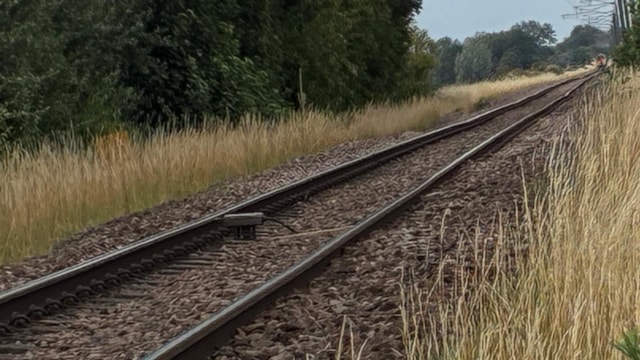
Network Rail made this announcement on 21 July:


Service changes as Anglia soil dries out in the heat​

Region & Route: Eastern: Anglia
From Monday 3 August, there will be timetable changes on the line to and from King’s Lynn, and extra late night engineering works on other Anglia routes, as track is again affected by hot weather and sustained low rainfall.

"Other Anglia routes" included the Southend Victoria line:

Meanwhile, extra engineering work to treat dried-out soil will also affect some other Anglia routes late at night and very early in the morning on Mondays – Thursdays from 3 August:

  • Greater Anglia. The London Liverpool Street – Southend Victoria and Wickford – Southminster routes, with changes to some services from 22:45 onwards including buses replacing some trains.

The work that Network Rail has been doing does include new ballast see here:

Network Rail engineers reduce the effects of dried-out soil by using machines called tampers to lift the track, push stone ballast underneath and create a solid foundation so that trains can run smoothly. New ballast is also put down to help raise the level of the track.

My understanding is that the soil has dried out and shrunk so significantly that new ballast is required to restore the required track geometry.
 
Sponsor Post - registered members do not see these adverts; click here to register, or click here to log in
R

RailUK Forums

millemille

Member
Joined
28 Jul 2011
Messages
407
Location
Derbyshire
Network Rail made this announcement on 21 July:


"Other Anglia routes" included the Southend Victoria line:


The work that Network Rail has been doing does include new ballast see here:


My understanding is that the soil has dried out and shrunk so significantly that new ballast is required to restore the required track geometry.
Exactly.

The required track geometry has been lost because of settlement of the soil under the ballast. There wasn't enough existing ballast under the track to allow the tamper to lift the track back into position and be able to pack the voids from the lift. So new ballast is dumped on top of the old ballast, the tamper lifts and packs both old and new ballast into the voids and geometry is restored.
 

hwl

Established Member
Joined
5 Feb 2012
Messages
8,235
My understanding is that the soil has dried out and shrunk so significantly that new ballast is required to restore the required track geometry.
Exactly.

The required track geometry has been lost because of settlement of the soil under the ballast. There wasn't enough existing ballast under the track to allow the tamper to lift the track back into position and be able to pack the voids from the lift. So new ballast is dumped on top of the old ballast, the tamper lifts and packs both old and new ballast into the voids and geometry is restored.
There are no obvious signs of buckling in the images but there are plenty of small undulations. Lots to measure and feed into VAMPIRE to see what tbe impact on vehicle suspension behaviour was.
 

AM9

Veteran Member
Joined
13 May 2014
Messages
16,006
Location
St Albans
There are no obvious signs of buckling in the images but there are plenty of small undulations. Lots to measure and feed into VAMPIRE to see what tbe impact on vehicle suspension behaviour was.
As a lay person, as you say, the track looks fairly typical with undulations. However, in the photo in post #33, there is a slight kink inwards on the left rail only at just past the first OLE mast on the right. I know that the photo is nothing special, probably taken on a phone, but that kink if actually there, might be significant if the train was travelling at linespeed. A trailing bogie on the rear car of a train is not as constrained as one further forward and might be subject to a whip movement.
 

NeakPed

Member
Joined
8 Nov 2025
Messages
91
Location
uk
I expect we’ll see a series of blanket 50mph ESRs imposed on sections of track identified as being at risk (in a similar fashion to the 20mph ESRs imposed after Hatfield/gauge corner cracking & probably just as extreme in volume).
 

AM9

Veteran Member
Joined
13 May 2014
Messages
16,006
Location
St Albans
I expect we’ll see a series of blanket 50mph ESRs imposed on sections of track identified as being at risk (in a similar fashion to the 20mph ESRs imposed after Hatfield/gauge corner cracking & probably just as extreme in volume).
I suppose it depends on how much appetite those running the railway are prepared to risk the safety of their passengers. Two events in two days has a great influence on those who wish to damage the railway.
 

Bald Rick

Veteran Member
Joined
28 Sep 2010
Messages
35,581
I expect we’ll see a series of blanket 50mph ESRs imposed on sections of track identified as being at risk (in a similar fashion to the 20mph ESRs imposed after Hatfield/gauge corner cracking & probably just as extreme in volume).

That won’t happen. Standard processes will continue.

It is, however, the longest sustained dry period I can remember, and it is clear that more localised TSRs will be applied in the coming weeks and months (regardless of when it starts raining) for track geometry reasons.
 

Deepgreen

Established Member
Joined
12 Jun 2013
Messages
7,458
Location
Gomshall, Surrey
'Treatment' to tackle dry soil - what will the effect when/if we get wet soil again? A reverse effect or has the sub-structure settled such that it won't expand in the same pattern again?
 

35B

Established Member
Joined
19 Dec 2011
Messages
5,362
That won’t happen. Standard processes will continue.

It is, however, the longest sustained dry period I can remember, and it is clear that more localised TSRs will be applied in the coming weeks and months (regardless of when it starts raining) for track geometry reasons.
I hope so. But I also hope that NR’s asset monitoring doesn’t have the black holes for earthwork conditions that it did for rail conditions after Hatfield.
 

Deepgreen

Established Member
Joined
12 Jun 2013
Messages
7,458
Location
Gomshall, Surrey
I suppose it depends on how much appetite those running the railway are prepared to risk the safety of their passengers. Two events in two days has a great influence on those who wish to damage the railway.
On the other hand, both incidents were relatively minor in terms of injuries, and severe weather/climate can easily be defended as an 'act of God' and outside the reasonable control of the railway. The ultra-rarity of such incidents can also be used as a robust defence.
 

YorkshireBear

Established Member
Joined
23 Jul 2010
Messages
9,661
That won’t happen. Standard processes will continue.

It is, however, the longest sustained dry period I can remember, and it is clear that more localised TSRs will be applied in the coming weeks and months (regardless of when it starts raining) for track geometry reasons.
And then it starts raining the embankments then 'wet up' unevenly which causes its own set of problems.
 

Bald Rick

Veteran Member
Joined
28 Sep 2010
Messages
35,581
'Treatment' to tackle dry soil - what will the effect when/if we get wet soil again? A reverse effect or has the sub-structure settled such that it won't expand in the same pattern again?

There is loads of additional tamping planned all over the affected parts of the network. When the banks ‘unshrink’ there will be issues, and that will need more tamping. It’s predictable in an unpredictable way, if you get my drift, as some of the sites go ‘off’ very quickly. The amount of ballast dropped on some of these sites over the past few years has been incredible.


The ultra-rarity of such incidents can also be used as a robust defence.

Indeed. And statistically it is highly improbable that at some point you wouldn’t get a concentration of such incidents, especially in the current weather condtions.
 

saismee

Established Member
Joined
20 Oct 2023
Messages
1,672
Location
UK
That won’t happen. Standard processes will continue.

It is, however, the longest sustained dry period I can remember, and it is clear that more localised TSRs will be applied in the coming weeks and months (regardless of when it starts raining) for track geometry reasons.
More TSRs have sprung up on the GA network today. Probably coincidence, but it feels like it's a reaction to the derailment. Some of us were expecting delays between Ingatestone and Stratford yesterday, but it seems speed restrictions were only imposed in the afternoon and this morning.
 
Joined
21 Feb 2009
Messages
41
Update from the MP for Billericay from numerous Facebook posts
IMPORTANT >>> Greater Anglia Update 1100 on 15/8/2026

From Greater Anglia this morning

1.) Limited train services are now running between London & #Billericay and between #Hockley & Southend Victoria, with a limited bus replacement service in between. A limited bus replacement service is also in place between #Wickford and Southminster.

2.) The damage to the infrastructure is very extensive (over a mile of track damaged, plus overhead line damage, plus signalling damage too), so it is likely that repairs will take a numbers of days beyond the weekend and the section of line involved will remain closed during the period with limited train services either side and a limited bus replacement service in between.

3.) Tickets are accepted on c2c Rail and customers are being encouraged to use those services wherever practical or local bus services if appropriate.

Best wishes

Richard Holden

 
Last edited:

davews

Member
Joined
24 Apr 2021
Messages
995
Location
Bracknell
Latest information from the Billericay MP.

IMPORTANT >>> Greater Anglia Update 1100 on 15/8/2026

From Greater Anglia this morning

1.) Limited train services are now running between London & #Billericay and between #Hockley & Southend Victoria, with a limited bus replacement service in between. A limited bus replacement service is also in place between #Wickford and Southminster.

2.) The damage to the infrastructure is very extensive (over a mile of track damaged, plus overhead line damage, plus signalling damage too), so it is likely that repairs will take a numbers of days beyond the weekend and the section of line involved will remain closed during the period with limited train services either side and a limited bus replacement service in between.

3.) Tickets are accepted on c2c Rail and customers are being encouraged to use those services wherever practical or local bus services if appropriate.

Best wishes,

Richard Holden
re 2.). Presumably that means that the point of derailment occurred quite a way back and is not shown on any of the photos that have been circulated.
 

saismee

Established Member
Joined
20 Oct 2023
Messages
1,672
Location
UK
Presumably that means that the point of derailment occurred quite a way back and is not shown on any of the photos that have been circulated.
It was reported by the passing 1K50, so maybe the driver was unaware that anything was amiss for a while, or perhaps it just took a while to stop. A quote from another post says that a passenger on board said that it lasted "minutes".
 
Joined
6 Feb 2014
Messages
99
While I have no railway experience I am interested in the similarities between the derailments at Wickford and Lewes.
  • The derailment was of the rear coaches - I am assuming possibly incorrectly that the rear coach at Lewes derailed first and pulled the other coaches off the track. This to me doesn't seem the obvious situation in a derailment (e.g. Grayrigg) but I stand to be corrected..
  • The derailments appear to have occurred at lower than line speed - were the trains breaking at the time?
  • Is it significant that the trains were 8 or 10 coaches - both formed of two units coupled together and lightly loaded?
  • What was the position of the trailing driver car against the motor cars in use.
  • Fortunately both trains derailed to the left (in the direction of travel) was there some reason for a bias to avoid impingement on the opposite direction track or was this just good luck?
I am sure the RAIB will on top of these matters, but I just wondered if there were established answers to thes points.
 

Intercity_225

Member
Joined
13 Jan 2024
Messages
582
Location
March
From pictures above (which I presume are taken from Rayleigh station considering the way they are taken), could the train be derailed leaving Rayleigh?
 

Annetts key

Established Member
Joined
13 Feb 2021
Messages
3,787
Location
West is best
I have no clue about these things but doesn't ballast get tamping or packing down after it's laid?

Yeah rail tampers get sent down to pack the ballast together after new ballast is laid, doesn’t mean new ballast will be as tightly packed as old ballast though as during regular working trains pack the ballast more as they pass over, so it could theoretically be a factor I suppose.
Ballast that has no weight on it has little resistance to being moved. Any ballast in the four foot or on the sleeper ends that is above the height of the sleeper is doing almost nothing useful. You can easily move it with your foot.

The purpose of the ballast (along with the rails and sleepers) is to spread the weight and downward forces of a train so that these are distributed evenly to the ground / earthworks / structure. When force is applied, the individual pieces of ballast "interlock" with each other and distribute the force across a wider area.

The ballast formation is also used to enable the maintenance of the height and the straightness or correct curvature and position of the rails. In addition, it provides drainage for rain water.

Ballast wears out, as this happens, the height of the line will reduce. In addition, the height of the ground (sub soil) may also change, so when required, engineering trains or machines will drop new ballast. A ballast regulator ("plough") machine is supposed to be used after the tamping machine(s) have gone through. But the time between the ballast drop, the tamping run and the regulator run could be weeks.

Until the regulator has been through, there will be loose ballast on the tops of the sleepers. Also covering the sleeper/rail fixings and any other equipment mounted on/in the track area (if I could have £1 for every piece of ballast I had to move as part of my job as a signalling technician, I would be a millionaire by now...).

Note also that if a train derails, the wheels will kick up ballast everywhere, making it look similar as if there has been a ballast drop.

As a lay person, as you say, the track looks fairly typical with undulations. However, in the photo in post #33, there is a slight kink inwards on the left rail only at just past the first OLE mast on the right. I know that the photo is nothing special, probably taken on a phone, but that kink if actually there, might be significant if the train was travelling at linespeed. A trailing bogie on the rear car of a train is not as constrained as one further forward and might be subject to a whip movement.
It's not unusual to see the shiny top of the rails not looking dead straight. The top of the rail may wear slightly differently due to a number of reasons (where the rails have been welded together is a typical example). It doesn't mean that the rail is kinked. In this case, it appears that there is at least a mile worth of damage. So it's likely the derailment occurred outside the area of the view of the photograph
 

Bald Rick

Veteran Member
Joined
28 Sep 2010
Messages
35,581
More TSRs have sprung up on the GA network today. Probably coincidence, but it feels like it's a reaction to the derailment. Some of us were expecting delays between Ingatestone and Stratford yesterday, but it seems speed restrictions were only imposed in the afternoon and this morning.

Educated guess here, based on similar events previously, but drivers will have suddenly started reporting lots more rough rides, with good intentions. This will have overwhelmed response teams ability to fix (if a fix is needed, about half ofrough ride reports are or track within genometry tolerance) so speeds will be going on as a result.
 

Ploughman

Established Member
Joined
15 Jan 2010
Messages
3,097
Location
Near where the 3 ridings meet
Ten foot is between two sets of double track rail where there is a large distance between them, but could be less than or more than 10 feet. What you were thinking of is the cess, which is on the outside of the rails
That is the situation in most locations but there are instances of a layout being Cess / 10ft / 6ft / 10ft / Cess
Not forgetting that the terms are generic and not Fixed. So a supposed 6ft can be greater than a 10ft.
 

saismee

Established Member
Joined
20 Oct 2023
Messages
1,672
Location
UK
From pictures above (which I presume are taken from Rayleigh station considering the way they are taken), could the train be derailed leaving Rayleigh?
The unit is on approach to Wickford station, after Rayleigh, so a mile of damage wouldn't reach Rayleigh.
 

Put Kettle On

Member
Joined
2 Apr 2019
Messages
57
Location
Here & there , but mainly there .
Seems to be some misconceptions here regarding ballast & tamping within this thread

New ballast dropped does not always require tamping.

It may be dropped as there is a lack of sufficient ballast within that area, so is dropped to correct the lack in that area.

Tamping is not a consequence of altering track geometry, it is a part of the process.

The tamper lifts and slues ( moves laterally ) the track then the tamping action uses vibration & hydraulic pressure to consolidate the ballast within a specific area under the rails.

This process forms a support triangle of ballast support under the rail area of the sleepers.

As track settles, it does not settle evenly, this being dependent on numerous factors.

To correct this settlement and areas of poor alignment the process of tamping is used again.

This lifting & slueing of track does cause issue during extreme heat, & planned work is cancelled
due to critical rail temperatures, as the movement of an otherwise settled area of track ( although requiring correction ) could create a risk that the freshly tamped area may be more prone to buckle due to having been disturbed.

It was stated previously that ballast above the level of the sleeper is doing almost nothing useful.

It most certainly is doing something very useful, it is not there merely for aesthetics.

The purpose of ballast shoulders is to provide much needed lateral stability to the track, both on straight & more importantly on curved track.

What is there to counteract the centrifugal forces caused by the movement of the train moving the track from its desired position ?


The ballast shoulder, along with the ballast under and between the sleepers are there to provide both vertical and lateral stability to the track.

If there are areas where there is a shortage of ballast, these areas can be more at risk during hot weather, due to there being insufficient resistance to prevent the track from unplanned movement ( buckling ).
 

Annetts key

Established Member
Joined
13 Feb 2021
Messages
3,787
Location
West is best
Seems to be some misconceptions here regarding ballast & tamping within this thread

New ballast dropped does not always require tamping.

It may be dropped as there is a lack of sufficient ballast within that area, so is dropped to correct the lack in that area.

Tamping is not a consequence of altering track geometry, it is a part of the process.

The tamper lifts and slues ( moves laterally ) the track then the tamping action uses vibration & hydraulic pressure to consolidate the ballast within a specific area under the rails.

This process forms a support triangle of ballast support under the rail area of the sleepers.

As track settles, it does not settle evenly, this being dependent on numerous factors.

To correct this settlement and areas of poor alignment the process of tamping is used again.

This lifting & slueing of track does cause issue during extreme heat, & planned work is cancelled
due to critical rail temperatures, as the movement of an otherwise settled area of track ( although requiring correction ) could create a risk that the freshly tamped area may be more prone to buckle due to having been disturbed.

It was stated previously that ballast above the level of the sleeper is doing almost nothing useful.

It most certainly is doing something very useful, it is not there merely for aesthetics.

The purpose of ballast shoulders is to provide much needed lateral stability to the track, both on straight & more importantly on curved track.

What is there to counteract the centrifugal forces caused by the movement of the train moving the track from its desired position ?


The ballast shoulder, along with the ballast under and between the sleepers are there to provide both vertical and lateral stability to the track.

If there are areas where there is a shortage of ballast, these areas can be more at risk during hot weather, due to there being insufficient resistance to prevent the track from unplanned movement ( buckling ).
With all due respect, I was careful to say that "any ballast in the four foot or on the sleeper ends that is above the height of the sleeper is doing almost nothing useful". So I was not talking about or meaning the ballast shoulder.

If you still think I am wrong, why is the four foot and the sleeper ends, from the top of sleeper level cleared by regulator machines?

Do ballast shoulders help with the lateral stability? Yes, but they are not strong enough on their own to prevent track bucking.
 

RingArm

Member
Joined
24 Jan 2024
Messages
12
Location
London
I suppose it's always possible that the RAIB will find something completely new. These trains are after all a recent acquisition.
 

Put Kettle On

Member
Joined
2 Apr 2019
Messages
57
Location
Here & there , but mainly there .
There are 2 main reasons ballast regulators are used to clear ballast from sleeper tops & ends.

During track renewals, they are used to clear those areas & as part of that the rail fastening areas so that either clipping machinery or staff can easily access rail fastenings to undo & then reinstall them when rail stressing is undertaken.

it is also a requirement of the handback process upon completion of renewal work before maintainer will sign off.

The other reason is the use of PLPR ( Plain Line Pattern Recognition ) trains.

They are programmed to recognise missing rail fastenings, & if they encounter an area where fastenings are covered in ballast
this is then recorded as a fault area, as the fastenings cannot be seen.

Ballast regulators are known & are often planned to work before the PLPR run is due to take place.

Track stability is ensured by the resistance of movement due to sufficient ballast, along with correct joint settings & correct stressing

If these are all correct & sufficient, there is a far lower likelihood of track buckle.

Track buckle is caused by rails having expanded due to heat, have no further expansion available and will normally occur at the point of least resistance of track stability.

This is often areas with insufficient ballast or other weakness.


Edited to add the following.

As part of the ballast regulators work it ploughs the ballast to move it to where it is needed.
If a ballast drop is only in 4 foot, but ballast is really needed on sleeper ends or shoulders, then the ploughs move it to where it is needed.
The ploughing does not scrape the sleepers, so behind the plough ( on the same regulator ) there is a brush to sweep the sleepers clean, and clear clips of ballast at same time.

They also have a hopper, so ballast picked up by brushing can be moved to other areas.

You may well find regulators programmed to work before and during hot weather, as a means of getting sufficient ballast where it is needed.

This is done as preventative maintenance to ensure risk areas are treated & ballast is moved to those areas.
 
Last edited:

RingArm

Member
Joined
24 Jan 2024
Messages
12
Location
London
The question is, how did the wheels of the derailed bogie come to climb over the rail on plain line and the rest of the train didn't.
 

Top