
GRALISTAIR
Established Member
Really serious progress and great to see. I said in a post about a year ago that 2026 would be a really key year.


Really serious progress and great to see. I said in a post about a year ago that 2026 would be a really key year.


Network Rail had a drone flying during yesterday’s Baker Viaduct beam lift and produced this picture. It shows well how the new line crosses the river and canal before tracks diverge for a flying junction near Ravensthorpe. https://pic.x.com/4K1pfKFqhQ
Good photo:
Philip Haigh (@philatrail) on X
Freelance railway writer, former interim and deputy editor at RAIL magazine: news, views and analysis of today's railway. Trustee Royal Artillery Institution.x.com
I presume that at the far end of the steel structure we can see the shape of the future grade-separated junction where the slows and fasts converge? The with of the viaduct suggests that the actual turnouts will be on the side closest to the camera though, presumably to avoid needing to maintain turnouts directly on a bridge!Good photo:
Philip Haigh (@philatrail) on X
Freelance railway writer, former interim and deputy editor at RAIL magazine: news, views and analysis of today's railway. Trustee Royal Artillery Institution.
I presume that at the far end of the steel structure we can see the shape of the future grade-separated junction where the slows and fasts converge? The with of the viaduct suggests that the actual turnouts will be on the side closest to the camera though, presumably to avoid needing to maintain turnouts directly on a bridge!
Tim's latestA major milestone has been reached on the TransPennine Route Upgrade as the first girder of Span Nine has been lifted into place, creating the first connection across the River Calder on the new Baker Viaduct.
In this update, we follow the day’s engineering work as the massive steel girder is secured into position, connecting both sides of the river for the very first time. With the lift complete, we then take a closer look at progress across the wider construction site, including the viaduct, eastern embankment, grade separation flyover and preparations for the next stages of work.
The video also looks ahead to the next girder lift, which will complete Span Nine, and the significant engineering activity expected throughout August as work continues between Mirfield and Huddersfield ahead of the upcoming Gledholt Tunnel blockade.
One reason is to allow slow west bound trains to leave the two track section and wait for the junction at Ravensthorpe to clear without impeding the fast lines.I presume that at the far end of the steel structure we can see the shape of the future grade-separated junction where the slows and fasts converge? The with of the viaduct suggests that the actual turnouts will be on the side closest to the camera though, presumably to avoid needing to maintain turnouts directly on a bridge!
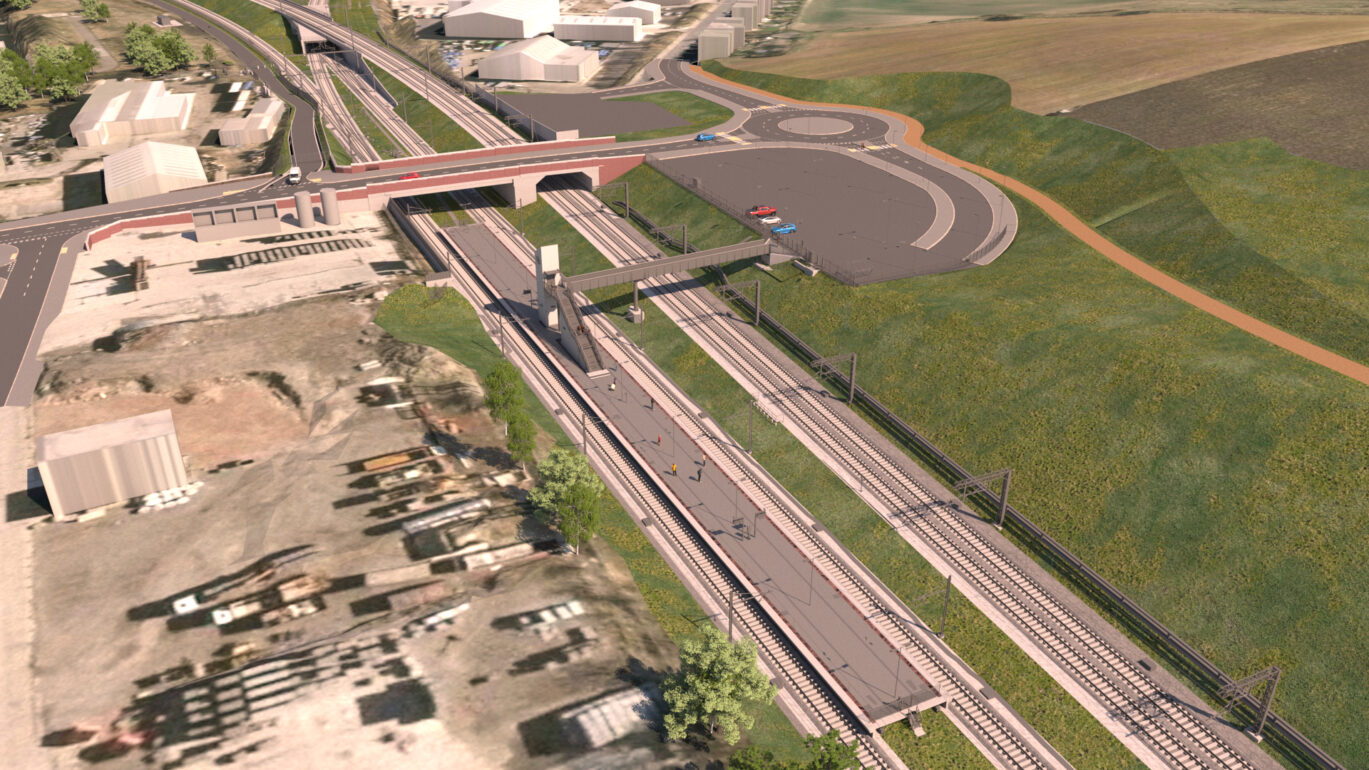
The fly through video is not very clear. This following image from the TRU website shows it from a better angle. The fast lines pass through the new Ravensthorpe station part way up the embankment. They pass under the Calder road bridge at a higher level than the slow lines.Zwk, the link below should provide a good reference, I look at it often because I still can't see how the lines at the flying junction will gain enough height so I guess you can't really tell from the video that Ravensthorpe new station must be going into a hole!
I presume that at the far end of the steel structure we can see the shape of the future grade-separated junction where the slows and fasts converge? The with of the viaduct suggests that the actual turnouts will be on the side closest to the camera though, presumably to avoid needing to maintain turnouts directly on a bridge!


Sarah Bell's latest video is up and displays some fantastic progress:
Yes, weathering steel turns bright orange very quickly once it gets wet for the first time then starts to dull. The beams normally get wet before they get near site, either in storage outside the factory, transit or on site before lifting. This means they are orange by the time they are installed. The long lack of rain recently means that lots of steel going up now hasn't seen water from fabrication to erection which is unusual.New parts haven’t had a chance to Weather yet. Will do next week with some rain. New parts on HS2 at Curzon street are the same.
Just trivial really but I wonder why one section seems to be Corten (Weathering) steel and the other in grey workshop primer.
New parts haven’t had a chance to Weather yet. Will do next week with some rain. New parts on HS2 at Curzon street are the same.
Yes, weathering steel turns bright orange very quickly once it gets wet for the first time then starts to dull. The beams normally get wet before they get near site, either in storage outside the factory, transit or on site before lifting. This means they are orange by the time they are installed. The long lack of rain recently means that lots of steel going up now hasn't seen water from fabrication to erection which is unusual.
Yes, weathering steel turns bright orange very quickly once it gets wet for the first time then starts to dull. The beams normally get wet before they get near site, either in storage outside the factory, transit or on site before lifting. This means they are orange by the time they are installed. The long lack of rain recently means that lots of steel going up now hasn't seen water from fabrication to erection which is unusual.
Yes, weathering steel turns bright orange very quickly once it gets wet for the first time then starts to dull. The beams normally get wet before they get near site, either in storage outside the factory, transit or on site before lifting. This means they are orange by the time they are installed. The long lack of rain recently means that lots of steel going up now hasn't seen water from fabrication to erection which is unusual.
Yes totally normal. As designed.

It's the new fast lines flying over the Wakefield line near the former Ravensthorpe station and continuing on towards Huddersfield without any conflict with the existing (slow) and Calder Valley lines.Why is there a new alignment after Dewsbury?
Also on on on trackwithtims latest video what I hadn't realised is that they are also straighting out an S curve just before the bridge including presumably a new bridge over Thornhill Road so it's going to be a very impressive ride over the section!
The fly through video is not very clear. This following image from the TRU website shows it from a better angle. The fast lines pass through the new Ravensthorpe station part way up the embankment. They pass under the Calder road bridge at a higher level than the slow lines.

I think the straightening south west of Dewsbury has always been in the plans.
There is a left and then right bend as you approach Dewsbury from Ravensthorpe on the existing tracks.
If they didn't fix the wiggle then you'd come off Baker Viaduct and have a right-left-right band.
At Thornhill road, Fall lane has already moved a bit. The houses at brooks yard have lost their driveway.
The old Calder Road bridge is just in the way of the new fast line route. Once it has gone, then should be clearer.
And the new Ravensthorpe station is going to be right on top of where the current 3 tracks are. It's going to be interesting how the phase the work.

The Design and Access Statement for the whole Huddersfield-Westtown scheme (March 2021) said (para. 8.7.35) 'The decision to match the existing span and skew angle of the MDL1/9 [Thornhill Road underbridge] creates theIt always feels like a bit of a waste to me that the new replacement bridge over Thornhill Road, which has only been there about 10 years, will soon be replaced.
A major milestone has been reached on the TransPennine Route Upgrade, with the steel girders and supporting piers of Baker Viaduct now complete across the River Calder.
Filmed on Saturday 1 August for Yorkshire Day, this update follows progress along the route between Ravensthorpe, Mirfield and Bradley Junction. The final steel girders have been secured at Baker Viaduct, while teams continue installing hundreds of precast concrete deck sections across the new structure.
The video also examines ongoing utility diversions along Calder Road, progress on the Ravensthorpe grade-separation structure and preparations for the next phase of the fast lines. A freight train is seen removing spoil between Leeds Road and Wheatley’s Colliery bridges, with work expected to continue towards Mirfield during the August engineering weekends.
Further east, the newly created Heaton Curve is taking shape. Designed with a wider radius to support higher speeds, it will bypass Heaton Lodge Junction as part of the upgraded railway alignment. Spoil removal is also progressing towards Bradley Junction, while Freightliner locomotive 66606 makes an unusual appearance near Colne Bridge.
The update concludes at the temporary road bridge, where final surfacing and preparations are under way ahead of its expected opening.

Does anyone know why there are two different colours of steel?Sarah Bell's latest video is up and displays some fantastic progress:

The dry weather has prevented the initial rusting process as that needs the Corten steel to be wettedDoes anyone know why there are two different colours of steel?
By the end of the year ( probably earlier) they will all be very similar. Weathering steel does this.Does anyone know why there are two different colours of steel?
They’d only need to wet them, but there’s probably a hosepipe ban.By the end of the year ( probably earlier) they will all be very similar. Weathering steel does this.
 Seriously though, I think some of the recent videos showing HS2 viaduct steelwork progress in the Lawley Middleway area showed this initial lack of oxidation, but it has since happened. (Just checked a couple of videos and the weathered look can appear on the new steel within a week, and I assume rain in Birmingham has been as rare as anywhere.)
The new part of the Leeds Road bridge opened today.Big weekend just passed.
Looking at Sarah and Tims excellent Youtubes the A62 Leeds road bridge should have now reopened over the new span, workers where swarming over Huddersfield station and the fast lines trackbed was being excavated around Bradley so more rails soon perhaps.
K
Between Cully and Pully in Switerland some years ago I remember seeing a train relaying track on one side of a double line while the other line remained open to traffic. At least I think that is what it was doing.It’s not really any faster if you’ve got an existing track to work from to deliver rail and sleepers using RRVs. The new track construction machine (NTC) needs the rails laid out ahead of it on the bottom ballast, they’re effective pulled off the end of the existing railway by small machines, and it then needs trains of sleepers queued up behind it.
