• Our new ticketing site is now live! Using either this or the original site (both powered by TrainSplit) helps support the running of the forum with every ticket purchase! Find out more and ask any questions/give us feedback in this thread!

What exactly were brake vans?

Status
Not open for further replies.
Sponsor Post - registered members do not see these adverts; click here to register, or click here to log in
R

RailUK Forums

Mcr Warrior

Veteran Member
Joined
8 Jan 2009
Messages
17,152
Did they actually help the train brake?

Yes. Usually would have been attached at the back of a freight train that didn't have continuous braking. Only the locomotive and the brake van would have had brakes. Not sure if/where they're still used. A simplistic explanation. Can anyone expand on it?
 

Bayum

Established Member
Joined
21 Mar 2008
Messages
3,268
Location
Leeds
Way back in ancient rail days, brake vans were coupled to the end of freight trains with a guard who could apply the brake as an additional braking force as and when required.
Passenger braking cars were designed with the same purpose but as braking systems became more modern, their old use fell by the wayside and retained their name.
 

D1511

Member
Joined
29 Jul 2023
Messages
1,199
Location
WCML N
In the Morpeth and Eltham crashes, both involving passenger trains, the guards in both cases were frantically applying the brake in their brake coach while the pissed drivers were going too fast......so they were useful on passenger trains at times.
 

norbitonflyer

Established Member
Joined
24 Mar 2020
Messages
5,658
Location
SW London
In both cases they were vehicles with a handbrake. In passenger service these brakes would only be used for parking - coaching stock has had to have comntiounous (air or vacuum) brakes since the 1890 - specifically after the Armagh runaway disaster of 1889. The brake coach was, obviously, where the guard rode (siomeone had to be there to operate it) and so a space for the guard was provided, and it was the obvious place to also have luggage, mail, parcels etc so that it could be supervised
"Unfitted" freights lasted a lot longer, and required a brake van at the rear so that, should the train become divided, the rear portion could be stopped.

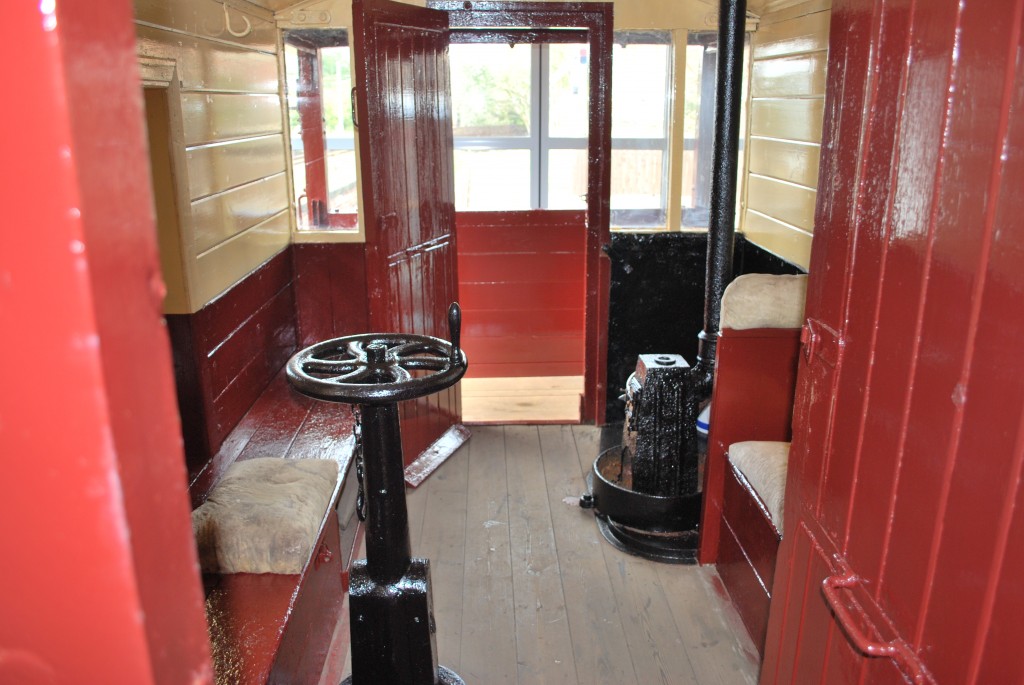
The brake is the large wheel in the foreground. The wheel is turned to operate a large screw that applies the brake.

DSC_0337-1024x685.jpg


DMU cabs had them too
OIP.GHc2xmSXEf3996GnaGwXbQHaFj


For a while, whilst oil lamps remained in use, certain trains carrying flammable substances (fuel, explosives) continued to use brake vans simply as something to carry the tail light - it being prohibited to have a flame on a wagon carrying such cargo.
 
Last edited:

D1511

Member
Joined
29 Jul 2023
Messages
1,199
Location
WCML N
In both cases they were vehicles with a handbrake. In passenger service these brakes would only be used for parking.
That was the screw operated handbrake, but MK1 BG, BSK and BCK coaches had an emergency brake valve as well, that could apply train brakes in an emergency.. ...like in the two I mentioned.

== Doublepost prevention - post automatically merged: ==

On reflection, I'm sure there was a brake gauge of some sort in a MK1 brake coach as well
 

Rescars

Established Member
Joined
25 May 2021
Messages
2,516
Location
Surrey
In the Morpeth and Eltham crashes, both involving passenger trains, the guards in both cases were frantically applying the brake in their brake coach while the pissed drivers were going too fast......so they were useful on passenger trains at times.
And back in the day, some demarcation disputes arose caused by a NUR guard (being in charge if the train) applying the brake because they considered the ASLEF driver was driving recklessly, the effect of which was to cause the train to run late. Much fun and games had by management sorting it all out!
On reflection, I'm sure there was a brake gauge of some sort in a MK1 brake coach as well
There was. An essential ingredient for conducting brake tests after coupling up a loco.

The braking of unfitted goods train was a particular challenge, especially on heavily graded routes, where the guard's brake was used to help keep the train under control and to keep the couplings between wagons taut to avoid snatches (and broken couplings in consequence). If a coupling broke and the train parted on a gradient it would only be guard's brake which could halt the runaway.
 

Trackman

Established Member
Joined
28 Feb 2013
Messages
4,246
Location
Lewisham
On reflection, I'm sure there was a brake gauge of some sort in a MK1 brake coach as well
I'm sticking my neck out here, MK3s had a gauge as well.

The braking of unfitted goods train was a particular challenge, especially on heavily graded routes, where the guard's brake was used to help keep the train under control and to keep the couplings between wagons taut to avoid snatches (and broken couplings in consequence). If a coupling broke and the train parted on a gradient it would only be guard's brake which could halt the runaway.

There was an issue if the loco driver braked suddenly on an unfitted goods train.
I assume the guard in the brake van braced for impact so speak!
I imagine it sprung back as well, which may have been the worst bit.
 

Harpo

Established Member
Joined
21 Aug 2024
Messages
3,733
Location
Newport
The braking of unfitted goods train was a particular challenge, especially on heavily graded routes, where the guard's brake was used to help keep the train under control and to keep the couplings between wagons taut to avoid snatches (and broken couplings in consequence). If a coupling broke and the train parted on a gradient it would only be guard's brake which could halt the runaway.
Or partially fitted. Where possible, the fitted vehicles would be formed up behind the loco as a fitted head.

If there were mixed air and vacuums in the consist then only one type went into the fitted portion and the rest ran loose. To brake, the straight air (loco brake) gathered the train and then the loco’s train brake was applied for the fitted head.

A brake van was mandatory on any freight without continuous brakes at the very rear although piped (unbraked) or isolated vehicles could run within the train. An (illegal) unbraked vehicle on the rear was called a swinger.

On steeper falling gradients, the brake van alone was not enough and extra brake force came from pinning down handbrakes, the pin being put in a hole above the lever to keep it in place.
 

Falcon1200

Established Member
Joined
14 Jun 2021
Messages
6,497
Location
Neilston, East Renfrewshire
Brake vans were also used on fully-braked freights running over lines with Traincrew-operated level crossings; The Secondman would shut the gates to the road, the train would draw forward over the crossing and the Guard at the back in the van would re-open the gates. Otherwise somebody would had have to walk the length of the train!
 

edwin_m

Veteran Member
Joined
21 Apr 2013
Messages
28,589
Location
Nottingham
Sometimes (not always) when a train had to propel back it would have a brake van, and the guard would be looking out ahead and able to stop the train with the brake valve if necessary. A variant on this was containerised waste trains that went to the Marston Vale line via reversal at Bedford, where the guard had their own special "container". There were also guard's containers on some early Freightliners.
 

MarlowDonkey

Established Member
Joined
4 Apr 2013
Messages
1,825
Brake vans were also used on fully-braked freights running over lines with Traincrew-operated level crossings
Would there not need to be a brake van on all services operated by steam? On a diesel, there's the back cab, but if steam opearted there's no accomodation for the guard.

On a parallel question, do freight trains still always have guards?
 

Harpo

Established Member
Joined
21 Aug 2024
Messages
3,733
Location
Newport
Sometimes (not always) when a train had to propel back it would have a brake van, and the guard would be looking out ahead and able to stop the train with the brake valve if necessary. A variant on this was containerised waste trains that went to the Marston Vale line via reversal at Bedford, where the guard had their own special "container". There were also guard's containers on some early Freightliners.
Some trains also had a brake van each end because they ran round on the way. Upton Park goods was one example with a run round at Barking.
 

edwin_m

Veteran Member
Joined
21 Apr 2013
Messages
28,589
Location
Nottingham
Would there not need to be a brake van on all services operated by steam? On a diesel, there's the back cab, but if steam opearted there's no accomodation for the guard.
Steam ended well before the agreement with the unions for suitable trains to operate without a guard, so yes all steam-hauled trains would have needed a brake van or a passenger brake, with very limited local exceptions. I think a brake van would also have been needed before those agreements for haulage by a single Class 20 or other loco with only one cab.
 

Rescars

Established Member
Joined
25 May 2021
Messages
2,516
Location
Surrey
Reverting to the OP, there were instances until the end of steam where passenger stock was controlled by the guard's hand brake alone. One example was the curious run round arrangement at Cowes where, after arrival, the loco shunted the train partway out of the station so as to clear access to the release road. After the loco had got out of the way, the points were reset and train was then allowed to trundle back to the stops powered by gravity and braked by the guard.
 

zwk500

Veteran Member
Joined
20 Jan 2020
Messages
18,401
Location
Northampton
Reverting to the OP, there were instances until the end of steam where passenger stock was controlled by the guard's hand brake alone. One example was the curious run round arrangement at Cowes where, after arrival, the loco shunted the train partway out of the station so as to clear access to the release road. After the loco had got out of the way, the points were reset and train was then allowed to trundle back to the stops powered by gravity and braked by the guard.
And, on a tangent, slip coaches.

Moderator note: please see the following thread for slip coach discussion:
 
Last edited by a moderator:

Gloster

Veteran Member
Joined
4 Sep 2020
Messages
12,940
Location
Up the creek
In very early days the only brake on any vehicle was a handbrake operated from someone standing alongside. As a result it quickly developed that the last vehicle in a train had a heavy, wind-on brake operated the guard, this was not just to hold the vehicles in place when stopped, but also to bring them to a stand if the couplings broke or to help the driver in an emergency.

By the latter part of the nineteenth century all passenger trains had continuous brakes, i.e. one controlled by the driver or the guard whereever he was in the train. The guard still a heavy duty brake in case it was needed and also for when the loco was not attached. The brake van also became used for other purposes, such as carrying parcels and mail, and as it could a bit of waste to use a whole vehicle just for this, the space was used for other purposes, primarily seating; the passenger Brake Vans were built to the same basic design as passenger coaches, which is what they were. A Brake First has both a guards compartment, which normally means also a luggage area, and First Class seats. A Brake Second had Second Class seats as well and a Brake Composite both First and Second. There were a few oddities as well, such as Brake Second Open (Trolley) which formed a minimal buffet provision and Brake portions in Postal sorting vehicles.

While the passenger coaches had through brakes, right up to the 1960s or 1970s most goods wagons didn’t, so you had to have a Brake Van at the rear of the train in case it should divide, to assist the driver with braking or to hold the wagons when stopped. These were the short wagons looking like a hut with a balcony at each end: they were primarily for the guard to ride in and had little inside other than a heavy, screw-on brake, stove, and somewhere to sit. These were just for use on goods trains and there had to be one at the rear of every goods train. Only in 1969 was it permitted for guards on fully fitted goods train to ride in the rear cab of the loco; up to then, even with a fully fitted goods train, ASLEF wouldn’t allow the guard on the loco.
 
Last edited:

Rescars

Established Member
Joined
25 May 2021
Messages
2,516
Location
Surrey
As Gloster notes, before continuous brakes, the guard's hand brake was essential to control the train. In the earliest days, locos frequently had no brakes, with just a hand brake fitted to the tender.

There was an interim stage where the LNWR used the Clarke and Webb chain brake. This was a mechanism which mechanically applied braking to several vehicles from one control point. Longer trains would have required several brakesmen placed along the train to operate the brakes. Coordination of their action must have been very haphazard, presumably relying on the driver whistling for the brakes to be applied as required.
 

Harpo

Established Member
Joined
21 Aug 2024
Messages
3,733
Location
Newport
While the passenger coaches had through brakes, right up to the 1960s or 1970s most goods wagons didn’t
Through braking on early goods vehicles was usually so they could be marshalled in passenger services. I believe the GWR started the XP designation for that.
 

Carbean

Member
Joined
15 Jan 2023
Messages
48
Location
Abingdon
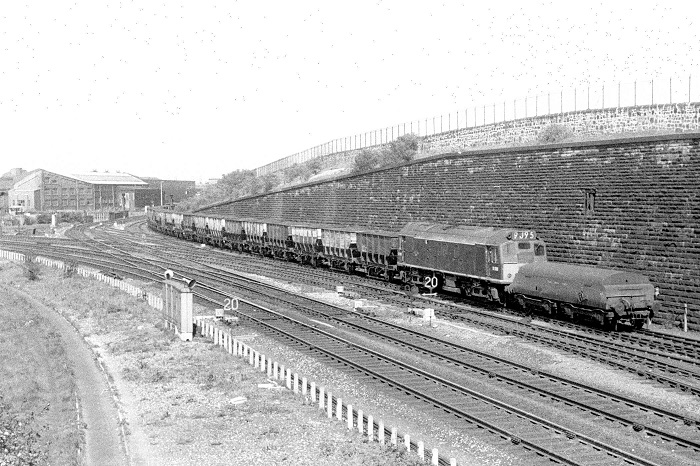
Back in the 1960s, due to their lower braking power, diesels pulling unfitted freight trains used to push “brake tenders” to improve braking. We’re these permanently attached to the locomotive?
 

Gloster

Veteran Member
Joined
4 Sep 2020
Messages
12,940
Location
Up the creek
Back in the 1960s, due to their lower braking power, diesels pulling unfitted freight trains used to push “brake tenders” to improve braking. Were these permanently attached to the locomotive?

No, they weren’t allocated to specific locos, just used on whichever train required them; they could be coupled and uncoupled as necessary. When the train got to its terminal yard they were uncoupled from the loco and stabled to await their next duty unless the loco was going straight on to another train that needed them; they still might need to be runround. They were just heavy wagons with brakes controlled by the loco that provided extra braking power directly under the control of the driver.
 

Carbean

Member
Joined
15 Jan 2023
Messages
48
Location
Abingdon
No, they weren’t allocated to specific locos, just used on whichever train required them; they could be coupled and uncoupled as necessary. When the train got to its terminal yard they were uncoupled from the loco and stabled to await their next duty unless the loco was going straight on to another train that needed them; they still might need to be runround. They were just heavy wagons with brakes controlled by the loco that provided extra braking power directly under the control of the driver.
Thankyou, I also think they had concrete in body to make them heavier. They always seemed to be pushed, I never saw one being pulled.
 

BanburyBlue

Member
Joined
18 May 2015
Messages
878
How did the operation of the brake van work in practice? Did the guards have to continually monitor speed etc and brake accordingly? How did they know the speed, and hence when to apply the brake?
 

edwin_m

Veteran Member
Joined
21 Apr 2013
Messages
28,589
Location
Nottingham
By the latter part of the nineteenth century all passenger trains had continuous brakes, i.e. one controlled by the driver or the guard whereever he was in the train.
However, some of the earliest continuous brakes were not failsafe. In the Armagh accident mentioned above, the train was fitted with "Smith's Vacuum Brake" where the creation of vacuum would apply the brake. The train was unable to climb a severe gradient and had to be split, so the continuous brake was immediately ineffective. The front portion is through to have rolled back into the rear one, overcoming the handbrake and some stones under is wheels so it in turn rolled back down the gradient and was wrecked at the bottom. This led to a legal requirement to continuous automatic brakes on passenger trains, where the creation of vacuum releases the brakes. Each fitted coach or wagon has an on-board reservoir of vacuum which is used to apply the bake if the train pipe pressure becomes closer to atmospheric. An emergency application or uncoupling of the train just opens the pipe to the atmosphere. These days air brakes are used instead, which follow the same principle but use excess air pressure instead of vacuum.

Having written all that, I've realised it's possible that the automatic vacuum brake wouldn't have prevented Armagh. A train left unattended or without a locomotive must be fully secured by handbrakes, as the vacuum or air leaks over time and there is then no force to keep the continuous brake applied. More modern multiple units have spring-applied brakes which provide enough force to keep them stopped if there is no air supply.
How did the operation of the brake van work in practice? Did the guards have to continually monitor speed etc and brake accordingly? How did they know the speed, and hence when to apply the brake?
In short, a combination of knowledge of the route, permitted speeds and gradients; observing signals; and whistle codes from the driver. But there were some pretty scary accidents over the years with unfitted trains.
 

norbitonflyer

Established Member
Joined
24 Mar 2020
Messages
5,658
Location
SW London
Back in the 1960s, due to their lower braking power, diesels pulling unfitted freight trains used to push “brake tenders” to improve braking. We’re these permanently attached to the locomotive?
I don't think so. They were not always in front of the loco, (the pair would run round their train coupled together if required) but were built with very low height to make this psossible.
5181gateshead.jpg


R.f166096328bcd5b9e481301406bcbe7d


50375052036_3024e61075_b.jpg


== Doublepost prevention - post automatically merged: ==

The front portion is thought to have rolled back into the rear one, overcoming the handbrake and some stones under its wheels so it in turn rolled back down the gradient and was wrecked at the bottom.
It never reached the bottom. The line was operated on the time interval system and the next train was already on its way.

Rather than split the first train, it would have been quicker to flag the second train down and get it to assist the first one up the bank. Would have saved a lot of lives too.
 

Rescars

Established Member
Joined
25 May 2021
Messages
2,516
Location
Surrey
In short, a combination of knowledge of the route, permitted speeds and gradients; observing signals; and whistle codes from the driver. But there were some pretty scary accidents over the years with unfitted trains.
D L Smith's writings about the GSWR are peppered with tales of heroics working unfitted goods trains on the switchback Stranraer road. Pieces of point rodding used to get extra turns on the brake wheel, brake van floors catching fire from the heat generated by the brake blocks, divided trains being accelerated by their drivers to try to keep ahead of runaways, etc etc. Railway operating in the raw, not perhaps as it's recognised in the 21st century!
 

The exile

Established Member
Joined
31 Mar 2010
Messages
9,306
Location
Somerset
How did the operation of the brake van work in practice? Did the guards have to continually monitor speed etc and brake accordingly? How did they know the speed, and hence when to apply the brake?
Same way as the driver did - experience and route knowledge. Speedometers on locos were a relatively late phenomenon, IIRC.
 

BanburyBlue

Member
Joined
18 May 2015
Messages
878
Same way as the driver did - experience and route knowledge. Speedometers on locos were a relatively late phenomenon, IIRC.
So, as alluded to in a previous post, if the guard thought the driver was going too fast, they'd apply the brake?
 
Status
Not open for further replies.

Top