• Our new ticketing site is now live! Using either this or the original site (both powered by TrainSplit) helps support the running of the forum with every ticket purchase! Find out more and ask any questions/give us feedback in this thread!

My suggestion for single platform stations for double track lines

Status
Not open for further replies.

CMS1

Member
Joined
15 Feb 2025
Messages
245
Location
uk
Since this is a speculative forum... Stations are now multi million items. Especially with a footbridge with 2 lifts, which can cost 10M+. And they are pain to use especially for those using the lifts. So as a low-hassle (for the passenger) alternative to a typical 2-platform station, which is also more accessible and puts all the facilities in 1 place, here's an idea!

1771447964427.png

Essentially both the up and down line serve a half of the same platform, by using a central crossover, so switch lines between each station. Not much good for through services but perhaps for a new busy metro line to save a few million in stations:s
 
Sponsor Post - registered members do not see these adverts; click here to register, or click here to log in
R

RailUK Forums

The Pelican

Member
Joined
3 Oct 2025
Messages
410
Location
London
Since this is a speculative forum... Stations are now multi million items. Especially with a footbridge with 2 lifts, which can cost 10M+. And they are pain to use especially for those using the lifts. So as a low-hassle (for the passenger) alternative to a typical 2-platform station, which is also more accessible and puts all the facilities in 1 place, here's an idea!

View attachment 198476

Essentially both the up and down line serve a half of the same platform, by using a central crossover, so switch lines between each station. Not much good for through services but perhaps for a new busy metro line to save a few million in stations:s
Brunel's original Swindon and Reading stations were like this, and Cambridge station remained like this until recently, although with a scissors crossover replacing the cross tracks.

Metro lines however, wouldn't be very well suited to this sort of station- if there were high frequency services with lots of trains an hour, the flat crossovers would cause disruption.

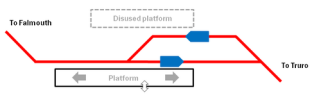
The ideal place for this sort of station is at a passing loop on an otherwise single track line, ideally on a branch line with relatively little through traffic- in other words, where the line as a whole has a capacity limit anyway, and so a single platform design won't make it any worse. Penrhyn station is the best example. Wikipedia has the attached diagram:

The diagram is also found at https://commons.wikimedia.org/wiki/File:Penryn_track_diagram_2009.png#mw-jump-to-license
 

Attachments

  • Penryn_track_diagram_2009.png
    Penryn_track_diagram_2009.png
    13.3 KB · Views: 93

The exile

Established Member
Joined
31 Mar 2010
Messages
9,427
Location
Somerset
Since this is a speculative forum... Stations are now multi million items. Especially with a footbridge with 2 lifts, which can cost 10M+. And they are pain to use especially for those using the lifts. So as a low-hassle (for the passenger) alternative to a typical 2-platform station, which is also more accessible and puts all the facilities in 1 place, here's an idea!

View attachment 198476

Essentially both the up and down line serve a half of the same platform, by using a central crossover, so switch lines between each station. Not much good for through services but perhaps for a new busy metro line to save a few million in stations:s
The problem is that you’re introducing a “blockage” into an otherwise simple 2 track layout. You’d need a big overlap either side of the crossover so the platform would have to be incredibly long. Penrhyn in Cornwall does this for a passing loop but there you’ve got those limitations anyway because it’s a single line. In many ways , the simplest is to put an island platform in the middle of the- only one access point / lift needed - and if it comes straight off a road bridge, so much the better.
 

Snow1964

Established Member
Joined
7 Oct 2019
Messages
11,155
Location
West Wiltshire
Many of the South Wales metro stations have had long ramps added instead of lifts. Cheaper and virtually maintenance free.

However needs to be lot of space behind the platforms to build those long sloping paths, without making platform narrow. And it is questionable as to which looks less ugly, long steel ramps, or lift towers clad in some out of keeping with locality material.

Much simpler than conflicting track layouts to serve one platform.
 

cle

Established Member
Joined
17 Nov 2010
Messages
5,644
Assuming everything stops there, isn't a single island platform (wide enough for lifts and as I said, no fast passing trains) - a better proposition? Much like many of the newer stations built these days along highway reservations - e.g. in Perth or even the Chicago Blue line.

Can't think of many mainline examples. Uusally side platforms as there is a legacy station building. Some suburban examples and tube ones (Royal Oak is quite sensory! but more lines obv) - but none on major routes I can think of.
 

izvor

Member
Joined
11 Jun 2014
Messages
594
Location
on the SER
The ideal place for this sort of station is at a passing loop on an otherwise single track line, ideally on a branch line with relatively little through traffic- in other words, where the line as a whole has a capacity limit anyway, and so a single platform design won't make it any worse. Penrhyn station is the best example.
Dovey Junction also works like this on the "main line" - of course Pwllheli trains have their own platform.
 

MarkyT

Established Member
Joined
20 May 2012
Messages
7,576
Location
Torbay
The ideal place for this sort of station is at a passing loop on an otherwise single track line, ideally on a branch line with relatively little through traffic- in other words, where the line as a whole has a capacity limit anyway, and so a single platform design won't make it any worse. Penrhyn station is the best example. Wikipedia has the attached diagram:

The diagram is also found at https://commons.wikimedia.org/wiki/File:Penryn_track_diagram_2009.png#mw-jump-to-license
My animation of Penryn:
 

Sir Felix Pole

Established Member
Joined
21 Oct 2012
Messages
2,180
Location
Wilmslow
Malton is one example - and until recently Hartlepool was too. Gloucester Central was designed as a single long platform when rebuilt in 1975, but the former parcels platform has subsequently been reopened for passenger use.
 

stevieinselby

Established Member
Joined
6 Jan 2013
Messages
1,699
Location
Selby
Assuming everything stops there, isn't a single island platform (wide enough for lifts and as I said, no fast passing trains) - a better proposition?
If the suggestion is to build a single platform so that you don't need to worry about lifts or ramps to access the far platform then an island platform where all passengers in both directions have to get between platform level and high level (or vice versa) doesn't solve the problem of needing expensive lifts or loooooong ramps to get people to and from the platform – what it does is make the station completely inaccessible to anyone who can't use stairs in the event of a lift failure, unlike a traditional arrangement where one platform can remain accessible.

I'm not saying island platforms shouldn't be built, but the reasons for building them shouldn't be this.
Malton is one example - and until recently Hartlepool was too. Gloucester Central was designed as a single long platform when rebuilt in 1975, but the former parcels platform has subsequently been reopened for passenger use.
Malton is slightly different, in that the single platform only functions as a single platform, in that the crossovers are on either side of it, so only one train can use the platform at a time, rather than either the OP's suggestion or the Penryn example where two trains can be in the platform at the same time.
 

Falcon1200

Established Member
Joined
14 Jun 2021
Messages
6,569
Location
Neilston, East Renfrewshire
Essentially both the up and down line serve a half of the same platform, by using a central crossover, so switch lines between each station.

At every such station every train, whether stopping there or not, blocks the opposite line! I'm struggling to think of any existing lines where this solution could be adopted, nor really any new-build routes.
 

The Planner

Veteran Member
Joined
15 Apr 2008
Messages
19,699
It would likely cost more in a capital cost way due to the signalling and S&C required.
 

Magdalia

Established Member
Joined
1 Jan 2022
Messages
7,392
Location
The Fens
I've had half a century of experience of using Cambridge, most of it before the island platform was constructed.

It worked well while the station wasn't very busy, not having lifts or footbridges gave Cambridge step free access to all platforms.

But as the station got busier conflicting moves became much more of a problem, both for the trains on the tracks and the passengers on the platforms!

Another factor to bear in mind is that there are swings and roundabouts regarding construction costs. While this proposal saves on bridges and lifts, it adds costs of points and signals. Looking at the work at Cambridge South, my guess is that the footbridge and lifts, though expensive, are cheaper than the points and signals. In particular, I dread to think how much it would cost now to replace the scissors crossover at Cambridge!
 

edwin_m

Veteran Member
Joined
21 Apr 2013
Messages
28,674
Location
Nottingham
The problem is that you’re introducing a “blockage” into an otherwise simple 2 track layout. You’d need a big overlap either side of the crossover so the platform would have to be incredibly long. Penrhyn in Cornwall does this for a passing loop but there you’ve got those limitations anyway because it’s a single line. In many ways , the simplest is to put an island platform in the middle of the- only one access point / lift needed - and if it comes straight off a road bridge, so much the better.
Ideally the trains in each direction would pass over the pointwork before they stop at the platform, so the train can stop immediately after clearing the pointwork, minimising the platform length and the distance people have to walk to/from the train. This is what happens at Penrhyn. However, the OP's arrangement means that alternate stations the train would have to stop before the pointwork, which requires a signal in between end either the opposite route has to be locked out for a period in case of overruns or the platform has to be much longer to accommodate the overrun distance (the overlap in signalling terms).
 

The exile

Established Member
Joined
31 Mar 2010
Messages
9,427
Location
Somerset
If the suggestion is to build a single platform so that you don't need to worry about lifts or ramps to access the far platform then an island platform where all passengers in both directions have to get between platform level and high level (or vice versa) doesn't solve the problem of needing expensive lifts or loooooong ramps to get people to and from the platform – what it does is make the station completely inaccessible to anyone who can't use stairs in the event of a lift failure, unlike a traditional arrangement where one platform can remain accessible.
No the reasoning is that only one ramp/ lift is needed rather than two (or even, in an ideal world that the money for two lifts is used to provide a second access /back up access) “One platform is always accessible” may well be true where the station is at ground level (or nearly so) but there are plenty where that does not apply.
 

CMS1

Member
Joined
15 Feb 2025
Messages
245
Location
uk
At every such station every train, whether stopping there or not, blocks the opposite line!
Not sure I understand how. Below is a poor animation to explain the concept. It doesn't require any points. Maybe it would work for a driverless light rail or similar where all the operation and stopping positions etc are automated.

View attachment Animation 2.mp4
 
Last edited:

etr221

Established Member
Joined
10 Mar 2018
Messages
1,597
There are - if memory serves - a few (a couple?) other single platform (serving both directions) stations on otherwise double track lines not mentioned above - two that come to mind are Ware and Maryport. Others with more knowledge may like to comment more on these, and any others.

But as with many things, this issue is a case of choose your difficulty - the extra cost of second platform/bridges/lifts vs extra cost for points and signals and operational difficulty - snags with everything, as my parents used to say.
 

jfollows

Established Member
Joined
26 Feb 2011
Messages
10,126
Location
Wilmslow
Dunbar used to have only a single platform on the up side.
Swindon forced down trains cross to the up side.
Both now “fixed”.
 

zwk500

Veteran Member
Joined
20 Jan 2020
Messages
18,574
Location
Northampton
Not sure I understand how. Below is a poor animation to explain the concept. It doesn't require any points.
It doesn't require points but does have a flat crossing, therefore treated as a conflict in the signalling system.
Maybe it would work for a driverless light rail or similar where all the operation and stopping positions etc are automated.

View attachment 198490
Anything busy enough to be considering automation will struggle with such a setup. However, some examples do exist globally (Charleroi metro).

Also worth noting that as laid out for left-hand running on the edge of your animation, you would want the right-hand station to have the platform on the opposite side of the line to allow trains to stop after the conflict.

I am with others that this is going to be less cost-effective than a 2nd platform and a footbridge.
 

The exile

Established Member
Joined
31 Mar 2010
Messages
9,427
Location
Somerset
Another point is that varying the running side is hardly conducive to safe operation. Bad enough where it’s absolutely necessary but alternating between every pair of stations is asking for trouble unless it’s a very closed set-up indeed.
 

MarkyT

Established Member
Joined
20 May 2012
Messages
7,576
Location
Torbay
Not sure I understand how. Below is a poor animation to explain the concept. It doesn't require any points. Maybe it would work for a driverless light rail or similar where all the operation and stopping positions etc are automated.

View attachment 198490
The difficulty with this arrangement is that when the trains need to approach each other head on along the platform at STATION B below, the signal overlaps (yellow path in my animation) conflict and prevent the two approaches occuring simultaneously, and while the first arrival is loading, the diamond remains blocked. At STATION A, where the signals can be set back from the conflict at the diamond, a simultaneous approach is permitted, so a second arrival can wait quite close to the platform for the first arrival to clear the diamond.
 

CMS1

Member
Joined
15 Feb 2025
Messages
245
Location
uk
Thanks, that's interesting. Would this apply on a moving block system like the DLR?
 

zwk500

Veteran Member
Joined
20 Jan 2020
Messages
18,574
Location
Northampton
Thanks, that's interesting. Would this apply on a moving block system like the DLR?
The DLR would still only be able to set a route for one train over the flat crossing at a time. Moving block doesn't make the trains any less solid. It would just mean the block occupation is minimised, as it only has to be reserved once the train is within the braking distance and can be released immediately that the train is clear.
 

edwin_m

Veteran Member
Joined
21 Apr 2013
Messages
28,674
Location
Nottingham
The DLR would still only be able to set a route for one train over the flat crossing at a time. Moving block doesn't make the trains any less solid. It would just mean the block occupation is minimised, as it only has to be reserved once the train is within the braking distance and can be released immediately that the train is clear.
It also means the overlap could be shorter because the signalling system monitors speed continuously and would apply the brake if it was going to fast to stop short of the conflict. This would probably apply to ETCS or other transmission-based train control systems, although some safety margin would still be needed for things like hitting a slippery rail at the last moment.
 

zwk500

Veteran Member
Joined
20 Jan 2020
Messages
18,574
Location
Northampton
It also means the overlap could be shorter because the signalling system monitors speed continuously and would apply the brake if it was going to fast to stop short of the conflict. This would probably apply to ETCS or other transmission-based train control systems, although some safety margin would still be needed for things like hitting a slippery rail at the last moment.
ETCS does still have overlaps (Supervised locations) although I believe it is possible to have the SvL concurrent with the EoA location.
 

HSTEd

Veteran Member
Joined
14 Jul 2011
Messages
20,330
Another point is that varying the running side is hardly conducive to safe operation. Bad enough where it’s absolutely necessary but alternating between every pair of stations is asking for trouble unless it’s a very closed set-up indeed.
A modern layout would likely have full train protection (or at least TWPS provided with full overlaps) and or cab signalling (ETCS), so I'm not sure running direction really matters any more.
 

The exile

Established Member
Joined
31 Mar 2010
Messages
9,427
Location
Somerset
A modern layout would likely have full train protection (or at least TWPS provided with full overlaps) and or cab signalling (ETCS), so I'm not sure running direction really matters any more.
So no foot crossings, no track workers, no trespassers…
 

HSTEd

Veteran Member
Joined
14 Jul 2011
Messages
20,330
So no foot crossings, no track workers, no trespassers…
Aren't Foot crossings are on their way out for other safety concerns, and in any case could be provided with arrows depicting the running direction at any given crossing?

Track workers working besides a line without a block is becoming less acceptable as time goes on isn't it? And in any case could be expected to know the running direction at a given location, perhaps with aide memoirs painted on location cabinets and other equipment.

And trespassers probably can't be expected to know running side in any case.
 

Bill57p9

Member
Joined
1 Dec 2019
Messages
886
Location
Ayrshire
Another point is that varying the running side is hardly conducive to safe operation. Bad enough where it’s absolutely necessary but alternating between every pair of stations is asking for trouble unless it’s a very closed set-up indeed.
Absolutely.
Remember what happened when BR “simplified” Newton in South Lanarkshire to a single lead junction?
”Simplified“ of course really meaning “made cheaper”.

There are - if memory serves - a few (a couple?) other single platform (serving both directions) stations on otherwise double track lines not mentioned above - two that come to mind are Ware and Maryport. Others with more knowledge may like to comment more on these, and any others.
Dunbar was another example for many years.


The Great Central Railway were particular fans of the island platform concept.
 

Mozd

Member
Joined
20 Jan 2024
Messages
19
Location
St Albans
I was in Japan recently and don't think I saw a single broken lift. Perhaps that's the solution we need!
 
Status
Not open for further replies.

Top