I'd imagine that a lot of people would like Horsham to Peterborough to terminate at Letchworth, and to have a separate Kings Cross to Peterborough service. This is presumably something that could happen if there were paths freed up at Welwyn (and space freed up at Kings Cross).Just doing a count of current,
6 Long Distance,
4 Thameslink,
4 Great Northern (that stop at Welwyn North)
4 Great Notherrn (that don’t Kings Lynn and Peterborough)
So realistically I would expect 2x Long Distances to go, but on the current loadings would we actually replace them with other services. Hitchin - Cambridge seems to also be full with 6 trains. Perhaps staying at 16 (maximum length) trains would be enough if it runs reliably. The Kings Lynn service might be able to run fast to Cambridge in the peak but as other threads highlight the Letchworth stopping service takes up capacity that prevents that happening.

-
Our new ticketing site is now live! Using either this or the original site (both powered by TrainSplit) helps support the running of the forum with every ticket purchase! Find out more and ask any questions/give us feedback in this thread!
You are using an out of date browser. It may not display this or other websites correctly.
You should upgrade or use an alternative browser.
You should upgrade or use an alternative browser.
Diverting the ECML around Welwyn's bottleneck
- Thread starter AlexSJW
- Start date
- Status
- Not open for further replies.
Sponsor Post - registered members do not see these adverts; click here to register, or click here to log in
R
RailUK Forums
Failed Unit
Established Member
Very true, I almost forget that the reduced use of the platforms at Kings Cross also helps other things. I also suspect that extending more platforms to 12 cars will be much cheaper then bypassing the section. Even with the current timetable. Couple that of course with selective door operation. There are still short trains on that route, LNER and GC are still not running maximum length in the peak.

As there is a half-hourly KGX-PBO in the peaks there's no reason why an off-peak service shouldn't run.I'd imagine that a lot of people would like Horsham to Peterborough to terminate at Letchworth, and to have a separate Kings Cross to Peterborough service. This is presumably something that could happen if there were paths freed up at Welwyn (and space freed up at Kings Cross).
You might actually run KGX-PBO (fast FPK-SVG) plus TL to Cambridge (ditto) and TL to Letchworth (stopping). That would make rather more sense than the present KGX-CBG stopper, which was never intended to be permanent.
When's the next TL timetable recast?

However, it leaves Welwyn exactly as is, so we're OT and almost in the real world
No platforms at Kings Cross, off peak this is taken by the open access operators.As there is a half-hourly KGX-PBO in the peaks there's no reason why an off-peak service shouldn't run.
Cambridge-Belle Isle is permanent, the only change is the trains run to/from Kings Cross not Maidstone.the present KGX-CBG stopper, which was never intended to be permanent.
As there is a half-hourly KGX-PBO in the peaks there's no reason why an off-peak service shouldn't run.
There’s lots of reasons!

Helvellyn
Established Member
- Joined
- 28 Aug 2009
- Messages
- 2,581
I think it's more than six long-distance:Just doing a count of current,
6 Long Distance,
4 Thameslink,
4 Great Northern (that stop at Welwyn North)
4 Great Notherrn (that don’t Kings Lynn and Peterborough)
- 2 x LNER to Edinburgh
- 1 x LNER to Newcastle
- 1 x LNER to Lincoln / York
- 2 x LNER to Leeds
- 1 x LNER to fast Edinburgh (every two hours)
I think it's more than six long-distance:
Then you have Hull Trains, Lumo and Grand Central slotting in as well.
- 2 x LNER to Edinburgh
- 1 x LNER to Newcastle
- 1 x LNER to Lincoln / York
- 2 x LNER to Leeds
- 1 x LNER to fast Edinburgh (every two hours)
It’s 6 LNER plus the open access. The fast Edinburgh is hourly, and part of the 2tph in your first bullet.
Stevenage to Leeds is a slightly larger flow than Peterborough to Leeds (PBO substantially ahead for York, Edinburgh and Newcastle, which might change a bit with more direct services), with 49,000 journeys per year, so I don't think cutting Stevenage's LNER service completely would be popular.That is the thing as you say, if we get rid of really long distance traffic you could probably have this kind of pattern in the high peak across the viaduct.
1. LNER (non stop Peterborough)
2. Great Northern - Kings Lynn
3 &4 Great Northern Welwyn Garden City and Welwyn North
5. Thameslink - Peterborough
6. LNER (non stop Peterborough)
7. Great Northern Peterborough
8 & 9 Great Northern Welwyn Garden City and Welwyn North
10 Thameslink - Cambridge.
Failed Unit
Established Member
Very true in the off-peak. However inI think it's more than six long-distance:
Then you have Hull Trains, Lumo and Grand Central slotting in as well.
- 2 x LNER to Edinburgh
- 1 x LNER to Newcastle
- 1 x LNER to Lincoln / York
- 2 x LNER to Leeds
- 1 x LNER to fast Edinburgh (every two hours)
the peak there are less long distance. GN 4th for Welwyn North not helping. I wasn’t clear on my post. To me the cheapest option to increase capacity would be reduce Welwyn North to 2 trains per hour.
Reducing Welwyn North peak time calls from 4tph to 2tph does not increase capacity in the 2 track section, which would still be 18tph. The trains would still be running, just not stopping at Welwyn North. There would be a marginal gain in resilience but no gain in capacity.Very true in the off-peak. However in
the peak there are less long distance. GN 4th for Welwyn North not helping. I wasn’t clear on my post. To me the cheapest option to increase capacity would be reduce Welwyn North to 2 trains per hour.
Failed Unit
Established Member
It was my understanding the stop takes up 2 paths.Reducing Welwyn North peak time calls from 4tph to 2tph does not increase capacity in the 2 track section, which would still be 18tph. The trains would still be running, just not stopping at Welwyn North. There would be a marginal gain in resilience but no gain in capacity.
If this is true or not people with better knowledge can say. But it makes sense as the train is stopped for about 2 mins. In that time I am sure a non-stop train could clear the whole section.
The stopping service that calls Welwyn GC-Welwyn North-Knebworth (or vice versa) does take nearly twice as long to get through the 2 track section, compared to a non-stop train. It isn't just about the stopping time, it is also about how fast the trains are going as they enter and leave the 2 track section. particularly at the Welwyn GC end.It was my understanding the stop takes up 2 paths.
If this is true or not people with better knowledge can say. But it makes sense as the train is stopped for about 2 mins. In that time I am sure a non-stop train could clear the whole section.
The peak hour calls at Welwyn North are not calling at Welwyn GC. In the morning the peak hour calls at Welwyn North do not stop at Knebworth either, Welwyn North is the only stop between Hitchin and Kings Cross. In the evening peak the Welwyn North calls are the first stop from Kings Cross and they are still doing 90-100 mph as they pass through Welwyn GC. This means that the peak hour Welwyn North calls have much less impact than the all day stopping service calls, and taking them out is not enough to create an extra path. Network Rail would just bank it as extra resilience.

Esker-pades
Established Member
<><><>
Last edited:
I commuted on the GN for 25 years and that's not my experience. In particular, trains merging in from the slow lines stop the job on the fast lines unless the nearest train is a long way away, and this is exaggerated when trains are running late. it isn't just about how the service is supposed to behave when everything runs on time.
William3000
Member
I’ve noticed the same.I commuted on the GN for 25 years and that's not my experience. In particular, trains merging in from the slow lines stop the job on the fast lines unless the nearest train is a long way away, and this is exaggerated when trains are running late. it isn't just about how the service is supposed to behave when everything runs on time.
Couple of things I’ve always wondered when travelling along this stretch is - could the point speeds between slow and fast in both directions be increased? Not sure what it is currently and maybe it’s the maximum.
The other is, I notice that there appears to be 4 tracking bed that runs about 800 metres or so south of the existing point at which 4 tracks merge into two (see green arrow), which shows the stretch where the four tracking bed appears to be there before the viaduct over Robbery Bottom Lane. While the northern most bridge appears to have its portals bricked up the rest of the route looks clear aside from electrification masts. Could four-tracking an additional 800 metres lead to marginally quicker clearances and greater resilience. Obviously such a move would still cost quite a lot for probably little benefit but if it let to an additional path per hour or at least greater resilience could it be worth it? While still not cheap it would cost a fraction of an additional tunnel bore and second Digswell Viaduct. Overall it would reduce the two track section from about 4.8km to 4km.
Attachments
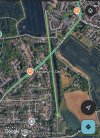
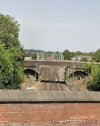
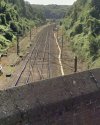
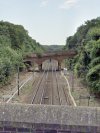
This was all done deliberately when the track and signalling were upgraded in the early 1970s, in preparation for electrification and HSTs.The other is, I notice that there appears to be 4 tracking bed that runs about 800 metres or so south of the existing point at which 4 tracks merge into two (see green arrow), which shows the stretch where the four tracking bed appears to be there before the viaduct over Robbery Bottom Lane. While the northern most bridge appears to have its portals bricked up the rest of the route looks clear aside from electrification masts. Could four-tracking an additional 800 metres lead to marginally quicker clearances and greater resilience. Obviously such a move would still cost quite a lot for probably little benefit but if it let to an additional path per hour or at least greater resilience could it be worth it? While still not cheap it would cost a fraction of an additional tunnel bore and second Digswell Viaduct. Overall it would reduce the two track section from about 4.8km to 4km.
The turnouts at both Digswell and Woolmer Green have been 70mph since the early 1970s changes, and the locations are different compared to what existed before. As your pictures show, the main reason that the Woolmer Green crossovers were moved was that there wasn't enough space for 70mph turnouts at the old location. The 70mph turnouts are far more important for capacity than having a slightly shorter 2 track section.Couple of things I’ve always wondered when travelling along this stretch is - could the point speeds between slow and fast in both directions be increased? Not sure what it is currently and maybe it’s the maximum.
What also mattered then was signal locations and spacing. With lights on sticks the signal berths are fixed, and care has to be taken where to place the signals in relation to the turnouts and stations. At the Woolmer Green end what mattered was having a full signal berth between the Woolmer Green turnouts and Knebworth, somewhere to hold a train that is on the four track section but not blocking either the Knebworth platforms or the two track section.
Moving the junction slightly makes little difference while the signals have to move too. The trains still have to clear the associated track circuits for the next train to follow.
What I don't know is whether ECTS will make any difference.
What I don't know is whether ECTS will make any difference.
It will, when the signals go. A stopping train off the slows following a fast will get a movement authority a little earlier than it would with signals. To go all Paul Daniels, not a lot, but every second counts.

You've said previously the additional ETCS block markers are there already, waiting to be exploited by suitably equipped trains, so even before the signals go entirely a fitted train should be able to follow another fitted or unfitted train more closely, while an unfitted one would still be limited by the longer signal blocks.It will, when the signals go. A stopping train off the slows following a fast will get a movement authority a little earlier than it would with signals. To go all Paul Daniels, not a lot, but every second counts.
You've said previously the additional ETCS block markers are there already, waiting to be exploited by suitably equipped trains, so even before the signals go entirely a fitted train should be able to follow another fitted or unfitted train more closely, while an unfitted one would still be limited by the longer signal blocks.
apparently not, because it needs signals away fortrains to be driven to the block markers.
zwk500
Veteran Member
Interesting, IIRC you (or possibly some other similarly knowledgeable person) mentioned that Thameslink changed the conventional signalling slightly to show Yellow if there was an MA issued to a Block Marker while the section to the next conventional signalling was still occupied. There was a concern about drivers being conditioned to routinely pass signals at Red I think?apparently not, because it needs signals away fortrains to be driven to the block markers.
Presumably as this project is going to full signals-away the interlocking changes required to achieve this have been judged to be not worth it, hence the limit to conventional blocks even when overlay is introduced?
Overlay will still help though, as things like MAs being extended before the next signal is in sight would still apply.
Will the Overlay allow approach controls to be released when an ETCS MA is issued to allow the braking curve to take precedence, as I believe happens on the GWML? This would be quite handy for trains turning onto the slows at Woolmer Green, Digswell and Welwyn to clear the fast lines that little bit quicker.
Ok thanks.apparently not, because it needs signals away fortrains to be driven to the block markers.
Earlier notification of better aspect step-up in old money.Interesting, IIRC you (or possibly some other similarly knowledgeable person) mentioned that Thameslink changed the conventional signalling slightly to show Yellow if there was an MA issued to a Block Marker while the section to the next conventional signalling was still occupied. There was a concern about drivers being conditioned to routinely pass signals at Red I think?
Presumably as this project is going to full signals-away the interlocking changes required to achieve this have been judged to be not worth it, hence the limit to conventional blocks even when overlay is introduced?
Overlay will still help though, as things like MAs being extended before the next signal is in sight would still apply.
Handy, but if they're trying to limit the scope of interlocking data alterations until the main changeover, then I'd suggest they may not implement this feature. On GWML, the signals will remain for the foreseeable future, so incorporating the functionality in the overlay data build is a permanent benefit.Will the Overlay allow approach controls to be released when an ETCS MA is issued to allow the braking curve to take precedence, as I believe happens on the GWML? This would be quite handy for trains turning onto the slows at Woolmer Green, Digswell and Welwyn to clear the fast lines that little bit quicker.
Presumably as this project is going to full signals-away the interlocking changes required to achieve this have been judged to be not worth it, hence the limit to conventional blocks even when overlay is introduced?
I assume so. Signals away isnt to far away in any event.
Will the Overlay allow approach controls to be released when an ETCS MA is issued to allow the braking curve to take precedence, as I believe happens on the GWML?
I don’t know, but in my experience the flashing yellows off the 2 track today mean that there will be little difference in practice.
- Status
- Not open for further replies.