Pakenhamtrain
Established Member




<snip>
As for arrows on signs vs. "left/right" in words, arrows are larger so are clearer in suboptimal conditions. At least an arrow degenerates into a fuzzy blob which is bigger at one end than the other, whereas words just turn into fuzzy blobs. And things on electronic display screens (emissive) are much more likely to turn into fuzzy blobs than things on ordinary signs (reflective).
You've given away that Australians can't cope with the 24 hour clockHCMTs here have it pop up after it runs over the platform ASDO beacon.
The dynamic displays will have "Doors are opening this side of train" or Doors are opening other side of the train"

Funny enough on the Metropolitan network it uses 12hr time yet the V/Line network uses 24hr time but will announce trains in 12 hour time.You've given away that Australians can't cope with the 24 hour clock

They do omit that part on occasion and just say "please exit on the left". Or the S Bahn sometimes abbreviates it to literally "EXIT LEFT" and it's just assumed you know that it means the part where they say facing the travelling direction.If it is sensitive to facing backwards or forwards, it would be clearer to say doors will open on this side plus an appropriate arrow, although I suppose this wouldn't happen because it would fall foul of accessibility regulations for blind and partially sighted people.
On German trains, next stop announcements are that doors will open on the right or left side in the direction of travel which seems a very sensible solution.
I've heard "Débarquez la gauche / la droite" in Wallonia.It is so wonderfully concise, compared to the English equivalent.
Does anyone know any other languages' equivalents that are actually in use?
Merseyrail 777 have acquired this in a recent update to their PIS, although the screens are not especially visible in the vestibules (they are a long way above eye line) so many passengers have not yet noticed. These displays are on the sides of the train above the doorways so the wording is unambiguous (and should be very useful on the loop, which is single bore tunnel and the platforms switch sides).The dynamic displays will have "Doors are opening this side of train" or Doors are opening other side of the train"
And that is the fix.Merseyrail 777 have acquired this in a recent update to their PIS, although the screens are not especially visible in the vestibules (they are a long way above eye line) so many passengers have not yet noticed. These displays are on the sides of the train above the doorways so the wording is unambiguous (and should be very useful on the loop, which is single bore tunnel and the platforms switch sides).
How does 'this side' or 'other side' at all work as verbal announcements for visually impaired people?And that is the fix.
Nobody needs to know which side the doors will open prior to being in the area of the doors. At that point 'This Side' or 'Other side' unambiguously provides what is needed.
In exactly the same way as the signs which started this thread (quoting left and right relative to the orientation of the reader).How does 'this side' or 'other side' at all work as verbal announcements for visually impaired people?


How does 'this side' or 'other side' at all work as verbal announcements for visually impaired people?
Left and right relative to the reader isn't applicable to verbal announcements. They either have to be left or right in the direction of travel, or not attempt to announce the side. In that case the visually impaired have to distinguish which side the door opening beep is, or be guided by any other passengers trying to use that door. I think I can tell which side the beep is when standing in the vestibule, but not being visually impaired I've not had to rely on it.In exactly the same way as the signs which started this thread (quoting left and right relative to the orientation of the reader).
Information for visually impaired people by definition cannot be done by visual information, and is done by announcements - this is well established, and is not the subject of the thread.
Three pages in, but for me this is the simple answer. I'd never even considered that there was another way of thinking.I always assumed within transportation that it means on the left ‘in the direction of travel’.
Remember that commonsense isn't that common.Three pages in, but for me this is the simple answer. I'd never even considered that there was another way of thinking.
Every day's a school day, even in the holidays!
Even if it wasn't obvious to someone, once their train has stopped at least once, they'll realise the announcement is in relation to the direction of travel when they see which side the doors openThree pages in, but for me this is the simple answer. I'd never even considered that there was another way of thinking.
Every day's a school day, even in the holidays!
On Northern trains most regulars have learnt that the 'door not in use' sign lighting up does not mean that the door is not in use. Indeed I have had to reassure people several times that just because there's a door not in use sign on it certainly doesn't mean that the door isn't in use.When the 197s were introduced this confused me because I was waiting to open the door then saw this notice so I darted to another door, only to realise it's not actually an error, despite it being in red and possibly in caps (though my memory in that is hazy).
In practice it's very difficult to determine what drives it, if it's the door release or something else related to it. It seems almost random when it does and doesn't show. Perhaps it's different on different units for all I know. At some other operators the driver has to enter the platform number which seems utterly bananas to me.It doesn't (or shouldn't) display at multi-platform stations, as it has no way of knowing which platform the train will arrive at.

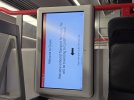
In direction of travel, surely....So I just noticed this on a Transport for Wales service.
I am travelling in a backwards facing seat. On the wall at the rear of the carriage is an electronic display.
As we approach stations, it will say, "Doors will open on the left-hand side". This is your left-hand as you face the screen which means the left side when looking towards the rear of the train.
Either this is a fault, or the side it says doors open on is dependent upon whether the screen you're looking at means you're looking at the front of the train or the rear.
Assuming it's not a fault (because I'd expect all the station info to be wrong also), to me this doesn't make sense. Consider for a moment that TfW might decide, like TfL do on some Tube services, to put it out over the public address system - you wouldn't be able to do this unless you made sure only to have screens facing one direction within each carriage.
Surely logic dictates that left hand side or right hand side is relative to forward direction of the train? Or am I going mad? Or is this just a fault and I can stop questioning life?
Missing their stop because they assumed that the sign meant that the door wasn't in use, surely? (or didn't mean that it was)As I'm sure you can understand it's led to people missing their stop on other types of train because they assumed, quite sensibly, that the door not in use sign didn't mean that the door wasn't in use.
In direction of travel, surely....
But this thread all started off with displays in the carriages. Left or right relative to the display makes the most sense as that's the direction the passenger is facing.It would never have occurred to me to expect anything else! Nor to most people, surely, because a moment's thought would show that passengers are seated facing both ways so the doors cannot possibly open on everyone's left.
No. Usually the sign saying the door isn't in use doesn't mean you can't use that door. That's the problem I'm trying to call attention to.Missing their stop because they assumed that the sign meant that the door wasn't in use, surely? (or didn't mean that it was)
But this thread all started off with displays in the carriages. Left or right relative to the display makes the most sense as that's the direction the passenger is facing.

They don't explicitly mention the part about direction of travel, but it is indeed the left/right in the direction of travel, as surely makes most sense.Transport for london announcement says " Doors will open on the -------- side in the direction of travel" I believe.
That doesn't make sense at all, as soon as the passenger stands up, picks up luggage etc, they could be facing a different direction....
Direction of travel works universally, why add in any layer of complexity?
But if they were, the screens facing the opposite direction will still having arrows point to the same side of the train, just with the word ‘left’ or ‘right’ switched.That doesn't make sense at all, as soon as the passenger stands up, picks up luggage etc, they could be facing a different direction....
Direction of travel works universally, why add in any layer of complexity?
Same here but there is always somebody who will manage misunderstand the simplest instruction.I also have never considered the issue. It may be because I have worked in the Auto industry all my working life , where left & right of the vehicle always refers to facing in the forward direction of travel.
"Exit this side" would be good to explain what the arrow means without the complication of left or right.Where an arrow display is used, the overall display should purely be visual.
As I'm sure you can understand it's led to people missing their stop on other types of train because they assumed, quite sensibly, that the door not in use sign didn't mean that the door wasn't in use.
Missing their stop because they assumed that the sign meant that the door wasn't in use, surely? (or didn't mean that it was)
Oh, now I get you. The "other types of train" part hadn't sunk in.No. Usually the sign saying the door isn't in use doesn't mean you can't use that door. That's the problem I'm trying to call attention to.