• Our new ticketing site is now live! Using either this or the original site (both powered by TrainSplit) helps support the running of the forum with every ticket purchase! Find out more and ask any questions/give us feedback in this thread!

Why did BR go for the double arrow in the first place?

Status
Not open for further replies.

43096

On Moderation
Joined
23 Nov 2015
Messages
18,886
It’s fair to say that the relatively ‘thin’ ac EMU services on electrified routes from Manchester, Liverpool and Birmingham with the miserable lurching and whining AM4 units on hourly frequencies hardly improved matters compared with the steam to electric transformation and higher frequencies in Glasgow with the lovely AM3s, especially on the sub-surface section. However the expansion of the Euston-Northampton line with lovely AM10s went from strength to strength from Day 1 in April 1966.
I have never understood why BR ordered so many AM4s given the service pattern.
 
Sponsor Post - registered members do not see these adverts; click here to register, or click here to log in
R

RailUK Forums

etr221

Established Member
Joined
10 Mar 2018
Messages
1,607
Interesting, thank you (and yes, the link works).
Following the link (and on) led to a comment:
There are only two things a corporate mark (NOT logo) needs for success. The first is obviously memorability, which usually means simplicity. The second, and far more important, is exposure, and plenty of it. Artistic quality and relevance come way down the list.
The BR 'double arrow' and the LT/TfL 'roundel' both have these in spades.
(Which makes one wonder: if one of the alternatives had been adopted, what would we now think of it (and the double arrow)?)
 

The exile

Established Member
Joined
31 Mar 2010
Messages
9,470
Location
Somerset
I have never understood why BR ordered so many AM4s given the service pattern.
Anticipation of a quick authorisation of the next phase of electrification perhaps (as in Weaver Jn, Liverpool and Manchester to Preston and Blackpool) - most of which took another half century or so to materialise?
 

SargeNpton

Established Member
Joined
19 Nov 2018
Messages
1,749
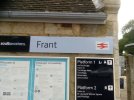
And even now, some people get the double arrow the wrong way round.

As this picture from Frant station in 2023 shows.
 

Attachments

  • Frant 2023.jpg
    Frant 2023.jpg
    596.7 KB · Views: 37

Spartacus

Established Member
Joined
25 Aug 2009
Messages
3,851
And even now, some people get the double arrow the wrong way round.

As this picture from Frant station in 2023 shows.

I don't know if it's been changed or not but the sign directing people from the Xscape/station car park at Glasshoughton to the station always had a 'Sealink' style arrow.

That the Sealink style arrow was because ships pass on the opposite side to normal railway operation, and knowing railway humour, it wouldn't entirely surprise me to find at least one of the mis-applications to be intentional, perhaps an incident of a loco running away on the wrong line or a flooding incident? :lol:There's a been a few stations prone to flooding that could perhaps have one applied, Rotherham for one!
 

ac6000cw

Established Member
Joined
10 May 2014
Messages
3,917
Location
Cambridge, UK
Much would have been learnt from the Glasgow Blue Trains project, possibly the earliest example of a "sparks effect". Other area of BR were much more muted. The launch of the WMCL electrics was high-profile but the conversion of the semi-fasts and locals from DMU's to EMU's was not.
It’s fair to say that the relatively ‘thin’ ac EMU services on electrified routes from Manchester, Liverpool and Birmingham with the miserable lurching and whining AM4 units on hourly frequencies hardly improved matters compared with the steam to electric transformation and higher frequencies in Glasgow with the lovely AM3s, especially on the sub-surface section. However the expansion of the Euston-Northampton line with lovely AM10s went from strength to strength from Day 1 in April 1966.
As much of the 'sparks effect' is down to more frequent, regular interval, train services that usually follow electrification, a slow hourly service isn't likely to produce much 'sparks effect'. And yes, the poor riding AM4s (with antiquated-looking 1950s style interiors in the 'white heat of technology' 1960s era) certainly didn't help...

When I first got interested in railways in the early 1970s, IIRC the local and secondary electric services on the WCML in the Birmingham, Manchester and Liverpool areas were mostly still hourly, and the local ones didn't improve much until the various PTEs got seriously involved in specifying (and I assume funding) them.
 

edwin_m

Veteran Member
Joined
21 Apr 2013
Messages
28,753
Location
Nottingham
That the Sealink style arrow was because ships pass on the opposite side to normal railway operation
The arrow on the funnel was reversed on one side so the upper arrow pointed forward. If I have this right in my head this would be the port (left) side, meaning that another ship passing on the right (port to port) would always see it. But the arrow on the starboard side (that they wouldn't see) was the normal one for left-hand running.

Did Sealink ever run any double-ended ferries?
 

ac6000cw

Established Member
Joined
10 May 2014
Messages
3,917
Location
Cambridge, UK
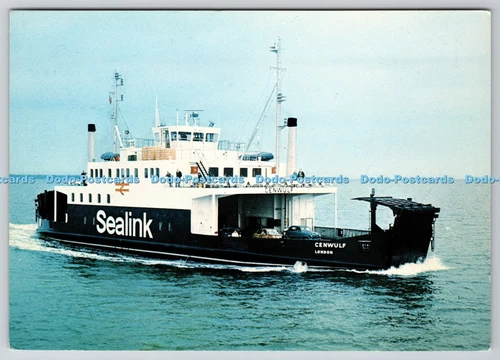
Did Sealink ever run any double-ended ferries?
IIRC the Portsmouth - Fishguard and Lymington - Yarmouth Isle of Wight car ferries were double-ended (we travelled on them regularly for family holidays in the 60s and 70s) e.g. see this vintage postcard of 'Cenwulf' on Ebay from 'Dodo-Postcards' - https://www.ebay.co.uk/itm/277123168687

s-l500.webp
 
Last edited:

Beebman

Member
Joined
17 Feb 2011
Messages
967
Location
Twyford
Did Sealink ever run any double-ended ferries?
Yes, to and from the Isle of Wight. I'm going to have to rely on my memories from frequent family trips in the 1970s but my recollection is that the vessels were kind of asymmetrical with one end designated as a 'bow' and the other a 'stern', and that the two arrows pointed towards the former so the one on the 'port' side was reversed while the one on the 'starboard' was normal. I've done some searching to see if I can find any photos of both sides of a particular ferry but without success, only one side or the other, some showing a normal double arrow and others showing a reversed one.
 

Spartacus

Established Member
Joined
25 Aug 2009
Messages
3,851
The arrow on the funnel was reversed on one side so the upper arrow pointed forward. If I have this right in my head this would be the port (left) side, meaning that another ship passing on the right (port to port) would always see it. But the arrow on the starboard side (that they wouldn't see) was the normal one for left-hand running.

Did Sealink ever run any double-ended ferries?

That sounds about right.

I think the IoW ferries would have been double ended ones.
 

Beebman

Member
Joined
17 Feb 2011
Messages
967
Location
Twyford
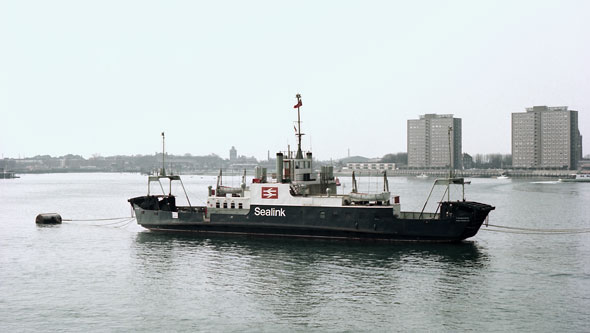
Here's a photo (taken at Portsmouth in 1976) of the MV Fishbourne with a reversed arrow but I can't find any pics of the other side (at least not in this livery):

Fishbourne_1976-001.jpg


(Source - https://simplonpc.co.uk/IOW4.html which has a selection of photos of IoW ferries)
 

Gloster

Veteran Member
Joined
4 Sep 2020
Messages
13,044
Location
Up the creek
As I mentioned in #26, although I may have got my port and starboard mixed up (port-left-red), the intention was to (roughly) fall in with maritime tradition by having the arrow pointing towards the bow; in this case the top arrow was chosen. The Isle of Wight ferries were double-ended, but one end was officially the bow and the other the stern, although it wasn’t obvious to most people which was which, and they followed the same practice as their larger sisters.
 

Beebman

Member
Joined
17 Feb 2011
Messages
967
Location
Twyford
I've found a couple of b/w photos of the IOW ferry MV Cuthred - this appears to have had the double arrows on rectangles on the hull near the loading doors at either end but with normal on one side and reversed on the other (source - https://www.doverferryphotosforums.co.uk/new-mv-cuthred-past-and-present/ with other photos of the vessel including larger versions of these two - credit to Roy Thornton Collection):

Normal:

img198-553x368.jpg

Reversed:

339259100_180652414817996_6469192466804338258_n-553x368.jpg
 

Deepgreen

Established Member
Joined
12 Jun 2013
Messages
7,490
Location
Gomshall, Surrey
I suspect because a symbol was felt to be modern and, because it lacked letters, completely divorced from the ‘old-fashioned’ heraldic designs. BR was desperately trying to project a modern, with-it image completely different from the old steam age one, so a complete change was probably felt necessary.
It worked, too, as it has not only survived privatisation (with its 'slash and burn' attitude to established designs/visuals), but is undergoing a revival.
 
Status
Not open for further replies.

Top