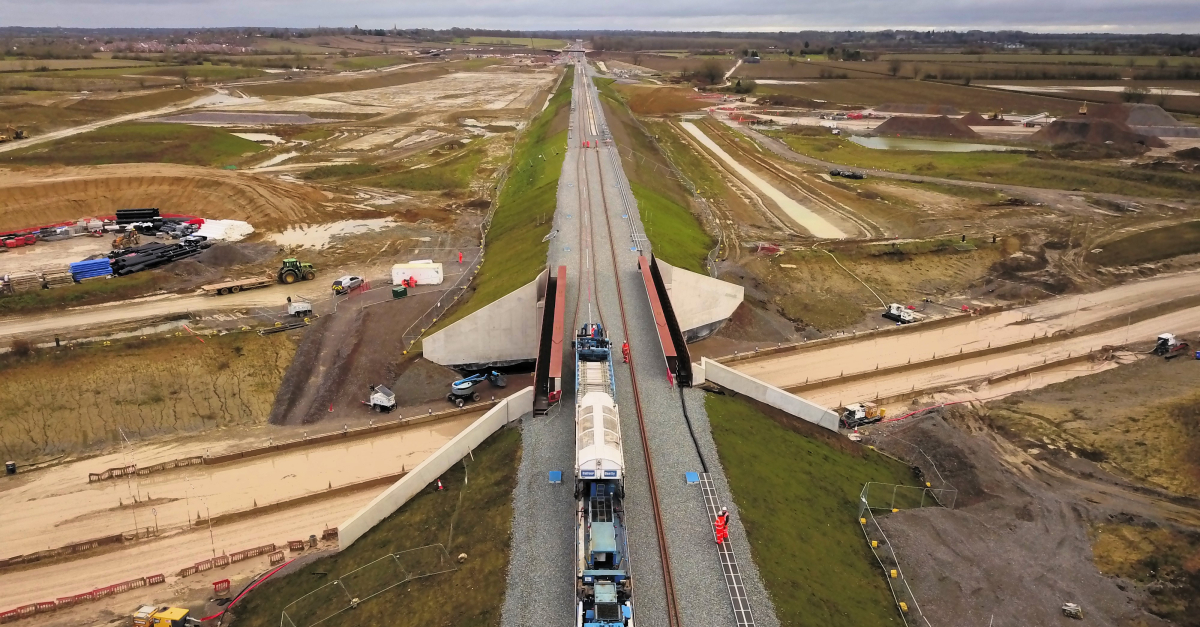
The cost of adding OLE will be a lot more:
- Inflation means the cost alone will be higher compared to building it at the time of the construction of the line,
- Adding OLE to an operational railway always costs more compared to building it at the time of construction of the line,
- The extra costs due to stop / start construction also will likely apply. Whereas if it was built as part of construction of the line, assuming work does not stop until the entire planned route is finished, overall costs per mile are likely to be lower in comparison.
Oh, like part of the new line is open to traffic, but has no scheduled passenger service on it yet?
Ideally you would have arranged for new trains to be ready for the new OLE equipped line. And have upgraded other lines with OLE at the same time.
Also there were many fairly modern electric trains already or about to come off lease when the decision was made, but lack of wiring at Oxford was a problem, an 'island' likely to be required anyway for battery conversion in the future.
But this is England, where the Treasury and the politicians worship budgets and would rather spend triple or more over ten to twenty years in small separate chunks rather than getting the job done as a continuous scheme. As clearly demonstrated by having stage 1, then splitting stage 2 into three...
There's no chance that wiring a mostly plain line newly reconstructed railway before service start, with new signalling already factored in etc, was going to cost the same or more per stkm as the much more complex and troubled GWML scheme. I feel the decision was firmly political, an act designed to show the public 'something had been done', to please conservative minds some money was being saved, and for rabid anti rail people, the crumb the decision might place difficulties in the path of future operations and improvements, perhaps a nice 'spanner in the works' for a future administration.
Paused wiring of the Oxford area under the GWML project also posed a problem. If sections wired for EWR couldn't have been energised immediately on construction, then stringing the copper wires to leave them unused for years would have invited theft and degradation, but many of the plain line stanchions at least might have been erected during the construction period.
We are where we are now, of course, and batteries for passenger trains will work fine on this line in the medium term, I'm sure. I expect Didcot-Oxford will be electrified before that happens, so the battery units can have regularly spaced wiring 'islands' around each major hub they serve to charge. Any additional isolated intermediate sections required for reliable range might be fed from local DNO supplies using the RCC concept. HS2 going live in the Calvert area might offer an opportunity to spur from their nearest feeder to EWR as well. That could probably cover the entire Oxford Bletchley section without adding too much load from new traffic at the mainline feeders.
As far as freight is concerned, the first revenue-earning intermodal train has already been diverted via EWR, well before any fare-paying passengers. As it was already diesel hauled, the lack of wiring was no impediment, though of course it couldn't take advantage of the wires once on the WCML. If bimode locos like cl.99 were substituted on such trains in the future, they would be able to use their diesels over EWR, then pan up once at Bletchley.