
-
Our new ticketing site is now live! Using either this or the original site (both powered by TrainSplit) helps support the running of the forum with every ticket purchase! Find out more and ask any questions/give us feedback in this thread!
You are using an out of date browser. It may not display this or other websites correctly.
You should upgrade or use an alternative browser.
You should upgrade or use an alternative browser.
Wigan-Bolton services after electrification?
- Thread starter darylyates17
- Start date
Sponsor Post - registered members do not see these adverts; click here to register, or click here to log in
R
RailUK Forums

pokemonsuper9
Established Member
It's going to be cleared for Pendolinos, 323s and 331s will surely be cleared for it as the units that will probably run the service, but don't know about 397s or 802s.They should definitely use this route as an emergency diversion for Avanti/TPE/Northern if euxton junction to lostock junction is blocked. The more routes staff sign the less likely of a replacement bus

Xenophon PCDGS
Veteran Member
Don't Northern Trains need units from these classes for the new Northumberland Line services, as the current passenger totals have exceeded what was originally envisaged.The line doesn't make sense as a 158 operated line anyway, as there are frequent stops. It would be welcome if 150s were used either instead of, or together with 158s.

There isn't hard evidence of that at present. Crowding is football related primarily.Don't Northern Trains need units from these classes for the new Northumberland Line services, as the current passenger totals have exceeded what was originally envisaged.
== Doublepost prevention - post automatically merged: ==
It could be the December 2026 timetable, it could be later.One might well ask when the time period will be when definite official routings will be officially announced.

amahy
Member
Surely this is more of a case for Southport to Leeds as one service, as splitting it will almost certainly mean that more units are required?I don't think there's going to be much difference between a 158 and a 156 on those terms. Almost every train on the Atherton line has a 156 or 158 in its formation.
Of the 10 Headbolt Lane diagrams, today, 8 of them are 150+156 and only 2 are 150+150
There aren't enough 158s, but there aren't enough 150s or 156s either! (and the 769s are mostly to blame for that)
It doesn't. Currently there's a turnaround of over an hour at Wigan. This results from the previous turnaround being too short, both at Wigan North Western and also at Southport before it. This wastes a driver circuit in addition to a unit as the driver must wait almost 60 minutes in the siding at Wigan Wallgate.Surely this is more of a case for Southport to Leeds as one service, as splitting it will almost certainly mean that more units are required?
Unfortunately this is has all been decided now anyway, the whole point of the turnbacks at Salford Crescent from the east and Manchester Victoria from the west is to help solve these problems.
== Doublepost prevention - post automatically merged: ==
Indeed. The 158s also have a higher top speed, which is reached on short sections of this route, and better acceleration.I don't think there's going to be much difference between a 158 and a 156 on those terms. Almost every train on the Atherton line has a 156 or 158 in its formation.
Of the 10 Headbolt Lane diagrams, today, 8 of them are 150+156 and only 2 are 150+150
There aren't enough 158s, but there aren't enough 150s or 156s either! (and the 769s are mostly to blame for that)
Last edited:
amahy
Member
And now we go full circle: what’s the point in long turnaround times if control always insist on skipping stops to get the train back on time at the earliest opportunity, instead of using the long turnaround to get the train back on on time?It doesn't. Currently there's a turnaround of over an hour at Wigan. This results from the previous turnaround being too short, both at Wigan North Western and also at Southport before it. This wastes a driver circuit in addition to a unit as the driver must wait almost 60 minutes in the siding at Wigan Wallgate.
pokemonsuper9
Established Member
I find that the Leeds -> Wigan trains usually only skip stops when it's running so late as to delay the Headbolt Lane train.And now we go full circle: what’s the point in long turnaround times if control always insist on skipping stops to get the train back on time at the earliest opportunity, instead of using the long turnaround to get the train back on on time?
Because if the train is running late through Manchester it'll delay other services, or the next one will catch it up. That's one of the many reasons such long turnaround times are a waste of scarce resources. The idea is to manage that one out, and focus on turnaround times generous enough to give 5-10 minutes of recovery but not so long they cost more units and drivers to run.And now we go full circle: what’s the point in long turnaround times if control always insist on skipping stops to get the train back on time at the earliest opportunity, instead of using the long turnaround to get the train back on on time?
Bletchleyite
Veteran Member
Because if the train is running late through Manchester it'll delay other services, or the next one will catch it up. That's one of the many reasons such long turnaround times are a waste of scarce resources. The idea is to manage that one out, and focus on turnaround times generous enough to give 5-10 minutes of recovery but not so long they cost more units and drivers to run.
Given the nature of the North West's operations I think while an hour is excessive, 5-10 minutes would mean Castlefield became even more of a joke. Ten minutes in the hour is about right to me for most cases.
How's the Bee Network going to affect this? Will Bee branded services be the shorter distance stopping services?
It would make sense to have a kind of tube map showing consistent end to end services. To suggest some straw man examples, Wigan - Bolton - Victoria as the "Red Line" (Electric trains), and Wigan - Atherton - Victoria - Rochdale as the "Green Line" (diesel), and services that go beyond (Eg Headbolt) might be shown differently.
It would make sense to have a kind of tube map showing consistent end to end services. To suggest some straw man examples, Wigan - Bolton - Victoria as the "Red Line" (Electric trains), and Wigan - Atherton - Victoria - Rochdale as the "Green Line" (diesel), and services that go beyond (Eg Headbolt) might be shown differently.
Bletchleyite
Veteran Member
How's the Bee Network going to affect this? Will Bee branded services be the shorter distance stopping services?
It would make sense to have a kind of tube map showing consistent end to end services. To suggest some straw man examples, Wigan - Bolton - Victoria as the "Red Line" (Electric trains), and Wigan - Atherton - Victoria - Rochdale as the "Green Line" (diesel), and services that go beyond (Eg Headbolt) might be shown differently.
Just like the Merseyrail City Line (a brand that is barely used now) the mainline services are going to have to extend past the boundary even if TfGM funds them inside it.
WibbleWobble
Member
Isn't this a result of the frequency reduction on the line? When Arriva increased the Atherton line to three trains per hour, the Leeds service only stopped at Daisy Hill, Atherton and Walkden. I would only assume there is no chance of that coming back, as it *could* (hypothetically) allow for a regional express service. It already is to a degree on the eastern half (especially non-stop from Victoria to Rochdale), the Rochdale - Todmorden bit lets it down; I suppose the only way to solve that would be a further service per hour (if paths available), which could be linked into the additional Atherton line stopper.The line doesn't make sense as a 158 operated line anyway, as there are frequent stops. It would be welcome if 150s were used either instead of, or together with 158s.
Beyond Wigan, I assume the service would have been hampered by the quick succession of stops between Burscough Bridge and Gathurst. Quite a few of those villages get a really good service in two per hour.

td97
Established Member
- Joined
- 26 Jul 2017
- Messages
- 1,563
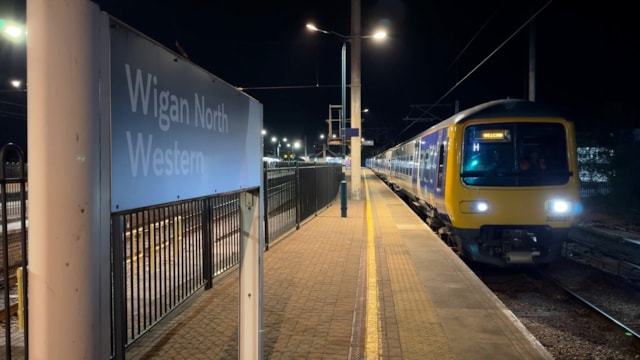
The NR press release following electric train testing all but confirms that initially 769s will changeover at Ince from late summer, and this will be the only change until a future timetable change brings in the EMU service.
 www.networkrailmediacentre.co.uk
Technical teams monitored how the overhead lines performed as the train travelled twice between the two towns as part of a robust testing regime before electric-powered trains can enter passenger service in late summer.
Already delivered as part of this investment, the recent May timetable change on Sunday 25 May saw Ince station being fully served by all services for the first time greatly improving the frequency of trains in that community.
In future the Wigan to Bolton will enable further flexibility for train operators to run electric services over longer distances to improve connectivity across the North West of England.
The upgrades to station platforms mean more space for passengers now, but in the future will allow for longer trains with more seats to serve destinations along the route.
First electric train runs between Wigan and Bolton during overnight tests
The first train powered by newly installed overhead electric lines has run between Wigan and Bolton after £100m of government investment to improve future railway journeys across the North West.
www.networkrailmediacentre.co.uk
The thing about longer trains is absolutely hilarious. Where's the fleet going to come from forany five or six car trains that can serve Westhoughton, Hindley or Ince?The NR press release following electric train testing all but confirms that initially 769s will changeover at Ince from late summer, and this will be the only change until a future timetable change brings in the EMU service.
First electric train runs between Wigan and Bolton during overnight tests
The first train powered by newly installed overhead electric lines has run between Wigan and Bolton after £100m of government investment to improve future railway journeys across the North West.
pokemonsuper9
Established Member
The ex-WM 323s.The thing about longer trains is absolutely hilarious. Where's the fleet going to come from forany five or six car trains that can serve Westhoughton, Hindley or Ince?
Clearly forgetting the Headbolt Lane services, which still skip itAlready delivered as part of this investment, the recent May timetable change on Sunday 25 May saw Ince station being fully served by all services for the first time greatly improving the frequency of trains in that community.
Six car 323s can't serve the stations between Bolton and Salford Crescent. You can't diagram a six car such that it never stops any any of them either, unless the suggestion is to simply close them all, which is probably sensible but incredibly unlikely. There are no 331s available. The trains to Manchester Airport do not have time to make these calls, and the DMUs don't have any capacity or enough time. So for the foreseeable future any 323s that do go that way will be in a three car format.The ex-WM 323s.
pokemonsuper9
Established Member
I think there are other problems with 6 cars (e.g. Manchester Oxford Road has no terminating platform long enough that can be regularly used (something with signal overlap at Platform 3 I think)).Six car 323s can't serve the stations between Bolton and Salford Crescent. You can't diagram a six car such that it never stops any any of them either, unless the suggestion is to simply close them all, which is probably sensible but incredibly unlikely. There are no 331s available. The trains to Manchester Airport do not have time to make these calls, and the DMUs don't have any capacity or enough time. So for the foreseeable future any 323s that do go that way will be in a three car format.
No way they'd be closed, we all know that closure is a very complex process.
Xenophon PCDGS
Veteran Member
I might agree with the closure of Clifton station, but not the closure of the stations of Kearsley, Farnworth and Moses Gate.Six car 323s can't serve the stations between Bolton and Salford Crescent. You can't diagram a six car such that it never stops any any of them either, unless the suggestion is to simply close them all, which is probably sensible but incredibly unlikely.
Bletchleyite
Veteran Member
I might agree with the closure of Clifton station, but not the closure of the stations of Kearsley, Farnworth and Moses Gate.
Agreed. Clifton just isn't that useful - it is on the edge of Clifton Green but down a massive hill.
The rest could really do with a Merseyrail style service, though I guess 2tph is the best that's likely.
The signalling overlap is 1 issue, but the other is the length of platform 3 in the up direction is 137m so if reversing then the driver cannot quite see the departure signal on the other end to go back towards Deansgate.I think there are other problems with 6 cars (e.g. Manchester Oxford Road has no terminating platform long enough that can be regularly used (something with signal overlap at Platform 3 I think)).
No way they'd be closed, we all know that closure is a very complex process.
2tph is incredibly unlikely. Two of them don't even have a Sunday service.Agreed. Clifton just isn't that useful - it is on the edge of Clifton Green but down a massive hill.
The rest could really do with a Merseyrail style service, though I guess 2tph is the best that's likely.
Bletchleyite
Veteran Member
2tph is incredibly unlikely. Two of them don't even have a Sunday service.
One would have thought that with 323s/331s (which go like absolute stink) replacing slow 1980s DMUs that it would be possible to path more stops at the three main ones (not Clifton) without seriously knackering the timetable. Probably not all three stops in one service, but between the two Wigans and two Blackpools (if that's indeed the plan) you should really be able to manage to give each 2tph.
Notably it appears that these stops (despite comments above) are presently in Southport and Clitheroe DMUs - and there's very little slower off the mark than a 769 on diesel, and TBH they're not much better on electric!
The lack of a Sunday service is a joke and to be honest probably relates more to the perennial problem of staffing when Sundays are voluntary. There is to give a comparison a strong desire to give Ormskirk-Preston a Sunday service, and there were successful trials in about 2018, but the staffing thing has kiboshed it for now.
Last edited:
pokemonsuper9
Established Member
Lots of the Southport DMUs you see are booked 769.Notably it appears that these stops (despite comments above) are presently in Southport and Clitheroe DMUs - and there's very little slower off the mark than a 769 on diesel, and TBH they're not much better on electric!
Clitheroe/Blackburn routes just have a couple stops at peak time to cover for the stops the Clifton train has to skip for time
Bletchleyite
Veteran Member
Lots of the Southport DMUs you see are booked 769.
They are, but 769s are notoriously slow even on electric. 319s were slow, and 769s have the extra weight of engines and fuel.
I suspect a 150 is probably more performant than a 769 on electric. That's certainly my observation.
Xenophon PCDGS
Veteran Member
I have been speaking to a friend this morning who lives in the Farnworth area and he tells me it has a population around the 27,000 mark and worthy of keeping its railway station.Agreed. Clifton just isn't that useful - it is on the edge of Clifton Green but down a massive hill.
The rest could really do with a Merseyrail style service, though I guess 2tph is the best that's likely.
Bletchleyite
Veteran Member
I have been speaking to a friend this morning who lives in the Farnworth area and he tells me it has a population around the 27,000 mark and worthy of keeping its railway station.
I don't think you could justify closing Moses Gate, Farnworth or Kearsley unless wielding a very big knife. Clifton is different because of its very inconvenient location to most of the housing nearby; it does serve a load of industry but most people will travel to that sort of work by car and not from very far away. Clifton after all was built as a junction station, not because of its convenient location for local users.
As literally just pointed out, the Blackpool North services can't call there because pairs of 323s don't fit. They are not an option. The existing services obviously can call with a class 769 or 150 because they are specifically timed to do so. The services via Darwen can't call as some are two car and are too slow. Of course there is a peak stop but some of these have had to be removed in recent timetables. So only the other Southport is in play. Both Southport services now have to call at Ince so these are under even more pressure than before.One would have thought that with 323s/331s (which go like absolute stink) replacing slow 1980s DMUs that it would be possible to path more stops at the three main ones (not Clifton) without seriously knackering the timetable. Probably not all three stops in one service, but between the two Wigans and two Blackpools (if that's indeed the plan) you should really be able to manage to give each 2tph.
== Doublepost prevention - post automatically merged: ==
It's because there's almost no demand, on any day of the week. It's not similar to Ormskirk or Headbolt Lane, because there the boxes aren't open at the necessary times, and their entire service group is missing from Sunday train crew diagrams.The lack of a Sunday service is a joke and to be honest probably relates more to the perennial problem of staffing when Sundays are voluntary. There is to give a comparison a strong desire to give Ormskirk-Preston a Sunday service, and there were successful trials in about 2018, but the staffing thing has kiboshed it for now.

daodao
Established Member
Urban rail services really need to be at least 2 tph to be of any real use. Having gone to the significant expense of electrifying the route, I suggest that ideally there should be a 2 tph (at least Mon-Sat 7am-7pm) electric multiple unit service from Wigan NW via Bolton to Manchester Victoria and Stalybridge, calling at all stops other than Clifton Junction, which could be left with its "parliamentary" 1 tpd service. All Southport services could run via Atherton to Manchester Victoria and beyond, using pure diesel multiple units as there would be minimal running under the wires.2tph is incredibly unlikely. Two of them don't even have a Sunday service.
Last edited:
I couldn't agree more with this. The fact it can't be delivered operationally I precisely the reason why I said serving them at all is of very little value. Your suggestion is certainly not possible. I would like to see something closer to that after the next Taskforce change but unfortunately it is really not pointing that way.Urban rail services really need to be at least 2 tph to be of any real use. Having gone to the significant expense of electrifying the route, I suggest that ideally there should be a 2 tph (at least Mon-Sat 7am-7pm) electric multiple unit service from Wigan NW via Bolton to Manchester Victoria and Stalybridge, calling at all stops other than Clifton Junction, which could be left with its "parliamentary" 1 tpd service. All Southport services should be diesel and run via Atherton to Manchester Victoria and beyond.