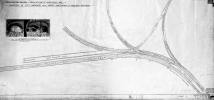
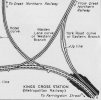
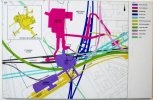
Would the unfinished Euston connecting tunnel be the same as the one seen in Rail Map Online, which appears to show an uncompleted route that stops at Midland Road where present day Gothic Bar is located or is that something else entirely?
That's about it, and the explanation I have found matches
@etr221's too.
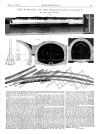
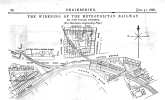
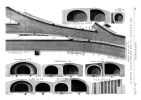
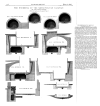
What I found is, in (bizarrely) the Derbyshire Advertiser and Journal of 16 July 1926. This article says it was built by the MR for the Met when the Midland hotel was built, since it was going underneath it. Its purpose "appears to have been" to connect the L&NWR to the Widened Lines along with its neighbours, but it stopped in a blank wall at Midland Road awaiting developments. For whatever reason - money, the cost of land, and company politics, most likely - these never happened.
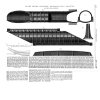
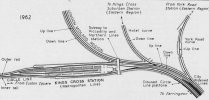
During 1924-26 this bit of unused tunnel was brought into use in a project sometimes called doubling the Circle Line. This involved digging up the two parallel tunnels and linking them, and putting some major steelwork in place to hold up Euston Road. A single line then went from the Outer Rail via this old tunnel to "Midland Junction" with the MR St Pancras Branch and so onto the Widened Lines. That enlarged tunnel later became the new Kings Cross St Pancras station.
At the same time, the Widened Lines were electrified and Moorgate Station altered to provide a double bay and two single bays. That is much as now (or before the Thameslink changes) except the P3/4 headshunt was a connection to the Widened Lines. This arrangement can be seen in
this truly wonderful modern version of the signalling diagram from 1933 at
Harsig's Signalling Page. The site has later ones too, after Kings Cross St Pancras station was moved and this link removed ca. 1940. (I've tried to clip a small image from those but can't as it needs so much zoom.)
How much use the link ever got is not clear from these sources, but after it was gone it was seen with hindsight as primarily a goods line. That would make sense while Smithfield (GWR) depot was still in use, but that closed in 1959 and no doubt was in decline long before and so didn't call for much capacity by 1939.
The large-scale OS plans from the 1950s show some tunnels, but mostly only ones regarded as "Underground". The one set that looks as if it might have other railways is missing the sheets needed for this. I suspect those hatched lines for tunnels were not revised, either. There is a similar set of plans from the 1870s, but none I can see from 1926-1939, when part of the tunnel was actually in use.

 . My thinking is that it would have been an extra tunnel, parallel to and just North of the Metropolitan Railway/Euston Road from Kings Cross (how far had St Pancras got at that time?) to a curve round into the east side of Euston stn. And that the bit of tunnel which was built - essentially under the forecourt of St Pancras Stn - was done while the contractors were at it, and it was all dug up anyway...