The lights are visible, but it’s hard to tell on which track they are, how far away they are, and whether and how fast they are moving.I disagree. When on the platform, the lights are visible well before the front end custard.

-
Our new ticketing site is now live! Using either this or the original site (both powered by TrainSplit) helps support the running of the forum with every ticket purchase! Find out more and ask any questions/give us feedback in this thread!
You are using an out of date browser. It may not display this or other websites correctly.
You should upgrade or use an alternative browser.
You should upgrade or use an alternative browser.
New trains cab ends not painted yellow.
- Thread starter Intercity Guy
- Start date
- Status
- Not open for further replies.
Sponsor Post - registered members do not see these adverts; click here to register, or click here to log in
R
RailUK Forums

birchesgreen
Established Member
On a sunny day a reflection off a shiny surface can be mistaken for train lights. I was at a station a few weeks ago wondering why there was a train in the distance stopped on approach for ages, then the sun went in. 

I won't argue with the people suggesting the headlights are too bright since many of them work on the railway and will have worked with them first hand, but I still ask whether the yellow front is that superior. In low-light conditions from afar, is it really going to be visible enough to see before the train is within the too close for comfort range? Many other countries around the world work without yellow fronts and I am not aware of them being any less safe than using yellow fronts. I know we have arguably the safest railway in Europe, but is there actual statistics to back up the notion that yellow fronts enhance safety? (ie. trackside fatalities due to poor visibility).
coppercapped
Established Member
Also as a 'non-railway' person I wonder how the yellow fronts help at night? After all the sun is not visible for about half the year...!I won't argue with the people suggesting the headlights are too bright since many of them work on the railway and will have worked with them first hand, but I still ask whether the yellow front is that superior. In low-light conditions from afar, is it really going to be visible enough to see before the train is within the too close for comfort range? Many other countries around the world work without yellow fronts and I am not aware of them being any less safe than using yellow fronts. I know we have arguably the safest railway in Europe, but is there actual statistics to back up the notion that yellow fronts enhance safety? (ie. trackside fatalities due to poor visibility).
How many people are near or crossing a rail line at night?Also as a 'non-railway' person I wonder how the yellow fronts help at night? After all the sun is not visible for about half the year...!
At night you have to accept the lack of speed and distance perception.

Sun Chariot
Established Member
Yes and in the 1950s-1960s, the locos and multiple units had marker lights barely better than oil-wick lanterns used for the steam locos of that time. Diesels and electrics were typically quieter and, with no smoke plume, were less easy to see at a distance.The original point of them was safety - a uniform front colour is quickly recognisable by track-workers, whereas a headlight may blend in with other bright lights.
Many years ago, I read of an incident when a new-to-service EE type 4 (class 40) hit a p.w. rail jack, left in situ by gangers who'd jumped for their lives - they had thought the sounded horn was a canal barge; and they couldn't make out the dark green loco from the surrounding green foliage
Last edited:
norbitonflyer
Established Member
Lights can fail. Yellow paint is always yellow.
theageofthetra
Established Member
I know, and if they hadn't? It's why yellow fronts are still importantWas a 195 that do have yellow fronts

AlexNL
Established Member
- Joined
- 19 Dec 2014
- Messages
- 1,721
Well, yes and no.I was aware that NS had yellow trains but as far as I knew that was just part of the corporate branding rather than requirements
The Netherlands used to have a regulation that the front of trains should have a contrast area of at least 1 m² in white or yellow. This rule was abolished around 2010. NS rolling stock introduced after 2010, such as the FLIRT and the SNG, did not have that white/yellow contrast area anymore.
This policy changed after the 2020 crash near Hooghalen*, where NS' internal accident investigation uncovered that visibility of SNG by surrounding traffic was rather poor in some conditions. NS then decided to start painting their trains yellow again, as much as possible. The entire fleet is getting its front overhauled to maximise the surface area of yellow on the nose.
* where an SNG hit a heavy dump truck, killing the driver
irish_rail
On Moderation
Think about a depot with relatively low lighting. Lots of staff crossing the various tracks. Lights get lost amongst other lights, especially when disguised by a dark black front end. Yellow on the other hand will show up better in dim lighting conditions, such as those on depots.Also as a 'non-railway' person I wonder how the yellow fronts help at night? After all the sun is not visible for about half the year...!
But is it actually the case that a yellow front is a significant contributor to the safety of depot and trackside workers in this situation? After all, several trains with non-yellow fronts have been in full service for several years now and yet I haven't heard of an increased number of fatalities at depots in which they are maintained.Think about a depot with relatively low lighting. Lots of staff crossing the various tracks. Lights get lost amongst other lights, especially when disguised by a dark black front end. Yellow on the other hand will show up better in dim lighting conditions, such as those on depots.
irish_rail
On Moderation
Well I would hope not seeing as depot fatalities are thankfully extremely rare. But one thing you would understand if you where on the railway is , that the railway always does everything possible to maximise safety to the greatest degree possible. Anything that reduces the "Swiss cheese" likelihood of an accident happening will be done if reasonable. Which is why in my view, something as cheap as removing the black front ends on some units wouldn't be a huge price to pay for the (admittedly very small) increase in safety. It just feels like vanity over safety (and yet the black is flipping ugly but hey!)But is it actually the case that a yellow front is a significant contributor to the safety of depot and trackside workers in this situation? After all, several trains with non-yellow fronts have been in full service for several years now and yet I haven't heard of an increased number of fatalities at depots in which they are maintained.
I suppose this is something I would better understand if I ever get the honour of working on the railway in future, I am just genuinely curious as to just how much safer yellow fronts are compared to non-yellow fronts. Obviously it will show better in low-light conditions to compared to black. I will at least agree with you on black fronts being less aesthetically pleasing than yellow ones though. I've done some picture edits of a Pendolino with a black smile instead of yellow and, while it could just be my editing skills, I found it quite ghastly.Well I would hope not seeing as depot fatalities are thankfully extremely rare. But one thing you would understand if you where on the railway is , that the railway always does everything possible to maximise safety to the greatest degree possible. Anything that reduces the "Swiss cheese" likelihood of an accident happening will be done if reasonable. Which is why in my view, something as cheap as removing the black front ends on some units wouldn't be a huge price to pay for the (admittedly very small) increase in safety. It just feels like vanity over safety (and yet the black is flipping ugly but hey!)
Sun Chariot
Established Member
I dimly recall reading (several decades ago now) that signal yellow was deemed (but I cannot recall if by the BTC, British Railways, or another industry body) to have the best visibility in daylight conditions.Flip the question. Why not yellow?
Orange was also tried, e.g. on the Southern Region 3H (205) DEMUs, a "V" painted - but not taken to wider adoption.
Irish Rail used a 'day-glow' orangey-red on the ends of some 001, 141, 181 members. As not all IR's locos were so treated, I presume the results were not significant enough.
Lknowles78
Member
- Joined
- 14 Sep 2014
- Messages
- 28
I completely disagree. With the bland grey livery they look odd and in pictures the look like a superimposed black and white image on a full colour background. They would benefit from a splash of yellow like the 700s!The black and white fronts of our 717s look quite smart, IMHO.
birchesgreen
Established Member
The 701s were originally going to have black ends, the mock-ups looked awful.

12LDA28C
Established Member
- Joined
- 14 Oct 2022
- Messages
- 5,058
Flip the question. Why not yellow?
Indeed. LU stock has red cab fronts. Why not yellow?
Speed and distance??Indeed. LU stock has red cab fronts. Why not yellow?
I was thinking more as to what reason there is to have a black front if yellow is safer. I reckon it’s just a designer fad to be different- it normally looks horrible and undramatic (I don’t know why you would waste a sleek streamlined front by making it less visible!)

Indeed. LU stock has red cab fronts. Why not yellow?
Now that you mention it, why does LU stock have red fronts?
(If this question can’t be dealt with briefly I’ll create a separate thread in the LU section.)
swt_passenger
Veteran Member
- Joined
- 7 Apr 2010
- Messages
- 34,276
The quick answer, when it came up before, was that LU did not usually allow staff trackside when trains were running, so the risk was not the same.Now that you mention it, why does LU stock have red fronts?
(If this question can’t be dealt with briefly I’ll create a separate thread in the LU section.)

XCTurbostar
Established Member
- Joined
- 13 Sep 2014
- Messages
- 2,540
I don’t really have an issue with non yellow fronts as long as it isn’t black, TfW have done a good job with the red fronts and think this perfectly illustrates how fronts can be done right. I do have a personal thought that it makes it look more ‘friendly’ though (compare the 745 and 231 for example)
Sun Chariot
Established Member
LU "signal red" all-over fronts came into being when the red-white-blue livery was adopted during stock refurbishment in the early 1990s.The quick answer, when it came up before, was that LU did not usually allow staff trackside when trains were running, so the risk was not the same.
When I first worked in London, the majority of surface and sub-surface stock was left in an unpainted aluminium. And, before my time, some stock was close to a red-ixide colour.
Last edited:

Dstock7080
Established Member
1973, 1983 and D Stock were delivered with half-red fronts after a trial using 1962 Stock.The "signal red" fronts only came into being when the red-white-blue livery was adopted, as part of early 1990s stock refurbishment.
Staff regularly patrolled the track in daylight hours with grey aluminium fronted trains. Vegetation gangs, signal engineers working alone, Duty Manager inspections and much further back the paint gangs refurbishing the air main and signalling boxes.The quick answer, when it came up before, was that LU did not usually allow staff trackside when trains were running, so the risk was not the same.
Sun Chariot
Established Member
True - I should have remembered, since I was using District, Jubilee & Piccadilly lines when those trains were like it.1973, 1983 and D Stock were delivered with half-red fronts after a trial using 1962 Stock.

The quick answer, when it came up before, was that LU did not usually allow staff trackside when trains were running, so the risk was not the same.
Thanks. That makes sense as to why they aren’t yellow, but I wondered why red specifically.
Just TfL corporate branding I guess.
baldyman26
Member
- Joined
- 2 Aug 2012
- Messages
- 137
Hard to see any arguments for either, it's clear yellow fronts aren't safer, otherwise they would all be yellow, the majority of this is personal taste and trying to find "railway" reasons for this in my opinion
Sun Chariot
Established Member
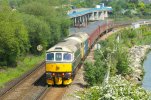
I am from an age where you'd see a yellow front much earlier than you'd you'd notice the dim marker lights (see attached).Hard to see any arguments for either, it's clear yellow fronts aren't safer, otherwise they would all be yellow, the majority of this is personal taste and trying to find "railway" reasons for this in my opinion
The high intensity headlights today, are a huge improvement.
Attachments
Last edited:
norbitonflyer
Established Member
Possibly because red means "stop" to any train driver (which is why the NSE corporate branding at West Croydon had to be modified, and also why hanging remembrance poppies from the canopies on platforms is frowned upon )Thanks. That makes sense as to why they aren’t yellow, but I wondered why red specifically.
Just TfL corporate branding I guess.
. When operating under "stop and proceed" rules, (Pass a signal failed at danger and proceed at caution), a large red object looming up in front of you is a good hint that you shouldn't go any further.
You can have integrated ticketing and timetabling without losing local identities.Why? Because it creates a confusing mess. Some livery variation is fine, but I suspect we will end up with as another poster suggested , just slapping a logo on everything in a small corner by the door and that will be the re brand. The current ugly mish mash will continue. Good for enthusiasts perhaps, less so for creating the sense of a joined up , smart and efficient rail system.
Back in the day it certainly made a difference. These days though Red Zone Working has almost been eliminated which has removed the greater part of the risk.I know we have arguably the safest railway in Europe, but is there actual statistics to back up the notion that yellow fronts enhance safety? (ie. trackside fatalities due to poor visibility).
My only guess is that a black front hides the splattered flies.Speed and distance??
I was thinking more as to what reason there is to have a black front if yellow is safer. I reckon it’s just a designer fad to be different- it normally looks horrible and undramatic (I don’t know why you would waste a sleek streamlined front by making it less visible!)
Red used to be the standard warning colour for an approaching train. That's why buffer beams were painted signal red (something which may have been mandated by the RCH or the Board of Trade, though I've a feeling that a pre-grouping Scottish railway painted bufferbeams green). Evidently in the case of DMMUs that wasn't found sufficient to prevent "whispering death" so first the whiskers, then yellow panels were applied. Visibility worked both ways of course, orange vests were introduced circa 1969.Thanks. That makes sense as to why they aren’t yellow, but I wondered why red specifically.
Just TfL corporate branding I guess.
- Status
- Not open for further replies.