
Totally agree with this.Hard to see any arguments for either, it's clear yellow fronts aren't safer, otherwise they would all be yellow, the majority of this is personal taste and trying to find "railway" reasons for this in my opinion

-
Our new ticketing site is now live! Using either this or the original site (both powered by TrainSplit) helps support the running of the forum with every ticket purchase! Find out more and ask any questions/give us feedback in this thread!
You are using an out of date browser. It may not display this or other websites correctly.
You should upgrade or use an alternative browser.
You should upgrade or use an alternative browser.
New trains cab ends not painted yellow.
- Thread starter Intercity Guy
- Start date
- Status
- Not open for further replies.
Sponsor Post - registered members do not see these adverts; click here to register, or click here to log in
R
RailUK Forums

Hard to see any arguments for either, it's clear yellow fronts aren't safer, otherwise they would all be yellow, the majority of this is personal taste and trying to find "railway" reasons for this in my opinion
I think you’re overlooking just how poor train headlights used to be, right up until relatively recently. Things have moved on significantly with the advent of LED lights, to the extent that modern headlights can arguably be too bright in some situations, and the standard for yellow fronts has been modified as a result.
I am from an age where you'd see a yellow front much earlier than you'd you'd notice the dim marker lights.
The high intensity headlights today, are a huge improvement.
Agreed. Consider much of the ex Southern region’s slam door EMU stock, for example, which was in service until the early-mid mid 2000s.
How is it clear yellow fronts aren’t safer? I can’t see how they can not be safer than black, so the question is what the justification is for not having them - black doesn’t make the train go faster!Hard to see any arguments for either, it's clear yellow fronts aren't safer, otherwise they would all be yellow, the majority of this is personal taste and trying to find "railway" reasons for this in my opinion

OneTrackMinded
Member
Aesthetics. Black is often seen as modern or metro likewhat the justification is for not having them
irish_rail
On Moderation
Exactly. The idea that somehow a black front end is safer than a yellow front end is laughable.How is it clear yellow fronts aren’t safer? I can’t see how they can not be safer than black, so the question is what the justification is for not having them - black doesn’t make the train go faster!

InkyScrolls
On Moderation
Seconded! Certain 158s I've had the 'pleasure' of driving are particularly bad, in my experience.I think you’re overlooking just how poor train headlights used to be, right up until relatively recently.

Elecman
Established Member
I’d prefer yellow ends and decent lights fitted for sighting purposes
Really…by who?Aesthetics. Black is often seen as modern or metro like

XCTurbostar
Established Member
- Joined
- 13 Sep 2014
- Messages
- 2,539
Agreed.I’d prefer yellow ends and decent lights fitted for sighting purposes
For me, it is also about familiarity. If you were a trackside lookout and a train approached you in the distance with no lights - which one of these is the one you are expecting to see?
Attachments
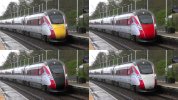
How is it clear yellow fronts aren’t safer? I can’t see how they can not be safer than black, so the question is what the justification is for not having them - black doesn’t make the train go faster!
Because the lighting has more of an effect on visibility than the colour of the unit or loco end.
Surely you aren’t suggesting that non yellow 717s, or 345s with modern headlights, are less visible/safe than the 4EPB in my avatar?
Agreed.
For me, it is also about familiarity. If you were a trackside lookout and a train approached you in the distance with no lights - which one of these is the one you are expecting to see?
If the train has no lights it’s limited to 20mph anyway.
More of an effect doesn’t mean the yellow doesn’t have an effect.Because the lighting has more of an effect on visibility than the colour of the unit or loco end.
Surely you aren’t suggesting that non yellow 717s, or 345s with modern headlights, are less visible/safe than the 4EPB in my avatar?
Bright lights are hard to judge for speed and distance. Being able to see the yellow front aids that.
Bright lights might not be a train. Yellow front is a train.
The one with the black front end looks fantastic.Agreed.
For me, it is also about familiarity. If you were a trackside lookout and a train approached you in the distance with no lights - which one of these is the one you are expecting to see?

Islineclear3_1
Established Member
On straight track and in good light - a fair old distance. In bad light; maybe negligible but yellow fronts were considered safe enough for decades since their introduction in the 1960s/1970sbut when a train is approaching from far away how likely are you to actually see it before it comes close enough where it can actually be determined as a moving train?
More of an effect doesn’t mean the yellow doesn’t have an effect.
Bright lights are hard to judge for speed and distance. Being able to see the yellow front aids that.
Bright lights might not be a train. Yellow front is a train.
This sounds more like an enthusiast who likes yellow fronts inventing reasons not to change them.
Modern lights are clearly visible from a mile or more away, which is less than thirty seconds’ travel at 125mph, and render the colour of the front irrelevant. If there was any proper statistical evidence that (invariably dirty) yellow fronts are safer, or that they make it easier to judge speed and distance, the change wouldn’t have been made.
Last edited:
The one with the yellow end. It would be the most visible from furthest away.Agreed.
For me, it is also about familiarity. If you were a trackside lookout and a train approached you in the distance with no lights - which one of these is the one you are expecting to see?
Sure the light is visible, but just a light. Lights are notoriously hard to judge for distance and speed.This sounds more like an enthusiast who likes yellow fronts inventing reasons not to change them.
Modern lights are clearly visible from a mile or more away, which is less than thirty seconds’ travel at 125mph, and render the colour of the front irrelevant. If there was any proper statistical evidence that (invariably dirty) yellow fronts are safer, or that they make it easier to judge speed and distance, the change wouldn’t have been made.
And it’s just a light, not a train.
irish_rail
On Moderation
I agree. Lights frequently get lost in a sea of lights, especially in towns and cities at night.Sure the light is visible, but just a light. Lights are notoriously hard to judge for distance and speed.
And it’s just a light, not a train.

Peter Mugridge
Veteran Member
If it's at night, would not the yellow end be invisible anyway unless they added another light pointing down across the front of the train?I agree. Lights frequently get lost in a sea of lights, especially in towns and cities at night.
irish_rail
On Moderation
What light there is will reflect off yellow and the yellow will be visible . However black will be completely invisible in low light.If it's at night, would not the yellow end be invisible anyway unless they added another light pointing down across the front of the train?

TheHovisKid
Member
Even buses joining in the act:

 www.facebook.com
(A common Whack-sone-of-our-paint-on-and-turf-it-out wheeze where a recent import could be confused with the opposition. But still.....)
www.facebook.com
(A common Whack-sone-of-our-paint-on-and-turf-it-out wheeze where a recent import could be confused with the opposition. But still.....)
A.E.C Buses & Coaches | One time Leeds City Transport Roe bodied AEC Regent V | Facebook
One time Leeds City Transport Roe bodied AEC Regent V 952 (952 JUB) of 1964 vintage paying a return visit to its home city after a spell as Tyne and Wear Metro 417. Seen at the Leeds Running Day in 2017
www.facebook.com

MarkWiles
Member
- Joined
- 21 Jul 2019
- Messages
- 69
There is another consideration in the yellow paint debate - footpath crossings. I remember a while back I was approaching a level crossing (driving a car) on the Cambrian and noticed a flash of yellow out of the corner of my eye, which gave me warning that the crossing lights ahead were about to go off. It got me thinking about farm and foot crossings of which there are plenty around locally. Although initially introduced for trackside safety, we've had near enough 60 years of yellow bibs and yellow ends, which help trains stand out against the countryside. Lights of course are equally visible so long as the sun isn't shining directly on them, but given many modern road vehicles are fitted with retina-melting LED lighting and daytime running lights, there is some margin for confusion by an occupation or footpath crossing user whereas lights + yellow end might just add an extra recognition factor for non-railway staff using crossings. I do wonder if the new Trans Pennine Class 802 units are conspicuous at the many footpath crossings on the TPE route when seen against the dark surrounding countryside.
Given no-one ever has said "Oh I'd love to catch the train but that yellow paint looks so awful it has put me off" I personally can see no argument whatsoever for ditching yellow paint on marketing or corporate grounds. If the yellow manages to make the train more visible alongside better lights, surely the potential visibility improvements, both for staff and people legitimately crossing the track, must make implementing both the better option - especially as there is evidence of that crash in the Netherlands, which I had heard about, leading to a change to add yellow to the front of a train which was already lit up like Blackpool seafront.
Given no-one ever has said "Oh I'd love to catch the train but that yellow paint looks so awful it has put me off" I personally can see no argument whatsoever for ditching yellow paint on marketing or corporate grounds. If the yellow manages to make the train more visible alongside better lights, surely the potential visibility improvements, both for staff and people legitimately crossing the track, must make implementing both the better option - especially as there is evidence of that crash in the Netherlands, which I had heard about, leading to a change to add yellow to the front of a train which was already lit up like Blackpool seafront.

I don't really care about yellow front ends. They're fine but I don't mind them. My main issue, however, is that despite operators now having the freedom to basically do whatever they want with the front ends, most operators just make them black. It's unusually boring - they could make the livery a whole wraparound job but they act like they must keep the front one block colour (that usually doesn't fit with the livery) and I don't get why.
Does it hide the splattered bugs better?I don't really care about yellow front ends. They're fine but I don't mind them. My main issue, however, is that despite operators now having the freedom to basically do whatever they want with the front ends, most operators just make them black. It's unusually boring - they could make the livery a whole wraparound job but they act like they must keep the front one block colour (that usually doesn't fit with the livery) and I don't get why.
- Status
- Not open for further replies.