• Our new ticketing site is now live! Using either this or the original site (both powered by TrainSplit) helps support the running of the forum with every ticket purchase! Find out more and ask any questions/give us feedback in this thread!

3 month old 737-9 Max depressurisation incident

Status
Not open for further replies.

DustyBin

Established Member
Joined
20 Sep 2020
Messages
3,927
Location
First Class
Which is called "doing it on the cheap". Indeed, like MCAS, the whole thing is doing it on the cheap - the more expensive and safer option would be not to have the gap at all unless the door is specified.

I'm not a fan of the MAX (at all!) but there's an obvious commercial benefit to offering this kind of flexibility for the reason @najaB has stated.

It's perfectly possible to have the handle lift the door when it is operated. I've seen at least one aircraft door that does work that way.

From what I can make out this is exactly how the door and plug options both operate. They lift over the stops before folding down via bottom mounted hinges.

I did note that they're fitted with lift-assist springs which may be significant, as if the locking bolts are missing the door isn't even held in place by it's own full weight....

Either way there was no need to have a design of door/plug with only one layer of safety - one set of bolts. That is flawed and I am not being swayed on that. A dangerous aircraft design found to be even more dangerous - is this Boeing's DC-10?

The bolts should be fail-safe though. Again, I think this incident is very likely the result of serious human error/negligence which is impossible to allow for. I suspect that the "lessons learned" will centre around quality control and training as opposed to the design of the door/plug itself. I could be wrong of course!
 
Sponsor Post - registered members do not see these adverts; click here to register, or click here to log in
R

RailUK Forums

Bletchleyite

Veteran Member
Joined
20 Oct 2014
Messages
113,752
Location
"Marston Vale mafia"
The bolts should be fail-safe though. Again, I think this incident is very likely the result of serious human error/negligence which is impossible to allow for.

Again, it's not impossible to allow for. If the door only opened inwards and was larger than the hole, then even if the bolts were completely absent it couldn't blow out.

There are things you can't mitigate other than by way of work procedures, but this isn't one of them.
 

bahnause

Member
Joined
30 Dec 2016
Messages
1,043
Location
bülach (switzerland)
Cargo doors often do, as do Boeing overwings (but not Airbus ones) but main exit doors don't. They open inwards in some form first (Airbus by way of top and bottom flaps, Boeing by way of the whole door being "bendy") and then outwards.
Thy system of plug is the same as used on many doors. It has to be liftet to clear the stop pads. The pressurisation locks the plug into place if correctly assembled.
 

DustyBin

Established Member
Joined
20 Sep 2020
Messages
3,927
Location
First Class
Again, it's not impossible to allow for. If the door only opened inwards and was larger than the hole, then even if the bolts were completely absent it couldn't blow out.

There are things you can't mitigate other than by way of work procedures, but this isn't one of them.

If the door opens inwards it needs to be the "disposable" type, which we know from experience introduce problems of their own.

Remember, if this was an actual door it wouldn't rely on concealed bolts to prevent it from moving. If anything there's an argument to say that the existence of the plug option is the underlying issue here, regardless of commercial considerations. Pending evidence to the contrary however, I maintain that serious human error is almost certainly to blame. The fail safe is that there are (I think) four locking bolts and a depressurisation warning. If (and I'm speculating at this stage) it transpires that all four bolts have to be missing for the door to open fully, and the airline ignored multiple depressurisation warnings, that's simply not a design issue.
 

najaB

Veteran Member
Joined
28 Aug 2011
Messages
33,730
Location
Scotland
If something is fitted externally then the pressure differential sucks it away from the fuselage, and you have a large hole where your plane should be.
I may have completely the wrong impression, but if the door plug is installed correctly then it is a plug and pressure holds it in place. The problem here is that they haven't been installed correctly.
 

edwin_m

Veteran Member
Joined
21 Apr 2013
Messages
28,741
Location
Nottingham
If the door opens inwards it needs to be the "disposable" type, which we know from experience introduce problems of their own.

Remember, if this was an actual door it wouldn't rely on concealed bolts to prevent it from moving. If anything there's an argument to say that the existence of the plug option is the underlying issue here, regardless of commercial considerations. Pending evidence to the contrary however, I maintain that serious human error is almost certainly to blame. The fail safe is that there are (I think) four locking bolts and a depressurisation warning. If (and I'm speculating at this stage) it transpires that all four bolts have to be missing for the door to open fully, and the airline ignored multiple depressurisation warnings, that's simply not a design issue.
I may have completely the wrong impression, but if the door plug is installed correctly then it is a plug and pressure holds it in place. The problem here is that they haven't been installed correctly.
If the door plug is in the correct position then the pressure holds it in place. The bolts hold it in the correct position, doing the same job as the open/close mechanism does on the aircraft that have a useable emergency door in this position.

I imagine the bolts have redundancy so only two or even one can keep the door plug in position. But if they aren't fitted or aren't tightened fully then whether it has one or two or four or ten bolts, the door plug is at risk of moving vertically and might do so during, say, a rough landing or some turbulence. The projections on the door plug and the fuselage that normally engage with each other under pressure are then no longer aligned and the pressure can push the door plug out.
 

najaB

Veteran Member
Joined
28 Aug 2011
Messages
33,730
Location
Scotland
I imagine the bolts have redundancy so only two or even one can keep the door plug in position. But if they aren't fitted or aren't tightened fully then whether it has one or two or four or ten bolts, the door plug is at risk of moving vertically and might do so during, say, a rough landing or some turbulence. The projections on the door plug and the fuselage that normally engage with each other under pressure are then no longer aligned and the pressure can push the door plug out.
Which goes back to the earlier point: no matter the design, if it's not assembled or maintained correctly then it may not fail safe.
 

Bletchleyite

Veteran Member
Joined
20 Oct 2014
Messages
113,752
Location
"Marston Vale mafia"
Which goes back to the earlier point: no matter the design, if it's not assembled or maintained correctly then it may not fail safe.

To which I go back to what I said - if it were a simple plug panel wider than the fuselage hole in all directions and installed from the inside, this isn't true.
 

AndyPJG

Member
Joined
29 Jun 2012
Messages
543
I'd say it was if it could drop into a position where it failed if just the bolts were loose or failed - safety is like a load of pieces of holed cheese, this design had only one layer. A failsafe design would be one where you had to lift it *up* against gravity to move it into the "unsafe" position.
The 'door' has to be RAISED to allow it to be opened, not lowered. See this video (circa 8:30):-

737 Mid-Cabin Emergency Exit Doors - Plug Option
 

DustyBin

Established Member
Joined
20 Sep 2020
Messages
3,927
Location
First Class
Which goes back to the earlier point: no matter the design, if it's not assembled or maintained correctly then it may not fail safe.

I agree. This incident appears to be the result of a level of negligence that simply couldn't be foreseen.

To which I go back to what I said - if it were a simple plug panel wider than the fuselage hole in all directions and installed from the inside, this isn't true.

But as per my previous post, you're then introducing a new problem. Most commercial aircraft doors open outwards; if this in itself posed an inherent danger we'd know.
 

theageofthetra

Established Member
Joined
27 May 2012
Messages
3,565
Location
Beckenham
If the door plug is in the correct position then the pressure holds it in place. The bolts hold it in the correct position, doing the same job as the open/close mechanism does on the aircraft that have a useable emergency door in this position.

I imagine the bolts have redundancy so only two or even one can keep the door plug in position. But if they aren't fitted or aren't tightened fully then whether it has one or two or four or ten bolts, the door plug is at risk of moving vertically and might do so during, say, a rough landing or some turbulence. The projections on the door plug and the fuselage that normally engage with each other under pressure are then no longer aligned and the pressure can push the door plug out.
Out of interest was significant turbulence experience in the incident flight up to the altitude where the incident occurred?
 

Bletchleyite

Veteran Member
Joined
20 Oct 2014
Messages
113,752
Location
"Marston Vale mafia"
Most commercial aircraft doors open outwards

No, they don't. They mostly open inwards first.

== Doublepost prevention - post automatically merged: ==

The 'door' has to be RAISED to allow it to be opened, not lowered. See this video (circa 8:30):-

737 Mid-Cabin Emergency Exit Doors - Plug Option

Just watched all of that and I gleaned the opposite from it, it has to be pushed down against springs then raises again once open.
 
Last edited:

YorkRailFan

Established Member
Joined
6 Sep 2023
Messages
3,430
Location
York
JAKARTA, Indonesia -- Indonesia has temporarily grounded three Boeing 737-9 Max jetliners, following an incident last week in which an Alaska Airlines plane suffered a blowout that left a gaping hole in the side of the fuselage.

The three aircraft, grounded since Saturday, belong to the Indonesian budget carrier Lion Air. The decision was made by the country's Transportation Ministry in coordination with the U.S. Federal Aviation Administration to ensure the safety and security of flight operations.Alaska Airlines jetliner prompted U.S. federal authorities to ground some Boeing 737 Max 9 aircraft. The FAA grounded all Max 9s operated by Alaska and United and some flown by foreign airlines for inspection. The inspections are focused on plugs used to seal an area set aside for extra emergency doors that are not required on United and Alaska Max 9s.

The grounded Lion Air planes use a mid-cabin emergency exit door that is different than the one on the Alaska Airlines’ plane involved in the incident, said Adita Irawati, a Transportation Ministry spokesperson.

Danang Mandala Prihantoro, a spokesperson for Lion Air, said the airline “has taken preventive steps” by grounding the planes and is “carrying out further inspections on the mid-cabin emergency exit door."In 2019, Indonesia temporarily grounded Boeing 737 Max 8 jets to inspect their airworthiness after a Lion Air plane of that model crashed in October 2018, killing all 189 people on board.

Good move from Indonesia, especially given Lion Air's history with the MAX, even though Lion Air's 737-9s use a different door to Alaska'a 737-9s, take note Icelandair and FlyDubai.
 

najaB

Veteran Member
Joined
28 Aug 2011
Messages
33,730
Location
Scotland
To which I go back to what I said - if it were a simple plug panel wider than the fuselage hole in all directions and installed from the inside, this isn't true.
And if the mating surface against which it presses isn't securely fastened to the rest of the structure? You're right back to a failsafe design that is made unsafe due to manufacturing defects.

And, before you say "That would never happen", thousands of rivets in 787s had to be drilled out and reinstalled because they weren't done properly in the first place.
 

AndyPJG

Member
Joined
29 Jun 2012
Messages
543
That video says they have to be lowered against the tension of the springs until the roller clears the guide track and then they open outwards.
The roller is attached to the airframe, and the guide is part of the door, so the guide has to move up for the roller to disengage.

1704843236382.png

1704843314581.png
 
Last edited:

DustyBin

Established Member
Joined
20 Sep 2020
Messages
3,927
Location
First Class
No, they don't. They mostly open inwards first.

So you agree they open outwards then?

Just watched all of that and I gleaned the opposite from it, it has to be pushed down against springs then raises again once open.

They’re lift assist springs. Their purpose is to reduce the amount of effort it takes to lift the door in order to open it.
 

AndyPJG

Member
Joined
29 Jun 2012
Messages
543
BBC News

Boeing admits mistake over plane door blow-out
The boss of Boeing has admitted the planemaker was at fault after one of its aircraft suffered a door blow-out shortly after take-off in the US.

No-one was injured when the unused cabin door broke away from the Alaska Airlines flight from Portland, Oregon on Friday.
The US has grounded 171 of the Boeing 737 Max 9 planes since the incident.
On Tuesday, Boeing's president and chief executive Dave Calhoun said the firm was "acknowledging our mistake".
The door "plug" which fell away from the aircraft weighed 27kg (60lb) and was used to fill an emergency exit that was built into the plane, but not required by Alaska Airlines.
The missing section of the plane was retrieved from the back garden of a Portland teacher, according to the US National Transportation Safety Board (NTSB).
It has also been revealed that the airline placed restrictions on the aircraft following pressurisation warnings in the days before the incident, investigators have said.
Speaking to Boeing staff, Mr Calhoun said: "We're going to approach this number one acknowledging our mistake. We're going to approach it with 100% and complete transparency every step of the way."
Mr Calhoun reassured staff that Boeing would work with the NTSB to investigate the cause of the accident.

"They will get to a conclusion… the FAA [Federal Aviation Authority] who has to now deal with airline customers who want airplanes back in service safely and to ensure all the procedures are put into place, inspections, all the readiness actions that are required to ensure every next airplane that moves into the sky is in fact safe and that this event can never happen again," he said.

The Boeing boss also empathised with those who watched with horror at the footage of the incident: "When I got that picture, all I could think about - I didn't know what happened so whoever was supposed to be in the seat next to that hole in the airplane. I've got kids, I've got grandkids and so do you. This stuff matters. Every detail matters."
Inspections of Boeing 737 Max 9's are continuing after the FAA said its first priority was "keeping the flying public safe".
 

Lost property

On Moderation
Joined
2 Jun 2016
Messages
739
15:45 explains the door interlocks

Well that was an informative video along with this being the first time I've heard of thrust lever settings being in degrees.

However, you do imply this is how aircraft doors are operated, which they aren't.

Allow me therefore to qualify why I feel my comments and criticisms are valid.

First, I've never, obviously worked on the type.

I have, however, worked on the B737 2/3/400 series, B767 1/200 series. B747 1/2/3 and limited involvement with 400 series in a professional maintenance capacity as in Lic Eng, plus ad hoc "flying spanner" trips.

And yourself ?

I can, therefore, base my comments on direct experience rather than interpretations of cut and paste articles.

It's been interesting to read the more informed posts however.

== Doublepost prevention - post automatically merged: ==

The suggestion is that an alternative design is possible where the bolts being missing wouldn't cause it to fail (or would cause it to fail in a noticeable way, i.e. it'd fall on the seats before you even got airborne).


And because of the design, it wasn't noticed.


Yes, that's true, there's a level of incompetence there too.
That's a very damning, and, unsubstantiated, statement unless, by any remote chance, you are privy to the rectification involved along with personal involvement with aircraft maintenance.

Let me try and explain. When a defect occurs, consulting the maintenance manuals follows along with fault finding thereafter. However, spurious warnings / one off defects also occur. These tend to complicate rectification procedures.

Just because a defect re-occurs does not, in anyway, prove negligence on the part of the engineers involved.
 
Last edited:

YorkRailFan

Established Member
Joined
6 Sep 2023
Messages
3,430
Location
York
Alaska and United recently discovered loose bolts on several MAX 9 aircraft.Boeing CEO Dave Calhoun has admitted the manufacturer's responsibility for the Alaska Airlines 737 MAX incident last week. Calhoun promised complete transparency in the ensuing investigation, which has so far led to over 170 jets being grounded for inspection."Our mistake"
In a safety meeting with employees at its factory in Renton, Washington, Boeing's CEO said, "we're going to approach this - number one - acknowledging our mistake." The incident on Alaska Airlines Flight 1282 on Friday has further impacted confidence in the 737 MAX, which was notably involved in two fatal crashes in 2018 and 2019, among other production problems.Calhoun added, "we’re going to approach it with 100% and complete transparency every step of the way." The company was criticized for its evasive handling of the 737 MAX crashes, which a congressional report claimed was tantamount to a "culture of concealment."Much like in the case of MCAS being omitted from pilot manuals, Boeing failed to inform pilots that the cockpit door is designed to spring open during rapid decompression events. For Alaska Airlines' part, news came out that the aircraft (registration: N704AL) - which was only delivered in October 2023 - had previously displayed pressurization warnings. While Alaska removed the plane from long overwater flights as a safety precaution, it continued to operate the plane.Boeing inspection update
Boeing will need to provide an updated list of instructions for MAX 9 operators after its initial instructions were met with feedback from operators and authorities. The Federal Aviation Administration (FAA) has now ordered every 737 MAX 9 with a plug door to remain grounded following the incident, affecting a total of 171 jets. The agency added,"The safety of the flying public, not speed, will determine the timeline for returning the Boeing 737-9 Max to service."

Alaska Airlines had briefly continued operating its MAX 9 fleet, with 18 of the jets returning to service following inspections that found no problems. However, the FAA directive has now meant all 65 of its MAX 9 remain grounded.NTSB believes the door plug was not fixed properly
According to a BBC report, National Transportation Safety Board (NTSB) investigators suggested on Monday that they believe the incident happened as the door was not bolted adequately. This follows the news that both Alaska Airlines and United Airlines discovered "loose hardware" while inspecting their 737 MAX 9 fleets.Michel Merluzeau, an aeronautics specialist with consulting firm AIR, told AFP News,

"It's just bad -- sloppy work like this. It's an indication of something going through the safety net at Boeing, for whatever reason."The door plug was manufactured by Boeing's partner, Spirit AeroSystems, although there is no indication that it was responsible for the door blowing out. The NTSB has already stated it does not believe a design flaw is at fault, so it would seem the blame lies with Boeing's assembly process, unless this particular door plug was built defectively. The planemaker has previously been accused of cutting corners to meet production targets, as has partner Spirit AeroSystems.


A positive step from Calhoun, especially compared to what his predecessor did after JT610 and ET302. Hoping Alaska CEO will apologise for keeping the aircraft flying after the aircraft was known to have pressurisation issues following earlier incidents.
 

Bletchleyite

Veteran Member
Joined
20 Oct 2014
Messages
113,752
Location
"Marston Vale mafia"
So you agree they open outwards then?

With regard to the protection that being an inside plug provides, they open inwards. That they then fold* (in a sense), turn and are pushed out (equivalent to the Airbus overwing doors) is irrelevant to the type of door. The doors are wider than the aperture and so could not fall out due to the pressure, and as such I don't believe such an incident has ever occurred, certainly I never heard of one. The further protection this provides is that it makes it impossible to open one in flight (other than at very low altitudes).

* With a Boeing the internal plug folds slightly, with an Airbus two panels, top and bottom, move in, both of these being to allow the door to be turned slightly sideways and pushed out.

== Doublepost prevention - post automatically merged: ==

However, you do imply this is how aircraft doors are operated, which they aren't.

Are you saying that person's video on them, which appears to be by someone who really knows his stuff, is incorrect?

Just because a defect re-occurs does not, in anyway, prove negligence on the part of the engineers involved.

I believe the media reports were that the issue was not addressed, not that it had recurred. Recurrence is understandable, sending an aircraft out with pressurisation warnings of unknown cause does not to me seem appropriate, that strikes me as a reason to completely stop an aircraft until the cause is at least believed to be found.
 
Last edited:

dosxuk

Established Member
Joined
2 Jan 2011
Messages
2,443
sending an aircraft out with pressurisation warnings of unknown cause does not to me seem appropriate
Pressurisation warnings are par for the course with modern airliners. They happen regularly for all sorts of benign reasons - often a stuck or sticky outflow valve. If the air conditioning can keep up with the leak and it doesn't seem to be getting worse, it wouldn't normally result in a grounding. A pressurisation warning is very unlikely to suggest to anyone in maintenance that the airframe wasn't put together correctly. Have a look at The Aviation Herald to get an idea of how common pressurisation issues are and how quickly aircraft are returned to service.

Alaska did what would be expect of them here - restrict the routes that the aircraft is operating on to ensure it's got a range of landing choices if the problem re-occurs more seriously, and if there's nothing obviously wrong, send it back out. It's also worth remembering that this aircraft was doing multiple flights per day leading up to the incident, with warnings only shown for three of those flights.
 

YorkRailFan

Established Member
Joined
6 Sep 2023
Messages
3,430
Location
York
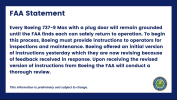
Every 737-9 MAX with a plug door will remain grounded until the FAA finds each can safely return to operation. To begin this process, Boeing must provide instructions to operators for inspections and maintenance. Boeing offered an initial version of instructions yesterday which they are now revising because of feedback received in response. Upon receiving the revised instructions from Boeing the FAA will conduct a thorough review.
The ball is now in Boeing's court, all eyes are on Boeing to provide revised instructions to the FAA and operators.
 

Attachments

  • Screenshot 2024-01-10 10.30.15.png
    Screenshot 2024-01-10 10.30.15.png
    929.7 KB · Views: 9

najaB

Veteran Member
Joined
28 Aug 2011
Messages
33,730
Location
Scotland
that strikes me as a reason to completely stop an aircraft until the cause is at least believed to be found.
Do you have access to the maintenance logs showing that they sent the aircraft back into service without believing they had found the cause?
 

Lost property

On Moderation
Joined
2 Jun 2016
Messages
739
With regard to the protection that being an inside plug provides, they open inwards. That they then fold* (in a sense), turn and are pushed out (equivalent to the Airbus overwing doors) is irrelevant to the type of door. The doors are wider than the aperture and so could not fall out due to the pressure, and as such I don't believe such an incident has ever occurred, certainly I never heard of one. The further protection this provides is that it makes it impossible to open one in flight (other than at very low altitudes).

* With a Boeing the internal plug folds slightly, with an Airbus two panels, top and bottom, move in, both of these being to allow the door to be turned slightly sideways and pushed out.

== Doublepost prevention - post automatically merged: ==


Are you saying that person's video on them, which appears to be by someone who really knows his stuff, is incorrect?


I believe the media reports were that the issue was not addressed, not that it had recurred. Recurrence is understandable, sending an aircraft out with pressurisation warnings of unknown cause does not to me seem appropriate, that strikes me as a reason to completely stop an aircraft until the cause is at least believed to be found.
I appreciate, that, many of you know each other and tend to be mutually supportive, BUT, I did not criticise the content of the video.

My comments were directed at the poster who implied, he mentions door handles, that, the systems on this particular model were applicable to other doors. Which, they most certainly, are not.

As others have pointed out, unless you have access to the maintenance logs, then there is no way of knowing what fault diagnosis / rectification took place. The term "not addressed " is misleading in many respects but nowhere near as defamatory as the poster who stated incompetence was evident.

You need to be aware, that, in this instance, possibly at least three signatures will have been required for the aircraft to subsequently fly. The engineer who carried out the rectification / the engineer who signed the "fit to fly " certification (the two may be different entities) and that of the Capt accepting the aircraft.

When you sign a Tech Log, irrespective of the regulatory authority involved, you are signing a legally binding document. In the UK, this is this A.N.O (Air Navigation Order) which is incorporated on the Statute book.

One contributor mentioned outflow valves. Their reliability has improved, significantly, since smoking was banned on aircraft. They used to "stick" with frequent regularity due to the accumulation of tar being vented through them.
 

YorkRailFan

Established Member
Joined
6 Sep 2023
Messages
3,430
Location
York
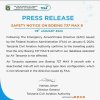
Following the Emergency Airworthiness Directive (EAD) issued by the Federal Aviation Administration (FAA) on January 6 2024, Tanzania Civil Aviation Authority confirms to the traveling public that the only Boeing 737-9 MAX aircraft in our database operated by Air Tanzania is not affected.

Air Tanzania operates one Boeing 737-9 MAX aircraft with a deactivated mid-aft exit non-plug type door configuration, which is not referenced in the directive issued by the FAA.
Air Tanzania might want to inspect the aircraft after the recent discovery of missing bolts despite the aircraft not using the door bolt.

== Doublepost prevention - post automatically merged: ==

Calhoun gave an interview to CNBC's Kelly Evans here. Seems to be out of his depth and on the verge of tears.
 

Attachments

  • Screenshot_20240111_113000_X.jpg
    Screenshot_20240111_113000_X.jpg
    191.9 KB · Views: 34
Last edited:

edwin_m

Veteran Member
Joined
21 Apr 2013
Messages
28,741
Location
Nottingham
Air Tanzania might want to inspect the aircraft after the recent discovery of missing bolts despite the aircraft not using the door bolt.
Have bolts been found to be loose or missing anywhere other than the plug door [discounting the presumably unrelated issue with the rudder control]? If bolts are missing here then do other bolts need to be checked? Right up to every bolt on every plane?
 

Towers

Established Member
Joined
30 Aug 2021
Messages
3,014
Location
UK
Have bolts been found to be loose or missing anywhere other than the plug door [discounting the presumably unrelated issue with the rudder control]? If bolts are missing here then do other bolts need to be checked? Right up to every bolt on every plane?
It’s beginning to sound that way, isn’t it? I don’t know much about the rudder issue, was that discovered as a result of some sort of routine maintenance or was there another “issue” somewhere?
 
Status
Not open for further replies.

Top