However I think mainland Scotland has a surplus of wind power, with a bottleneck in the grid between there and the English market, so it may be too early to rule out, say, an electrolysis plant at Inverness making hydrogen for trains to the Far North and Kyle.It won't (shouldn't) because of the shockingly poor round-trip efficiency if made from renewable energy, and because otherwise it is either made (using lots of power) from natural gas or is an industrial by-product from the fossil-fuel industry.
Its only real use is to mop up renewable electricity which would otherwise go to waste, such as on a distant Hebridean island where the power can't be exported...

-
Our new ticketing site is now live! Using either this or the original site (both powered by TrainSplit) helps support the running of the forum with every ticket purchase! Find out more and ask any questions/give us feedback in this thread!
You are using an out of date browser. It may not display this or other websites correctly.
You should upgrade or use an alternative browser.
You should upgrade or use an alternative browser.
Is Hydrogen dead as a power source for trains?
- Thread starter reddragon
- Start date
- Status
- Not open for further replies.
Sponsor Post - registered members do not see these adverts; click here to register, or click here to log in
R
RailUK Forums
N-S "Internal" interrconnectors are currently being built down both the Irish and North Seas to address this, I beleve.However I think mainland Scotland has a surplus of wind power, with a bottleneck in the grid between there and the English market, so it may be too early to rule out, say, an electrolysis plant at Inverness making hydrogen for trains to the Far North and Kyle.

HSTEd
Veteran Member
- Joined
- 14 Jul 2011
- Messages
- 20,344
Those interconnectors have a small fraction of the required capacity.N-S "Internal" interrconnectors are currently being built down both the Irish and North Seas to address this, I beleve.
Unfortunately, it has become essentially impossible to build high-capacity on-shore power links, and offshore power cables will never be able to move the tens of gigawatts that will be needed long term if Scottish wind is to make a significant contributor to the energy system.
Those interconnectors have a small fraction of the required capacity.
Unfortunately, it has become essentially impossible to build high-capacity on-shore power links, and offshore power cables will never be able to move the tens of gigawatts that will be needed long term if Scottish wind is to make a significant contributor to the energy system.
If you look at Wikipedia (https://en.wikipedia.org/wiki/List_of_electricity_interconnectors_in_the_United_Kingdom) you will see that we already have 7.3 GW of connector capacity, and to come, the NSeaLink to Norway at 1.4MW plus others adding up to another 9.1GW. How can that evidence allow you to claim that additional internal interconnectors can't make a difference? 2 or 3 to Scotland would make a big difference.
What really is missing (the elephant in the room) is the UK's lack of storage in the areas where we shall have power surpluses.
There are several big permitted HEP schemes in areas where there is plenty of RE but the Govt/the Grid are deliberately doing nothing about the fact that they are financially unviable because of the way the grid charges them for both importing and exporting power.
So you and I pay RE not to generate because the grid can't accept it, and we (and the planet) pay again for gas generation a bit later on when that stored RE would have been of use, and we pay a third time because that power is generated from gas (and diesel) at the peak rate when the grid is getting a bit short.
It's almost as if the system was designed to cost consumers as much as possible while hiding the real reasons.
HSTEd
Veteran Member
- Joined
- 14 Jul 2011
- Messages
- 20,344
Why are you including a link to Norway when I was referring to "internal interconnectors"?If you look at Wikipedia (https://en.wikipedia.org/wiki/List_of_electricity_interconnectors_in_the_United_Kingdom) you will see that we already have 7.3 GW of connector capacity, and to come, the NSeaLink to Norway at 1.4MW plus others adding up to another 9.1GW. How can that evidence allow you to claim that additional internal interconnectors can't make a difference? 2 or 3 to Scotland would make a big difference.
And the reality is, in a decarbonised energy system, we would expect peak system demands of over 150GW, absent heroic and unrealistic energy efficiency assumptions, and even then well over 100GW.
Compared to that 9GW is woefully insufficient in a renewable system.
Those schemes still represent a small fraction of what would be required, recent studies on this have implied many terrawatt-hours of storage would be required.What really is missing (the elephant in the room) is the UK's lack of storage in the areas where we shall have power surpluses.
There are several big permitted HEP schemes in areas where there is plenty of RE but the Govt/the Grid are deliberately doing nothing about the fact that they are financially unviable because of the way the grid charges them for both importing and exporting power.
Electricity storage is far too expensive and will remain so for the foreseeable future.
This is my field of employment at the moment, and the reality is we need several times as many interconnectors to make an all renewable system work, including tens of gigawatts of capacity to Scotland.
https://www.nationalgrideso.com/res...city-transmission-network/scottish-boundaries States the capacity at B6 which is the boundary between Scotland and England is 6.3GW.If you look at Wikipedia (https://en.wikipedia.org/wiki/List_of_electricity_interconnectors_in_the_United_Kingdom) you will see that we already have 7.3 GW of connector capacity, and to come, the NSeaLink to Norway at 1.4MW plus others adding up to another 9.1GW. How can that evidence allow you to claim that additional internal interconnectors can't make a difference? 2 or 3 to Scotland would make a big difference.
What really is missing (the elephant in the room) is the UK's lack of storage in the areas where we shall have power surpluses.
There are several big permitted HEP schemes in areas where there is plenty of RE but the Govt/the Grid are deliberately doing nothing about the fact that they are financially unviable because of the way the grid charges them for both importing and exporting power.
So you and I pay RE not to generate because the grid can't accept it, and we (and the planet) pay again for gas generation a bit later on when that stored RE would have been of use, and we pay a third time because that power is generated from gas (and diesel) at the peak rate when the grid is getting a bit short.
It's almost as if the system was designed to cost consumers as much as possible while hiding the real reasons.
Scottish Generation capacity could be 43GW by 2030. So you’re looking at providing several times the existing capacity to be able to make use of it.
If you look at Wikipedia (https://en.wikipedia.org/wiki/List_of_electricity_interconnectors_in_the_United_Kingdom) you will see that we already have 7.3 GW of connector capacity, and to come, the NSeaLink to Norway at 1.4MW plus others adding up to another 9.1GW. How can that evidence allow you to claim that additional internal interconnectors can't make a difference? 2 or 3 to Scotland would make a big difference.
The North Sea Link to Norway was commissioned nearly 2 years ago, and we have been largely importing Norwegian hydro power ever since.
The Viking Link to Denmark commissions later this year, with another 1.4GW available. Although I suspect we shall be exporting more there than we have to Norway.
National Grid is investing in ‘domestic’ interconnectors in the North Sea to get Scottish power to the south, but it will take a long time to bear fruit.
I can't argue with you there, as far as physics is concerned. As you say, batteries could be charged using 'islands' of electrification (indeed, later in the post which you quoted I suggested that the Cambrian could be wired between Shrewsbury and Dovey Junction, "which might put Pwllheli within battery range of the wires"). What I didn't say, but have also had in mind for a while, if a train couldn't make it from Dovey to Pwllheli and back on batteries alone, you could also have an 'island' of OHLE somewhere in between (such as Barmouth to Harlech). The physics of doing something like that make sense.Not so. Absolutely no reason why units with, say, a 70km battery range couldn’t be charged on short islands of electrification en route. Just like is being done elsewhere in Wales.
If hydrogen gets any serious main line application on the passenger railway, it will be because of politics, not economics (or physics).
However, I suspect economics did play a part in the fact the TDNS does recommend hydrogend trains in (very) limited cases. Those 'islands' of electrification cost money and, certainly in the case of the Heart Of Wales Line (HOWL), the low frequency means the benefits are small (not many trains to benefit from a technically better solution = not many benefits) and therefore the cost:benefit ratio fails to stack up. Add in the fact that a larger fleet of trains that can be maintained together etc. gives eccomonies of scale (vs a micro fleet for the HOWL) and the Cambrian gets lumped in with the Heart Of Wales with a shared fleet of hydrogen trains. Just my guess.
There's also another factor to consider alongside politics, economics and physics - that of time (and the capacity of the railway/construction/engineering industries to electrify lines (or parts thereof)). The TDNS looked at decarbonisation 'pathways' ending in 2040, 2050 and 2061 - even the slowest (which would have only delivered an 80% cut in emissions rather than a net-zero railway) required an average rate of 259 Single Track Kilometres per year. Even if 'islands' of electrification on the HOWL were the ideal solution in every way, the lack of progress with the higher-priority electrification schemes may mean an interim on-train solution (hydrogen) is required for the quieter routes while the nation catches up on its infrustructure backlog.
Last edited:
because they illustrate how interconnectors are getting bigger all the time, and because (until this hot dry summer) Norway was acting as pumped storage for us, having repurposed one of its HEP plants (p.s. and I meant to say that we quite often see inward and outward international flows at the same time, whether for just moving power because of need or because an opportunity has been spotted for a bit of arbitrage we shall never know... Websites like https://gridwatch.co.uk/ often show simultaneous inward and outward flows.)Why are you including a link to Norway when I was referring to "internal interconnectors"?
but 9GW is not the limit - and much more will be available before any more railway gets wiredAnd the reality is, in a decarbonised energy system, we would expect peak system demands of over 150GW, absent heroic and unrealistic energy efficiency assumptions, and even then well over 100GW.
Compared to that 9GW is woefully insufficient in a renewable system.
You seem very keen to dismiss storage. Decentralised storage (a few 10s of kWhr in each house) would be - already is - a very effective way of taking power out of the network when it is in surplus and also peak-shaving which also cuts the flows needed.Those schemes still represent a small fraction of what would be required, recent studies on this have implied many terrawatt-hours of storage would be required.
Electricity storage is far too expensive and will remain so for the foreseeable future.
This is my field of employment at the moment, and the reality is we need several times as many interconnectors to make an all renewable system work, including tens of gigawatts of capacity to Scotland.
By coincidence I received this today: (https://octopus.energy/press/smarte...new-smart-tariff-to-unlock-solar-and-storage/)
‘Intelligent Octopus Flux’ (IOF) offers the same rate for both importing and exporting electricity, with a 21-hour off peak window priced 10% below Octopus Energy’s standard variable tariff ‘Flexible Octopus’ and a three-hour ‘peak’ window between 4pm and 7pm*.
Customers on IOF will be able to save more than £450 a year compared to customers on ‘Flexible Octopus’ and its fixed export tariff ‘Octopus Outgoing’.
The combo import-export tariff is available to new and existing customers who have solar panels and eligible batteries installed in their homes.
This next generation tariff is powered by Kraken, Octopus’ proprietary tech platform, and optimises a home’s batteries and solar panels to better use green electrons when they are abundant and cheap. Until now, solar and battery owners had to manually programme their tech to charge and discharge. IOF removes this hassle – allowing customers to automatically receive the best rates for both the power they use (import) and the power they sell back (export) to the grid.
Octopus has been a pioneer of smart tariffs for several years. It offers a range of different smart tariffs to suit customers’ homes and engagement with their energy use, all of which help to unlock the benefits of a renewable grid.
In 2022, the UK spent £215 million on turning wind farms off, and over £715 million on turning on gas power plants**.
Improving grid flexibility through tariffs like IOF reduces the need for National Grid to pay renewable energy generators to switch off and fossil fuel power plants to switch on when the grid is under stress. This will help reduce everyone’s bills as these costs are paid for by all energy consumers.
Last edited:
A major new link to Hinkley Point is under construction right now, on shore, and above groundUnfortunately, it has become essentially impossible to build high-capacity on-shore power links, and offshore power cables will never be able to move the tens of gigawatts that will be needed long term if Scottish wind is to make a significant contributor to the energy system.

GRALISTAIR
Established Member
sadly, it was always thus.If hydrogen gets any serious main line application on the passenger railway, it will be because of politics, not economics (or physics).
Maybe. I know Germany has become severely down on hydrogen. Other countries are still pressing ahead, and whether or not that's for primarily political reasons something like the TDNS has to be written with one eye on politics.I’m reasonably sure that if the TDNS was being written today, it would be dismissive of hydrogen. Things have changed rather rapidly on that front.
HSTEd
Veteran Member
- Joined
- 14 Jul 2011
- Messages
- 20,344
And it has taken well over a decade to get it built, through terrain much less beloved of NIMBYs than the Scottish borders.A major new link to Hinkley Point is under construction right now, on shore, and above ground
Noone will ever get permission for another pylon line or four through the Scottish borders, hence the billions being blown on offshore HVDC.
Invincible
Member
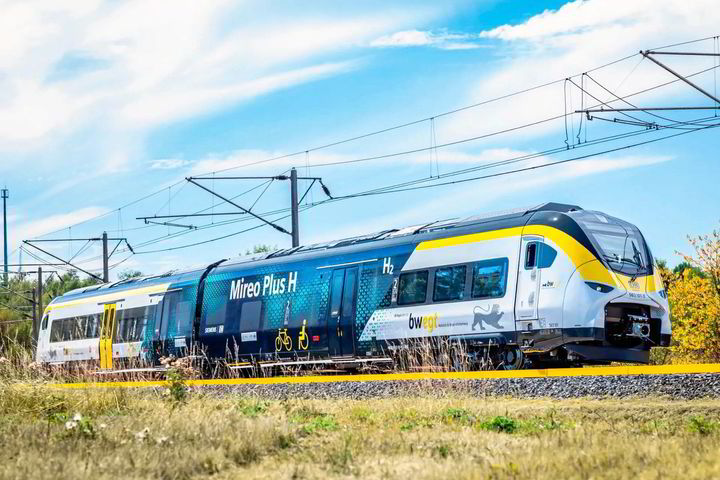
'A waste of taxpayer’s money' | German passenger group slams hydrogen trains as a distraction from need to electrify
Call to back direct electrification and batteries comes as Bavaria prepares first test run of H2 train
 www.hydrogeninsight.com

AlastairFraser
Established Member
- Joined
- 12 Aug 2018
- Messages
- 4,162
So electrification islands at Newtown, Machynlleth, Aberystwyth and Pwllheli would be a decent plan?Not so. Absolutely no reason why units with, say, a 70km battery range couldn’t be charged on short islands of electrification en route. Just like is being done elsewhere in Wales.
If hydrogen gets any serious main line application on the passenger railway, it will be because of politics, not economics (or physics).
Longer charging at Pwllheli and Aberystwyth to charge the full battery and 5 mins at the other stations.
So electrification islands at Newtown, Machynlleth, Aberystwyth and Pwllheli would be a decent plan?
Longer charging at Pwllheli and Aberystwyth to charge the full battery and 5 mins at the other stations.
wherever it’s easiest to stick a container full of batteries and a short stretch of OLE.
mike57
Established Member
Have removeable and replaceable batteries for rolling stock been considered, something similar in outline to a mini container, with an automated lifting and placing system. A fully charged battery could then be swapped in. Quick than trying to partial charge. Flat battery can be recharged ready for the next service. On busier routes have a buffer of 2 or more so that there is time to recharge to full.wherever it’s easiest to stick a container full of batteries and a short stretch of OLE.
AlastairFraser
Established Member
- Joined
- 12 Aug 2018
- Messages
- 4,162
The kit would be very, very expensive and Vivarail's Fast Charge battery tech is a lot cheaper to install and constantly charging batteries to full shortens battery service life.Have removeable and replaceable batteries for rolling stock been considered, something similar in outline to a mini container, with an automated lifting and placing system. A fully charged battery could then be swapped in. Quick than trying to partial charge. Flat battery can be recharged ready for the next service. On busier routes have a buffer of 2 or more so that there is time to recharge to full.
== Doublepost prevention - post automatically merged: ==
Most likely in a developed area where electricity is available,no?wherever it’s easiest to stick a container full of batteries and a short stretch of OLE.

ac6000cw
Established Member
Well, yes, of course. But the UK is very 'developed' in reality (and even the parts that are fairly remote may have power distribution cables running through them).Most likely in a developed area where electricity is available,no?
The 'container full of batteries and a short stretch of OLE' could be the 21st century equivalent of pausing at the water tower and 'putting the bag in' to replenish steam loco water tanks
 .
.
AlastairFraser
Established Member
- Joined
- 12 Aug 2018
- Messages
- 4,162
Well, yes, of course. But the UK is very 'developed' in reality (and even the parts that are fairly remote may have power distribution cables running through them).
The 'container full of batteries and a short stretch of OLE' could be the 21st century equivalent of pausing at the water tower and 'putting the bag in' to replenish steam loco water tanks

Yes, but we do have issues in some areas with scarcity of suitable OHLE feeds e.g. the ECML north of Newcastle, and I'd say that part of Mid Wales may be one of them.
With lines like the Conwy Valley, it's less of an issue, because of the industry in Blaenau Ffestiniog and the extant HVDC power lines to the former Trawsfynydd power station.
ac6000cw
Established Member
Yes, but that's about being able to supply considerable peak power loads (multiple long trains running at high speed) directly from the grid supply, rather than supplying the much lower power needed to comparatively slowly re-charge the 'container full of batteries' in-between trains (and overnight). Then the peak 'top up the train for 5 minutes' power loads are supplied from the container batteries.but we do have issues in some areas with scarcity of suitable OHLE feeds e.g. the ECML north of Newcastle,
This why it's the same basic idea as the wayside water tower - that gets filled slowly from whatever river, stream or borehole is nearby, then periodically a portion of the water in it is dumped at high speed via a fat pipe into another water tank on the train.
Last edited:
AlastairFraser
Established Member
- Joined
- 12 Aug 2018
- Messages
- 4,162
Perhaps it'll be a good idea, it's a good 20-30 years away anyway given TfW have just bought a new diesel fleet for the line.Yes, but that's about being able to supply considerable peak power loads (multiple long trains running at high speed) directly from the grid supply, rather than supplying the much lower power needed to comparatively slowly re-charge the 'container full of batteries' in-between trains (and overnight). Then the peak 'top up the train for 5 minutes' power loads are supplied from the container batteries.
Is the power available in the right places, and wouldn’t they be quite long ’short sections’?Not so. Absolutely no reason why units with, say, a 70km battery range couldn’t be charged on short islands of electrification en route. Just like is being done elsewhere in Wales.
.
A positive is that the stretch will only be single track.
Those diesels don’t have to stay there - there will be older diesels elsewhere for them to replace.Perhaps it'll be a good idea, it's a good 20-30 years away anyway given TfW have just bought a new diesel fleet for the line.
Is the power available in the right places, and wouldn’t they be quite long ’short sections’?
I don’t know, but 1) almost certainly, and 2) depends on what you mean by long. A few km should do it.
AlastairFraser
Established Member
- Joined
- 12 Aug 2018
- Messages
- 4,162
Yes, but the Welsh Government only have a limited investment fund for the railways and it is likely that the significant investment needed for a more comprehensive Welsh electrification plan would not be available, unless the WG were to possibly receive significant Barnett consequential capital as a result of HS2.Those diesels don’t have to stay there - there will be older diesels elsewhere for them to replace.
At 60mph it’s going to be quite a few km surely?I don’t know, but 1) almost certainly, and 2) depends on what you mean by long. A few km should do it.
They may not get a choice if Birmingham/Manchester/Liverpool have got bi-modes and refuse to let diesels in any more.Yes, but the Welsh Government only have a limited investment fund for the railways and it is likely that the significant investment needed for a more comprehensive Welsh electrification plan would not be available, unless the WG were to possibly receive significant Barnett consequential capital as a result of HS2.
At 60mph it’s going to be quite a few km surely?
Between 2 stations will be enough.
AlastairFraser
Established Member
- Joined
- 12 Aug 2018
- Messages
- 4,162
They'd just shift the tri mode 756s from the South Wales regional.They may not get a choice if Birmingham/Manchester/Liverpool have got bi-modes and refuse to let diesels in any more.
Standing for 5 minutes at somewhere like Newtown (which although there are two platforms isn't where trains are normally booked to pass') would probably screw up the single-line occupation so that an hourly service is no longer possible without more double track. Longer islands, such as Machynlleth to Newtown, would make more sense to me.So electrification islands at Newtown, Machynlleth, Aberystwyth and Pwllheli would be a decent plan?
Longer charging at Pwllheli and Aberystwyth to charge the full battery and 5 mins at the other stations.
An interesting aside - just how quickly can the crew refill a steam loco's water tanks? I ask this because I've been looking at some working timetables for the Cardigan branch (which I understood required all tank engines to replenish water at Glogue and noticed that some trains were scheduled to stand for just one minute, or even not call at Glouge (which I understood was the only intermediate station on the branch with water available*) at all.it's the same basic idea as the wayside water tower - that gets filled slowly from whatever river, stream or borehole is nearby, then periodically a portion of the water in it is dumped at high speed via a fat pipe into another water tank on the train.
* although come to think of it there was once a loco shed at Llanfalteg - could you have a shed with no water tower?
While a new DMU fleet is intended to be deployed on the route, I would argue that it was not designed for the Cambrian. The class 197 looks like it was designed for the Castlefield corridor in a crazy world where the Government refuses to invest in electrification for the next 30 years. As such, it would be no big loss if the class 197s were diverted elsewhere (I suggest back to the CAF works near Newport, along with the 195s and possibly 196s, for convertion to battery-fitted class 331s (keeping the gangwayed fitted cabs on the 197/196 though) to keep the workforce there employed once assembly of the 197s is complete).Perhaps it'll be a good idea, it's a good 20-30 years away anyway given TfW have just bought a new diesel fleet for the line.
The tri-mode 756s are for the South (East) Wales Metro - NOT South Wales regional. As such - they (the class 756s) have more doors than the Greater Anglia FLIRTs (which are closer to being regional trains). Also, unit end gangways are rather important for the Cambrian services, since many westbound trains split at Machynlleth with portions for Aberystwyth and Pwllheli.They'd just shift the tri mode 756s from the South Wales regional.
- Status
- Not open for further replies.