Which day is 23:59:60, when we have one?But as 2400 is not a real time, surely 0000 is the same day as 0001?

-
Our new ticketing site is now live! Using either this or the original site (both powered by TrainSplit) helps support the running of the forum with every ticket purchase! Find out more and ask any questions/give us feedback in this thread!
You are using an out of date browser. It may not display this or other websites correctly.
You should upgrade or use an alternative browser.
You should upgrade or use an alternative browser.
Are trains deliberately never timetabled for precisely midnight?
- Thread starter Gaelan
- Start date
- Status
- Not open for further replies.
Sponsor Post - registered members do not see these adverts; click here to register, or click here to log in
R
RailUK Forums

Haywain
Veteran Member
- Joined
- 3 Feb 2013
- Messages
- 24,801
No, it finishes at 04:29 but starts at 00:01 the previous day.Doesn't the railway "day" start at 04:30 and not 00:00 though?
Oxfordblues
Member
- Joined
- 22 Dec 2013
- Messages
- 1,128
As Gladys Knight might have sung: "He's leaving ... on that treble-zero one train to Georgia...."
thenorthern
Established Member
- Joined
- 27 May 2013
- Messages
- 4,714
Depends on which bit of the railway… when you work a night shift (say 22:00 to 06:00) when would you say your day started?
I was thinking in terms of ticketing it ends at 04:29, for most companies though I suppose the day ends at the end of service and starts at the start of service.
Man_with_beard
Member
Looking through old national rail timetables from the 1970s, 80s and 90s I still can't find a single departure for 0000, and departure boards were manually operated in those days. Not using 00:00 could be down to just avoiding passenger confusion rather than thinking modern computer software is allergic to it.
Bletchleyite
Veteran Member
As Gladys Knight might have sung: "He's leaving ... on that treble-zero one train to Georgia...."
I seem to recall Anne announces 00something trains as "midnight N", e.g. "the midnight ten London Northwestern service to Northampton". You could just about cram "midnight-one" in!

Surreytraveller
On Moderation
- Joined
- 21 Oct 2009
- Messages
- 3,905
I've known rail replacement buses turn up 24 hours early because planners have used midnight.

Big Jumby 74
Established Member
From a very historical point of view, my timings colleagues (SR/SWD) never AFAIR used 2400/0000 as a timing reference once computers became involved, it was either 2359 or 0001. Most of my time was pen and paper so we used "a.m/p.m" which everyone (back then) understood.
The only instance of possible confusion with issued notices surrounded the BST/GMT changes, when, from a paper point of view 0300 was used as the changeover time reference, in my time at least. This was based around those services that were still planned to be moving on the ground at that hour, and in this case this related to only one train, 1B01, 0105 Waterloo to Southampton (aka: unofficially known amongst some of us as the 'vomit comet') which was due in to Southampton Central at 0252. The next planned movement in those days was the 0400 Guildford to Waterloo.
The only instance of possible confusion with issued notices surrounded the BST/GMT changes, when, from a paper point of view 0300 was used as the changeover time reference, in my time at least. This was based around those services that were still planned to be moving on the ground at that hour, and in this case this related to only one train, 1B01, 0105 Waterloo to Southampton (aka: unofficially known amongst some of us as the 'vomit comet') which was due in to Southampton Central at 0252. The next planned movement in those days was the 0400 Guildford to Waterloo.
Haywain
Veteran Member
- Joined
- 3 Feb 2013
- Messages
- 24,801
Did that run on Saturday nights?This was based around those services that were still planned to be moving on the ground at that hour, and in this case this related to only one train, 1B01, 0105 Waterloo to Southampton
zwk500
Veteran Member
There's a few more now on the Southern (not sure about the Wessex area) with Thameslink being a through-the-night operation. I've been shown the published intruction for one clock change (can't remember when), detailing which trains should be held and which should be allowed to run early to sertain points etc.The only instance of possible confusion with issued notices surrounded the BST/GMT changes, when, from a paper point of view 0300 was used as the changeover time reference, in my time at least. This was based around those services that were still planned to be moving on the ground at that hour, and in this case this related to only one train, 1B01, 0105 Waterloo to Southampton (aka: unofficially known amongst some of us as the 'vomit comet') which was due in to Southampton Central at 0252. The next planned movement in those days was the 0400 Guildford to Waterloo.

D6130
Established Member
When I was involved in train planning (1977-1983), the primitive punch card-operated binary timetable database systems could not cope with 00 00 timings. I was told this on a course at Webb House, Crewe in May 1982. As TOPS dates from before that date - and TRUST from not long afterwards - it doesn't surprise me that 00 00 is still not used for timetabled arrivals and departures.
Big Jumby 74
Established Member
Yes, if you assume 2400/0000 is the cut off point, in my day 1B01 ran Tuesday mornings to Sunday mornings, ie MX in railway speak (of the time). Due to planned engineering work it very rarely reached Southampton in my time, the often more usual termination point being Basingstoke with a bus forward.Did that run on Saturday nights?
Last edited:

Llanigraham
On Moderation
When I did my signalling course (at Leeds) we were told that 0000 did not exist and that we had to use either 2359 or 0001 in the TRB.
zwk500
Veteran Member
Out of interest, do engineering works items in the WON ever start at 0000? Most obviously start earlier than that anyway so it isn't a problem, but I can't remember if 0000 or 0001 was used when needed.

Annetts key
Established Member
Shame then that lots of computerised equipment such as (some) Train Describer systems, (some) remote control systems (Time Division Multiplexers -TDM), computer based interlockings, remote condition monitoring (RCM), level crossing clocks (that control the loud/reduced sound output of the Yodal alarms), some HABD systems and various other equipment all do use 00:00 as a valid timeWhen I did my signalling course (at Leeds) we were told that 0000 did not exist and that we had to use either 2359 or 0001 in the TRB.
I can’t say that I can remember having seen either 00:00 or 00:01, as most either start before midnight, typically at or before 23:40. Or they start sometime after midnight, such as 00:30 or maybe later.Out of interest, do engineering works items in the WON ever start at 0000? Most obviously start earlier than that anyway so it isn't a problem, but I can't remember if 0000 or 0001 was used when needed.
But then, most shifts that I worked started hours before midnight, so it would not be memorable.
Certainly, at least one proposed roster (from the company side) that I have seen included some shifts that started at 00:00. And such a shift is considered as starting on the day after 23:59.

75A
Established Member
Two years running I was rostered @ 00:01 on Boxing Day morning in the 1980's.Certainly, at least one proposed roster (from the company side) that I have seen included some shifts that started at 00:00. And such a shift is considered as starting on the day after 23:59.
The Planner
Veteran Member
- Joined
- 15 Apr 2008
- Messages
- 19,718
0001Out of interest, do engineering works items in the WON ever start at 0000? Most obviously start earlier than that anyway so it isn't a problem, but I can't remember if 0000 or 0001 was used when needed.
Lewisham2221
Established Member
Whilst it causes less of a problem Mon-Fri, planning a journey for around midnight on Friday night would quite quickly get confusing if 2400 wasn't used. It ensures it ends up at the correct "end" of a timetable (I.e at the end of the day, rather than the beginning). I can't imagine many people planning their journey home on a "Friday" night are going to instinctively consult the Saturday timetable.I really don’t understand how people can have such difficultly. 23:59:59 is the last second of a (24 hour) day. 00:00:00 is the start of a (24 hour) day. Hence if you don’t include the seconds, 23:59 is the last minute of the day and 00:00 is still the start of the next day.
Hence 23:59 on Monday ticks over to 00:00 on Tuesday.
People don’t get confused when watching their own digital clocks or watches…

The problem is that 2400 day 1 and 0000 day 2 are the same time, which the human brain can probably cope with but other systems can't. 2359 and 0001 are unambiguous.Whilst it causes less of a problem Mon-Fri, planning a journey for around midnight on Friday night would quite quickly get confusing if 2400 wasn't used. It ensures it ends up at the correct "end" of a timetable (I.e at the end of the day, rather than the beginning). I can't imagine many people planning their journey home on a "Friday" night are going to instinctively consult the Saturday timetable.
I seem to rember from doing some timetable work for TUL fifteen years ago that their traffic day started & ended at 03:00 so it midnight wouldn't be an issue for them. (I don't know if this is still the case or what the effect of Night Tube is.)

splashoutradio
Member
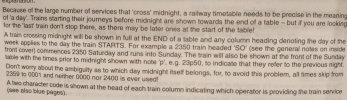
Like others have said, I can recall recall a note was printed in the older editions of the National Rail Timetable (NRT). Unfortunately I've not been able to find this, but have come across a paragraph printed in the NRT from around the year 2000 until production in the printed form was ceased.
Attachments

miklcct
Established Member
There's a few more now on the Southern (not sure about the Wessex area) with Thameslink being a through-the-night operation. I've been shown the published intruction for one clock change (can't remember when), detailing which trains should be held and which should be allowed to run early to sertain points etc.
Why don't just align the biannual timetable change with the clock change to avoid this problem?
Computer systems generally represent times as UNIX timestamps internally, which don't have this problem.The problem is that 2400 day 1 and 0000 day 2 are the same time, which the human brain can probably cope with but other systems can't. 2359 and 0001 are unambiguous.
zwk500
Veteran Member
It doesn't really solve the problem though, because the trains would still be in flight.Why don't just align the biannual timetable change with the clock change to avoid this problem?
Also we align the timetable changes with Europe.

UNIX timestamps aren’t really suitable for railway timetables, as they inherently encode both a date and time, whereas timetable times don’t have a date (because they represent a general pattern that applies on multiple days).Computer systems generally represent times as UNIX timestamps internally, which don't have this problem.


brad465
Veteran Member
In a way it's a shame there isn't a 00:00 timed departure as it would be interesting to hear how an automated announcement pronounces it. "O, O, hundred" would sound odd I think.
- Status
- Not open for further replies.