westcoaster
Established Member
Is that really necessary here?
I do not see the issue, it's within there remit is it not. Or do you mean talking about the raib.

Is that really necessary here?
No more of a possibility than two vehicles separating at the BSI coupler between two (previously) coupled units, surely? Quite a few 15x units have bar couplings between the vehicles now in any case - had this formed part of the work done at Brush?As someone who's qualified on 156, were taught that this is a possibility due to the inter-vehicle coupling being the BSI. I've seen a video on Facebook where the vehicle on the left continued onto the left with the right vehicle stationary after Train Wire 4 was broken, throwing the brakes onto the rear vehicle. But still quite concerning as we'll be getting 158's up at Newcastle soon! Looks like it was on the Up Main too which they've had a possession on some nights this week recently for ballast renewal. Coincidence?

"We are never ever ever getting back together"

As a point of order, in the second example given above, train wire 4 breaking should've applied the brakes on the leading portion (unless the EBS had been raised, in which case it'd have no effect). The loss of train wires 23/24 (?) would've applied the brakes on the rear portion in either case.

No more of a possibility than two vehicles separating at the BSI coupler between two (previously) coupled units, surely? Quite a few 15x units have bar couplings between the vehicles now in any case.

a thought not far from a consideration of the tightest left-hand curve a few hundred meters before, on the approach to the King Edward Bridge. (Curves which ~20 years ago, notoriously prevented the Eurostar sets reaching Newcastle or beyond as anticipated.)That's probably the tightest right-hand curve it will have been round since leaving Loughborough. . . . .
Off topic really, but there's a bit of detail in this RAIB report. Train wires 23 and 24 'repeat' the state of the brake controller along the length of the train, 25 is additionally de-energised when the brake controller is placed to emergency (but this shouldn't result in a further increase in brake cylinder pressure). Losing both of 23 and 24, or 25 on its own, should result in a brake application on the rear portion (but not the leading portion where they're still energised?). Losing train wire 4 will initiate a brake application on the leading portion (as long as the EBS isn't raised).I thought brakes were wires 10/11/12 on a 15x?
Yes, presumably with a bit of extra work because the BSI coupler between vehicles doesn't have the electrical and air connections, only the mechanical bit (there is a separate main res connection and jumper cables for the electrical signals). Are there still hybrid units in service? The move to bar couplings on the 15x fleet is relatively recent, and I'm not sure how widespread it is yet.What about the hybrid 158's? Woundn't the redundant cab and extra car be connected by BSI couplings?
Off topic really, but there's a bit of detail in this RAIB report. Train wires 23 and 24 'repeat' the state of the brake controller along the length of the train, 25 is additionally de-energised when the brake controller is placed to emergency (but this shouldn't result in a further increase in brake cylinder pressure). Losing both of 23 and 24, or 25 on its own, should result in a brake application on the rear portion (but not the leading portion where they're still energised?). Losing train wire 4 will initiate a brake application on the leading portion (as long as the EBS isn't raised).
I do not see the issue, it's within there remit is it not. Or do you mean talking about the raib.
Train division is classified as an accident in the rulebook (along with fire, derailment and collision) - the highest classification of an incident. Therefore is a serious issue that will be investigated by the RAIB.
I don't often comment on technical railway matters, but as a regular at Newcastle station, this was my first thought:-a thought not far from a consideration of the tightest left-hand curve a few hundred meters before, on the approach to the King Edward Bridge. (Curves which ~20 years ago, notoriously prevented the Eurostar sets reaching Newcastle or beyond as anticipated.)

Train division is classified as an accident in the rulebook (along with fire, derailment and collision) - the highest classification of an incident. Therefore is a serious issue that will be investigated by the RAIB.
Train division is classified as an accident in the rulebook (along with fire, derailment and collision) - the highest classification of an incident. Therefore is a serious issue that will be investigated by the RAIB.
Anyone care to explain what happened here? Haha
Anyway, a quick look on Scot-Rail.co.uk confirms that this was indeed the move from Loughborough. It is indeed only 156s that go from Newcastle to Carlisle.
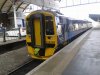
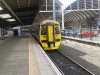
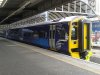
Identified as 158789. I understand some units have been going to Loughborough for internal refurbishment.
Yes, presumably with a bit of extra work because the BSI coupler between vehicles doesn't have the electrical and air connections, only the mechanical bit (there is a separate main res connection and jumper cables for the electrical signals). Are there still hybrid units in service? The move to bar couplings on the 15x fleet is relatively recent, and I'm not sure how widespread it is yet.


Well, the front fell off.
[youtube]3m5qxZm_JqM[/youtube]


Still on P1 at Newcastle as of today (Sat 20th May)
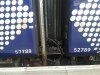
Image of coupler - Taken from station platform I might add as a disclaimer!
That joke last saw the light of day when that 455 came apart at Battersea two years ago...
What was the cause?
Quite rightly so. If nothing else, if a passenger had been crossing between coaches at the time it happened they could well have been killed or seriously injured by falling out of the train.