Okay, So I have compiled passenger data of scheduled flights from all UK airports that have scheduled flights to Heathrow and compared them to Amsterdam for the last 10 years (2002-2011). I have also included Dubai, with data from all UK destinations.
Top Left Graph 1, Top Right Graph 2, Bottom Left Graph 3, Bottom Right Graph 4 - Own Work
Right, so what do these graphs show us. In graph 1, we can see a clear trend, a decrease in the number of passengers flying domestic routes. However, looking at the most drastic losses, Manchester and Edinburgh once the passenger numbers begin to fall to Heathrow, they begin to rise to Amsterdam. This link cannot be proved with these graphs alone, however it is well known that Amsterdam and other airports such as Frankfurt, Munich, Istanbul, Madrid, Paris and Zurich all take business away from Heathrow,
http://www.independent.co.uk/news/u...ecret-plot-to-build-third-runway-7584591.html .
Now unlike Heathrow's data, which shows mainly trends of decreasing passenger numbers, the airports that serve both Amsterdam and Heathrow show for stable passenger numbers. All these airports for the period of 2010/2011 showed growth in passenger numbers. This suggests more people are flying to Amsterdam and that the numbers will increase in the future. Is this a case of many people wishing to visit the city itself or are people transferring through Schipol to onward destinations. No doubt a large number of tourists visit Amsterdam each year, but many people flying from UK to AMS are for connecting flights.
Graph 4 shows the passenger data of people flying to Dubai from all UK destinations served. This no doubt proves that people are flying through other airports in large numbers and connecting to onward destinations. All the routes are showing signs of growth and as Emirates, the airline of UAE, presses ahead on a very vigorous expansion plan, you can expect to see many thousands more flying through Dubai each year.
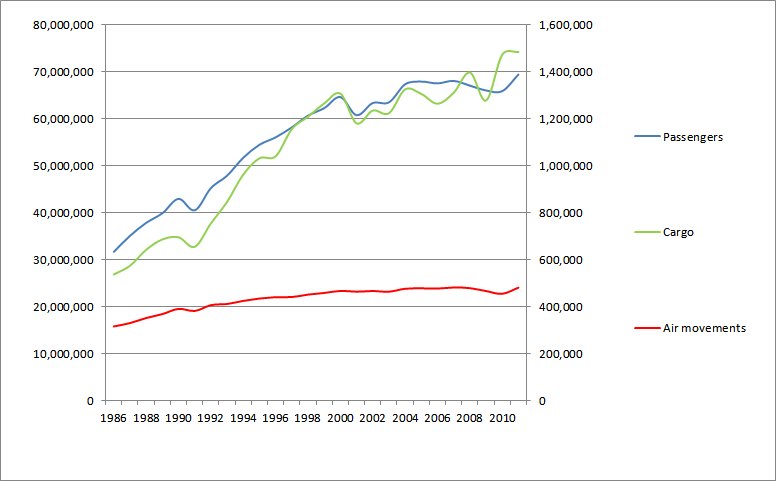
Graph 5, Wikipedia.org
air travel demand is falling
This is one of the most ridiculous statements I have ever seen. This is not true at all. Demand is constantly increasing, and graph 5 demonstrates this. The number of passengers flown from Heathrow has been continuously increasing and it is only the past few years it has begun to slow down. Mainly due to the economic conditions we are in, but the amount of capacity available is now null. And so for the time being, Heathrow is at its peak. I agree, yes, unless a third runway is approved, then demand for flights from Heathrow will begin to decrease, as more people will begin to transfer through the hub airports around the world as mentioned. How will this be achieved. Numerous daily flights from airports around the UK to those hub airports. What will this do, move jobs and wealth to other countries.
That is what this all boils down to. As stated by HH, airports lead to masses of amounts of direct and indirect employment. If you have 100,000 people wanting to travel from Manchester to Xiamen each year for example (an airport not served directly from Heathrow). At present the only option is to fly to Amsterdam and then onwards to Xiamen. When booking, more likely than not using a site like Expedia or Skyscanner, people will select there flights. Now more often than not in this case, the airline would be KLM for both legs. So for those 100,000 people each year, paying say on average £500 for a one way flight, £50million is leaving the British economy and going into the Dutch. This also then creates jobs in Amsterdam and further strengthening their economy.
Now, if there was more slots at Heathrow, routes to Xiamen direct would then become available. In this instance, British Airways start the route. And so those 100,000 people who would previously of flown via AMS now can fly via LHR. Granted, may will still choose to fly via AMS, but the vast majority would route through Heathrow on BA. This then keeps that money being spent on air fares in the British economy as it is being paid to a British company. It also creates British jobs as BA will need pilots, crew, ground crew and more jobs at the airport in security, duty free, bars and so on are created. Not only does this have direct job creation, it also creates jobs during the construction phase and can lead to new business being made with the Xiamen region and London meaning more jobs. More jobs, more money.
Map, Gcmap.com
Code:
			Train			Plane
Method	via	Leave	Dep	Arr	Checkin	Dep	Arr	Price	Journey Time	Distance
Air	via LHR	16:53		-	17:05	19:25	15:20+1	£951	16:07	9831km
	via AMS	11:23		-	11:35	13:35	09:35+1	£803	16:12	9705km
	via DXB	18:48		-	19:00	21:00	18:10+1	£486	17:22	10571km
Train	via LHR	16:00	16:15	19:31	20:05	22:05	15:20+1	£932	17:30	9831km
This final part shows the journey from Barlow Moor in Manchester to Bangkok in two weeks time, via Air through LHR, AMS and DXB and also rail via LHR.
A third runway would allow for British Airways to reduce fares on existing flights as more capacity is available and more capacity leads to more competition. As such, the flight from Heathrow I believe could be around 600 if a third runway existed.
As great as rail is, I cannot see it leading to the end of domestic air travel. Journey times and hassle just make it an unattractive option. As shown above, MAN-LHR-BKK takes an hour and a half longer if doing the MAN-LHR leg on train. That also means a change of train is required twice, all to save around £20. It is far more hassle dragging your baggage on and off of trains down the length of the country and checking in at Heathrow, which can be hell on earth at times, when you could simple check them in at Manchester, a great amount less stressful and then not have to worry about your bags again until you arrive in Bangkok.
Unlike many on here, I have an aviation background and have been involved with the industry for little over 10 years now, as such my views may seem a little biased. But there is no other option than to build a third runway at Heathrow.