How many couldn't read when railways were first developed? Most could count though.
How many still can't today?!

How many couldn't read when railways were first developed? Most could count though.
This is similar for New Cross, where letters were used instead of numbers to stop people getting confused between New Cross and New Cross Gate (which uses numbers).
However, I speak from experience when I say that this hasn't helped. The number of confused people who I have seen alight at New Cross from the Overground and think they're at New Cross Gate is brilliant.
Don't think Platform 0 had been thought of 40 years ago, or maybe LT objected! Seriously, renumbering platforms is always going to confuse. Altering by 3-4, as at Leeds and York, isn't too bad, but altering by 1 seems to be avoided like the plague.Fair enough, though it still seems strange they renumbered it with letters rather than numbers.
The confusing platform/track thing is standard across PL, CZ and SK, but the very high numbers I've only come across in Germany.View attachment 54071 Gdansk has Island platforms 1 and 2... with tracks 2 and 4, and 1 and 3 at them respectively! The suburban trains go from lines 501 and 502 from Platform 3...

Don't think Platform 0 had been thought of 40 years ago, or maybe LT objected! Seriously, renumbering platforms is always going to confuse. Altering by 3-4, as at Leeds and York, isn't too bad, but altering by 1 seems to be avoided like the plague.
Another odd one was Bromley South, where until 1959 1 and 2 were down, 3 and 4 up, opposite to the stations either side - when the present arrangement of lines paired by use was brought it, the numbers were reversed. Or so I was told.

Perhaps it's simply that "the railway" likes numbers? Locos have numbers, carriages & wagons have numbers, traincrew diagrams have numbers and in many places even the signalboxes have numbers!
(Yes, I know that a tiny number of locos were lettered, but ...)

As I already alluded to, this is why we have the phonetic alphabet. Numbers can sound similar too, especially in the tens, but if you say platform Charlie or Bravo...On a slightly more serious note, two thoughts:
1. People generally find a numerical sequence easier and quicker than an alphabetical sequence, and can probably "place" two numbers in relation to each other more readily than two letters. How close are 5 and 8 - three, easy. How close are E and H ... er ... [personally I find myself having to run through the alphabet in my head].
2. Numbers are more distinctive to the ear than letters (especially lower in the range). One, two, three, four, five, six are all very distinctive. B, C, D, E, G all sound similar (apart, obviously, from the opening consonantal sound). So less chance of aural confusion.
"Did you say Platform C?"
"No, platform B."
"Oh, platform D ..."
Now try that conversation with 3, 2 and 4 instead.
4 & 5 (& 6) is area A. Platform 3 is also accessible from that area.Those are "waiting areas" - i.e go to waiting area B if your train is from the platforms at the far end (4 & 5?)
Letter suffixes the long-held standard way of doing it anyway, no?recently some of the platform signs have been changed to (eg) 1A and 1B - presumably because trains have a habit of being stacked up and front train and back train wasn’t the best way of organising it, especially if English wasn’t your first language.
You are limited to 26 platforms per station if you use letters
Any station big enough to have "platform hotel" would create even more confusion.As for the phonetic alphabet - how many people know it? Certainly fewer than the latin alphabet and basic numbers. "I couldn't find a platform called Delta, only A,B,C and D".

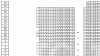
Theatres with more than 26 rows (or less if they omit I and O to avoid confusion) often use double letters at the rear. The attached image shows the seating plans of the rear stalls of a theatre going upto row NN.
[I appreciate that this would not be a good idea in a rail context]
Echoing the previous two posts, at the football stadium I frequent the rows are lettered rather than numbered - A at the front and working backwards, after row Z is Row AA, BB,CC etc, so the problem is not insurmountable. But do you use I and O or leave them out as them might be confused with 1 and 0?You are limited to 26 platforms per station if you use letters.
But do you use I and O or leave them out as them might be confused with 1 and 0?
Good point - very true but something I had never realised till you pointed it out. Same goes for trains, more seats in a carriage (numbers) than carriages in a train (letters).The theatre I referenced above does not use rows I or O (row II is missing from the seating plan attached).
Theatres and stadia tend to have lots of seats in a row but they have relatively few long rows for their seating capacity so it is less confusing to use letters for the rows and numbers for the seats in each row. Aircraft are the opposite, being long and thin, so they number their rows and use letters for the seats.