• Our new ticketing site is now live! Using either this or the original site (both powered by TrainSplit) helps support the running of the forum with every ticket purchase! Find out more and ask any questions/give us feedback in this thread!

Why platform numbers not letters

Status
Not open for further replies.
Sponsor Post - registered members do not see these adverts; click here to register, or click here to log in
R

RailUK Forums

LLivery

Established Member
Joined
13 Jul 2014
Messages
1,711
Location
Southeastern land
This is similar for New Cross, where letters were used instead of numbers to stop people getting confused between New Cross and New Cross Gate (which uses numbers).
However, I speak from experience when I say that this hasn't helped. The number of confused people who I have seen alight at New Cross from the Overground and think they're at New Cross Gate is brilliant.

NXG should've never had that name in the first place. Hatcham made more sense.
 

30907

Veteran Member
Joined
30 Sep 2012
Messages
21,937
Location
Airedale
Fair enough, though it still seems strange they renumbered it with letters rather than numbers.
Don't think Platform 0 had been thought of 40 years ago, or maybe LT objected! Seriously, renumbering platforms is always going to confuse. Altering by 3-4, as at Leeds and York, isn't too bad, but altering by 1 seems to be avoided like the plague.
Another odd one was Bromley South, where until 1959 1 and 2 were down, 3 and 4 up, opposite to the stations either side - when the present arrangement of lines paired by use was brought it, the numbers were reversed. Or so I was told.
 

30907

Veteran Member
Joined
30 Sep 2012
Messages
21,937
Location
Airedale
View attachment 54071 Gdansk has Island platforms 1 and 2... with tracks 2 and 4, and 1 and 3 at them respectively! The suburban trains go from lines 501 and 502 from Platform 3...
The confusing platform/track thing is standard across PL, CZ and SK, but the very high numbers I've only come across in Germany.
 

6Gman

Established Member
Joined
1 May 2012
Messages
9,194
Perhaps it's simply that "the railway" likes numbers? Locos have numbers, carriages & wagons have numbers, traincrew diagrams have numbers and in many places even the signalboxes have numbers!

(Yes, I know that a tiny number of locos were lettered, but ...)
 

6Gman

Established Member
Joined
1 May 2012
Messages
9,194
On a slightly more serious note, two thoughts:

1. People generally find a numerical sequence easier and quicker than an alphabetical sequence, and can probably "place" two numbers in relation to each other more readily than two letters. How close are 5 and 8 - three, easy. How close are E and H ... er ... [personally I find myself having to run through the alphabet in my head].

2. Numbers are more distinctive to the ear than letters (especially lower in the range). One, two, three, four, five, six are all very distinctive. B, C, D, E, G all sound similar (apart, obviously, from the opening consonantal sound). So less chance of aural confusion.

"Did you say Platform C?"
"No, platform B."
"Oh, platform D ..."

Now try that conversation with 3, 2 and 4 instead.
 

hexagon789

Veteran Member
Joined
2 Sep 2016
Messages
18,287
Location
Glasgow
Don't think Platform 0 had been thought of 40 years ago, or maybe LT objected! Seriously, renumbering platforms is always going to confuse. Altering by 3-4, as at Leeds and York, isn't too bad, but altering by 1 seems to be avoided like the plague.
Another odd one was Bromley South, where until 1959 1 and 2 were down, 3 and 4 up, opposite to the stations either side - when the present arrangement of lines paired by use was brought it, the numbers were reversed. Or so I was told.

In a ideal world I'd number everything working away from the main station entrance/building. So 1 would be closest, higher numbers further away.
 

krus_aragon

Established Member
Joined
10 Jun 2009
Messages
6,105
Location
North Wales
Perhaps it's simply that "the railway" likes numbers? Locos have numbers, carriages & wagons have numbers, traincrew diagrams have numbers and in many places even the signalboxes have numbers!

(Yes, I know that a tiny number of locos were lettered, but ...)

That is a very insightful post. Any railway of significant size would have had to start numbering its locomotives and rolling stock long before they'd have to start labelling their platforms.
 

Mordac

Established Member
Joined
5 Mar 2016
Messages
2,386
Location
Birmingham
On a slightly more serious note, two thoughts:

1. People generally find a numerical sequence easier and quicker than an alphabetical sequence, and can probably "place" two numbers in relation to each other more readily than two letters. How close are 5 and 8 - three, easy. How close are E and H ... er ... [personally I find myself having to run through the alphabet in my head].

2. Numbers are more distinctive to the ear than letters (especially lower in the range). One, two, three, four, five, six are all very distinctive. B, C, D, E, G all sound similar (apart, obviously, from the opening consonantal sound). So less chance of aural confusion.

"Did you say Platform C?"
"No, platform B."
"Oh, platform D ..."

Now try that conversation with 3, 2 and 4 instead.
As I already alluded to, this is why we have the phonetic alphabet. Numbers can sound similar too, especially in the tens, but if you say platform Charlie or Bravo...
 

cuccir

Established Member
Joined
18 Nov 2009
Messages
3,694
There only very few stations (9 according to this list) with more than a couple of platforms in the teens though, and thirteen/fourteen sound quite distinct. The most simialr sounding teens (fourteen, fifteen, sixteen) are still more distinct that B and D for example.

As for the phonetic alphabet - how many people know it? Certainly fewer than the latin alphabet and basic numbers. "I couldn't find a platform called Delta, only A,B,C and D".
 

si404

Established Member
Joined
28 Dec 2012
Messages
1,267
Those are "waiting areas" - i.e go to waiting area B if your train is from the platforms at the far end (4 & 5?)
4 & 5 (& 6) is area A. Platform 3 is also accessible from that area.

I've never seen any reference to the areas beyond on the posters that you have to get close to to read. They are pretty pointless.
recently some of the platform signs have been changed to (eg) 1A and 1B - presumably because trains have a habit of being stacked up and front train and back train wasn’t the best way of organising it, especially if English wasn’t your first language.
Letter suffixes the long-held standard way of doing it anyway, no?

Latin letters aren't necessarily that useful for the non English-speaking contingent at Marylebone, what with them being East Asian or Arab tourists heading for Bicester Village!
 

mark-h

Member
Joined
14 Jan 2015
Messages
374
You are limited to 26 platforms per station if you use letters

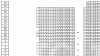
Theatres with more than 26 rows (or less if they omit I and O to avoid confusion) often use double letters at the rear. The attached image shows the seating plans of the rear stalls of a theatre going upto row NN.

[I appreciate that this would not be a good idea in a rail context]
 

Attachments

  • eph.png
    eph.png
    74 KB · Views: 18
Last edited:

edwin_m

Veteran Member
Joined
21 Apr 2013
Messages
28,615
Location
Nottingham
As for the phonetic alphabet - how many people know it? Certainly fewer than the latin alphabet and basic numbers. "I couldn't find a platform called Delta, only A,B,C and D".
Any station big enough to have "platform hotel" would create even more confusion.
 

Mikey C

Established Member
Joined
11 Feb 2013
Messages
8,240
Theatres with more than 26 rows (or less if they omit I and O to avoid confusion) often use double letters at the rear. The attached image shows the seating plans of the rear stalls of a theatre going upto row NN.

[I appreciate that this would not be a good idea in a rail context]

Football grounds are the same, I sit in row CC

According to Wiki, New Cross has lettered platforms due to it sharing staff with NXG back in pre privatisation days, I doubt customers back then would have been confused between the stations, seeing that the passenger numbers were far lower and everyone knew that the East London line alternated between the 2 stations.
 

Bedpan

Established Member
Joined
4 Feb 2010
Messages
1,299
Location
Harpenden
You are limited to 26 platforms per station if you use letters. ;)
Echoing the previous two posts, at the football stadium I frequent the rows are lettered rather than numbered - A at the front and working backwards, after row Z is Row AA, BB,CC etc, so the problem is not insurmountable. But do you use I and O or leave them out as them might be confused with 1 and 0?
Cant type any more as my wife wants me to go down the shops to buy a box of F eggs and B litres of milk (or should that be C.EAI pints).
 
Last edited:

mark-h

Member
Joined
14 Jan 2015
Messages
374
But do you use I and O or leave them out as them might be confused with 1 and 0?

The theatre I referenced above does not use rows I or O (row II is missing from the seating plan attached).

Theatres and stadia tend to have lots of seats in a row but they have relatively few long rows for their seating capacity so it is less confusing to use letters for the rows and numbers for the seats in each row. Aircraft are the opposite, being long and thin, so they number their rows and use letters for the seats.
 
Last edited:

Bedpan

Established Member
Joined
4 Feb 2010
Messages
1,299
Location
Harpenden
The theatre I referenced above does not use rows I or O (row II is missing from the seating plan attached).

Theatres and stadia tend to have lots of seats in a row but they have relatively few long rows for their seating capacity so it is less confusing to use letters for the rows and numbers for the seats in each row. Aircraft are the opposite, being long and thin, so they number their rows and use letters for the seats.
Good point - very true but something I had never realised till you pointed it out. Same goes for trains, more seats in a carriage (numbers) than carriages in a train (letters).
 
Status
Not open for further replies.

Top
