Birmingham Corporation buses generally ran city to suburb but always showed the outer destination regardless of the direction of travel. The "To City/From City" signs were added at about the time as rear engined buses were being introduced to help people work out which way the buses were going. This could be important where buses are going in loops around one-way systems.That was I believe, and AIUI, a Birmingham Corporation (pre WMPTE) innovation (not quite sure when it came in), based on their services largely radiating from the city centre - after it came in, the main 'destination' display would be the outer terminal for city bound buses.

-
Our new ticketing site is now live! Using either this or the original site (both powered by TrainSplit) helps support the running of the forum with every ticket purchase! Find out more and ask any questions/give us feedback in this thread!
You are using an out of date browser. It may not display this or other websites correctly.
You should upgrade or use an alternative browser.
You should upgrade or use an alternative browser.
Why did some operators have number, then 2 destination displays ?
- Thread starter Simon75
- Start date
- Status
- Not open for further replies.
Sponsor Post - registered members do not see these adverts; click here to register, or click here to log in
R
RailUK Forums

DanielTheEMid
Member
- Joined
- 13 Mar 2019
- Messages
- 103
This is only on the announcement fitted buses though. It’s automatically set by the ticketer too. In Grantham on the 1 to Alma and Earlsfield, it shows “this bus terminates here” on the destination as soon as it reaches the bus station.Centrebus have recently updated their destination displays so as the bus passes a via point it is removed from the via points shown on the front screen.
Attachments
Until about 2015 Edinburgh / Lothian still had 3piece screens which showed Number, destination and 3 via points (eg Tollcross, Princes Street. Leith Walk) on that route. I have.one of the actual blinds with over 70 different displays! As well as via points, there were other coloured displays some if which were 'Part Route' on a Pink background, 'Route Diverted' on Red, Limited Stop' on yellow and others. These were all designed to give locals and visitors info on exactly where a bus was going.I've seen photographs of Edinburgh / Lothian buses with 'part route' showing in place of via points,
I've not seen 'part route' on a Manchester bus, but that of course doesn't prove it didn't exist. I think Manchester tended to show an X after the route number for short workings or anything else unusual.
'Part Route' seems to be a Scottish term as I have never seen it used in England, but Liverpool used 'Short Journey' on screens as needed.
Last edited:
py_megapixel
Established Member
A few First routes in Sheffield have short workings at the start/end of the day to get buses to/from the depot on Olive Grove Road. They show "PART ROUTE - Bus Depot" at the top of the display.'Part Route' seems to be a Scottish term as I have never seen it used in England, but Liverpool used 'Short Journey' on screens as needed.
I've also seen in various places the word "only" used for this purpose. For example when what would usually be cross city routes germinate in the city centre it might show "Sheffield Centre ONLY" (although now I think if it it's a while since I've seen this done in Sheffield specifically so maybe it's been removed)
A quirk of the way several operators' displays are configured is that part routes are missing the "via" points. This presumably reduces the amount of time they need to spend programming displays that are only used occasionally. Of course it also means the same displays can be used for terminating services at a particular point from either direction.
It would seem logical that the system should allow you to program the full length of a route and then choose any pair of "via" points as the origin and destination, but that doesn't seem to be how it works
A few First routes in Sheffield have short workings at the start/end of the day to get buses to/from the depot on Olive Grove Road. They show "PART ROUTE - Bus Depot" at the top of the display.
I've also seen in various places the word "only" used for this purpose. For example when what would usually be cross city routes germinate in the city centre it might show "Sheffield Centre ONLY" (although now I think if it it's a while since I've seen this done in Sheffield specifically so maybe it's been removed)
A quirk of the way several operators' displays are configured is that part routes are missing the "via" points. This presumably reduces the amount of time they need to spend programming displays that are only used occasionally. Of course it also means the same displays can be used for terminating services at a particular point from either direction.
It would seem logical that the system should allow you to program the full length of a route and then choose any pair of "via" points as the origin and destination, but that doesn't seem to be how it works
The Stagecoach 1 has a part route blind included on the Monday to Friday morning journey from Batemoor that terminates at Ecclesfield The Travelers. It shows:
Ecclesfield 1
Part Route
Joe Paxton
Established Member
- Joined
- 12 Jan 2017
- Messages
- 2,959
'Part Route' seems to be a Scottish term as I have never seen it used in England, but Liverpool used 'Short Journey' on screens as needed.
First Bus in London definitely used "Part Route" blinds for some time, alas ultimately they went as they didn't conform to tightening TfL specs (maybe in the late noughties?). Shame as I think TfL could have learnt from them but c'est la vie.
See here for a First Centrewest bus on route 79 with a Part Route only blind, as featured on Ian Armstrong's londonbuses.co.uk website.
KevinBrum12
Member
It was a BCT practice but was not very passenger friendly, the "TO CITY" or "FROM CITY" display was tiny. WMPTE started to get rid of that and used "BIRMINGHAM" as the ultimate destination for buses coming into the city from places outside such as the 87 from Dudley or "CITY CENTRE" for those coming from an outer termini within the city, such as the 7 from Perry Common. There were in WMPTE days cross-city services between the north and south of Birmingham, I think they may have used "VIA CITY" in the via display.That was I believe, and AIUI, a Birmingham Corporation (pre WMPTE) innovation (not quite sure when it came in), based on their services largely radiating from the city centre - after it came in, the main 'destination' display would be the outer terminal for city bound buses.
py_megapixel
Established Member
Another observation related to part routes. A few months ago I was on Manchester route 330 Stockport-Hyde-Ashton. To try and contain the effect of an accident causing very major congestion in Stockport, they split the route at in two at Hyde. I was impressed that the bus was able to display "Hyde - Part Route Only", and even perfectly announce the stops and destination on a 330 to Hyde, despite that never being timetabled to happen in normal service.

Usually with an intermediate destination that would fix non-locals (Elm Row / Antigua Street being the ones on “our” routes)I've seen photographs of Edinburgh / Lothian buses with 'part route' showing in place of via points,
Now that Lothian buses have digital screens, 'Part Route' is shown in a box block before the destination. Another box shows a 'broken' arrow for 'Route Diverted' buses.Usually with an intermediate destination that would fix non-locals (Elm Row / Antigua Street being the ones on “our” routes)
== Doublepost prevention - post automatically merged: ==
I remember seeing that and always thought it was to save the driver changing the front screen at each terminus!It was a BCT practice but was not very passenger friendly, the "TO CITY" or "FROM CITY" display was tiny.
Last edited:
Sussexwatch
Member
In WMPTE days buses on the Inner and Outer Circle routes 8A/8C & 11A/11C (denoting clockwise or anti clockwise) showed blank top destinations with INNER CIRCLE or OUTER CIRCLE in the bottom via display, which was logical since there was no final destination. Buses not completing a full circuit showed route 8E or 11E (normal practice for short workings or variations) with the destination in the top blind and blank via blind.

Tetchytyke
Veteran Member
It’s good to see.Centrebus have recently updated their destination displays so as the bus passes a via point it is removed from the via points shown on the front screen.
Bus Vannin do something similar on the buses from the south. The bus destination is “Onchan via Douglas” until it reaches the first stop in the Douglas outskirts, at which point the destination changes to state whichever of the Onchan estates the bus is going to.
Used on the pre-war STL and early RT deliveries. Gave a bigger display of intermediate calling points but needed somebody To go to the front of the upper deck to set the route number.Some buses in London had a roof number was certainly easy to see
The intermdiate calls display could be misleading on short workings and there was the perennial problem of showing stops already passed. Overall though it was far better than most provincial operations.
At the other extreme how many operators didn't bother displaying route numbers? I mean operators with networks of routes not Joe Blogs running a bus once a week on market day. The one example that comes to me is Western Welsh. The buses around Pontypool in the 60s mostly just showed a destiation
edwin_m
Veteran Member
I suppose the route number was expected to stay the same all day, so they wouldn't need to do that much. Unless the destinations also had to be set from upstairs. I recall this being so with some of the Oldham Atlanteans in the 70s, and unusually they had to do that with people like me on board when the 184 became a 183 or vice versa in Uppermill.Used on the pre-war STL and early RT deliveries. Gave a bigger display of intermediate calling points but needed somebody To go to the front of the upper deck to set the route number.
No numbers, just destyUsed on the pre-war STL and early RT deliveries. Gave a bigger display of intermediate calling points but needed somebody To go to the front of the upper deck to set the route number.
The intermdiate calls display could be misleading on short workings and there was the perennial problem of showing stops already passed. Overall though it was far better than most provincial operations.
At the other extreme how many operators didn't bother displaying route numbers? I mean operators with networks of routes not Joe Blogs running a bus once a week on market day. The one example that comes to me is Western Welsh. The buses around Pontypool in the 60s mostly just showed a destiation
Samuel ledgard.
Pennine

Tom B
Established Member
- Joined
- 27 Jul 2005
- Messages
- 4,680
It always interested/raised my eyebrows how some of the 'part route' destinations, very seldom used, were very similar. For instance you might have a 22 part route "Foot o' the' Walk", a 25 part route "Duke Street" and a 35 part route "Easter Road" which would all, effectively, be turning around within spitting distance of each other next to Scotmid on Duke Street.Usually with an intermediate destination that would fix non-locals (Elm Row / Antigua Street being the ones on “our” routes)
Similarly, a part route destination of Burdiehouse can't have been used often when Kaimes was one stop beforehand - that was used as a 'fake' part route destination on some 33s which morphed into 18s to get back to Longstone at the end of the day.
The part route (pink), express / limited stop (yellow) etc were very useful so you could be aware at a distance, for example if two buses were approaching. They were very smart but I suppose people not from the city wouldn't know that, for example, the part route denoted in this image was the loss of two stops at the far far end. (NMP)

There was then a "route diverted" which appeared after the MUDFA chaos of 2008/9. We could go into tramboards but that's a whole other kettle of fish and, again, I believe they've been discontinued as well.
I don't think LRT have any more buses with the traditional displays with intermediates, but neither (I think) do London (I haven't seen one in a very long time) and indeed, a long long time after other operators, they now have LED screens on modern vehicles.
SYT had two destination blinds on their standard vehicles throughout the 70s and 80s. Again NMP. The bottom blind tended to be intermediate points but only 'corridor' ones e.g. via the DRI, via Racecourse etc, or for where clarification was required if services took two routes to a common destination. I think they also included the 'sundry' destinations like 'special' / 'schools' etc. On the other hand, there are lots of pictures around of SYT buses going around in Doncaster with the top blind being the destination, and the bottom showing "town centre" to avoid the need to change the blinds!

As time went on, they were gradually replaced with single blind units, especially in Doncaster/Rotherham. I think the ones in Sheffield held out for a bit longer.
Sheffield also had some 'triangles' which were mounted inside in the n/s windscreen, underneath the destination blind. These showed "via city centre" and another via point (Meadowhell?) as well as a blank outer. I couldn't find a picture to hand but they certainly existed, until maybe the early 00s after the Firstbus takeover.

fairysdad
Member
Stagecoach Exeter had this around 2003 or so; one window but three blinds, one with the route number, one with calling points, and one with the destination. I was beginning to think I'd imagined it as online image searches were extraordinarily unfruitful (probably because I've no idea what type of bus they were other than double-deckers!) but finally found an image on this page - but I expect the photo is not contemporary to the date on the web page itself! I recall in the dim recesses of my memory that they were ex-London buses, but don't recall them having a centre door, so not sure (and this photo is from the wrong side to show!) - then again, had London standardised on centre doors in the late 90s before TfL?
Dwarfer1979
Member
In terms of London, my Dad was a part time conductor around his University years and he told me the crews were only allowed to change the ultimate destination blind, they weren't allowed to change number or via blinds and that was only allowed to be done by an Inspector or Manager so when buses were running dead conductors would open the casing and pull the unit back so it couldn't be seen by waiting passengers. Buses & crews, in the red zone at least (country area of course was very different just in the nature of their route network), were effectively route allocated and pretty much never moved during the day between routes (only in emergencies for most routes) and even day to day the regular crews were tied to single routes basically permanently.Used on the pre-war STL and early RT deliveries. Gave a bigger display of intermediate calling points but needed somebody To go to the front of the upper deck to set the route number.
I suppose the route number was expected to stay the same all day, so they wouldn't need to do that much. Unless the destinations also had to be set from upstairs.
Tom B
Established Member
- Joined
- 27 Jul 2005
- Messages
- 4,680
In terms of London, my Dad was a part time conductor around his University years and he told me the crews were only allowed to change the ultimate destination blind, they weren't allowed to change number or via blinds and that was only allowed to be done by an Inspector or Manager so when buses were running dead conductors would open the casing and pull the unit back so it couldn't be seen by waiting passengers. Buses & crews, in the red zone at least (country area of course was very different just in the nature of their route network), were effectively route allocated and pretty much never moved during the day between routes (only in emergencies for most routes) and even day to day the regular crews were tied to single routes basically permanently.
I understand that this unusual state of affairs persists even today. Everywhere else it is the norm for drivers to drive a selection of different services either on a given day or over a period of time, but London operators tend to keep drivers on single services (although I understand many are trained on others to enable overtime / shift swaps).
It always interested/raised my eyebrows how some of the 'part route' destinations, very seldom used, were very similar. For instance you might have a 22 part route "Foot o' the' Walk", a 25 part route "Duke Street" and a 35 part route "Easter Road" which would all, effectively, be turning around within spitting distance of each other next to Scotmid on Duke Street.
Similarly, a part route destination of Burdiehouse can't have been used often when Kaimes was one stop beforehand - that was used as a 'fake' part route destination on some 33s which morphed into 18s to get back to Longstone at the end of the day.
The part route (pink), express / limited stop (yellow) etc were very useful so you could be aware at a distance, for example if two buses were approaching. They were very smart but I suppose people not from the city wouldn't know that, for example, the part route denoted in this image was the loss of two stops at the far far end. (NMP)
There was then a "route diverted" which appeared after the MUDFA chaos of 2008/9. We could go into tramboards but that's a whole other kettle of fish and, again, I believe they've been discontinued as well.
I don't think LRT have any more buses with the traditional displays with intermediates, but neither (I think) do London (I haven't seen one in a very long time) and indeed, a long long time after other operators, they now have LED screens on modern vehicles.
SYT had two destination blinds on their standard vehicles throughout the 70s and 80s. Again NMP. The bottom blind tended to be intermediate points but only 'corridor' ones e.g. via the DRI, via Racecourse etc, or for where clarification was required if services took two routes to a common destination. I think they also included the 'sundry' destinations like 'special' / 'schools' etc. On the other hand, there are lots of pictures around of SYT buses going around in Doncaster with the top blind being the destination, and the bottom showing "town centre" to avoid the need to change the blinds!
As time went on, they were gradually replaced with single blind units, especially in Doncaster/Rotherham. I think the ones in Sheffield held out for a bit longer.
Sheffield also had some 'triangles' which were mounted inside in the n/s windscreen, underneath the destination blind. These showed "via city centre" and another via point (Meadowhell?) as well as a blank outer. I couldn't find a picture to hand but they certainly existed, until maybe the early 00s after the Firstbus takeover.
This picture I took of KKU 120W during the SYTT running day in September shows the bus having the board in the window. The options usually were:
Via City Centre, Via Meadowhall, Get Back Day Returns available.
The Sheffield & Rotherham ones stuck with the 2 piece blinds, it was only Doncaster that went for the one piece.
Other regulars on the lower blind were Circular, Outer Circle, Via City Centre & on certain ones a main destination.
Yorkshire Terrier buses had Via City Centre vinyls in the top of the windscreens on the single deckers, definitely in place on the Nationals
Attachments
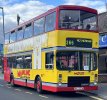
Some buses in London had a roof number was certainly easy to see
Used on the pre-war STL and early RT deliveries. Gave a bigger display of intermediate calling points but needed somebody To go to the front of the upper deck to set the route number.
The display of intermediate points wasn't any bigger (the same 'via points' blind will fit in a 'roofbox' RT or a standard RT) and on a standard RT, the front route number and via point blinds can only be changed by going to the front of the top deck - the only one that can be changed from the cab is the ultimate destination.
At the other extreme how many operators didn't bother displaying route numbers? I mean operators with networks of routes not Joe Blogs running a bus once a week on market day. The one example that comes to me is Western Welsh. The buses around Pontypool in the 60s mostly just showed a destiation
a few municipal operators didn't do route numbers either - Reading didn't display them until (I think) the 1960s.
Buses & crews, in the red zone at least (country area of course was very different just in the nature of their route network), were effectively route allocated and pretty much never moved during the day between routes (only in emergencies for most routes) and even day to day the regular crews were tied to single routes basically permanently.
Yes - there were a few odd exceptions, usually where one route had very different peak hours to another - the Beckton Gas Works 100 worked off route 15 from Upton Park Garage, think there was something to a power station in North London that worked off route 76 from Tottenham. I don't personally remember either, but of the photos I've seen of buses on route 100, most had some blinds still showing 15.
Most garages had a few 'cross linked' buses, where the morning peak hour on one route needed more buses than the afternoon, and another vice versa, so a bus or two would do one route in the morning and another in the afternoon, but the blinds would be changed by the 'inside staff' at mid day. There are still a few of these around, as well as 6xx school route buses that work off other routes. A handful of garages had a small number of duties that did different routes in each 'half' but this was a rarity.
And yes, at most (not all) garages, one rota for each route was fairly standard, although (much more in historic LT days than now) there were some routes that didn't run on Saturdays or Sundays and a few that only ran on Sundays, or routes that had a bigger allocation / more duties on Saturdays (mainly ones that linked suburban residential areas with shopping areas) or where one garage had a Sunday only allocation to balance the weekend work around. So for example Upton Park garage had a Saturday only allocation on route 86, with Saturday 86 duties on the route 15 or 23 rota. In turn Poplar had a small Saturday only allocation on the 23 worked by crews who did route 40 on other days.
Operators tend to prefer it now, as it makes it easier to transfer drivers out to the new operator if a route is lost on re-tender, legally a driver has to do a majority of their working time on route X to be eligible for a transfer, a joint or 'all in' rota means an operator could be stuck with more drivers than they need if they lost a route.
py_megapixel
Established Member
I am reminded by looking at some photos that a few buses used to combine a roller blind destination display with a flipdot numeric display. Here is an example: https://flic.kr/p/2h6kJ5Q
(Unless of course the numeric display isn't flipdot at all and is just another blind, printed to look like one of those modern newfangled digital things - something which I absolutely wouldn't put past designers to try!)
(Unless of course the numeric display isn't flipdot at all and is just another blind, printed to look like one of those modern newfangled digital things - something which I absolutely wouldn't put past designers to try!)
I am reminded by looking at some photos that a few buses used to combine a roller blind destination display with a flipdot numeric display. Here is an example: https://flic.kr/p/2h6kJ5Q
(Unless of course the numeric display isn't flipdot at all and is just another blind, printed to look like one of those modern newfangled digital things - something which I absolutely wouldn't put past designers to try!)
I think that you're right and it was an electronic number display and roller blind destination (although I don't think I met that batch in service.)
At least some of the ex West Midlands Ailsas that ended up on the northern fringes of London (example - not my photo or Flickr account) had something similar in the late 80s, I'm not sure if this is something that West Midlands did or a modification that was made for London.
I'm not quite sure why - possibly so that route number displays all round could be changed from the cab?
ian1944
Member
I'm a bit late to this. Post 15 linked to a Crossley on MCTD route 47X to Altrincham, with the intermediate blind blank. This was a local route in my youth, and I remember that the the blind was normally set regardless of direction to either Old Trafford Stretford Sale or Stretford Sale Broadheath, the four places being consecutive on the canvas meant that both were available quickly. I suspect that individual buses were set by someone to their own preference in the garage (Princess Road) and were just left while they were on 47 (Piccadilly) or 48 (Exchange).
Yes, that was essentially it. A number display only front, side and rear that was flip dot, and just the roller blind for the destination on the front.I'm not quite sure why - possibly so that route number displays all round could be changed from the cab?
WibbleWobble
Member
Although First also specified a roller blind on the side - although in Manchester, most of the time they were only ever blank or showed the logo or the great destination of "Service".Yes, that was essentially it. A number display only front, side and rear that was flip dot, and just the roller blind for the destination on the front.
Tyne & Wear PTE specified a layout, inherited from Newcastle Corporation, which had the destination and via point above each other on the offside front and the service number on the nearside front. There was also a nearside number display next to the entrance, though this was seldom used.
Newcastle (Byker and Slateford), along with Sunderland (Fulwell and Hylton Road) used the front screen displays as intended. South Shields, however, opted to screen both termini and the service number.
Newcastle (Byker and Slateford), along with Sunderland (Fulwell and Hylton Road) used the front screen displays as intended. South Shields, however, opted to screen both termini and the service number.

1D53
Established Member
- Joined
- 2 Apr 2006
- Messages
- 2,896
Certainly a trend of the time in the mid 90s - Leeds had plenty like this - https://www.flickr.com/photos/buspi...M4-7jES2o-7hJCtr-2hWFSfb-XwJcaA-SLWyw9-4gz65qI am reminded by looking at some photos that a few buses used to combine a roller blind destination display with a flipdot numeric display. Here is an example: https://flic.kr/p/2h6kJ5Q
(Unless of course the numeric display isn't flipdot at all and is just another blind, printed to look like one of those modern newfangled digital things - something which I absolutely wouldn't put past designers to try!)
- Status
- Not open for further replies.